
Family offices are navigating a financial environment shaped by inflation concerns, interest-rate uncertainty, geopolitical risk, market volatility and increasingly complex family structures. The Citi Wealth 2026 Family Office Report provides a recent snapshot of how some large family offices are responding.
Citi surveyed 351 family-office clients across 41 countries in June and July 2026. The families represented in the survey reported an average net worth of approximately $2.1 billion. Citi organizes the findings around three themes: Capital, Capability and Continuity.
The report does not represent every family office globally. However, it offers useful evidence of how participating family offices are balancing investment returns with liquidity, risk management, technology, operational capability and succession.
What the 2026 Citi Family Office Report Reveals
The three-part framework is important because the report goes beyond asset allocation.
Capital covers how family offices are deploying and protecting wealth. Capability focuses on the systems, technology and expertise needed to manage increasingly complex organizations. Continuity addresses succession, governance and preparation for the next generation.
Together, these themes point to a broader shift: family-office strategy is becoming less about choosing individual investments in isolation and more about building an organization capable of managing wealth over long periods.
Public Equities Return to the Center of the Portfolio
One of the clearest findings is the renewed importance of public equities.
Citi reports that nearly half of survey respondents increased their public-equity exposure during 2026, making public equities the leading destination for new capital. Global developed equities also ranked as the most favored asset class for future net allocations.
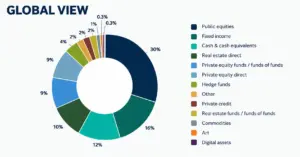
Several characteristics help explain why public markets remain useful within a diversified family-office portfolio. Public securities generally provide greater liquidity than private investments, transparent market pricing and the ability to adjust positions more easily.
That flexibility matters when family offices are dealing with uncertain economic conditions. Liquidity can also give investors more room to rebalance portfolios when circumstances change.
This does not mean family offices are abandoning long-term investments. Instead, the finding suggests that liquid public markets can play an important role alongside less-liquid holdings.
The distinction is important because portfolio construction does not require every asset to perform the same function. Public equities can provide growth and liquidity, while other holdings may serve different objectives.
Private Markets Are Still a Strategic Pillar
The return of public equities has not pushed private markets aside.
Citi says private markets remain a strategic pillar of family-office portfolios. Private equity continues to attract capital, while direct investments and growth-stage opportunities remain areas of interest. At the same time, respondents are becoming more selective, placing greater emphasis on sourcing, expertise and differentiated access.
Private investments can offer access to companies and opportunities that are not available through public exchanges. They can also suit investors with long time horizons and the ability to tolerate limited liquidity.
However, those characteristics create challenges as well. Private investments can require more extensive due diligence, specialized expertise and longer holding periods. Valuation can also be less frequent than in public markets.
Recent UBS research similarly describes family offices as reassessing the balance between public and private markets while continuing to view private assets as an important part of long-term portfolios.
The broader message is therefore not simply “public versus private.” Family offices appear to be considering what role each investment type should play.
How Family Offices Are Balancing Portfolio Roles
| Investment Approach | Primary Role | Key Consideration |
|---|---|---|
| Public Equities | Growth and liquidity | Market volatility and valuation |
| Private Equity | Long-term growth | Selectivity and access |
| Direct Investments | Control and targeted exposure | Sourcing and expertise |
| Fixed Income | Income and portfolio stability | Interest-rate and inflation risk |
| Cash | Liquidity and flexibility | Opportunity cost |
The table illustrates why different asset classes do not necessarily compete for a single “best” position. Their usefulness depends partly on liquidity needs, investment horizon, diversification and the role they serve within the broader portfolio.
Investing Through Uncertainty Without Abandoning Opportunity
The Citi Wealth 2026 Family Office Report also shows a measured response to geopolitical uncertainty.
More than 40% of respondents made no major portfolio changes following recent geopolitical developments. Others used active management, hedging and targeted adjustments rather than completely restructuring their portfolios.
That distinction matters.
Risk avoidance means attempting to eliminate exposure to uncertainty. Risk management instead accepts that uncertainty exists and seeks to control its effect on the overall portfolio.
For large family offices with diversified holdings and long investment horizons, the second approach can be particularly relevant. The objective is not necessarily to react to every market event, but to maintain enough flexibility to respond when circumstances change.
Inflation Is Changing the Wealth-Preservation Conversation
Inflation emerged as a leading concern among Citi’s survey respondents in 2026, followed by interest rates, financial-system stability and market volatility.
For family wealth, inflation presents a problem that goes beyond portfolio performance. Even when the nominal value of assets rises, sustained inflation can reduce purchasing power.
Citi’s report points to greater attention toward short-duration income assets, quality exposures and inflation-sensitive diversifiers as part of the wealth-preservation discussion.
These observations should not be read as universal investment recommendations. Rather, they show how inflation concerns are influencing the way participating family offices think about preserving real wealth.
AI Moves From Experimentation to Implementation
Another significant finding concerns artificial intelligence.
The Citi Wealth 2026 Family Office Report says family offices are increasingly deploying AI for investment analysis, information management, reporting, workflow automation and decision support. The emphasis is currently more on productivity than directly generating investment returns. Citi also says experienced humans remain responsible for final decisions.
That distinction is important.
There is a difference between using AI to summarize information and using it to make an investment decision. Family offices appear to be concentrating first on areas where technology can reduce repetitive work, process information faster and improve due diligence.
Independent research supports the broader movement toward practical AI adoption among family enterprises. Deloitte reported in 2026 that 86% of surveyed family businesses were actively or selectively using AI, although almost half said they were moderately or insufficiently invested in the operational technology needed to support their organizations.
For family offices, the challenge is therefore not simply whether to use AI. It is also how to introduce it while maintaining appropriate oversight, data controls and human judgment.
The Global Family Office Is Becoming More Complex
Family wealth is increasingly spread across borders.
Citi reports that 38% of survey respondents expect family globalization to increase over the next five years. Respondents also described situations involving assets, businesses and family members across multiple jurisdictions.
This creates additional responsibilities around tax coordination, asset structuring, regulatory compliance and cross-border planning.
It can also affect investment decisions. A family with operating businesses, properties and family members in several countries may need to consider different legal, tax and regulatory environments at the same time.
As a result, global family wealth management increasingly requires expertise that extends beyond traditional portfolio management.
Succession Is No Longer a Distant Problem
The report also places succession firmly within the current family-office agenda.
Approximately one-third of respondents expect leadership transitions within their family, family office or family business during the next five years. Citi identifies unclear succession plans, insufficient preparation among future leaders and disagreement over future direction as important challenges.
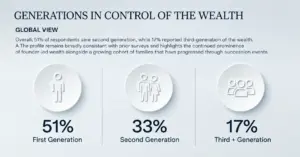
Succession is therefore more than the question of who eventually receives family wealth.
It can involve educating the next generation, giving younger family members exposure to governance, transferring institutional knowledge and establishing a shared understanding of the family’s future objectives.
Recent UBS research also identifies succession and next-generation preparation as continuing challenges for family offices, reinforcing the idea that continuity requires more than simply transferring ownership.
The New Family Office Priorities
| Family Office Trend | Strategic Opportunity | Key Challenge |
|---|---|---|
| AI Implementation | Operational efficiency | Governance and oversight |
| Globalization | Broader investment access | Tax and regulatory complexity |
| Succession Planning | Intergenerational continuity | Leadership readiness |
| Professionalization | Stronger governance | Organizational complexity |
| Private-Market Selectivity | Better access discipline | Sourcing and competition |
These priorities show why family offices are becoming increasingly institutional in their day-to-day operations.
Beyond Investing: The Professionalization of Family Offices
Investment performance remains important, but the report suggests that family-office effectiveness increasingly depends on what happens outside the portfolio.
Citi highlights greater attention to operational planning, risk management, succession and organizational development.
That means a family office may need capabilities spanning investment research, legal and tax coordination, technology, reporting, governance and professional talent.
The shift is significant because a larger and more internationally connected family can create operational complexity even when its investment strategy remains relatively stable.
Professionalization can help create clearer processes and responsibilities. At the same time, it can introduce its own challenges, including higher organizational complexity and the need to coordinate family members, executives and external advisers.
What the Report Says About the Next Era of Family Wealth
Taken together, the findings point toward a family-office model built around several connected priorities: diversification, liquidity, selective private-market exposure, technology, risk management, global expertise, governance and continuity.
The Citi Wealth 2026 Family Office Report does not suggest that every family office is following the same strategy. In fact, the differences between families, regions, structures and investment objectives remain important.
What the report does show is a common need to manage several demands at once: pursue growth while preserving capital, use technology without removing human oversight, access global opportunities while managing cross-border complexity, and prepare for succession while current leaders remain responsible for the organization.
Unique Insight
The most significant part of the Citi Wealth 2026 Family Office Report may not be the renewed interest in public equities itself.
The deeper development is the growing connection between investment strategy and institutional capability.
A family office today may need to think simultaneously about portfolio liquidity, private-market access, AI systems, cybersecurity and data, international structures, governance and the preparation of future leaders.
That makes family-office investing less of a standalone portfolio exercise and more of an organizational discipline.
Conclusion
The Citi Wealth 2026 Family Office Report offers a useful snapshot of how participating family offices are approaching wealth in a period of uncertainty.
Public equities have regained importance, while private markets remain central but more selective. Inflation and financial stability remain concerns, yet respondents have not generally abandoned long-term investment strategies. Meanwhile, AI is moving into practical operational use, global family structures are becoming more complex, and succession is receiving greater attention.
The broader theme is not a single preferred investment. It is resilience: the ability to manage capital, build organizational capability and maintain continuity across generations.
Because the survey covers 351 Citi family-office clients across 41 countries, its findings should be viewed as an informed snapshot rather than a universal description of global family offices.
Nevertheless, it provides a clear picture of an important change in family wealth management: preserving and growing wealth increasingly requires attention not only to assets, but also to the systems, people, technology and governance surrounding them.
Frequently Asked Questions
What is the Citi Wealth 2026 Family Office Report?
It is Citi Wealth’s 2026 survey of family-office clients examining investment sentiment, portfolio actions, operational practices, family governance and priorities for the next generation.
How many family offices were surveyed for Citi’s 2026 report?
The survey received responses from 351 family-office clients across 41 countries during June and July 2026.
What are the main findings of the Citi Wealth 2026 Family Office Report?
The major themes include renewed public-equity interest, continued importance of private markets, greater use of AI, increased cross-border complexity, stronger risk-management practices, professionalization and a growing focus on succession.
Are family offices increasing their public-equity exposure?
Citi reports that nearly half of survey respondents increased public-equity exposure during 2026, making public equities the leading destination for new capital among respondents.
Do family offices still invest heavily in private markets?
Private markets remain a strategic pillar, according to Citi. However, respondents are becoming more selective and placing greater emphasis on sourcing, expertise and differentiated access.
How are family offices using AI in 2026?
Citi reports applications including investment analysis, information management, reporting, workflow automation and decision support. The current emphasis is on productivity and efficiency, with experienced humans retaining final decision-making responsibility.
What are the biggest risks family offices are concerned about?
Among Citi’s survey respondents, inflation was the leading concern in 2026, followed by interest rates, financial-system stability and market volatility.
Why is succession becoming a priority for family offices?
Approximately one-third of respondents expect leadership transitions within their family, family office or family business over the next five years. Citi also identifies future-leader readiness and alignment around future direction as challenges.
How is globalization affecting family-office strategy?
More international families can create additional requirements around tax coordination, asset structuring, regulatory compliance and cross-border planning. Citi says 38% of respondents expect family globalization to increase over the next five years.
What does the Citi report reveal about the future of family wealth management?
The report points toward greater integration between investment management, risk controls, technology, operational capability, global expertise, governance and succession. These are themes in Citi’s survey rather than universal prescriptions for every family office.