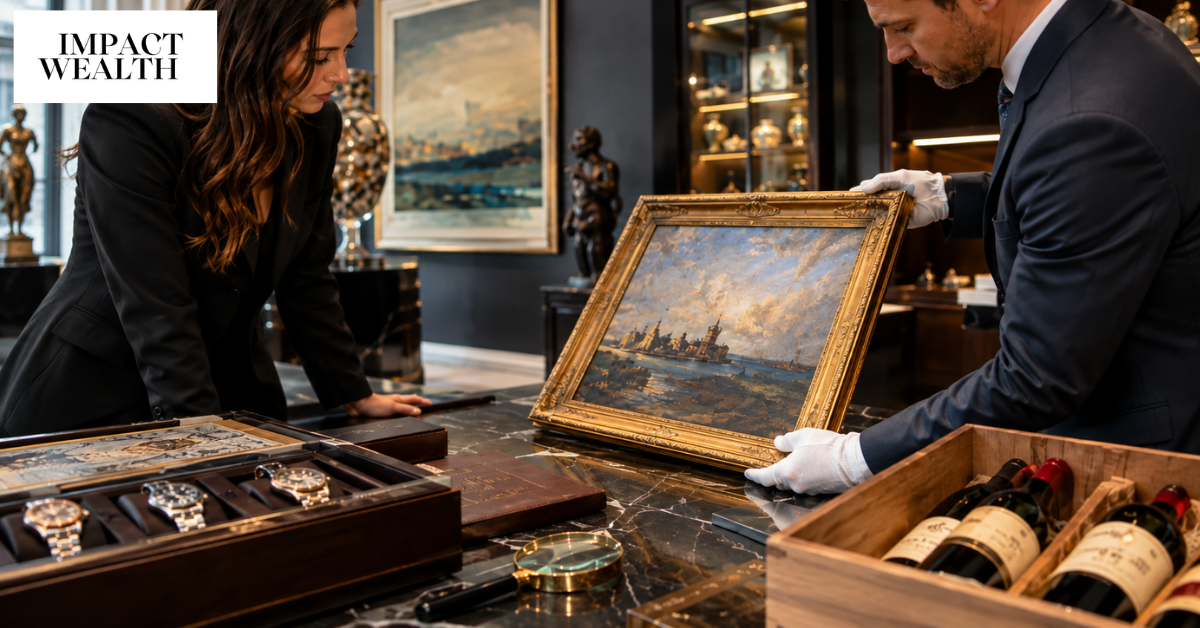
Rare paintings, collectible watches and fine wines can be more than luxury purchases. For some ultra-high-net-worth individuals (UHNWIs), freeports and collectible investments form part of a broader wealth strategy involving tangible assets, international holdings and long-term estate planning.
An often-overlooked part of this market is the freeport: a specialist customs facility where eligible goods can be stored under arrangements that suspend certain import charges. These facilities help collectors manage valuable objects across borders, but they also raise a larger question: can freeports influence collectible prices, and what financial advantages do they offer wealthy owners?
The answer requires separating documented tax and logistical benefits from the less certain relationship between storage, market supply and prices.
What Is a Freeport?
A freeport is a designated customs area where eligible imported goods can be stored or processed under specific customs procedures. Certain specialist facilities, including art-storage freeports, serve collectors, dealers, auction houses and international investors.
The arrangements vary by jurisdiction. In the United Kingdom, for example, HM Revenue & Customs explains that customs duties and import VAT can be suspended while eligible imported goods remain under the applicable Freeport customs procedure. Charges generally become payable when goods are released into domestic circulation, subject to the relevant rules.
This does not mean every item stored in a freeport is exempt from every tax. Nor are all freeports governed by identical rules.
For collectors, the main attraction is the ability to hold valuable goods securely while retaining flexibility over when and where they are sold, exported or imported.
How Freeports Affect Collectible Investments
1. Deferring certain import charges
Moving an expensive artwork or collectible between countries can create customs and tax costs. Where an eligible arrangement suspends import duties or VAT, the owner may avoid paying those charges immediately.
Deferral can improve cash-flow flexibility, particularly when an asset is being held for a future sale rather than brought into the domestic market for use.
However, deferring a payment is not the same as eliminating it. The final treatment depends on the applicable customs procedure, the destination of the goods and the nature of the transaction.
2. Supporting international transactions
Specialist facilities can combine secure storage, insurance arrangements, transport coordination and access to art-market services. This infrastructure allows collectors and dealers to manage assets internationally without necessarily importing them into each market through which they move.
Academic research published in Arts in 2024 examined Shanghai’s art-freeport model and described how storage, logistics, exhibitions and related financial services can operate together as part of an international art-trading hub.
The significance is practical: freeports can make the movement and management of valuable assets more flexible. That does not automatically mean they increase the assets’ market value.
3. Changing when assets come to market
Owners who can store collectibles securely may choose to wait for a suitable buyer or selling opportunity. If more owners retain rare objects rather than offering them for sale, the available supply at a particular time could decline.
In markets where demand remains strong, reduced availability can contribute to higher prices. But this is an economic possibility, not proof that freeports systematically push prices upward.
The opposite outcome is also possible. Easier storage and trading arrangements may facilitate additional transactions, bringing more assets to market.
Research by John Zarobell in Arts in 2020 highlighted a major limitation: the lack of transparent data on assets held in freeports makes their overall impact on the art market difficult to measure.
What the Latest Collectible Market Data Shows
The latest complete annual figures available by October 2026 show that different collectible markets have followed different paths.
Art: The Art Basel and UBS Global Art Market Report 2026 estimated global art sales at $59.6 billion in 2025, an increase of 4% from 2024. Public auction sales rose 9%, while dealer sales increased 2%. The recovery was uneven, and total sales remained below their 2022 peak.
Luxury collectibles: Knight Frank’s Luxury Investment Index reported a 0.4% decline in 2025, following losses in the preceding two years. Its April 2026 review also highlighted differing performances within the market: the WatchCharts Overall Market Index rose 5.1% over the year covered by the report, while the Liv-ex Fine Wine 100 Index fell 2.5% during 2025.
These figures illustrate why investors should assess each market separately. They do not establish that freeports caused the art market’s recovery or the differences between watches and wine.
Freeports and collectible investments are closely connected through the international infrastructure that supports the ownership, storage and trade of rare art and other high-value assets.
For collectors, rarity, condition, provenance, brand or artist reputation, buyer demand and purchase price remain central considerations. Storage arrangements are one part of the ownership equation, not a substitute for evaluating the underlying asset.
Freeports and Wealth Planning for UHNWIs
For UHNWIs and family offices, specialist storage can serve several purposes beyond protecting valuable possessions.
Portfolio diversification: Art, watches and wine offer exposure to markets that operate differently from listed equities and bonds. Their returns are not necessarily independent of financial markets, and their valuations can be difficult to establish.
Asset preservation: High-value objects may require controlled environments, specialised handling, insurance and detailed ownership records. Appropriate storage helps protect physical condition, which can influence resale value.
Some wealthy collectors also open private museums to share their collections with the public, reflecting another way high-value art can be managed and displayed.
International flexibility: Collectors with assets or residences across multiple jurisdictions may benefit from being able to store an object in one location while evaluating opportunities in another.
Estate and succession planning: Collectibles can form part of a family estate. Accurate records, valuations and documented ownership can support transfers between generations. Any tax benefits depend on the relevant inheritance, gift and estate rules rather than on storage alone.
Financing opportunities: Certain artworks and other valuable objects may be accepted as collateral for loans. Research into art-market financialisation has examined how ownership structures and art-finance arrangements can connect collectibles with wider financial markets. Borrowing against an asset, however, introduces interest costs, valuation risk and the possibility of forced sale.
These strategies require professional advice. A collectible’s market value does not guarantee that it can be sold quickly or used as collateral on favourable terms.
Do Freeports Shield Appreciation From Tax?
This is an important distinction for investors.
A freeport arrangement may suspend customs duties or import VAT while goods remain under a qualifying procedure. It does not automatically eliminate capital gains tax, income tax, inheritance tax or other taxes that may apply to an asset or its sale.
The tax treatment depends on the jurisdiction, the owner’s tax residence, the type of asset, the transaction and any applicable exemptions or reliefs.
For example, an artwork may appreciate while stored in a customs facility. Whether a later sale creates a taxable gain is a separate legal question. Its location in a freeport alone does not establish that the appreciation is tax-free.
The United Kingdom’s customs rules provide a clear illustration of the distinction between suspending import charges and removing tax obligations altogether. Switzerland also requires cultural property stored in customs warehouses or freeports to be declared under its cultural-property rules. The Swiss Federal Office of Culture introduced revised declaration requirements effective January 1, 2026, including more detailed information about cultural objects.
For family offices, tax planning should therefore begin with the applicable laws and the intended transaction. Investors should not assume that moving an asset into a freeport removes reporting obligations or creates a general exemption from tax.
Risks of Freeports and Collectible Investments
Freeports offer logistical advantages, but collectible investments remain exposed to risks that storage cannot remove.
Liquidity: A rare painting, watch or bottle of wine may take considerable time to sell. Auction estimates do not guarantee realised prices, and selling fees can reduce proceeds.
Valuation: Private transactions are not always publicly reported. Limited comparable sales can make independent valuations difficult, particularly for unique artworks or exceptionally rare objects.
Ownership and provenance: Buyers need to establish that a seller owns the asset and has authority to transfer it. Chambers’ 2026 guide to Swiss art and cultural-property law describes fraud risks involving purported sales of artworks stored in freeports. Secure storage does not, by itself, prove valid ownership.
Regulatory compliance: The Financial Action Task Force’s 2023 report on money laundering and terrorist financing in the art and antiquities market identifies risks associated with opaque transactions and third-party intermediaries. These risks do not imply that most collectors or freeport users engage in misconduct, but they underline the importance of due diligence.
Ongoing costs: Storage, insurance, transport, authentication, financing and professional advice can all reduce returns. These costs should be considered alongside any potential customs or tax savings.
What Investors Should Check Before Using a Freeport
Before placing a collectible in a specialist facility, investors and family offices should establish:
- Which customs and tax rules apply to the facility and the asset.
- Whether the arrangement suspends, defers or reduces a specific charge.
- What happens when the asset is sold, transferred, exported or released into domestic circulation.
- Whether ownership, provenance and valuation records are complete.
- What storage, insurance, transaction and financing costs apply.
- Whether the proposed arrangement creates reporting or compliance obligations in any relevant jurisdiction.
These checks are particularly important when an asset moves across borders or is held through a company, trust or other ownership structure.
The Bottom Line
Freeports and collectible investments are closely connected through the international infrastructure that supports the ownership, storage and trade of rare art and other high-value assets.
They may also influence how owners choose to hold and sell assets. However, the available evidence does not establish that freeports consistently increase collectible prices across the market.
For UHNWIs and family offices, the value of these facilities lies in understanding their specific legal, tax and operational benefits not in assuming that storage guarantees appreciation or a tax-free gain.
The investment case for any collectible still depends on its quality, scarcity, purchase price, demand, holding costs and eventual sale value. Freeport arrangements should be evaluated as one element of that broader decision.