
Why Smart Investors Choose Discretionary Investment Management
Why Smart Investors Choose Discretionary Portfolio Management
Discretionary portfolio management is a professional investment service where you hand over day-to-day trading authority to a qualified portfolio manager — who then buys, sells, and rebalances your assets without needing your approval for every decision.
Here is what that means in practice:
| Feature | What It Means for You |
|---|---|
| Full delegation | Your manager acts immediately on market opportunities, no sign-off required |
| Pre-agreed mandate | Your risk tolerance, goals, and constraints are locked in upfront |
| Segregated account | Your capital stays yours — tracked and weighted independently |
| Active oversight | Ongoing monitoring, rebalancing, and risk management on your behalf |
| Regular reporting | Transparent updates on performance, transactions, and costs |
For ultra-high-net-worth individuals and family offices, this is not just convenient — it is often essential. Modern wealth is too complex, too global, and too time-sensitive to manage alone. A sudden market dislocation does not wait for a phone call.
The scale of the industry reflects this reality. The largest discretionary wealth managers oversee tens of billions in assets, and typical clients hold anywhere from £250,000 to well over £5 million in managed portfolios.
Yet despite its widespread use among the wealthy, discretionary management is widely misunderstood — especially when it comes to fees, mandate structures, and how to choose the right firm.
This guide covers everything you need to know.
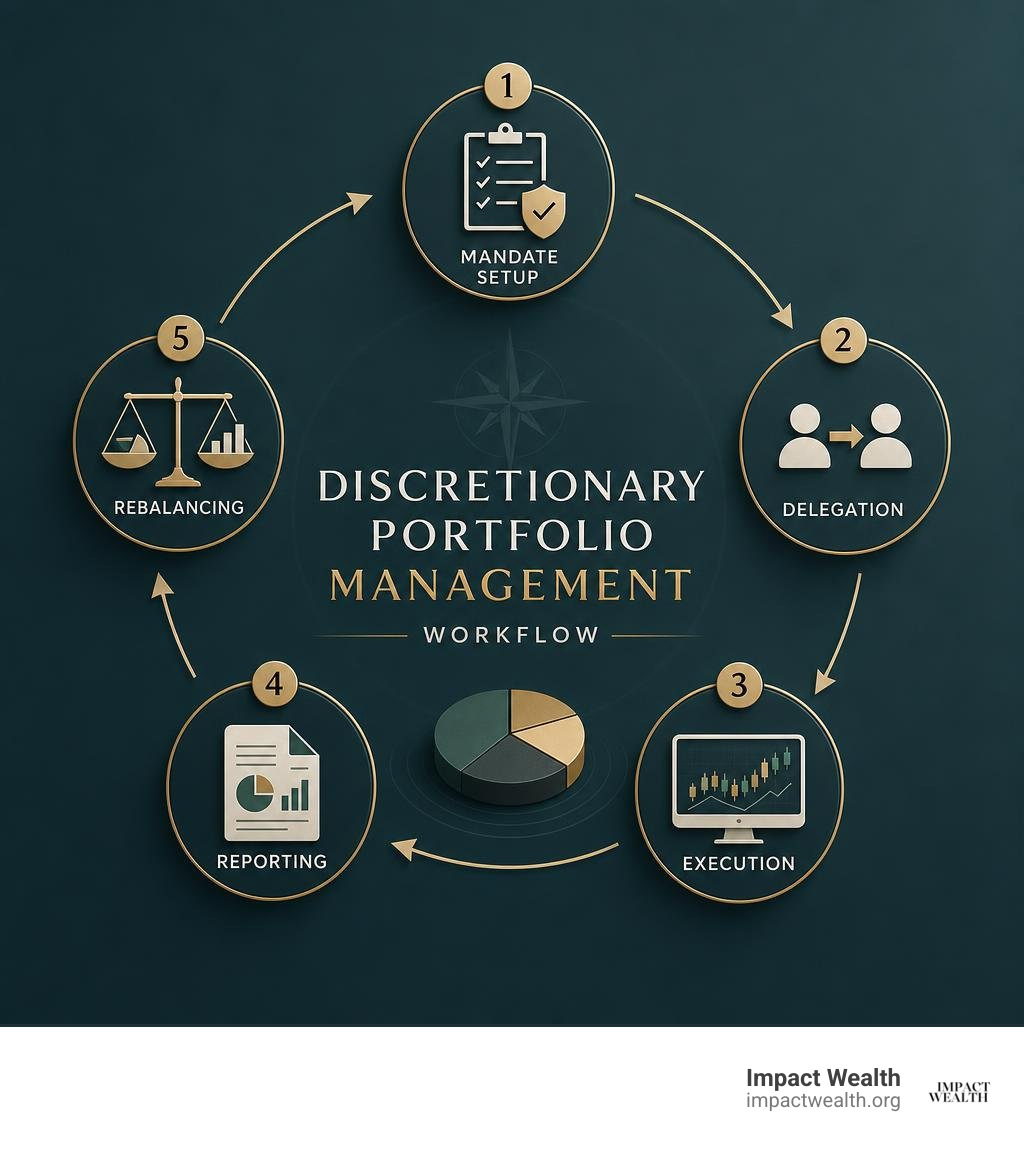
Discretionary portfolio management definitions:
Understanding Discretionary Portfolio Management

At its core, discretionary portfolio management is built on the concept of professional stewardship. When you opt for a discretionary mandate, you are not just hiring someone to execute trades; you are hiring an expert to make ongoing, highly calculated decisions on your behalf.
This relationship is governed by a strict fiduciary duty. The portfolio manager is legally and ethically bound to act entirely in your best interest. This contrasts sharply with transactional brokerage relationships, where the incentive structure can sometimes favor high trade volumes over long-term performance.
By delegating day-to-day control, you free yourself from the psychological burden of watching the ticker tape. Professional managers bring emotional detachment to the table, which is invaluable during periods of extreme market volatility. Instead of panic-selling during a dip, a discretionary manager views market dislocations as buying opportunities, executing strategic moves instantly.
To explore how these services fit into a broader wealth plan, you can read our Discretionary portfolio management overview.
Discretionary vs. Advisory and Execution-Only Services
To truly understand discretionary management, it helps to compare it to the other two primary service models in wealth management: advisory services and execution-only services.
| Feature | Discretionary | Advisory | Execution-Only |
|---|---|---|---|
| Decision Maker | Portfolio Manager | Client (with advisor input) | Client |
| Execution Speed | Instant | Delayed (awaits client approval) | Instant (by client) |
| Time Commitment | Extremely Low | Moderate to High | Very High |
| Fiduciary Responsibility | High (Manager decides) | Shared (Advisor recommends) | Low (No advice given) |
| Best Suited For | Busy UHNWIs & Family Offices | Investors wanting final veto power | Active, hands-on DIY traders |
In an advisory model, your wealth manager acts as a consultant. They will research opportunities and present them to you, but no trade can occur until you give explicit verbal or written consent. While this keeps you in the driver’s seat, it can be highly inefficient. If you are on a long-haul flight, in a board meeting, or vacationing in Europe, a time-sensitive market opportunity can easily slip away.
Execution-only services are exactly what they sound like. You make all the decisions, and the firm simply provides the platform to execute your trades. This model offers no professional guidance, leaving you entirely responsible for your own asset allocation, risk management, and compliance.
The Mechanics of a Discretionary Portfolio Management Mandate
How does a discretionary relationship actually work? It all begins with the Investment Policy Statement (IPS) or the investment mandate. This is a legally binding document that outlines your risk tolerance, return objectives, liquidity needs, time horizon, and any unique constraints (such as tax considerations or ethical restrictions).
Once the mandate is established, your assets are held in a segregated account. Unlike a mutual fund, where your money is pooled with thousands of other investors, a segregated account means you directly own the underlying stocks, bonds, and alternative assets.
To maintain fairness and efficiency across different account sizes, managers use proportional weighting and block trading. For example, if a manager decides to allocate 1% of their strategy to a specific global tech stock, they will execute a single massive “block trade” for all eligible clients simultaneously. A client with a £10 million portfolio will have £100,000 allocated, while a client with a £1 million portfolio will have £10,000 allocated. This ensures that all clients receive the exact same execution price, regardless of their portfolio size.
To understand the regulatory and operational controls that govern this process, refer to the Discretionary mandate framework.
Strategic Benefits and Potential Drawbacks of Delegation

Delegating your investment decisions is a major step. For many self-made entrepreneurs and executives, relinquishing control can feel counterintuitive. However, the strategic benefits of a well-executed discretionary mandate far outweigh the drawbacks for most wealthy families.
By working with professional stewards, you gain access to institutional-grade research, exclusive private market deals, and sophisticated risk management tools that are simply unavailable to retail investors. For deeper perspectives on managing multi-generational wealth, explore our curated Wealth Insights.
Why High-Net-Worth Individuals Delegate Authority
The most precious asset for any high-net-worth individual is time. Managing a diversified global portfolio across equities, fixed income, real estate, and alternatives requires dozens of hours of research every week. Delegating this responsibility allows you to focus on your business, your family, or your philanthropic pursuits.
Beyond time savings, the primary advantage is market agility. Modern markets move at breakneck speed. A discretionary manager can shift allocations, hedge currency exposures, or cut underperforming assets in real time as macroeconomic conditions change.
Furthermore, professional delegation removes emotional bias. Individual investors are notoriously prone to behavioral traps—such as loss aversion (holding onto losing stocks for too long) or herd behavior (buying into market bubbles at the peak). A disciplined investment manager relies on objective data and systematic frameworks to achieve your High Net Worth Financial Goals.
Understanding the Costs and Risks of Discretionary Portfolio Management
While the benefits are clear, discretionary portfolio management is not free, nor is it entirely without risk. It is crucial to understand the fee structure before committing your capital.
Most discretionary managers charge an annual Assets Under Management (AUM) fee. This fee typically ranges from 0.1% to 4.0% per annum, depending on the complexity of the strategy and the size of the portfolio. For example, a standard multi-asset portfolio might feature a tiered fee structure:
- First £5 million / $5 million: 1.00% to 1.20% per annum
- Next £10 million: 0.90% to 1.05% per annum
- Amounts above £20 million: 0.50% to 0.75% per annum
In addition to AUM fees, some boutique managers or hedge-fund-style mandates charge a performance fee. This is typically structured as 10% to 30% of the profits generated, often subject to a “high-water mark” (meaning the manager only earns the fee if they exceed the portfolio’s previous peak value).
The biggest “risk” of discretionary management is not market volatility—which affects all investments—but rather mandate drift or a lack of trust. If you choose a manager who does not align with your core values, or if you find yourself constantly second-guessing their trades, the relationship will fail. If you still want to approve every trade, paying for a discretionary mandate is an expensive mistake; you are paying for delegation you aren’t actually using.
For a detailed breakdown of how these costs are structured globally, see Discretionary portfolio management costs.
How Professional Managers Build and Rebalance Portfolios
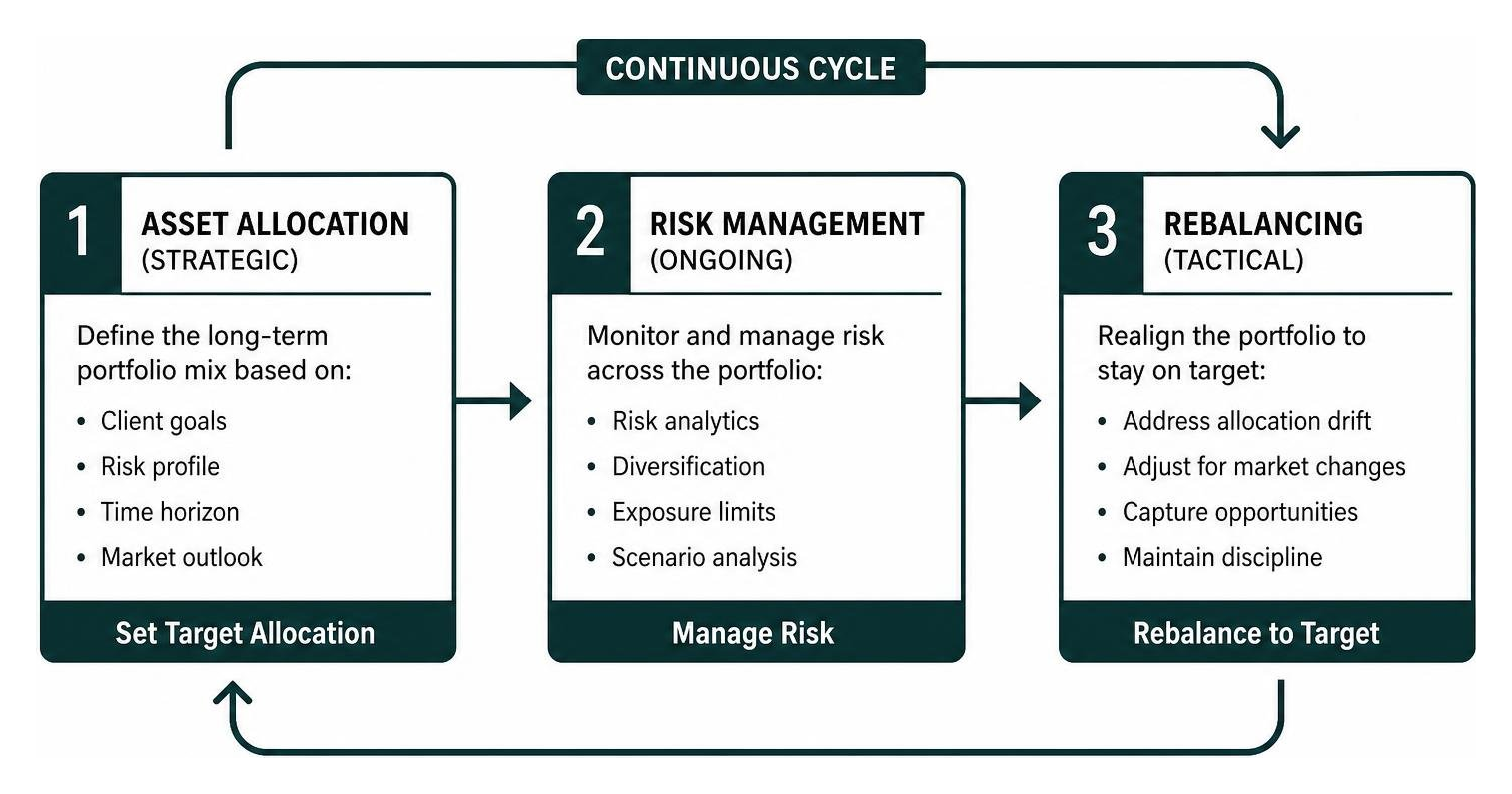
Building a resilient discretionary portfolio is a continuous, highly structured process. It is not about chasing the hottest stock or timing the market perfectly. Instead, it is about constructing a robust asset allocation framework that can withstand various economic cycles.
This process involves three continuous phases:
- Strategic Asset Allocation: Defining the long-term mix of assets (e.g., 60% equities, 30% fixed income, 10% alternatives) based on the client’s risk profile.
- Tactical Adjustments: Making short-term tilts to capitalize on immediate market opportunities or mitigate specific risks.
- Dynamic Rebalancing: Periodically buying and selling assets to return the portfolio to its target allocation after market movements alter the original weightings.
To see how these principles apply to tangible assets, read our guide on Portfolio Management.
Core Investment Philosophies and the Barbell Strategy
Many top-tier discretionary managers utilize a Barbell Strategy to balance growth and capital preservation. This approach divides your capital into two distinct, contrasting pillars:
- The Growth Barbell: Focused on capturing long-term megatrends, such as artificial intelligence, healthcare innovation, and emerging market expansion. These assets are highly dynamic and offer substantial upside potential.
- The Income Barbell: Focused on stable, cash-generating assets designed to protect capital during market downturns. This includes investment-grade corporate bonds, sovereign debt, real estate investment trusts (REITs), and high-yield dividend stocks.
By avoiding the “middle ground” of mediocre, moderate-risk assets, the barbell strategy allows your portfolio to capture explosive growth while maintaining a highly resilient defensive foundation. Achieving this balance requires deep expertise in Strategic Wealth planning.
Integrating ESG and Responsible Investing
In July 2026, responsible investing is no longer a niche preference—it is a core fiduciary duty. Sophisticated investors increasingly recognize that Environmental, Social, and Governance (ESG) risks are material financial risks. A company with poor environmental compliance or weak corporate governance is highly vulnerable to regulatory fines, reputational damage, and ultimate capital loss.
Modern discretionary mandates integrate ESG factors directly into their security selection processes. This goes beyond simple negative screening (such as avoiding tobacco or weapons manufacturers). Instead, managers practice active stewardship. This involves engaging directly with corporate boards and exercising voting rights to promote sustainable business practices that drive long-term shareholder value.
To learn more about how sustainable criteria are integrated into institutional-grade portfolios, consult the guide on Sustainable discretionary mandates.
Frequently Asked Questions About Discretionary Investment Services
What is the typical minimum investment threshold for discretionary services?
Discretionary portfolio management is historically a premium service designed for affluent individuals. Entry-level tiers for basic, mutual-fund-based discretionary portfolios often start around S$1.5 million or US$1 million.
For a fully customized, bespoke mandate—where the manager builds a tailored portfolio of direct equities, specialized fixed-income instruments, and private market alternatives—the thresholds are significantly higher. Premium global private banks typically require a minimum investment portfolio of at least £3 million in the UK, or $5 million (or local currency equivalent) in other international jurisdictions. Ultra-high-net-worth bespoke mandates often require $25 million or more to establish.
For details on premium international eligibility, see Discretionary portfolio management requirements.
How do regulatory environments like the FCA or SEC protect clients?
Discretionary portfolio managers operate under some of the strictest financial regulations in the world. In the UK, the Financial Conduct Authority (FCA) enforces strict rules, including the Consumer Duty, which mandates that wealth firms must deliver good outcomes for retail and private clients, ensuring clear communication and fair value.
In the United States, the Securities and Exchange Commission (SEC) regulates discretionary managers under the Investment Advisers Act, holding them to a strict fiduciary standard. These regulatory frameworks ensure that managers cannot self-deal, must disclose all conflicts of interest, and must ensure that every investment decision aligns perfectly with the client’s documented risk profile.
How often do discretionary managers report performance?
Transparency is a cornerstone of modern discretionary management. While your manager runs the portfolio day-to-day without calling you for permission, they are highly accountable for the results.
Typically, clients receive comprehensive quarterly performance reports that include detailed performance attribution (explaining exactly which assets drove returns and why). Additionally, firms provide formal annual statements summarizing all transactions, realized capital gains, and total management costs for tax reporting purposes. Most modern wealth managers also offer secure digital portals and mobile apps, allowing you to view your holdings, performance, and cash flows in real time.
Conclusion
Choosing discretionary portfolio management is ultimately a decision to prioritize your time, eliminate emotional bias, and secure institutional-grade expertise for your capital. For ultra-high-net-worth families and family offices, delegating the day-to-day complexities of global markets to a trusted, professional steward is the most efficient way to preserve and grow wealth across generations.
At Impact Wealth, we understand that managing substantial capital requires a highly sophisticated, multi-jurisdictional approach. Aligning your assets with a disciplined Wealth Building Strategy is the foundation of long-term financial freedom.
To discover how to integrate bespoke discretionary mandates into your broader family office and wealth preservation architecture, Explore Family Office Solutions.