
The Complete Guide to Private Banking Services
What Private Banking Services Actually Are (and Why They Matter for Serious Wealth)
Private banking services are a specialized tier of financial offerings designed exclusively for high-net-worth and ultra-high-net-worth individuals, families, and family offices — combining personalized banking, lending, investment coordination, and wealth planning under one dedicated relationship.
Here’s a quick overview of what private banking delivers:
| What You Get | How It Works |
|---|---|
| Dedicated private banker | One point of contact for all financial needs |
| Tailored lending solutions | Mortgages, credit lines, art and aircraft financing |
| Cash and liquidity management | Checking, savings, FX in 70+ currencies |
| Investment coordination | Portfolio advice, private markets, CIO research |
| Wealth and estate planning | Trusts, estate strategy, generational transfer |
| Exclusive access | Private deals, curated investments, niche assets |
If you have significant assets and complex financial needs, the standard retail bank model simply wasn’t built for you.
Private banking exists for a reason: your financial life isn’t simple. You may have liquidity needs tied to a business, real estate across multiple jurisdictions, a family trust, and a concentrated stock position — all at the same time. A branch banker with a script can’t help you navigate that.
What private banking offers instead is a dedicated team that knows your full picture. One senior relationship manager coordinates across lending, investment, tax, and estate specialists — so nothing falls through the cracks.
The stakes are high. According to industry data, over $80 trillion in wealth is expected to change hands globally over the next two decades. Families who have the right banking infrastructure in place — built around their specific goals, risk tolerance, and legacy intentions — are far better positioned to protect and grow what they’ve built.
Some institutions have been doing this for centuries. BNY Wealth, for example, traces its private banking history back more than 240 years, with one family client spanning seven generations. That kind of continuity doesn’t happen by accident — it’s the result of deep, trust-based relationships that go far beyond transactional banking.
This guide breaks down everything you need to know: how private banking works, who qualifies, what services are included, and how to evaluate whether a private bank is truly the right partner for your wealth.
What Private Banking Services Are and How They Differ From Retail Banking
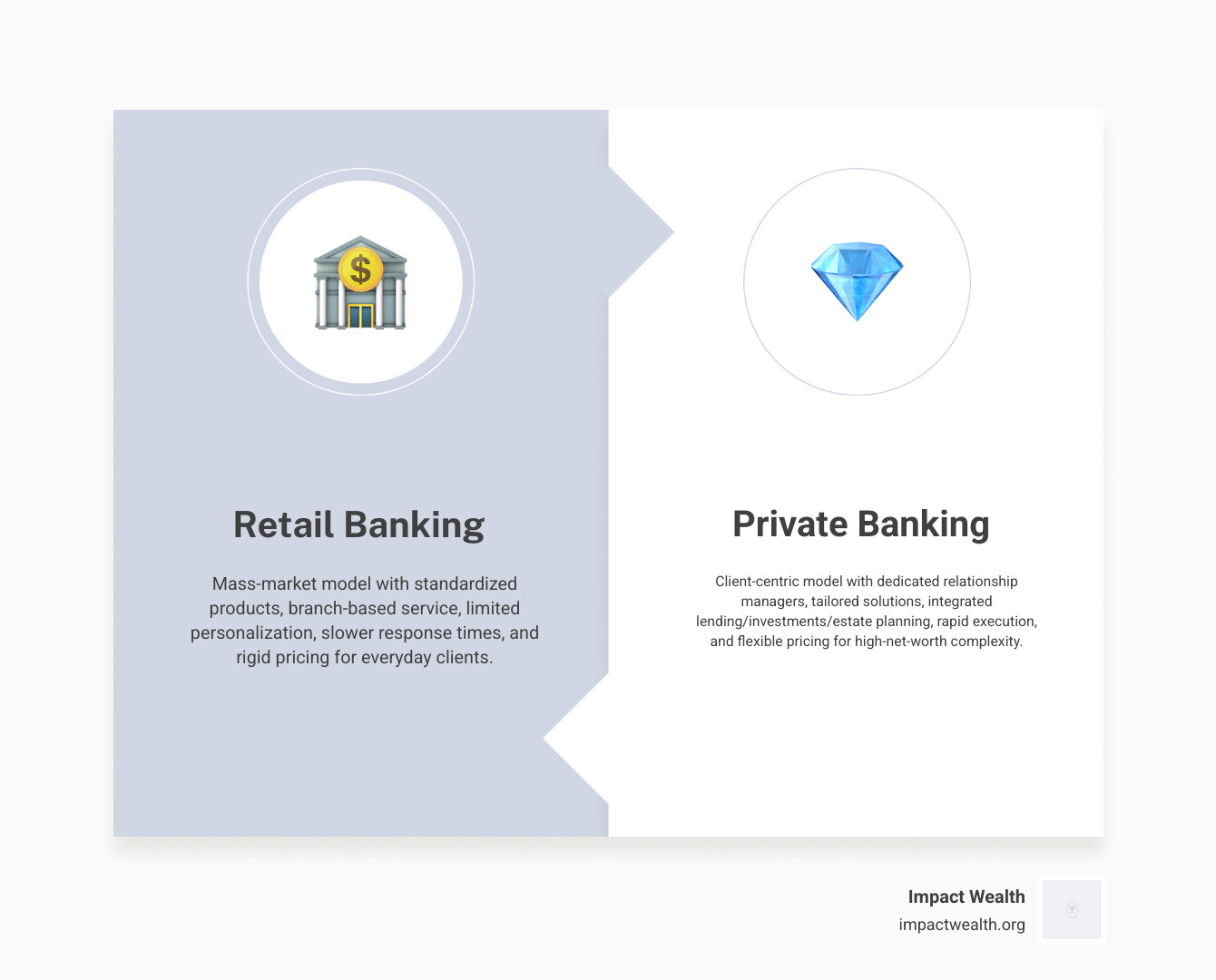
At the simplest level, private banking is banking built around the client rather than around the branch. Retail banking is designed for scale. Private banking is designed for complexity.
For affluent families, executives, founders, and family offices, that difference matters. A private bank typically combines deposits, lending, investment coordination, trust and estate support, and often cross-border capabilities into one relationship.
What private banking means in practice
In practice, private banking usually means you work with a dedicated banker or relationship team who understands your balance sheet, cash flow, borrowing needs, and long-term goals.
That team may help you:
- Coordinate liquidity around a home purchase or business sale
- Structure credit against securities instead of forcing asset sales
- Manage multiple accounts for personal, family, and business use
- Support trust structures and beneficiary planning
- Connect banking decisions with broader investment strategy
It is also more lifestyle-aware than retail banking. If you need a fast wire, a customized mortgage, foreign exchange support, or financing tied to a nontraditional asset, private banking is built to respond faster and with more flexibility.
Private banking vs traditional retail banking
Retail banking is mostly standardized. Private banking is mostly tailored.
| Feature | Private Banking | Retail Banking |
|---|---|---|
| Service model | Dedicated relationship team | Branch or call-center based |
| Client type | HNW and UHNW clients | General public |
| Advice | Personalized and integrated | Limited and product-based |
| Lending | Customized underwriting | Standard qualification rules |
| Response speed | Higher-touch, faster escalation | Process-driven |
| Pricing | May offer preferential pricing | Usually fixed schedules |
| Complexity handled | High | Low to moderate |
If retail banking is off-the-rack, private banking is bespoke. Same shirt category, very different tailoring.
Private banking vs wealth management vs family office
These terms overlap, but they are not identical.
- Private banking focuses on deposits, payments, borrowing, liquidity, and day-to-day financial infrastructure, often with planning support.
- Wealth management centers more on investing, asset allocation, portfolio construction, and long-term planning.
- A family office goes wider still, sometimes handling bill pay, governance, philanthropy, education, lifestyle management, and coordination across advisors.
Many wealthy families use all three in some form. If protecting a complex balance sheet is the priority, it helps to understand how banking fits into the broader picture of wealth protection.
Who Qualifies for Private Banking Services
Private banking is not reserved only for billionaires, but it is generally meant for clients with substantial assets or complex needs.
Most institutions use some combination of:
- Investable asset minimums
- Deposit balances
- Borrowing potential
- Business ownership or executive status
- Complexity of financial situation
Typical minimum asset requirements by institution
A common benchmark starts in the six figures and often moves into seven figures. Research across the market shows many private banks require at least $1 million in investable assets, while some accept lower thresholds for clients with strong deposits, lending needs, or broader relationships.
One example from the research is that TD Bank Private Client Group is available to clients with at least $750,000 in assets. That gives a helpful reference point: entry levels can begin below $1 million, but more exclusive tiers often require $1 million or more.
Eligibility can also vary by region, service line, and household relationship. A client with significant borrowing needs, concentrated stock, or a large business banking relationship may qualify differently from someone with a plain-vanilla brokerage account.
Who private banking is designed for
Private banking is often a strong fit for:
- Entrepreneurs with business and personal finances that overlap
- Corporate executives with stock compensation or concentrated positions
- Families managing trusts and intergenerational transfers
- Professionals with high income and growing complexity
- Retirees seeking coordinated estate, tax, and income planning
- Global citizens with assets or residences in more than one jurisdiction
- Family offices that need institutional-style banking support
In other words, private banking is often less about a magic number and more about whether your financial life has become complicated enough that coordination is valuable.
When private banking may not be the right fit
Private banking may not be worth it if:
- Your finances are simple
- You rarely borrow
- You prefer fully self-directed investing
- You do not need estate or trust coordination
- Minimums or fees outweigh the benefits
For many households still building wealth, the smarter move is mastering fundamentals first. Our guide to smart money management is a better starting point than paying for complexity you do not yet need.
Core Private Banking Services for High-Net-Worth Clients
Private banks aim to become the central operating system for a client’s financial life. That means banking, credit, planning, and investment coordination all need to work together.

Cash management and everyday banking within private banking services
This is the least glamorous part of private banking, but often the most useful.
Core cash services usually include:
- Premium checking and savings
- Money market and certificate of deposit options
- Large domestic and international wires
- Foreign exchange support
- Bill pay and account aggregation
- Treasury or cash tools for family offices and businesses
Some private banks also support international payments in more than 70 currencies. That is particularly relevant for globally mobile clients with homes, staff, vendors, or investments across the U.S., Europe, the UK, the Middle East, and China.
Good cash management is not just about convenience. It helps clients separate liquidity by purpose: daily spending, near-term opportunities, and longer-term reserves.
Lending solutions: liquidity without forced selling
This is one of the biggest reasons wealthy clients use private banking.
Instead of selling appreciated assets and potentially triggering taxes, clients can often borrow against eligible securities or other collateral. Common solutions include:
- Securities-based lines of credit
- Jumbo and custom residential mortgages
- Real estate financing
- Business and working capital loans
- Customized credit for executives
- Aircraft financing
- Art-backed lending
This flexibility matters. A client might fund a property purchase, bridge a liquidity event, restructure debt, or finance a business opportunity without disrupting a long-term investment plan.
That approach shows up often in private banking: preserve optionality first, liquidate later if needed.
Wealth planning and investment coordination
Not every private bank is the same as an investment manager, but many coordinate closely with investment teams.
That can include:
- Asset allocation guidance
- Portfolio reviews
- Private market access
- Research from chief investment offices
- Market outlooks during volatile periods
- Sustainable investing options
Research in this space increasingly emphasizes long-term discipline during shocks, including energy-related volatility and shifting global market conditions. For wealthy families, the private banking value is often not a hot stock tip. It is having banking, portfolio, and tax decisions aligned so one move does not accidentally damage another.
Estate planning, trust services, and intergenerational transfer
As wealth scales, estate planning stops being a side project and becomes infrastructure.
Private banking teams often coordinate with trust, fiduciary, legal, and tax professionals on:
- Trust structures
- Beneficiary design
- Estate settlement planning
- Family governance
- Wealth transfer strategies
- Philanthropic structures
This is especially important as global wealth transfer accelerates. Families trying to balance control, privacy, and fairness should also explore our perspective on multi-generational wealth planning.
Specialized services for complex lives
This is where private banking starts to look very different from ordinary banking.
Depending on the institution, specialized services may include:
- Executive banking for stock options or concentrated equity
- ESOP monetization support
- Escrow solutions for complex transactions
- Law-firm and partner banking structures
- Business-owner cash flow planning
- Philanthropic coordination
- Family office support
For self-employed professionals and business owners, retirement planning also intersects with tax efficiency, succession, and liquidity timing. Related reading: retirement planning for self-employed professionals.
The Biggest Advantages and Potential Drawbacks of Private Banking Services
Private banking can be enormously useful, but it is not magical. A polished lobby and fancy coffee do not automatically equal better outcomes.

Key benefits wealthy clients value most
The biggest advantages usually include:
- One point of contact across complex needs
- Faster service and execution
- More tailored credit solutions
- Better coordination between banking and investing
- Potentially better pricing on large relationships
- Access to curated or exclusive opportunities
- Support for cross-border lives and assets
For families with complexity, convenience itself has value. Reducing friction, avoiding poor timing, and coordinating advisors can save both money and headaches.
Potential disadvantages and limitations to understand
Private banking also has limits:
- Fees may be high or bundled in opaque ways
- Account minimums can be steep
- Some banks push proprietary products
- Service quality varies by team, not just by brand
- Private investments can be illiquid
- Concentration risk may still remain if planning is weak
In other words, private banking can give you better tools, but it does not replace judgment.
How to evaluate whether a private bank is worth the cost
We recommend looking at six things:
- Service breadth: Can the team handle lending, cash, trust, and investment coordination?
- Advisor quality: Are you getting senior, responsive professionals?
- Lending depth: Can they structure credit creatively and prudently?
- Digital tools: Is the platform modern and usable?
- Transparency: Do you understand fees, conflicts, and product menus?
- Reach: Can they support your geographic footprint in the U.S., Europe, the UK, the Middle East, or China?
Client satisfaction can be a helpful signal too. For example, BNY Wealth reports 96% overall client satisfaction and is cited as a top 10 U.S. private bank in the 2025 Cerulli Report. Those figures do not guarantee fit, but they do suggest that service consistency matters.
How Private Banking Services Work for Families, Business Owners, and Global Clients
The best private banking relationships are not generic. They adapt to who the client actually is.
For multi-generational families and family offices
For families, private banking often supports:
- Wealth transfer planning
- Family trust administration
- Governance structures
- Education for next-generation heirs
- Coordinated philanthropy
- Privacy and information control
The research highlights a striking example: one long-standing private banking client relationship has continued across seven generations. That reinforces a core truth about private banking: its real value often compounds over decades, not quarters.
Families navigating aging, healthcare costs, and late-life risk should also read when wealth meets health.
For entrepreneurs, executives, and business owners
Business owners often need a bridge between personal and enterprise wealth.
Private banking can help with:
- Liquidity event planning
- Stock option and concentrated equity strategies
- Acquisition financing
- Working capital support
- Debt restructuring
- Personal borrowing tied to business cash flow cycles
For founders, timing matters more than almost everything. Selling the wrong asset at the wrong moment to solve a short-term cash need is the kind of expensive mistake private banking is designed to prevent.
For global and mobile clients
Modern wealth is mobile. Families may live in Palm Beach, work in Miami, maintain structures in Europe or the UK, invest internationally, and have family members studying or relocating abroad.
Private banks serving global clients often offer:
- Foreign exchange and multicurrency support
- Cross-border account coordination
- International payments
- Coordination with local specialists
- Structuring support around mobility and residency changes
This global model has become more important over time. Citi, for example, emphasizes a cross-border private banking approach and operates from 52 offices globally, reflecting how international many wealthy families have become. You can see how major institutions position these services at Citi Private Bank and J.P. Morgan Private Bank Europe, Middle East & Africa.
Real-world examples of private banking services in action
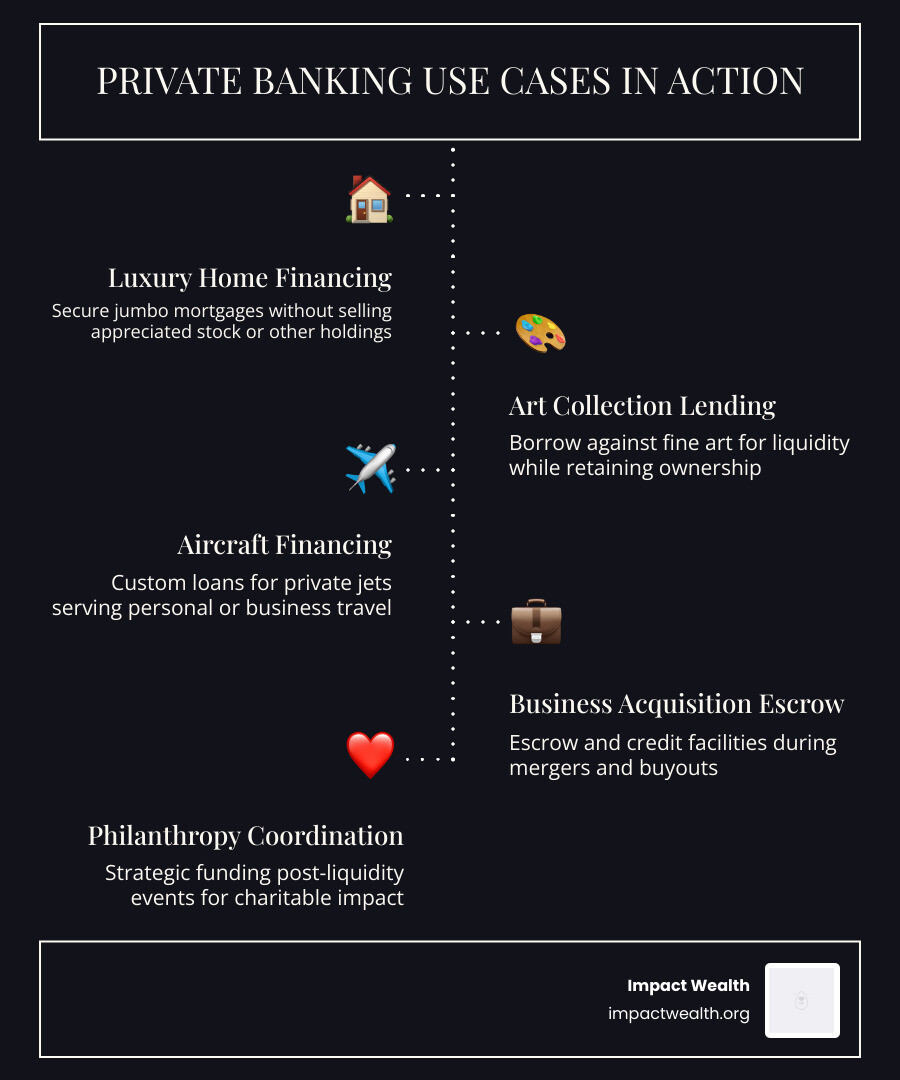
Common real-world use cases include:
- Financing a luxury home without liquidating appreciated holdings
- Borrowing against a fine art collection to create liquidity
- Structuring aircraft financing for personal or business travel
- Using escrow and credit solutions during a business acquisition
- Coordinating philanthropy after a major liquidity event
These are not edge cases anymore. For wealthy households, assets are often illiquid, emotional, or tax-sensitive. That is why specialized banking can matter so much. If your wealth includes collectibles or other passion assets, see our guide to passion asset discipline.
Technology, Security, and the Future of Private Banking
Private banking used to be almost entirely relationship-driven and paper-heavy. Today, clients expect both white-glove service and excellent technology. Fair enough. Nobody wants to wait three days to move money just because the wallpaper is expensive.
The modern digital private banking experience
Increasingly, clients expect:
- Mobile account access
- Secure messaging with relationship teams
- Digital approvals and signatures
- Consolidated portfolio views
- Real-time cash visibility
- 24/7 service support
Some institutions combine dedicated bankers with always-on digital tools, which is the ideal mix: human judgment for important decisions, technology for speed and control.
Security, privacy, and regulatory compliance
Private banks are expected to pair convenience with rigorous oversight.
Common protections include:
- Know your customer procedures
- Anti-money laundering controls
- Fraud monitoring
- Data encryption
- Identity verification
- Regulatory disclosures
Depending on the product, clients may also interact with entities governed by FDIC, FINRA, or SIPC frameworks. That matters because private banking often spans deposit products, advisory accounts, brokerage services, and trust structures under related but distinct legal entities.
Cyber hygiene also matters on the client side. The bank can do a lot, but if a family office shares passwords in a spreadsheet called “finalfinalpasswords.xlsx,” the system is not the problem.
Where private banking is heading next
Several trends are shaping the future:
- AI handling routine service and administrative tasks
- More relationship-led advice for complex decisions
- Greater access to private markets
- Rising interest in sustainability and impact
- More curated solutions for next-generation wealth holders
- More cross-border structuring for globally mobile families
Industry commentary also points to a major generational handoff underway, with values shifting toward impact, flexibility, and digital experience. That aligns with how we think about modern wealth at Impact Wealth.
Frequently Asked Questions About Private Banking Services
What is the minimum net worth for private banking services?
There is no universal rule. Many institutions start around $750,000 to $1 million in investable assets, while some require substantially more for their highest-touch tiers. The exact threshold may depend on deposits, brokerage assets, borrowing needs, or total household relationship.
Are private banking services only for ultra-high-net-worth individuals?
No. While UHNW families are core clients, many banks also serve high-net-worth or upper mass affluent households with increasing complexity. The real dividing line is often not just wealth level, but whether your needs justify a dedicated service model.
Do private banking services include investment management and lending?
Often, yes. Most private banking offerings include some mix of cash management, lending, mortgages, securities-based credit, investment coordination, and trust or estate support. The exact mix depends on the institution and your relationship tier.
Conclusion: Choosing the Right Private Banking Partner for Long-Term Wealth
The right private banking partner should make your financial life simpler, more coordinated, and more resilient.
We believe the best way to evaluate private banking services is to start with your own needs:
- How complex is your balance sheet?
- Do you need customized lending?
- Are family governance and wealth transfer priorities?
- Do you have cross-border exposure?
- Will you actually use the service breadth you are paying for?
From there, do your due diligence. Ask about minimums, fees, product conflicts, digital tools, trust capabilities, and service responsiveness. A strong private banking relationship should feel like infrastructure, not ornament.
If you are thinking beyond banking alone and want a broader perspective on UHNW strategy, explore our resources on Medicare premium pitfalls in retirement and our broader family office coverage.
For serious wealth, the right structure matters. Private banking is not just about access. It is about alignment, liquidity, protection, and legacy.