
When Standard Banking Is No Longer Enough
Private banking options exist for one simple reason: at a certain level of wealth, a standard checking account and a 1-800 number just don’t cut it anymore.
Here’s a quick look at the most important private banking options available today, and what it takes to access them:
| Bank | Minimum Investable Assets | Key Offering |
|---|---|---|
| Chase Private Client | $150,000 | Priority service, preferred rates |
| Citigold International Private Bank | $250,000 | Global access, multi-currency |
| TD Bank Private Client Group | $750,000 | Dedicated advisor, custom lending |
| UBS Wealth Management | $2,000,000 | Full wealth management suite |
| BNP Paribas Wealth Management | $3,000,000 | Global investment access |
| Bank of America Private Bank | $3,000,000 | Trust, estate, and tax planning |
| Morgan Stanley Private Wealth | $5,000,000 | Alternative investments, family office |
| J.P. Morgan Private Bank | $10,000,000 | Institutional-grade, global reach |
| Barclays Private Bank | £3,000,000 (UK) | Bespoke multi-currency banking |
Personal banking serves the general public — think savings accounts, basic loans, and automated customer service. Private banking is a fundamentally different experience. It’s built around you: a dedicated relationship manager who knows your full financial picture, access to investments that never appear in a retail branch, preferential lending terms, and a level of discretion that matches the complexity of your wealth.
The U.S. private banking industry grew at nearly 10% annually from 2018 to 2023 — a clear signal that more families and business owners are recognizing when their financial lives have outgrown standard banking.
And the stakes are real. As one seasoned forum participant put it bluntly: choosing the wrong bank, the wrong jurisdiction, or the wrong structure can result in frozen assets, unexpected compliance headaches, or fees quietly eroding returns year after year.
This guide cuts through the noise so you can make a clear-eyed comparison.
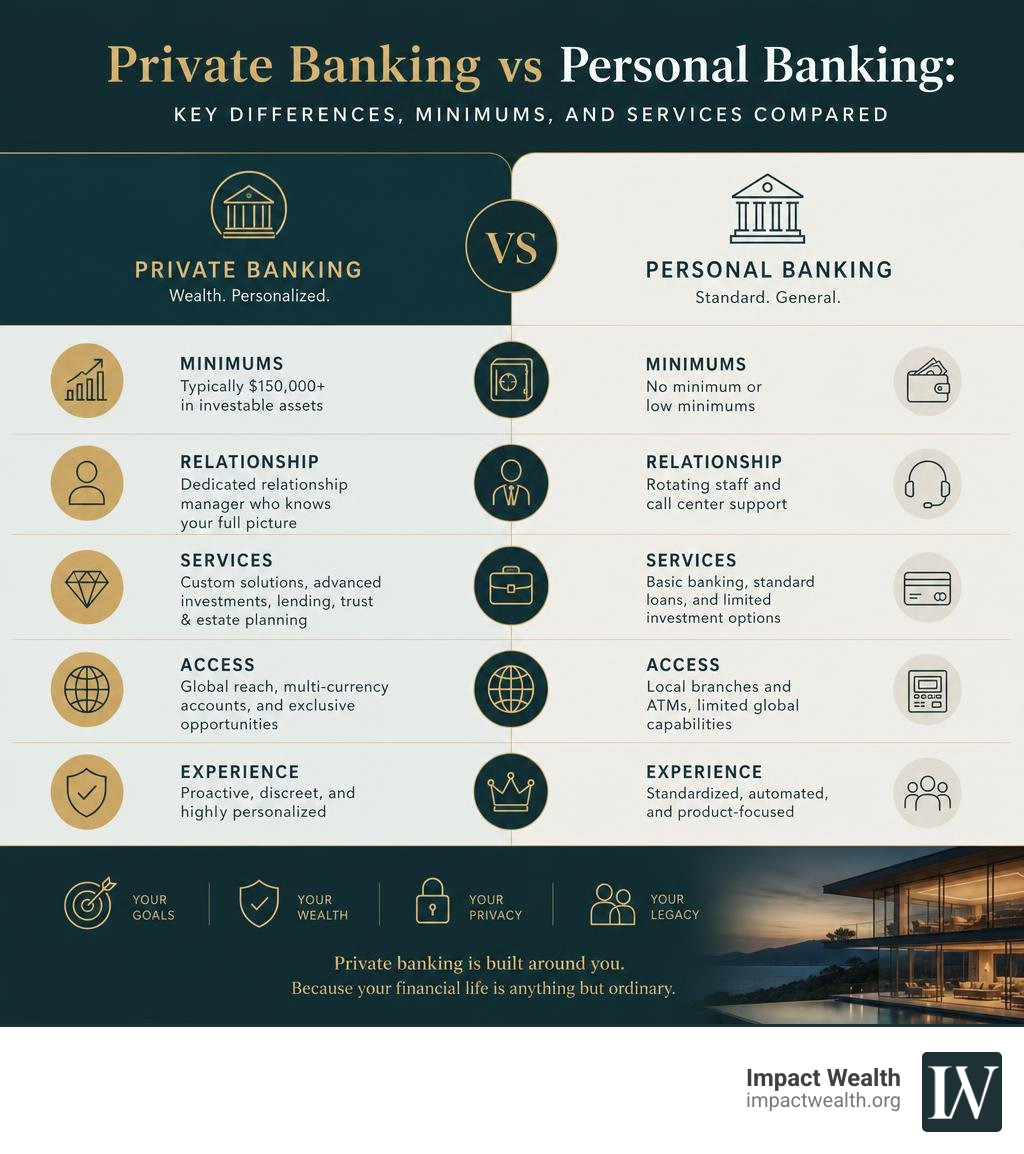
Basic private banking options vocab:
The Elite Perks of Bespoke Wealth Management

When we talk about the elite perks of private banking, we are looking far beyond waived ATM fees or a shiny metal debit card. True private banking functions as a highly coordinated command center for your entire balance sheet.
At the center of this ecosystem is your dedicated relationship manager. This individual acts as a single point of contact, orchestrating a team of specialists—including tax strategists, trust and estate attorneys, and portfolio managers. Instead of explaining your complex corporate structure to a different call center representative every time you need a transaction, your relationship manager understands your family office, your businesses, and your legacy goals.
Beyond personalized attention, private banking unlocks sophisticated credit and liquidity strategies. Foremost among these is preferential lending, particularly securities-backed loans. Rather than liquidating a portion of your stock portfolio to fund a real estate purchase or business expansion—which triggers substantial capital gains taxes—private banks allow you to pledge your eligible securities (stocks, bonds, or mutual funds) as collateral. This provides rapid liquidity at highly competitive interest rates, keeping your long-term investment strategies fully intact.
Furthermore, private banks offer customized financing solutions for high-value lifestyle assets. Whether you are seeking structured lending for fine art, private aviation, or custom construction projects, private bankers bypass rigid automated underwriting models in favor of manual, holistic financial reviews. This level of customization is essential for implementing Tax Efficient Strategies For Asset Heavy Portfolios that protect your wealth from unnecessary erosion.
Finally, the lifestyle and concierge perks are meticulously curated. Elite private clients often enjoy complimentary access to global airport lounges, private art collection tours, and bespoke lifestyle concierge services. From coordinating complex international travel to securing priority entry to exclusive global events, these services are designed to match the fast-moving lifestyles of ultra-high-net-worth families.
Tiered Private Banking Options and Asset Minimums
The private banking landscape is highly segmented, with entry barriers designed to filter clients based on the complexity of their financial needs. When evaluating these tiers, it is important to focus on investable assets—such as cash, equities, and liquid funds—while excluding non-deployable capital like your primary residence.
For those transitioning from traditional retail banking, entry-level programs offer an excellent starting point. The Welcome to J.P. Morgan Private Client | J.P. Morgan program, which establishes a clear $750,000 qualifying balance threshold to waive its high-tier service fees, provides dedicated relationship management and preferred rates on savings and lending. Similarly, regional options like TD Bank’s Private Client Group, which operates physical hubs including their office at 1626 E Hallandale Beach Boulevard, require a minimum of $750,000 to access tailored advisory services.
As wealth scales, the options become increasingly sophisticated:
- $1,000,000 to $3,000,000: This mid-tier includes institutions like UBS Wealth Management (requiring a $2,000,000 minimum) and BNP Paribas Wealth Management (requiring $3,000,000). At this level, clients gain access to comprehensive wealth planning, advanced sweep accounts to maximize yield and FDIC insurance, and structured investment products.
- $3,000,000 to $5,000,000: The Bank of America Private Bank – Private Wealth Solutions requires a minimum of $3,000,000 in investable assets. This tier focuses heavily on trust, estate, and specialized tax-planning strategies, integrating corporate and institutional capabilities for business owners.
- $10,000,000 and Above: Reserved for ultra-high-net-worth individuals, J.P. Morgan Private Bank requires a minimum of $10,000,000 in investable assets. Operating out of key wealth centers—including Our Palm Beach, FL Office | J.P. Morgan Private Bank U.S. , Our Miami, FL Office | J.P. Morgan Private Bank U.S. , and Our Los Angeles, CA Office | J.P. Morgan Private Bank U.S. —this elite tier provides institutional-grade investments, direct private equity access, and multi-generational family office advisory.
Evaluating Your Private Banking Options: Global vs. Boutique

Choosing the right private banking partner requires a careful evaluation of global banking giants versus specialized boutique firms. Both models offer distinct advantages, and the optimal choice depends heavily on your geographic footprint, the complexity of your business holdings, and your long-term wealth preservation goals.
Global powerhouses—such as Citi Private Bank (serving clients from 52 offices globally) and J.P. Morgan Private Bank (present in over 100 markets worldwide)—offer unmatched scale and a “fortress balance sheet.” These institutions excel at cross-border wealth management, multi-currency cash optimization, and institutional-grade capital market access. If your business requires interest rate swaps, international currency hedging, or direct access to global venture capital syndicates, a global bank provides the infrastructure necessary to execute these complex transactions.
Conversely, boutique private banks and independent wealth managers prioritize highly personalized, human-led advisory. Free from the rigid corporate structures of global conglomerates, boutique firms often utilize manual underwriting models to review complex lending scenarios, such as financing a historic estate or a mega-yacht. Furthermore, many boutique firms operate under a pure fiduciary standard, meaning they are legally bound to act in your best interest and are not incentivized to cross-sell proprietary bank products.
To help visualize how these private banking options compare, we have outlined their primary structural differences below:
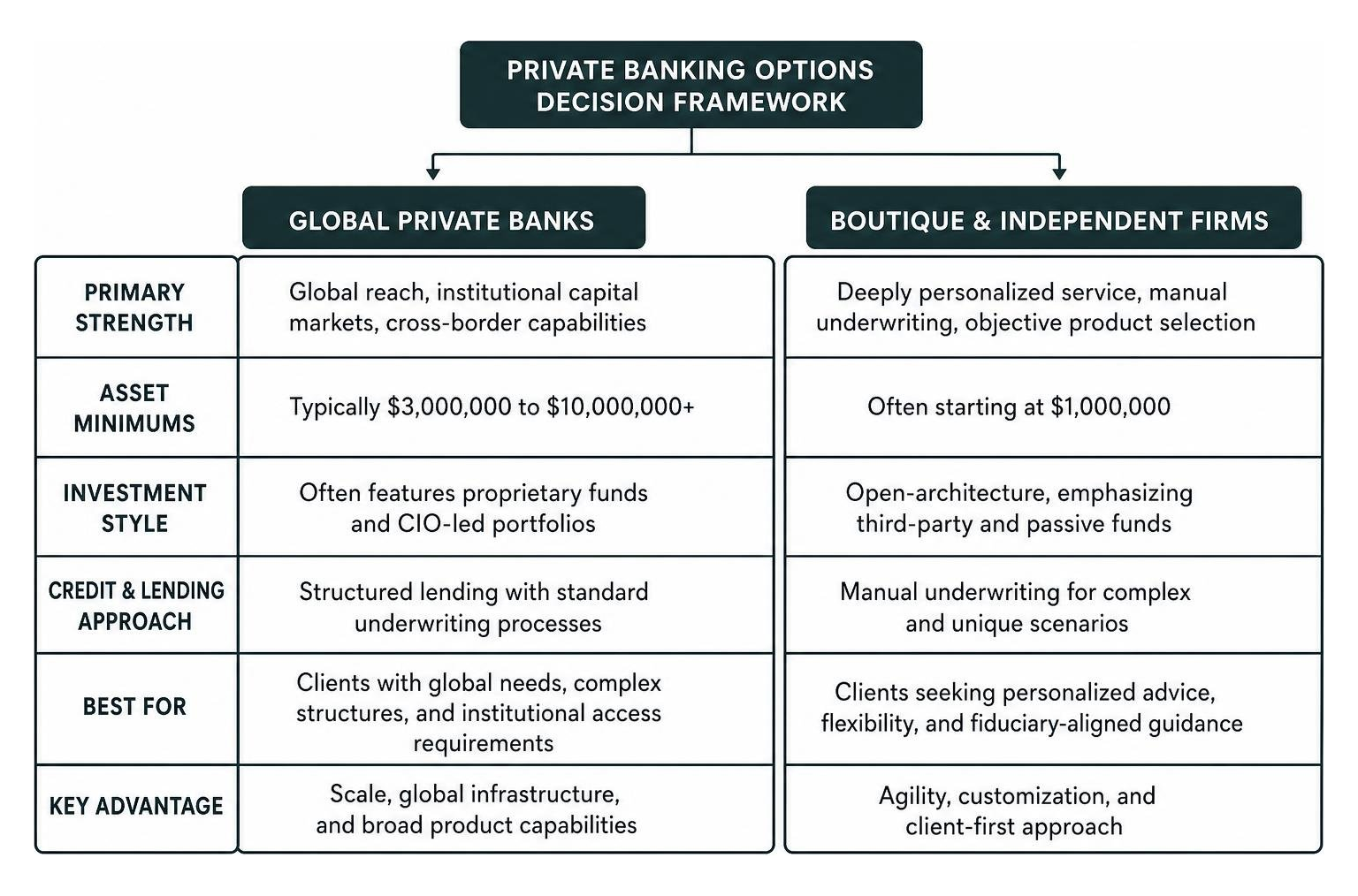
| Feature | Global Private Banks | Boutique & Independent Firms |
|---|---|---|
| Primary Strength | Global reach, institutional capital markets, cross-border capabilities | Deeply personalized service, manual underwriting, objective product selection |
| Asset Minimums | Typically $3,000,000 to $10,000,000+ | Often starting at $1,000,000 |
| Investment Style | Often features proprietary funds and CIO-led portfolios | Open-architecture, emphasizing third-party and passive funds |
| Lending Solutions | Standardized securities-backed lines, jumbo mortgages | Highly customized luxury asset and commercial financing |
Whether you choose a global giant or a boutique firm, your primary objective remains the same: establishing a resilient framework to manage risk. This is particularly critical when learning How To Protect Wealth During Recession, where portfolio diversification and capital preservation are paramount.
How to Select the Best Private Banking Options for Your Legacy
True wealth management is not just about growing your balance sheet; it is about establishing a sustainable family legacy. When selecting among your private banking options, it is vital to evaluate how an institution handles family governance and succession planning.
According to global wealth research, nearly 40% of entrepreneurs have initiated the process of transferring their wealth, yet two-thirds have not discussed a formal succession plan with their families. This gap highlights the emotional and operational complexities of generational wealth transfers. A premier private bank should act as an objective mediator, helping you establish clear family governance frameworks, define roles for next-generation leaders, and prepare heirs for the responsibilities of stewardship.
For instance, Personalised banking and savings | Barclays Private Bank —which requires a minimum investment portfolio of £3 million in the UK and £5 million in international jurisdictions—combines day-to-day banking with bespoke legacy planning, children’s savings structures, and multi-generational trust administration. By integrating legacy planning early, you ensure that your wealth transitions smoothly, preserving family harmony and minimizing fiscal friction across generations.
Jurisdictional Safety and International Wealth Management
For international families and business owners, wealth management is inherently cross-border. Managing assets across multiple jurisdictions requires a deep understanding of safety, regulatory oversight, and currency flexibility.
When evaluating jurisdictional safety, traditional European hubs like Switzerland and the UK Crown Dependencies (such as Jersey, Guernsey, and the Isle of Man) remain highly favored by high-net-worth individuals. These jurisdictions offer strong legal protections, robust political stability, and highly liquid, ring-fenced banking entities that are structurally protected from mainland parent bank liabilities.
For those seeking Swiss precision paired with modern luxury privileges, Concierge Bank | #1 Private Swiss Banking in USA | Premium Wealth Management represents a compelling hybrid option. Managing $2.4 trillion in assets under management across 180 countries, it bridges Swiss-grade security and FINMA-modeled standards with US-based, FDIC-insured accounts up to $250,000. This combination allows clients to access elite multi-currency debit cards, international wires, and dedicated art and estate acquisition advisory within a single, secure digital platform.
Navigating Pitfalls and Modern Wealth Assets
Despite the premium nature of private banking, high-net-worth individuals frequently encounter operational pitfalls. The most common complaints center on hidden fees—such as high assets under management (AUM) fees exceeding 1.5%—and conflicts of interest arising from advisors pushing high-commission, in-house investment products rather than lower-cost, passive index funds.
Furthermore, aggressive compliance frameworks and Know Your Customer (KYC) regulations have led to a rise in arbitrary account freezes, particularly for international clients with multi-jurisdictional business structures. To prevent these disruptions, maintaining pristine, transparent source-of-wealth documentation is non-negotiable.
The private banking landscape has also had to adapt rapidly to the rise of digital assets. Historically, traditional private banks avoided cryptocurrency and non-traditional wealth sources. Today, forward-thinking institutions are establishing specialized compliance divisions to onboard crypto-native founders and integrate digital assets into traditional wealth reporting. For modern family offices, managing these risks requires sophisticated Family Office Operations that balance digital asset volatility with institutional-grade security and strict regulatory compliance.
Frequently Asked Questions About Private Wealth Services
What is the difference between a representative office and a bank headquarters?
A representative office handles marketing, client relations, and paperwork locally, but cannot directly book assets or execute transactions. The actual assets are booked and held at the bank’s headquarters entity (e.g., in Switzerland or the UK). Consequently, your deposits fall under the regulatory protections and deposit insurance schemes of the headquarters’ home country rather than the local jurisdiction where the representative office is situated.
How do private banks handle non-traditional wealth like cryptocurrency?
While some traditional banks remain highly conservative, leading private banks have established specialized compliance frameworks to accommodate cryptocurrency. They conduct exhaustive source-of-wealth tracing on fiat-to-crypto transitions. Once compliance standards are met, they can facilitate digital asset custody, include crypto holdings in consolidated wealth reporting, and assist crypto-native entrepreneurs with traditional wealth planning.
Is an external asset manager better than a bank’s in-house wealth management?
An External Asset Manager (EAM) provides independent oversight, utilizing an open-architecture model to select the best financial products across multiple custodian banks without institutional bias. However, utilizing a bank’s in-house wealth management team often streamlines day-to-day operations, offering direct, friction-free access to the bank’s proprietary balance sheet, custom lending solutions, and institutional investment syndicates.
Conclusion
Your wealth is more than just a number on a balance sheet—it represents your hard work, your family’s security, and the legacy you will leave behind. Navigating the diverse array of private banking options requires a partner that understands the unique complexities of ultra-high-net-worth wealth management.
At Impact Wealth, we believe that managing significant capital demands absolute precision, uncompromised safety, and a deeply personalized approach. By aligning your financial strategies with your personal values, you secure your path toward long-term financial independence and generational wealth preservation.
To discover how to structure your wealth for the future, explore our comprehensive Impact Wealth Family Office Guide.