
Is Private Banking Worth It for High Net Worth Individuals?
Private banking for high net worth individuals is a specialized, invitation-only tier of financial services that goes far beyond what a standard bank account can offer. Instead of walking into a branch and waiting in line, you get a dedicated relationship manager, bespoke investment strategies, preferential lending rates, and integrated estate planning — all under one roof.
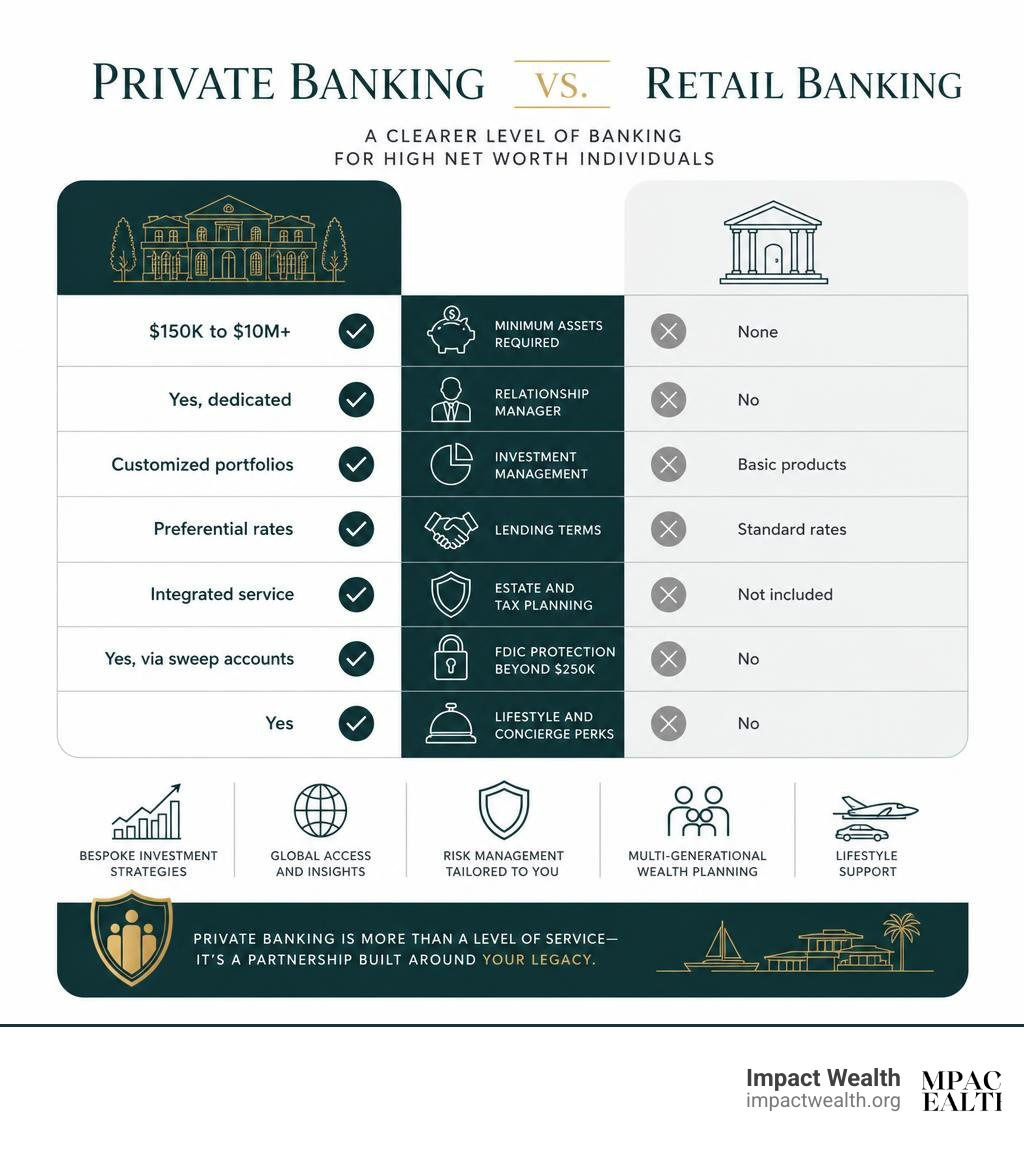
Here is a quick snapshot of what separates private banking from retail banking:
| Feature | Retail Banking | Private Banking |
|---|---|---|
| Minimum assets required | None | $150K to $10M+ |
| Relationship manager | No | Yes, dedicated |
| Investment management | Basic products | Customized portfolios |
| Lending terms | Standard rates | Preferential rates |
| Estate and tax planning | Not included | Integrated service |
| FDIC protection beyond $250K | No | Yes, via sweep accounts |
| Lifestyle and concierge perks | No | Yes |
The industry has grown fast. The US Private Banking Services sector expanded at nearly 10% per year from 2018 to 2023 — a clear sign that more wealthy individuals and families are moving their financial lives into this space.
But not all private banks are equal. Minimums range from $150,000 at Chase Private Client all the way to $10 million at J.P. Morgan Private Bank and Citi Private Bank. And in 2026, fee structures are shifting at major institutions — making it more important than ever to choose the right fit for your wealth profile.
Whether you are an entrepreneur planning a liquidity event, a family office principal managing multi-generational assets, or an executive with a complex balance sheet, finding the right private banking partner is one of the most consequential financial decisions you will make.
Easy private banking for high networth individuals glossary:
- Luxury asset financing
- Real estate financing
- Yacht financing options
What is Private Banking for High Networth Individuals?

At its core, private banking for high networth individuals is an elite financial ecosystem designed to treat your balance sheet as a unified, dynamic engine. Standard retail banking is highly transactional. It is built to process deposits, clear checks, and auto-approve standardized credit cards. Private banking, on the other hand, is entirely relationship-driven.
When you enter a private banking relationship, you are no longer just an account number; you are a partner. The bank assigns a dedicated team to manage your liquid assets, optimize your debt, and coordinate your long-term wealth strategy. Whether you are navigating the complex liquidity demands of a family enterprise or looking for ways on how to diversify your portfolio for long term success, private banking functions as the central command center for your capital.
Defining Private Banking for High Networth Individuals
True private banking is built on a foundation of fiduciary-level care, multi-generational wealth preservation, and rigorous asset protection. Unlike standard financial planners who might only manage a brokerage account, a private bank looks at your entire financial footprint.
This includes everything from structured trust and estate services to custom credit facilities that let you borrow against your investment portfolio without triggering a taxable event. Institutions like Coutts, which has spent centuries refining Private Banking | For High Net Worth Individuals, emphasize that this relationship is deeply personal. It is about understanding your family’s unique culture and ambitions, translating complex financial hurdles into seamless, long-term opportunities.
Key Differences: Private Banking vs. Retail Banking
The differences between private and retail banking go far deeper than free checks and a premium metal credit card. In retail banking, your transaction limits are strictly capped, and your deposits above $250,000 sit exposed to institutional risk. In private banking, those limits are customized to your cash flow, and sophisticated sweep accounts automatically distribute your excess cash across a network of partner banks to maximize your insurance coverage.
Furthermore, retail platforms offer off-the-shelf financial products with rigid terms. Private banking offers bespoke credit lines, direct access to institutional-grade investments, and structured yield opportunities. If you have ever looked at retail wealth platforms—as we did in our Wealthify Gia Review 2026 Exploring Pros And Cons—you know they are excellent for emerging savers. However, they lack the sophisticated, personalized lending and tax-arbitrage strategies that high-net-worth individuals require to protect their wealth.
Entry Requirements and Elite Tiers of Private Wealth

Private banking is not a one-size-fits-all service. The industry is highly tiered, with different institutions catering to specific levels of wealth. Understanding where your balance sheet fits within these tiers is essential for choosing a partner that can actually handle your complexity.
At the entry-level tier, often called “Private Client” or “Preferred Banking,” the requirements are relatively accessible. As you scale to the ultra-high-net-worth (UHNW) levels, the services shift from basic wealth management to institutional-grade solutions, including advanced tax strategies. Implementing tax efficient strategies for asset heavy portfolios becomes the primary focus when your net worth crosses into the tens of millions.
Minimum Asset Thresholds for Top Institutions
To help you compare your options, we have compiled the asset requirements and typical target profiles for some of the world’s leading private banking institutions:
| Institution | Minimum Investable Assets | Target Client Profile | Key Specialty |
|---|---|---|---|
| Chase Private Client | $150,000 | Emerging affluent families & business owners | Priority retail service & relationship rates |
| RBC Private Banking | $1,000,000 (or $3M net worth) | Corporate executives & business owners | Cross-border banking & integrated credit |
| Wells Fargo Private Bank | $1,000,000 | Multigenerational families & entrepreneurs | Trust administration & philanthropic advisory |
| Citi Private Bank | $10,000,000 (net worth) | Global business leaders & family offices | Cross-border wealth & institutional access |
| J.P. Morgan Private Bank | $10,000,000 | Ultra-high-net-worth individuals | Alternative investments & global capital markets |
For those looking to bridge the gap between retail convenience and elite advisory, programs like the J.P. Morgan Private Client tier offer an excellent entry point. You can learn more about their specific relationship offerings by visiting the Welcome to J.P. Morgan Private Client | J.P. Morgan portal.
The 2026 Shift in Premium Banking Fees
The private banking landscape has experienced a major shift. For years, major institutions offered premium “private client” tiers with waived monthly fees as long as you kept a modest balance or held a mortgage with the bank. However, starting in 2026, major players like J.P. Morgan Private Client are tightening their requirements.
Under the new 2026 fee structures, clients with less than $750,000 in qualifying balances will be assessed a monthly fee. This change highlights a broader industry trend: banks are dedicating more resources, security, and human relationship managers to their high-value clients, while nudging lower-balance accounts toward automated, digital-only platforms. If you are currently positioned between Chase Private Client and J.P. Morgan Private Client, auditing your qualifying balances is crucial to avoid unexpected maintenance fees.
Comparing the Best Private Banking for High Net Worth Individuals
When selecting a private banking partner, geography, heritage, and institutional strength are just as important as the asset minimums. The top private banks generally fall into three categories: North American giants with massive balance sheets, historic European and Swiss institutions focused on absolute privacy, and regional specialists that excel at cross-border transactions.
For modern high-net-worth families, these institutions are no longer just places to keep cash—they are gateways to sophisticated investment opportunities. From venture capital to private debt, private banks provide the liquidity and access needed to determine if are alternative investments worth it what finance experts say for your specific portfolio.
North American Giants: J.P. Morgan, Citi, and Wells Fargo
The largest US financial institutions offer unmatched scale, global trading desks, and massive balance sheets. Wells Fargo is a titan in this space, ranking 16th on Forbes’ Global 2000 list of the largest public companies. Backed by 170 years of banking history, Wells Fargo manages a staggering $2.5 trillion in client assets and oversees $28 billion in philanthropic assets. Their structured, long-term wealth strategies are detailed on the Private Wealth | Overview platform, which specializes in combining family culture services with traditional wealth management.
Citi Private Bank takes a highly globalized approach, catering directly to UHNWIs who live, work, and invest across multiple borders. With a strict $10 million net worth entry requirement, Citi is built for the “worldly wealthy.” They offer highly specialized advisory services for non-traditional assets like art collections and sports teams, which you can explore through their dedicated guide on Banking for high & ultra high net worth individuals.
For clients based in major luxury hubs, Citi maintains elite local offices, such as their dedicated hub for Private banking in Los Angeles, ensuring that high-touch, local relationship managers are always within reach.
European and Swiss Heritage: Pictet and Coutts
If your priorities lean toward absolute privacy, independent ownership, and multi-generational wealth preservation, the traditional European and Swiss private banks are unmatched. Pictet, with over 200 years of Swiss banking history and 31 offices in major financial centers globally, operates under an independent partnership model. This structure frees them from the short-term public market pressures that often plague Wall Street giants.
Their core philosophy centers on long-term stewardship, sustainable investing, and bespoke estate planning, which they outline on their Private banking services | Individuals and families | Pictet portal.
Similarly, Coutts represents the pinnacle of British private banking. Famous for serving the UK elite, Coutts combines historic, high-touch relationship banking with modern, client-co-designed digital tools. They treat borrowing as a strategic wealth-structuring tool rather than just debt, offering faster payments of up to £1 million and 24/7 concierge-level service.
Cross-Border and Regional Specialists: RBC and UOB
For families whose lives and businesses span specific regional corridors, specialized cross-border private banks are essential. RBC Private Banking is the premier choice for North American cross-border wealth, particularly for high-net-worth individuals moving assets, businesses, or lifestyles between the US and Canada. RBC requires a minimum of $1 million in investable assets (or $3 million in net worth) and provides integrated cash management, bespoke credit, and cross-border tax planning via RBC Private Banking .
In the Asia-Pacific region, UOB Private Bank stands out by blending traditional Asian family values with forward-looking wealth solutions. Operating with a deep ASEAN heritage, UOB specializes in family office establishment, discretionary portfolio management, and their highly acclaimed “Next-gen programme.” This program prepares younger heirs for wealth transitions through structured internships with tech startups and venture capital firms. You can explore their regional wealth capabilities at Home | UOB Private Bank .
Strategic Wealth Planning, Estate Management, and Legacy Transfer
Managing substantial wealth is rarely just about beating a market benchmark. It is about ensuring that your hard-earned assets survive the transition to the next generation, navigate changing tax laws, and survive personal disruptions.
Whether you are designing a philanthropic foundation or insulating your assets during a major lifestyle transition—such as protecting generational wealth during high net worth divorce cases—a private bank provides the legal, structural, and financial architecture required to secure your legacy.
The Role of the Dedicated Relationship Manager
Your relationship manager (RM) is the quarterback of your entire financial life. Instead of forcing you to deal with separate departments for mortgages, trusts, and commercial lending, the RM serves as your single point of contact.
A truly comprehensive private banking team, like the model utilized by PNC Private Bank, is built around a five-person advisory squad:

This team works in unison to simplify complex balance sheets and build customized wealth strategies. To learn how this integrated team approach can support your family, you can explore the PNC Private Bank Services for Individuals & Families framework.
For clients residing in premier wealth enclaves like South Florida, working with a localized team that understands regional estate tax nuances is invaluable. If you are looking for local, high-touch advisory services in these regions, visiting the Citizens Private Bank Palm Beach Office is an excellent place to start your search.
Private Banks vs. Family Offices for UHNW Clients
As your wealth scales past the $30 million to $50 million mark, you will likely face a choice: do you continue relying solely on a private bank, or is it time to establish a dedicated family office?
While a private bank operates as a specialized division within a larger financial institution, a family office is an independent entity dedicated entirely to your family’s balance sheet, lifestyle, and generational education.
Fortunately, this is not a mutually exclusive choice. In fact, most ultra-high-net-worth families use both in tandem. Private banks act as an integrated extension of family offices by providing specialized global trading execution, custody services, and complex asset-backed lending that an independent office cannot easily manage in-house.
For families looking to design a highly structured wealth sustainability model, institutions like UBS offer specialized, firmwide resources. You can explore their dedicated family office advisory services at UBS Private Wealth Management | UBS United States of America .
Frequently Asked Questions About High-Net-Worth Banking
Can high-net-worth individuals use normal banking services alongside private banking?
Yes, absolutely. Many high-net-worth individuals maintain standard retail banking accounts alongside their private banking relationships. This “dual banking” approach is often used for daily transactional convenience, such as managing minor household expenses, paying local vendors, or providing debit cards to younger family members.
It allows you to keep your primary wealth insulated in secure, private structures while enjoying the widespread ATM networks and instant mobile payment integrations of major retail brands.
How do private banks protect deposits exceeding the standard FDIC limit?
The standard FDIC insurance limit is $250,000 per depositor, per insured bank. For high-net-worth individuals holding millions in liquid cash, leaving those funds in a standard retail account represents significant counterparty risk.
To solve this, private banks utilize sophisticated cash sweep programs. These programs automatically distribute your excess liquid cash across a network of dozens of partner banks in increments of $249,000. This ensures that your entire multi-million-dollar cash balance remains fully FDIC-insured and liquid, all managed through a single private banking dashboard.
What is the difference between US private client services and traditional European private banking?
US “private client” services are often rebranded retail banking programs. They focus heavily on transactional perks, such as relationship interest rates, waived ATM fees, priority branch service, and premium credit cards.
In contrast, traditional European private banking is built around the concept of “house accounts.” These relationships are highly private, relationship-driven, and designed to span generations. European private banks focus less on credit card rewards and more on bespoke wealth structuring, international tax optimization, asset protection, and providing exclusive business and social introductions within their elite global networks.
Conclusion
At Impact Wealth, we understand that managing substantial wealth requires a delicate balance of institutional strength, absolute privacy, and highly personalized execution. Choosing a private bank is not just about finding a place to deposit your capital; it is about selecting a long-term partner that understands your family’s values, protects your assets across multiple jurisdictions, and helps you transition your legacy to the next generation.
Whether you choose a North American giant like Wells Fargo, a historic Swiss partner like Pictet, or establish a dedicated family office, the key is to align your bank’s specific strengths with your long-term legacy goals.
Ready to elevate your wealth strategy and explore how the world’s wealthiest families manage their estates? We invite you to Explore Family Office Strategies and access our exclusive guides to luxury wealth management.