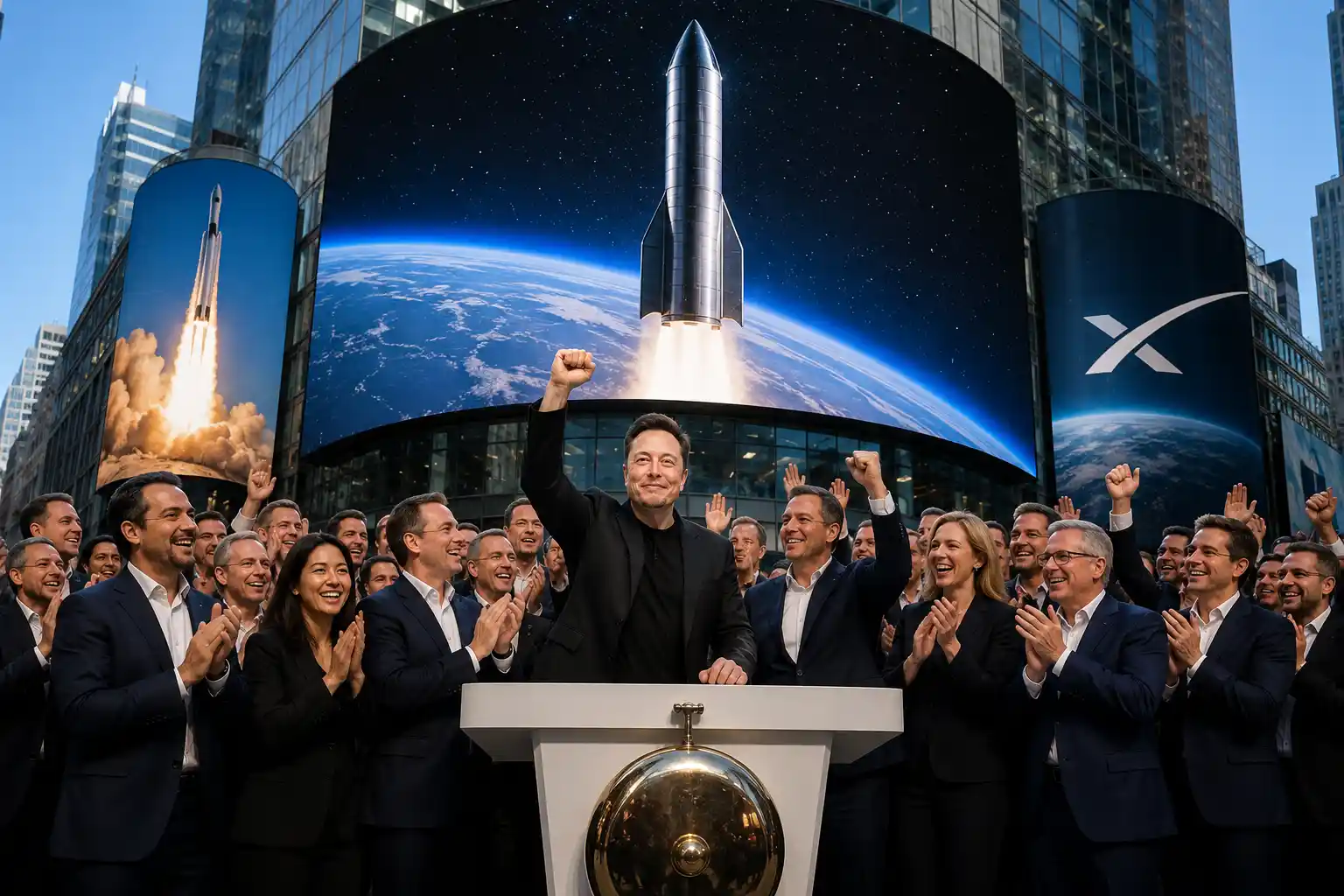
The SpaceX IPO has become one of the defining financial stories of 2026 because investors increasingly view Elon Musk’s space empire as more than a launch company. Instead, markets are treating SpaceX as a platform business spanning rockets, satellite communications, digital infrastructure, defense applications, and future space commercialization.
That shift explains why anticipation has expanded far beyond traditional equity markets. Institutional investors, sovereign wealth funds, venture capital firms, and retail traders have all positioned themselves around the possibility that SpaceX represents the next generation of infrastructure ownership.
The scale of the discussion reflects broader Wall Street IPO trends 2026 has accelerated: mega-unicorn listings, frontier technology investing, and renewed enthusiasm for companies that promise to reshape entire industries rather than simply capture market share.
At the center of the conversation sits an extraordinary SpaceX valuation story. Years of private capital accumulation, rapid technological execution, and vertical integration transformed the company into one of the most closely watched private space company investment opportunities in modern history.
Moreover, the expansion of the space economy has changed investor expectations. Space is no longer viewed as a government-funded scientific frontier. It increasingly resembles a commercial ecosystem with launch services, orbital infrastructure, communications networks, and long-duration economic activity.
Why the SpaceX IPO Is One of the Most Anticipated in Market History?
Few listings have generated comparable anticipation because few companies entered public markets with such scale and narrative power.
Investor interest developed across multiple dimensions.
- Massive private valuation expansion
- Limited historical access to private shares
- Strong liquidity demand
- Elon Musk’s capital allocation reputation
- Exposure to space economy growth
However, enthusiasm extends beyond scarcity.
SpaceX spent years operating with private-market flexibility while scaling into industries traditionally dominated by governments and defense contractors. Consequently, investors built expectations around a company that appeared to compress decades of aerospace development into a much shorter innovation cycle.
Elon Musk SpaceX strategy also contributed to the timing discussion. Unlike traditional IPO preparation, SpaceX historically relied on private funding rounds and secondary transactions. That approach preserved operational control while allowing valuation growth to compound outside public markets.
Meanwhile, public investors increasingly searched for exposure to long-duration infrastructure themes after the AI expansion cycle concentrated capital into fewer companies.
Supporters argue markets are rewarding strategic dominance.
Skeptics argue investors are pricing decades of future execution into present-day expectations.
That tension has become one of the defining characteristics of the SpaceX investment debate.
SpaceX Business Model: Rockets, Satellites, and Starlink
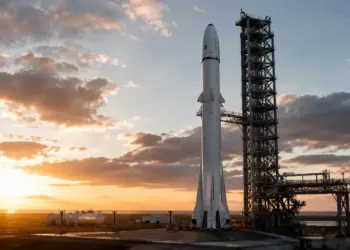
SpaceX is unusual because it combines manufacturing, launch services, communications, and long-term infrastructure development into a single operating system.
Falcon launch vehicles created the original foundation.
Reusable rockets dramatically altered rocket launch economics by reducing hardware replacement costs and increasing launch frequency. As a result, SpaceX shifted launch from a customized aerospace event toward a repeatable industrial process.
Yet launches increasingly appear to be only one layer.
Starlink introduced recurring revenue at global scale.
Instead of depending entirely on launch contracts, SpaceX built a subscription-based satellite network capable of generating predictable cash flows across households, enterprises, mobility markets, and government clients.
Key business pillars include:
- Launch services and reusable rockets
- Starlink connectivity subscriptions
- Government and defense contracts
- Deep-space commercialization initiatives
- Future orbital infrastructure opportunities
Additionally, public-sector relationships expanded revenue diversification. NASA programs and defense-related demand reinforced credibility while reducing dependence on purely commercial launch cycles.
Then comes the SpaceX Starship program.
Starship represents the company’s highest-risk and potentially highest-upside initiative. If operational economics improve meaningfully, transportation costs to orbit could decline again and unlock manufacturing, logistics, communications, and future off-world economic activity.
Therefore, investors increasingly evaluate SpaceX less like an aerospace manufacturer and more like a layered infrastructure platform.
How SpaceX Compares to Traditional Aerospace Giants?
Traditional aerospace firms historically optimized around reliability, procurement cycles, and long-term contracts.
SpaceX prioritized iteration speed.
That distinction changed competitive dynamics.
| Company | Core Strength | Innovation Level | Market Position |
|---|---|---|---|
| SpaceX | Reusable launches, satellite networks | Very High | Commercial space leader |
| Boeing | Aerospace manufacturing | Moderate | Legacy industrial scale |
| Lockheed Martin | Defense systems | High | Government-focused |
| Northrop Grumman | Strategic defense technologies | High | Defense and aerospace |
Unlike established aerospace firms, SpaceX reinvested aggressively into launch cadence and internal manufacturing.
For example:
- Faster development cycles
- Higher launch frequency
- Vertical integration
- Greater software integration
- Recurring communications revenue
In contrast, legacy aerospace players remain deeply embedded in government procurement structures.
That does not automatically mean incumbents lose.
However, aerospace market disruption increasingly rewards companies capable of lowering costs while expanding total market demand.
This comparison helps explain why investors often compare SpaceX with platform technology companies rather than pure aerospace peers.
Investor Frenzy Around SpaceX Private Markets
Before broad public access, SpaceX developed one of the most active secondary ecosystems in private markets.
Institutional demand created persistent premiums.
Secondary trading became attractive because direct allocation remained constrained.
Major themes driving private market activity included:
- Venture capital exposure scarcity
- Secondary share premiums
- Long-duration infrastructure demand
- Sovereign wealth fund positioning
- Liquidity event expectations
Meanwhile, sovereign capital became increasingly interested in strategic infrastructure assets that combined communications, transportation, and industrial capability.
Private market unicorn IPO discussions often center on liquidity.
SpaceX created something different.
Investors pursued access not simply for near-term gains but because ownership represented participation in a potentially foundational economic platform.
Nevertheless, limited liquidity historically amplified valuation uncertainty.
IPO Timing: When Could SpaceX Go Public?
IPO timing became one of the most debated questions surrounding SpaceX.
Market conditions matter.
Capital markets typically reward growth narratives during periods of strong liquidity and elevated risk appetite.
Several factors influence timing.
| Factor | Bull Case | Bear Case |
| Market sentiment | Strong demand | Volatility |
| Starlink performance | Revenue expansion | Growth slowdown |
| Starship progress | Commercial breakthrough | Delays |
| Macro conditions | Lower rates | Risk repricing |
| Regulation | Stable environment | Operational limits |
Starlink IPO speculation added another layer.
Some investors expected a separate listing to unlock value. Others argued keeping Starlink integrated preserves strategic advantages across launches and network deployment.
Additionally, Musk’s historical approach favors retaining operational flexibility for as long as possible.
Therefore, timing has always been less about market windows and more about strategic readiness.
SpaceX IPO vs Historic Tech IPOs
History provides useful comparisons.
Tesla IPO
Investor sentiment initially focused on skepticism rather than dominance.
Market disruption emerged slowly before accelerating into a category-defining transformation.
Meta (Facebook) IPO
Execution concerns shaped early trading.
However, long-term monetization eventually redefined valuation expectations.
Google IPO
Google introduced a new model of scalable digital infrastructure and reshaped public market thinking.
Airbnb IPO
Airbnb demonstrated how platform economics can convert physical assets into digital networks.
Comparison themes:
- Disruption intensity
- Investor confidence
- Valuation expansion
- Long-term capital creation
The SpaceX IPO differs because it combines industrial assets with software economics and infrastructure characteristics.
Consequently, investors view it as a hybrid between aerospace, telecom, and frontier technology.
Risks and Challenges Facing SpaceX
Despite enthusiasm, risks remain substantial.
Launch economics remain capital intensive.
Major challenges include:
- Launch failures
- Regulatory oversight
- Capital requirements
- Competitive pressure
- Geopolitical exposure
Moreover, commercialization timelines may stretch longer than markets expect.
Starship execution carries technical uncertainty.
Satellite networks require sustained investment.
Meanwhile, competition across launch services and communications continues to intensify.
On the other hand, high expectations themselves may become a risk factor if valuation assumptions move faster than operational performance.
That reality explains why institutional investors increasingly focus on scenario analysis rather than narrative alone.
The Future of the Space Economy
Space economy growth increasingly appears tied to infrastructure rather than exploration.
Satellite internet expansion already demonstrates this shift.
Future growth vectors may include:
- Global broadband coverage
- Defense connectivity
- Orbital logistics
- Commercial manufacturing
- Data and communications infrastructure
Mars colonization narratives often attract headlines.
However, nearer-term economics likely emerge from connectivity and industrial capability.
Additionally, governments increasingly rely on private operators for mission execution.
As a result, private markets may become the primary funding mechanism for future space development.
Unique Insight: The Financialization of Space
The most important takeaway may be that this moment extends beyond a single listing. The SpaceX IPO represents the financialization of space itself. Infrastructure that once belonged primarily to governments increasingly moves into private capital markets. That transition changes investment frameworks. Space becomes an investable asset class. Starlink evolves into foundational digital infrastructure. Launch systems become industrial utilities.
Meanwhile, orbital economies begin attracting long-duration capital. SpaceX may ultimately serve as the bridge connecting Earth-based capital formation with future off-world economic activity. If that transition accelerates, investors will no longer ask whether space belongs in portfolios. They will ask what percentage belongs there.
Conclusion
The SpaceX IPO has captured Wall Street because it combines scarcity, scale, technological ambition, and infrastructure economics in a way few companies ever have.
Whether investors view SpaceX as an aerospace leader, communications platform, or future industrial backbone, the debate extends beyond a conventional listing.
This moment reflects broader shifts in capital markets toward frontier technologies, mega-unicorn liquidity events, and the belief that the next generation of value creation may occur above Earth rather than only on it.
Frequently Asked Questions
Why is the SpaceX IPO attracting so much investor attention?
Investors view SpaceX as more than a rocket company. Its combination of launch services, satellite internet, and long-term infrastructure ambitions has created exceptional market interest.
What is the current SpaceX valuation?
SpaceX valuation estimates have expanded significantly through private funding rounds and secondary markets, making it one of the most valuable private companies in history.
Why has Elon Musk delayed taking SpaceX public?
Elon Musk historically preferred private funding to maintain strategic flexibility, reduce public market pressure, and focus on long-term execution.
Will Starlink have a separate IPO?
Starlink IPO speculation continues because investors see the satellite business as a high-growth recurring revenue platform, although no separate listing strategy is guaranteed.
Why is the SpaceX IPO important for Wall Street?
The SpaceX IPO reflects broader Wall Street IPO trends 2026 has accelerated, including mega-unicorn liquidity events and investor demand for frontier technologies.
How does SpaceX make money?
SpaceX generates revenue through launch services, Starlink subscriptions, government contracts, and emerging commercial space opportunities.
Is SpaceX considered a good long-term investment?
Supporters see long-term upside from space economy growth, while critics point to valuation risk and execution challenges.
How does SpaceX compare with traditional aerospace companies?
SpaceX competes through reusable rockets, faster innovation cycles, and integrated satellite infrastructure rather than conventional defense-driven models.
When could the SpaceX IPO happen?
IPO timing depends on market conditions, operational milestones, and Elon Musk’s broader capital strategy.
What makes the SpaceX IPO different from other tech IPOs?
Unlike typical listings, the SpaceX IPO combines aerospace, communications, infrastructure, and frontier technology into a single investment narrative.