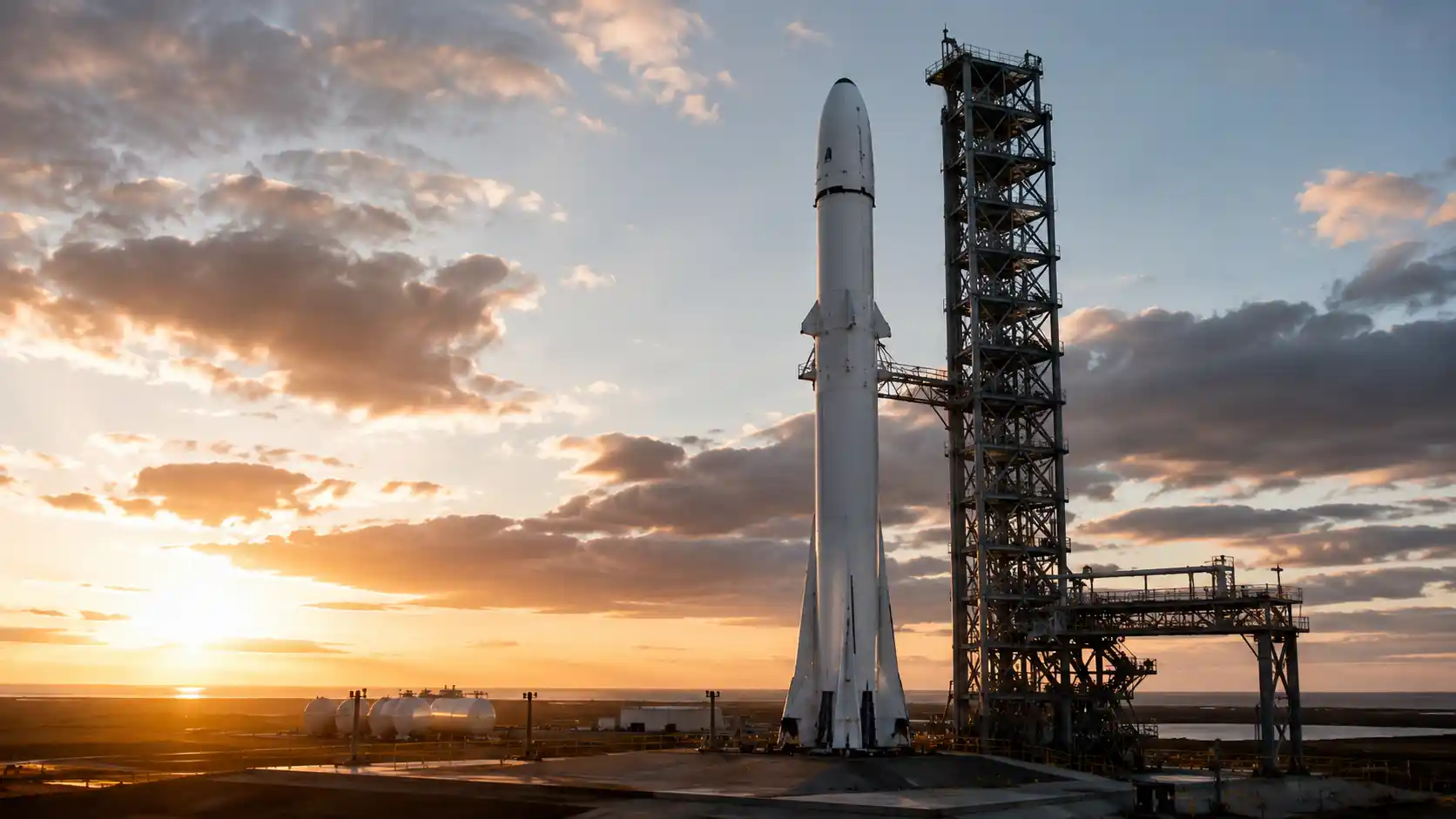
The rise of New Glenn marks a pivotal moment in the evolution of modern launch systems, as demand for heavy-lift capability continues to accelerate across the global space economy. New Glenn sits at the center of Blue Origin’s long-term strategy, designed as a next-generation heavy-lift rocket built to support the expanding needs of commercial spaceflight, national security missions, and deep-space exploration. In an era where reusable architecture and scalable launch systems define competitiveness, Blue Origin New Glenn represents the company’s most ambitious step toward becoming a full-scale orbital launch provider.
As satellite constellations expand, lunar programs mature, and defense agencies increase orbital deployments, the demand for reliable space launch systems has never been higher. Blue Origin’s entry into this segment signals a direct challenge to established providers and emerging disruptors alike. At its core, New Glenn is more than just a reusable rocket it is a strategic platform intended to reshape how payloads reach orbit and beyond.
What makes New Glenn especially significant is not only its size or power, but its role in redefining access to space. By combining high payload capacity with reusability and long-term infrastructure thinking, Blue Origin aims to position itself at the center of the next phase of the space industry, where flexibility, cost efficiency, and mission diversity determine leadership.
The Vision Behind New Glenn
The origins of New Glenn trace back to Blue Origin’s broader philosophy: build infrastructure that enables sustained human and commercial activity in space. Unlike incremental launch programs, New Glenn was conceived as a foundational orbital launch vehicle capable of serving multiple markets simultaneously.
Jeff Bezos and Blue Origin leadership envisioned a rocket that could bridge today’s commercial satellite economy with tomorrow’s lunar and deep-space infrastructure. As a result, New Glenn is designed not just for payload delivery, but for long-term scalability across missions that include government contracts, commercial constellations, and interplanetary logistics.
This vision aligns closely with NASA’s growing reliance on commercial partners and the U.S. Space Force’s increasing demand for assured access to orbit. In this context, New Glenn becomes a strategic asset rather than just a transportation system.
Ultimately, the vision behind New Glenn reflects Blue Origin’s belief that heavy-lift capability will define the next phase of future of space exploration, where reusable systems unlock sustained economic activity beyond Earth.
Engineering and Design of Blue Origin’s Heavy-Lift Rocket
At a technical level, New Glenn is engineered as a two-stage heavy-lift launch system with a strong emphasis on reusability and performance scalability. The first stage is designed for multiple re-flights, a core requirement for reducing long-term launch costs in the modern space industry.
The rocket is powered by BE-4 engines, which use liquid natural gas and liquid oxygen—a combination that provides both high thrust and cleaner combustion compared to older kerosene-based systems. These engines represent a critical advancement in Blue Origin rocket technology and also support ULA’s Vulcan Centaur program, demonstrating cross-industry relevance.
Key engineering characteristics include:
- Reusable first-stage booster designed for vertical landing recovery
- BE-4 methane-based propulsion system for high-efficiency thrust
- Large payload fairing optimized for commercial satellite deployment
- Modular second-stage architecture for mission flexibility
- Advanced avionics for precision orbital insertion
Together, these systems allow New Glenn to balance raw power with operational efficiency. Unlike many legacy rockets, it is built from the ground up to support repeated launches, aligning with the broader shift toward reusable launch systems.
As development progresses, New Glenn continues to position itself as one of the most technically ambitious vehicles in modern aerospace engineering.
Launch Capabilities, Missions, and Commercial Applications
New Glenn is designed to serve a wide range of mission profiles, from commercial satellite deployment to national security payloads and deep-space exploration support. Its heavy-lift capacity enables it to carry large satellite clusters or single high-mass payloads directly into orbit, reducing the need for complex multi-launch architectures.
Its expected mission applications include:
- Deployment of large commercial satellite constellations
- U.S. government and Space Force payloads
- Lunar cargo and infrastructure support missions
- Deep-space scientific and exploration spacecraft
- Potential human-rated cargo support systems in the future
This versatility places New Glenn in direct competition with other major space launch systems, particularly in the medium-to-heavy payload segment. Its ability to serve both commercial and government customers is a key factor in Blue Origin’s long-term revenue strategy.
By targeting diverse markets simultaneously, New Glenn strengthens Blue Origin’s position in the evolving commercial spaceflight economy, where flexibility increasingly determines launch provider success.
New Glenn Feature Breakdown
| New Glenn Feature | Capability | Mission Benefit |
|---|---|---|
| Reusable First Stage | Vertical landing recovery system | Reduces launch cost and increases flight frequency |
| BE-4 Engines | High-thrust methane/oxygen propulsion | Improved efficiency and cleaner combustion |
| Heavy Payload Capacity | Multi-ton orbital delivery capability | Supports large satellites and deep-space missions |
| Modular Upper Stage | Configurable mission architecture | Enables diverse orbital and interplanetary missions |
| Large Payload Fairing | Expanded volume for spacecraft | Accommodates next-generation satellite systems |
This combination of engineering features demonstrates how New Glenn is built not just for performance, but for adaptability across evolving commercial and government requirements.
How New Glenn Competes in the Global Launch Market?
In the global launch ecosystem, New Glenn enters a highly competitive environment shaped by rapid innovation and aggressive scaling. Its primary competition comes from SpaceX, United Launch Alliance, and Europe’s Arianespace, each of which occupies distinct segments of the launch market.
However, New Glenn distinguishes itself by focusing on heavy-lift reusability combined with long-term infrastructure planning. While some competitors prioritize rapid iteration or fully reusable systems, Blue Origin’s strategy centers on reliability and gradual operational maturity.
In commercial terms, New Glenn targets customers seeking large payload capacity without the complexity of fully experimental systems. This positions it as a middle-ground solution between traditional expendable rockets and next-generation fully reusable vehicles.
Its competitiveness is strengthened by growing demand in:
- Satellite mega-constellations
- National security space assets
- Lunar logistics programs
- Deep-space scientific missions
As demand expands, New Glenn is expected to play a significant role in balancing capacity constraints across the global launch market.
New Glenn vs. Falcon Heavy, Starship, Vulcan, and Ariane 6
The introduction of New Glenn inevitably invites comparison with other major launch systems. Each rocket serves a different strategic and technical purpose, shaping how they compete in the evolving space economy.
Comparative Launch Vehicle Analysis
| Launch Vehicle | Primary Strength | Best Suited For |
|---|---|---|
| New Glenn | Heavy-lift reusable architecture | Large commercial and government payloads |
| SpaceX Falcon Heavy | Proven high-lift performance | Deep-space missions and large satellites |
| SpaceX Starship | Full reusability and extreme payload capacity | Mars missions and mega-constellations |
| ULA Vulcan Centaur | Reliability and national security focus | Defense and critical government missions |
| Ariane 6 | European institutional launch capability | ESA missions and commercial European payloads |