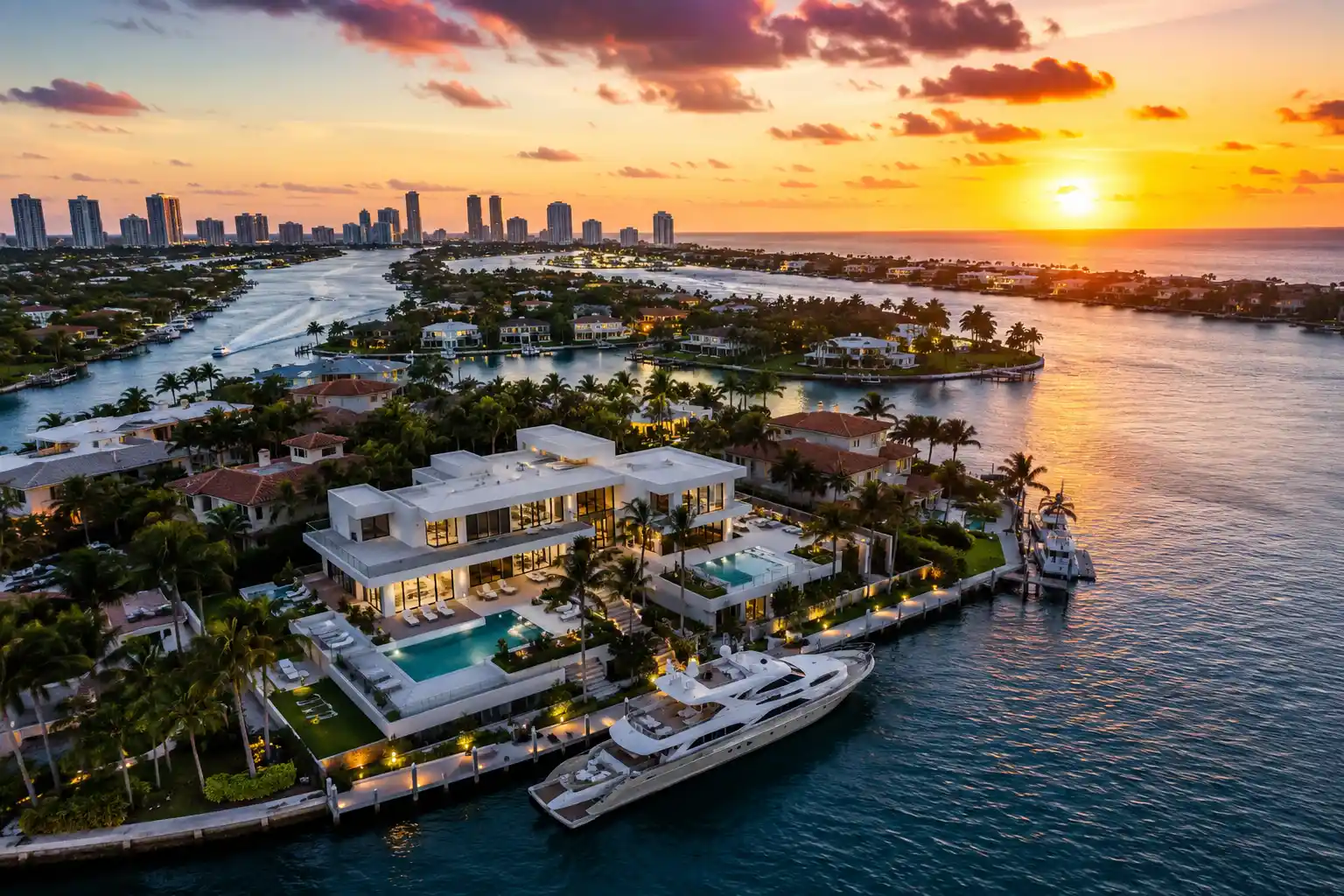
Miami luxury real estate has evolved far beyond a regional housing market it has become one of the world’s most closely watched destinations for global wealth. Over the past decade, South Florida has transformed into a magnet for billionaires, hedge fund founders, entrepreneurs, family offices, and international investors seeking more than spectacular waterfront homes. They are investing in a lifestyle, a tax-efficient environment, and a long-term store of wealth that combines architectural excellence with exceptional scarcity.
At the same time, neighboring West Palm Beach has emerged from Miami’s shadow to establish itself as a sophisticated financial and residential hub. Once known primarily for seasonal luxury living, the city now attracts major investment firms, private wealth managers, and technology entrepreneurs who increasingly view South Florida as an attractive alternative to traditional financial centers such as New York and San Francisco.
This shift reflects broader structural changes in global wealth migration. High-net-worth individuals increasingly prioritize jurisdictions that offer lifestyle advantages alongside financial flexibility, political stability, and resilient investment opportunities. Limited oceanfront land, iconic architecture, branded residences, and evolving urban infrastructure have combined to elevate South Florida into one of the world’s premier destinations for Miami luxury real estate.
Rather than representing isolated luxury neighborhoods, Miami Beach, Fisher Island, Indian Creek, Palm Beach, and West Palm Beach now form an interconnected network of elite coastal communities. Together, these enclaves create what can be described as the “Billionaires’ Triangle” a geography where capital, architecture, privacy, and legacy investments converge to redefine trophy real estate for a new generation of global wealth.
The Rise of the Billionaires’ Triangle
Luxury property markets rarely emerge overnight. They develop through a combination of economic opportunity, limited supply, institutional investment, and cultural prestige. South Florida’s evolution into one of the world’s leading destinations for billionaire real estate reflects each of these forces operating simultaneously.
At the heart of this transformation lies the concept of the Billionaires’ Triangle a collection of interconnected coastal enclaves stretching from Miami Beach through Fisher Island and Indian Creek before extending north to Palm Beach and West Palm Beach. While each location possesses a distinct identity, they share defining characteristics that appeal to ultra-high-net-worth individuals (UHNWIs): exceptional privacy, direct waterfront access, world-class architecture, and enduring global recognition.
Miami Beach, Fisher Island, and Indian Creek
Miami Beach remains the region’s international gateway. Its blend of luxury condominiums, waterfront mansions, cultural institutions, and hospitality brands continues to attract entrepreneurs, entertainers, and global executives seeking vibrant urban living alongside premium coastal amenities.
Just offshore, Fisher Island represents exclusivity on another level. Accessible primarily by private ferry or yacht, the island offers residents unparalleled privacy, private beaches, championship golf, and an environment intentionally designed to minimize public access. For many affluent buyers, exclusivity itself has become one of the property’s greatest assets.
Indian Creek often referred to as the “Billionaire Bunker” has become synonymous with discretion. Home to a small collection of expansive estates surrounded by water and protected by dedicated security, it illustrates how privacy has become an increasingly valuable component of trophy real estate.
Palm Beach and West Palm Beach’s Evolution
Further north, Palm Beach continues to symbolize established luxury. Historic estates, oceanfront residences, prestigious clubs, and generations of family wealth have preserved its reputation as one of America’s premier luxury destinations. Yet the neighboring city of West Palm Beach is rapidly redefining its own identity.
Major financial firms, investment managers, and family offices have expanded operations into West Palm Beach, creating a dynamic ecosystem that blends business opportunity with luxury coastal living. New mixed-use developments, premium office towers, cultural institutions, and luxury hospitality projects continue reshaping the city’s economic landscape.
Rather than competing against one another, these communities reinforce their collective appeal. Wealth migration between them strengthens South Florida’s broader luxury ecosystem, encouraging continued investment in infrastructure, architecture, and lifestyle amenities.
This interconnected geography has elevated the region from a collection of affluent neighborhoods into one of the world’s most influential centers for luxury real estate investment.
What Defines Trophy Real Estate in South Florida?
Not every expensive property qualifies as trophy real estate. True trophy assets possess characteristics that remain difficult or impossible to replicate.
Scarcity is perhaps the most important factor. Oceanfront land in South Florida is inherently limited. As developable waterfront parcels become increasingly rare, existing estates command substantial premiums because supply cannot expand to meet growing demand.
Architecture also distinguishes the market. Leading architects increasingly view South Florida as a laboratory for contemporary luxury design, producing residences that combine expansive glass façades, indoor-outdoor living spaces, private wellness facilities, and advanced environmental engineering. These homes are designed not simply as residences but as enduring architectural statements.
Another defining characteristic is customization. Many affluent buyers commission bespoke residences tailored to their lifestyles, incorporating private marinas, wine galleries, art exhibition spaces, wellness pavilions, recording studios, and sophisticated security systems. Such personalization transforms properties into highly individual legacy assets rather than standardized luxury homes.
The rapid growth of branded residences has further elevated the market. Luxury hospitality brands have partnered with renowned developers to create residential towers that combine hotel-style services with private ownership, offering concierge programs, wellness amenities, fine dining, and curated lifestyle experiences that appeal to globally mobile buyers.
Privacy has also become increasingly valuable. Gated communities, controlled access, expansive setbacks, and integrated security technologies provide the discretion many high-profile residents seek. In today’s luxury market, exclusivity often carries as much value as architectural design.
Finally, record-breaking transactions reinforce market confidence. High-profile sales establish new pricing benchmarks while signaling continued international demand for South Florida’s oceanfront estates and ultra luxury homes. Although individual transactions attract headlines, they also reflect broader structural trends, including global wealth creation, limited inventory, and sustained investor confidence.
Leading Luxury Enclaves in South Florida
| Luxury Enclave | Signature Appeal | Buyer Profile |
|---|---|---|
| Miami Beach | Iconic waterfront living, luxury towers, vibrant culture | Entrepreneurs, international investors, executives |
| Fisher Island | Private island exclusivity with resort amenities | Billionaires, family offices, global elites |
| Indian Creek | Exceptional privacy, security, expansive estates | Ultra-high-net-worth individuals seeking discretion |
| Palm Beach | Historic estates, oceanfront prestige, established legacy | Multi-generational wealth, philanthropists, financiers |
| West Palm Beach | Financial hub, luxury developments, emerging prestige | Hedge fund executives, technology founders, private investors |
As buyer expectations continue to evolve, the definition of luxury has expanded beyond square footage and prime locations. Today’s purchasers increasingly evaluate properties through the lens of lifestyle flexibility, technological innovation, wellness integration, and long-term resilience. These changing priorities help explain why South Florida’s luxury market continues attracting both established wealth and a new generation of globally mobile investors.
Why Billionaires Continue Choosing Miami and West Palm Beach?
The sustained demand for Miami luxury real estate reflects far more than favorable weather or picturesque coastlines. Economic policy, financial migration, institutional investment, and evolving lifestyle preferences have combined to create one of the world’s most compelling destinations for wealth preservation and luxury living.
Tax Advantages and Wealth Migration
One of the strongest catalysts has been Florida’s tax environment. The absence of a state income tax, combined with comparatively business-friendly regulations, has encouraged entrepreneurs, hedge fund managers, and investment professionals to relocate significant portions of their personal and professional operations to South Florida. This migration has, in turn, accelerated demand for waterfront mansions, Palm Beach luxury homes, and other premium residential assets.
Beyond tax advantages, South Florida has experienced remarkable growth in its financial ecosystem. In recent years, hedge funds, private equity firms, venture capital groups, and family offices have expanded their presence in Miami and West Palm Beach, creating a business environment that increasingly rivals established financial centers. Rather than commuting between global cities, many executives now choose to live and work in the same coastal communities, reinforcing long-term residential demand.
International capital has also remained an important driver of the South Florida luxury market. Investors from Latin America, Europe, the Middle East, and Canada often view premium Florida real estate as a relatively stable asset within diversified global portfolios. Political uncertainty, currency volatility, and economic instability in other regions have further strengthened the appeal of U.S. luxury property ownership.
Lifestyle, Infrastructure, and Long-Term Investment Appeal
Lifestyle continues to differentiate the region as well. Michelin-starred restaurants, private yacht clubs, championship golf courses, luxury retail, cultural institutions, and year-round outdoor recreation create an environment where business, leisure, and family life intersect. Increasingly, affluent buyers are purchasing homes not only for seasonal use but also as permanent residences designed around wellness, flexibility, and multigenerational living.
Infrastructure investment has reinforced these trends. Modern airports, expanding private aviation facilities, upgraded marinas, luxury hotels, and mixed-use developments continue improving connectivity while supporting South Florida’s reputation as an international business and lifestyle destination.
Collectively, these forces have elevated Miami luxury real estate beyond traditional residential investment. For many buyers, acquiring an oceanfront estate now represents a strategic allocation within a broader wealth preservation strategy rather than a discretionary lifestyle purchase alone.
The Challenges Behind South Florida’s Luxury Boom
While long-term fundamentals remain compelling, no luxury market is immune to structural challenges. South Florida’s continued success will depend on its ability to balance extraordinary demand with evolving environmental, financial, and regulatory realities.
Climate resilience has become one of the most significant considerations. Rising sea levels, stronger storm events, and coastal flooding have encouraged developers to incorporate advanced engineering, elevated construction techniques, improved drainage systems, and resilient building materials into new luxury projects. Increasingly, buyers evaluate resilience alongside architectural beauty.
Insurance costs have also become a growing factor in ownership decisions. Premium waterfront properties often require specialized insurance coverage, and rising premiums influence both operating costs and long-term investment calculations. Sophisticated buyers increasingly examine total ownership expenses rather than focusing solely on acquisition prices.
Supply constraints present another challenge. Limited oceanfront land remains one of South Florida’s greatest strengths, yet that same scarcity restricts future inventory. While constrained supply generally supports long-term pricing, it also intensifies competition for exceptional properties and raises development costs.
Sustainability expectations continue to evolve as well. Luxury buyers increasingly seek residences incorporating renewable energy systems, energy-efficient materials, smart water management, and environmentally responsible landscaping without compromising design or comfort.
Regulatory considerations may also influence future development. Building codes, environmental protections, zoning requirements, and coastal resilience initiatives will likely shape how the next generation of ultra luxury homes is designed and constructed.
Importantly, luxury markets remain cyclical. Periods of exceptional appreciation are often followed by phases of stabilization. However, markets supported by genuine scarcity, global demand, and diversified wealth creation historically demonstrate greater resilience than speculative real estate cycles.
Key Forces Shaping South Florida’s Trophy Real Estate Market
| Market Driver | Impact on Trophy Real Estate | Long-Term Outlook |
|---|---|---|
| Limited Oceanfront Supply | Supports long-term value through scarcity | Strong appreciation potential |
| Wealth Migration | Expands demand from UHNW buyers | Continued growth |
| Tax Advantages | Encourages executive and family office relocation | Positive, subject to policy changes |
| Climate Adaptation | Drives resilient construction and innovation | Increasing importance |
| Infrastructure Expansion | Enhances business and lifestyle appeal | Positive |
| Rising Insurance Costs | Increases ownership expenses | Ongoing challenge |
| Sustainability | Influences design and buyer preferences | Becoming a market standard |
These factors illustrate that South Florida’s luxury market is evolving through structural change rather than short-term speculation. Buyers increasingly view premium coastal property as a long-duration asset shaped by economic fundamentals, demographic shifts, and lifestyle priorities.
The Future of Trophy Real Estate Along Florida’s Coast
The next chapter of Miami luxury real estate will likely be defined by innovation rather than simply rising prices.
Architects are designing residences that seamlessly integrate indoor and outdoor living while maximizing natural light, privacy, and environmental resilience. Wellness spaces including private spas, fitness pavilions, meditation gardens, and medical-grade air filtration systems are becoming expected features rather than optional amenities.
Artificial intelligence and smart home technology are also reshaping luxury living. Intelligent energy management, predictive maintenance, biometric security, automated lighting, climate optimization, and integrated concierge systems are transforming residences into highly responsive environments tailored to their owners’ lifestyles.
Branded residences are expected to remain a major growth segment as globally recognized hospitality companies expand luxury residential offerings that combine private ownership with curated services.
West Palm Beach appears particularly well positioned for continued expansion. As financial firms, technology companies, and wealth management organizations deepen their presence, demand for premium residential communities may continue diversifying beyond traditional seasonal buyers.
At the same time, international wealth migration is unlikely to disappear. Families seeking political stability, high-quality infrastructure, lifestyle advantages, and sophisticated financial ecosystems continue viewing South Florida as an attractive long-term destination.
Future appreciation will likely depend less on speculation and more on enduring fundamentals: limited supply, exceptional design, resilient construction, and sustained global demand for irreplaceable waterfront locations.
The Bigger Picture
The next era of Miami luxury real estate will not be defined only by record-breaking sales or headline-grabbing mansions. Instead, it will be shaped by architecture, smart wealth planning, climate resilience, and lifestyle design working together.
The emerging Billionaires’ Triangle reflects a broader shift in global wealth. Today, affluent buyers see luxury homes as legacy assets rather than simple status symbols. These properties help preserve wealth while supporting family life, business mobility, privacy, and long-term security. Moreover, oceanfront estates now combine emotional appeal with strong financial value, making them attractive for long-term ownership.
Furthermore, this evolution sets South Florida apart from many traditional luxury markets. The region continues to attract capital because of its favorable tax environment, innovative architecture, expanding financial sector, and world-class lifestyle. As a result, more family offices and global investors are establishing a lasting presence across Miami and Palm Beach. Looking ahead, these connected coastal enclaves could become a global model for the future of luxury real estate.
Conclusion
Miami luxury real estate continues to redefine the global standard for trophy residential property. Together, Miami Beach, Fisher Island, Indian Creek, Palm Beach, and West Palm Beach form an interconnected network built on limited oceanfront land, outstanding architecture, and sustained wealth migration.
Although challenges such as climate resilience, insurance costs, and market cycles deserve careful attention, the region’s long-term outlook remains strong. Furthermore, exceptional scarcity, continued international investment, expanding financial hubs, and world-class design continue to support demand for trophy real estate, oceanfront estates, and luxury real estate investment.
Ultimately, the Billionaires’ Triangle represents much more than a collection of prestigious addresses. It reflects a new geography of global wealth, where privacy, resilience, architecture, and long-term value increasingly guide investment decisions. Therefore, South Florida is likely to remain one of the world’s most influential and closely watched luxury property markets for years to come.
Frequently Asked Questions
What is trophy real estate?
Trophy real estate refers to rare, high-value properties in exceptional locations. These homes stand out for their architecture, exclusivity, privacy, and long-term investment appeal.
Why is Miami luxury real estate attracting billionaires?
Miami luxury real estate attracts billionaires because it offers tax advantages, limited waterfront inventory, global connectivity, a luxury lifestyle, and a growing financial sector. In addition, many buyers see South Florida as a stable place to preserve wealth over the long term.
What is the Billionaires’ Triangle in South Florida?
The Billionaires’ Triangle describes the connected luxury enclaves of Miami Beach, Fisher Island, Indian Creek, Palm Beach, and West Palm Beach. Together, these communities attract many of the world’s wealthiest individuals seeking privacy, security, and premium waterfront living.
Why is West Palm Beach becoming a luxury hotspot?
West Palm Beach has attracted hedge funds, private equity firms, family offices, and technology entrepreneurs. At the same time, the city continues investing in infrastructure, luxury developments, and cultural attractions, making it increasingly attractive to affluent buyers.
What makes oceanfront estates so valuable?
Oceanfront estates are valuable because waterfront land is limited. Additionally, these homes offer privacy, direct water access, exceptional views, architectural quality, and lasting demand from high-net-worth buyers.
How do tax advantages influence luxury home purchases?
Florida does not levy a state income tax. As a result, many high-net-worth individuals find luxury home ownership more financially efficient while supporting broader wealth management strategies.
What risks face South Florida’s luxury property market?
The primary risks include climate change, rising insurance costs, construction expenses, evolving regulations, and periodic luxury market cycles. However, many developers continue investing in resilient design and sustainable construction.
Are trophy homes a good long-term investment?
No investment guarantees returns. However, trophy homes in exceptional locations have historically retained value because of their scarcity, architectural quality, and continued demand from affluent buyers.
How is architecture shaping luxury real estate?
Modern luxury architecture emphasizes sustainability, wellness, smart technology, indoor-outdoor living, resilience, and bespoke design to meet evolving buyer expectations.
What trends will define Miami luxury real estate over the next decade?
Future trends include climate-resilient construction, AI-powered smart homes, branded residences, wellness-focused design, continued wealth migration, and growing demand for legacy-quality waterfront assets.