What luxury buyers actually walk away from
In a 2024 survey of approximately 300 Redfin Premier agents — real estate professionals who specialize exclusively in high-end transactions — more than half of luxury home buyers reported they would be unlikely to make an offer on a home with outdated kitchen and closet spaces. The finding places the walk-in closet in an unusual category: it is simultaneously one of the most practically used spaces in any home and one of the most decisive factors in a premium real estate transaction. For buyers at this level, a closet that feels like an afterthought signals something broader about the property — a lack of attention to the spaces that matter most in daily life.
Understanding what separates a high end closet system that commands this kind of buyer confidence from one that merely passes inspection is not primarily a question of size or configuration. It’s a question of execution quality — the precision of the details that are touched, seen, and felt every day. Ornare’s approach to luxury closet design starts from this principle: a closet is not a storage unit. It is a daily experience, and every element of that experience communicates quality or its absence.
Drawer systems: where quality is most immediately felt
The single most telling indicator of quality in any high end closet system is the performance of its drawer system. In a standard closet, drawers open with some resistance, may tilt slightly when extended to full depth, and produce a degree of noise and friction that is acceptable but always noticeable. In a premium system, every drawer — regardless of its size or the weight of its contents — opens with the same smooth, controlled motion, extending fully without tipping and closing with a soft, damped return that requires almost no effort.
This isn’t a subtle difference. It’s one of the most immediately perceptible quality markers in any residential millwork project, and it’s the detail that most reliably separates a closet that was built well from one that was built expensively. The mechanism is the message.
Door alignment: the standard that reveals construction quality
Stefan Schattan, CEO of Ornare, identifies alignment as one of the defining markers of genuine luxury: “The drawers have to glide perfectly, the door alignment has to stay exact, the handles have to feel right every single time. The lacquer can’t chip at the edges, the glass can’t have scratches or distortions. These aren’t elevated standards — they are simply the standard. That’s what it means to build at this level.”
The alignment of cabinet doors is one of the most reliable indicators of manufacturing quality in any luxury wardrobe. At installation, even a poorly made door can be adjusted to look acceptable. The test comes after months and years of use — when the doors have been opened and closed thousands of times, exposed to seasonal humidity fluctuations, and subjected to the normal settlement of the building structure. In a premium system, the doors maintain their alignment, and when minor adjustments are needed, the hinge hardware allows for precise multi-axis correction without removing the door or modifying the cabinet.
Hardware and finishes: the language every detail speaks
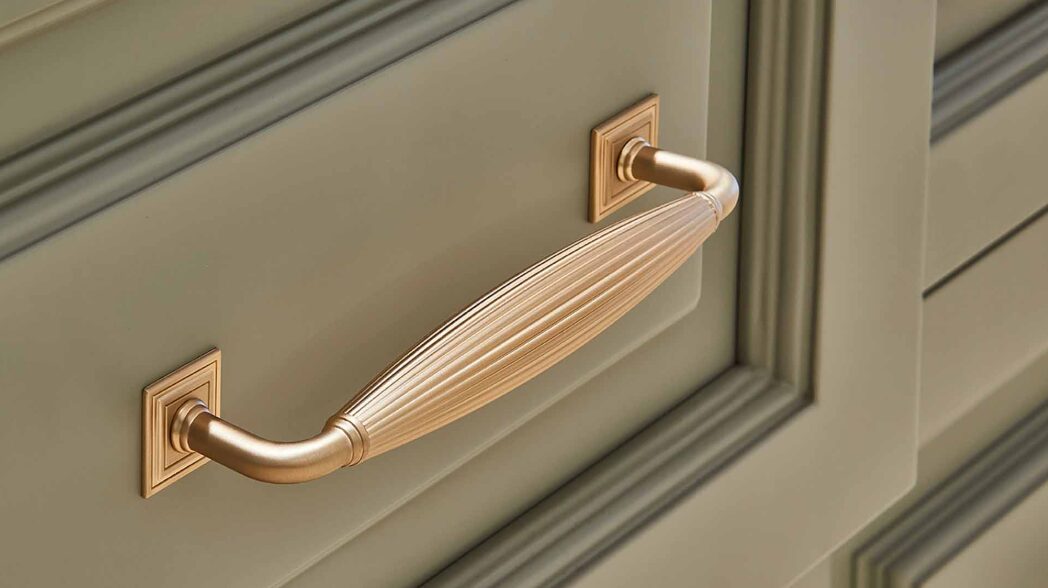
In luxury closet design, hardware is never an afterthought. The handle is the most frequently touched element — the point of daily physical contact that communicates quality more directly than any finish or material. A handle that feels solid, sits perfectly flush, and responds precisely to the hand is a pleasure to use. One that wobbles, has visible gaps at the fixing points, or feels hollow under pressure undermines the entire quality message of the closet, regardless of how good everything else is.
The same logic applies to every metal element: shelf edge profiles, rail brackets, lighting fixtures, door stops. In a coherent high end closet system, all of these elements share a common finish family — brushed brass, matte black, polished nickel — applied consistently throughout, so the closet reads as a unified design object rather than an assembly of separately specified components.