The debate around Rocket Lab vs Blue Origin reflects far more than a comparison between two ambitious aerospace companies. Within today’s rapidly expanding commercial spaceflight industry, these organizations represent fundamentally different strategies for building sustainable businesses in space. While Rocket Lab has concentrated on responsive launch services, spacecraft manufacturing, and end-to-end mission support, Blue Origin has invested heavily in reusable heavy-lift rockets, human spaceflight, and the infrastructure required for a long-term space economy.
As governments, defense agencies, and private enterprises increase their investment in space, the market has evolved well beyond simply launching rockets. Modern private space companies now compete across satellite deployment, spacecraft systems, lunar exploration, national security missions, and orbital services. Consequently, success depends not only on engineering excellence but also on developing resilient business models capable of generating recurring revenue across multiple markets.
Although both companies share the goal of expanding humanity’s presence beyond Earth, their methods differ significantly. Rocket Lab prioritizes operational efficiency, vertical integration, and frequent satellite launches for commercial and government customers. In contrast, Blue Origin pursues long-term infrastructure projects designed to support millions of people living and working in space, even if that vision requires decades of investment.
Understanding these contrasting approaches provides valuable insight into the broader transformation of the space industry. Rather than competing on identical objectives, Rocket Lab and Blue Origin illustrate how diverse business strategies can accelerate innovation, strengthen competition, and expand opportunities throughout the global space economy.
Blue Origin’s Long-Term Vision for Space Infrastructure
While Rocket Lab has built its business around operational efficiency and diversified aerospace services, Blue Origin has pursued a far more expansive vision centered on transforming humanity’s relationship with space. Its strategy extends beyond launching payloads and instead focuses on creating the infrastructure necessary for sustained economic activity beyond Earth.
The company’s philosophy is encapsulated in its long-standing objective of enabling millions of people to live and work in space. Rather than viewing rockets as standalone products, Blue Origin treats them as foundational transportation systems supporting a much larger ecosystem that includes commercial stations, lunar operations, advanced manufacturing, and deep-space logistics.
One of the company’s earliest achievements came through New Shepard, a fully reusable suborbital launch system designed for research payloads and human spaceflight. Although its missions last only minutes, New Shepard has demonstrated repeated booster and capsule reuse while advancing technologies critical for future reusable spacecraft.
Key features of New Shepard include:
- Fully reusable booster and crew capsule.
- Suborbital research missions.
- Commercial space tourism flights.
- Microgravity experiments.
- Reusable operational model.
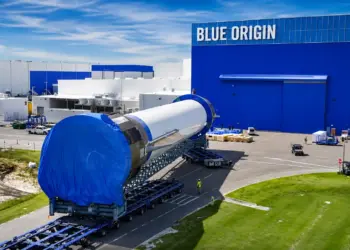
Blue Origin’s most ambitious launch vehicle, however, is New Glenn. Designed as a heavy-lift reusable rocket, New Glenn targets commercial satellite deployment, national security missions, deep-space exploration, and large-scale scientific payloads. Its reusable first stage reflects Blue Origin’s long-term commitment to lowering launch costs through repeated flight operations.
Unlike companies focused primarily on smaller payloads, Blue Origin intends to compete for missions requiring significantly greater lift capacity. These include deploying large satellite constellations, transporting lunar cargo, supporting government exploration programs, and serving future orbital infrastructure projects.
Blue Origin’s lunar ambitions further distinguish its long-term strategy. Through investments in lunar landers, cargo systems, and exploration technologies, the company seeks to become a major participant in the next phase of human exploration beyond low Earth orbit. These initiatives align closely with increasing public and private interest in establishing a sustainable presence on the Moon.
As these contrasting visions become increasingly clear, the next step is to compare how both companies translate their strategies into technology, launch capabilities, and competitive positioning within the evolving commercial space economy.
Rocket Lab vs. Blue Origin at a Glance
| Category | Rocket Lab | Blue Origin |
|---|---|---|
| Founding Vision | Affordable, responsive access to space | Long-term space infrastructure for millions of people |
| Founder | Peter Beck | Jeff Bezos |
| Primary Launch Vehicles | Electron, Neutron (in development) | New Shepard, New Glenn |
| Core Focus | Satellite launch services, spacecraft systems, end-to-end mission support | Human spaceflight, heavy-lift launches, lunar exploration |
| Primary Customers | Commercial satellite operators, defense agencies, government missions | NASA, commercial customers, national security, future lunar markets |
| Business Model | Diversified aerospace services with vertical integration | Infrastructure-led growth centered on reusable launch systems |
| Reusability Strategy | Partial reuse (Electron), full reuse planned for Neutron | Fully reusable systems as a core design philosophy |
| Long-Term Goal | End-to-end space services ecosystem | Build transportation and infrastructure for a permanent space economy |
Technology, Reusability, and Commercial Launch Capabilities
As the commercial space industry matures, technology and reusability have become defining competitive levers rather than optional innovations. In the case of Rocket Lab vs Blue Origin, both companies pursue reusable systems, but they approach engineering from opposite ends of the spectrum.
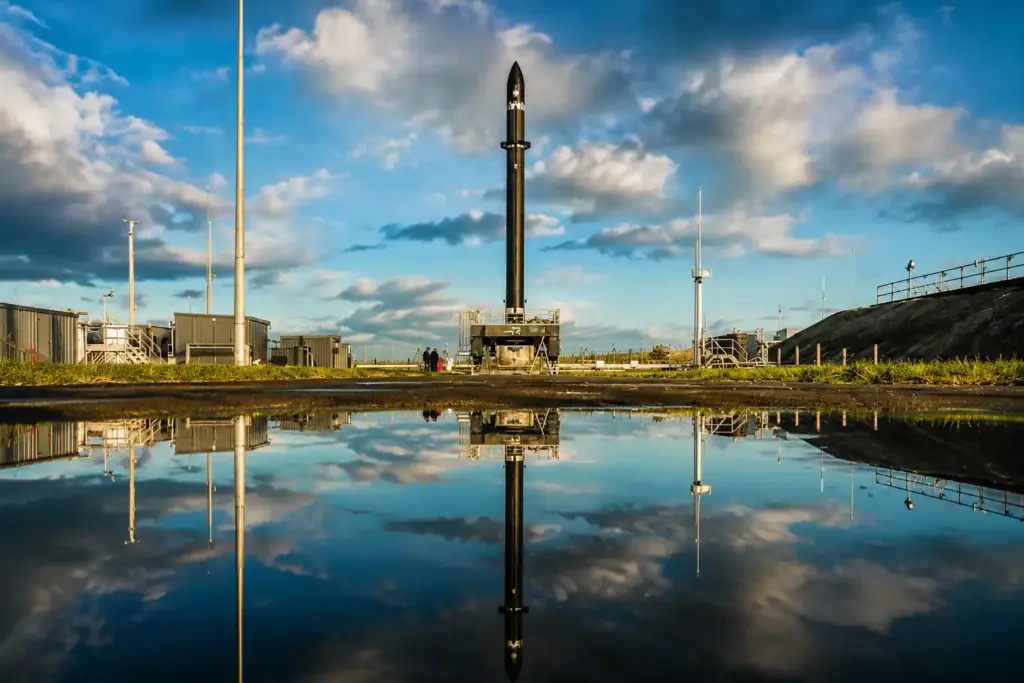
Rocket Lab has historically focused on precision, responsiveness, and mission frequency. Its Electron rocket introduced partial reuse through booster recovery, but the company’s broader strategy centers on maximizing launch cadence and reliability rather than pursuing full-scale heavy reuse at any cost. This pragmatic approach aligns with its customer base in satellite launch services, where timing and orbital accuracy often matter more than raw payload capacity.
By contrast, Blue Origin builds its entire architecture around full reusability. The company’s philosophy assumes that space transportation must eventually function like aviation—highly reusable, cost-efficient over time, and capable of frequent operations at scale. This is visible in both New Shepard and New Glenn, where reusable boosters are not experimental features but foundational design principles.
Technological priorities also diverge sharply. Rocket Lab invests heavily in spacecraft systems, software-defined satellites, and vertically integrated manufacturing. Meanwhile, Blue Origin prioritizes propulsion systems, heavy-lift structures, and long-duration infrastructure capable of supporting lunar and orbital ecosystems.
These differences highlight a broader truth: in modern space innovation, success is not defined by a single technological path but by how effectively technology aligns with business strategy.
Rocket Lab vs Blue Origin: Comparing Business Models and Market Positioning
The Rocket Lab vs Blue Origin comparison becomes most revealing when examined through their commercial positioning. Each company occupies a distinct segment of the space launch companies ecosystem, reducing direct competition while expanding the overall market.
Rocket Lab operates in the high-frequency, mid-to-small payload segment, where demand is driven by Earth observation satellites, defense constellations, and commercial communications networks. Its business model depends on rapid iteration, short launch cycles, and diversified aerospace services.
Blue Origin, however, targets a longer horizon. Its focus on heavy-lift capability and human spaceflight places it in markets tied to national space programs, lunar exploration, and next-generation orbital infrastructure.
Key strategic differences include:
- Rocket Lab emphasizes service frequency and mission flexibility.
- Blue Origin prioritizes scale, payload capacity, and long-term infrastructure.
- Rocket Lab monetizes across multiple aerospace verticals.
- Blue Origin invests heavily in capital-intensive future markets.
This divergence reduces direct overlap while positioning both companies to benefit from the same macro trend: expanding global demand for orbital access and space-based infrastructure.
Strategic Comparison of Advantages
| Strategic Area | Rocket Lab Advantage | Blue Origin Advantage |
|---|---|---|
| Market Speed | Rapid launch cadence and responsive scheduling | Long-term program stability and sustained funding |
| Technology Focus | Vertically integrated spacecraft + launch systems | Heavy-lift rockets and reusable propulsion systems |
| Customer Base | Commercial satellites, defense, scientific missions | NASA, lunar programs, future orbital infrastructure |
| Revenue Model | Diversified (launch, spacecraft, components, services) | Long-cycle infrastructure and government contracts |
| Scalability | Flexible small-to-medium payload scaling | Massive payload and deep-space scalability |
| Innovation Style | Iterative engineering and rapid deployment | Foundational systems for future space economy |
Rather than identifying a single winner, this comparison highlights how each company is optimized for entirely different layers of the emerging space economy.
Government Partnerships, Defense Opportunities, and Future Growth
Government contracts and defense programs have become essential pillars for both companies, but again, their roles differ significantly. Rocket Lab has established strong relationships with agencies such as NASA and the U.S. Space Force, particularly in responsive launch services and rapid deployment missions.
Its ability to deliver small satellites on short notice makes it highly attractive for national security applications, where timing and orbital precision are critical. In many cases, Rocket Lab functions as a strategic logistics provider for defense-related space assets.
Blue Origin, meanwhile, aligns more closely with long-term government exploration programs. Its involvement with NASA’s lunar initiatives reflects its ambition to support sustained human presence beyond Earth orbit. Through lunar lander development and heavy-lift systems, the company positions itself as a core infrastructure partner for deep-space missions.
Looking ahead, both companies are expected to benefit from rising government spending in:
- National security space architecture
- Lunar exploration programs
- Satellite-based surveillance networks
- Deep-space scientific missions
As these programs expand, competition will increasingly depend on reliability, cost efficiency, and system scalability rather than purely technological breakthroughs.
The Future of Commercial Space Competition
The future of commercial spaceflight is not defined by a single dominant player but by an expanding ecosystem of specialized companies. In this environment, Rocket Lab and Blue Origin represent two complementary paths rather than mutually exclusive competitors.
Rocket Lab is likely to continue strengthening its position in satellite deployment, spacecraft systems, and integrated mission services. Its expansion into Neutron will broaden its market reach, enabling participation in larger payload missions while preserving its core efficiency-driven model.
Blue Origin, on the other hand, will likely continue focusing on infrastructure-heavy development. New Glenn’s operational success will be critical in determining its competitiveness in the heavy-lift market, while lunar programs will define its long-term strategic relevance.
As private space companies expand, the industry is also seeing:
- Growth in mega-constellations
- Rising demand for reusable rockets
- Increased defense integration
- Expansion of lunar and deep-space markets
- Greater vertical integration across aerospace supply chains
These trends suggest that both companies are positioned to grow, even if their paths diverge significantly.
Unique Insight
The deeper significance of Rocket Lab vs Blue Origin lies not in determining which company is superior, but in understanding how their differences reflect the maturation of the global space economy.
Rocket Lab demonstrates how operational efficiency, vertical integration, and diversified services can create a resilient aerospace business capable of scaling with commercial demand. Blue Origin, in contrast, represents the long-view philosophy: building foundational infrastructure that may not fully mature for decades but could redefine humanity’s presence in space.
Importantly, the space industry is large enough to accommodate both models. As satellite networks expand, lunar missions accelerate, and orbital infrastructure develops, the demand spectrum will broaden rather than consolidate.
In that sense, Rocket Lab and Blue Origin are not converging toward a single endpoint. Instead, they are helping define a multi-layered ecosystem where different strategies serve different segments of a rapidly expanding space economy.
Conclusion
The comparison of Rocket Lab vs Blue Origin ultimately reveals two compelling yet fundamentally different visions for the future of space. Rocket Lab focuses on agility, responsiveness, and end-to-end mission services that serve today’s rapidly growing satellite economy. Blue Origin invests in heavy-lift systems, reusable infrastructure, and long-term exploration programs designed to support humanity’s future beyond Earth.
Together, they illustrate how the commercial space sector is evolving into a complex, multi-tiered industry rather than a single competitive race. As demand for satellite launch services, reusable rockets, and lunar infrastructure continues to grow, both companies are likely to play essential roles in shaping the next era of space exploration.
Frequently Asked Questions
What is the difference between Rocket Lab and Blue Origin?
Rocket Lab focuses on small satellite launches and end-to-end space services, while Blue Origin prioritizes heavy-lift rockets and long-term space infrastructure.
Which company has a stronger long-term strategy?
Blue Origin emphasizes long-term infrastructure, while Rocket Lab focuses on near-term commercial scalability. Both are strong but in different time horizons.
Does Rocket Lab compete directly with Blue Origin?
Not heavily. Rocket Lab serves small-to-medium payload markets, while Blue Origin targets heavy-lift and deep-space missions.
What rockets does Rocket Lab operate?
Rocket Lab operates Electron and is developing Neutron for larger payload missions.
What launch vehicles does Blue Origin use?
Blue Origin operates New Shepard and is developing New Glenn for orbital heavy-lift missions.
Which company focuses more on satellite launches?
Rocket Lab is more focused on frequent satellite deployment and responsive launch services.
How do Rocket Lab and Blue Origin generate revenue?
Rocket Lab earns from launches, spacecraft systems, and components, while Blue Origin relies on government contracts and long-term infrastructure development.
Are Rocket Lab and Blue Origin involved in government contracts?
Yes, both work with NASA and defense agencies, though in different mission categories.
Which company has greater growth potential?
Rocket Lab has faster commercial scaling potential, while Blue Origin has higher long-term infrastructure upside.
Why is Rocket Lab vs Blue Origin important for the future of commercial spaceflight?
Because it shows how different business models can coexist and jointly accelerate innovation in the expanding space economy.