Moments of discovery are fascinating because they suddenly pull you into something unexpected. Over the course of a career, only a handful of names and artists reveal themselves this way. My own art sleuthing has led me to figures such as Jackie Ferrara, Robert Longo, Cindy Sherman, Franz Erhard Walther, Ulay and Marina Abramovic, and Damien Hirst. More recently, my discoveries and rediscoveries have included five women worth following: Katherine Porter, Max Cole, Maureen Dougherty, Sally Davies, and Tracey Snelling, for those who can never get enough art. Three of them were collected for the Microsoft Art Collection in the early 2000s.
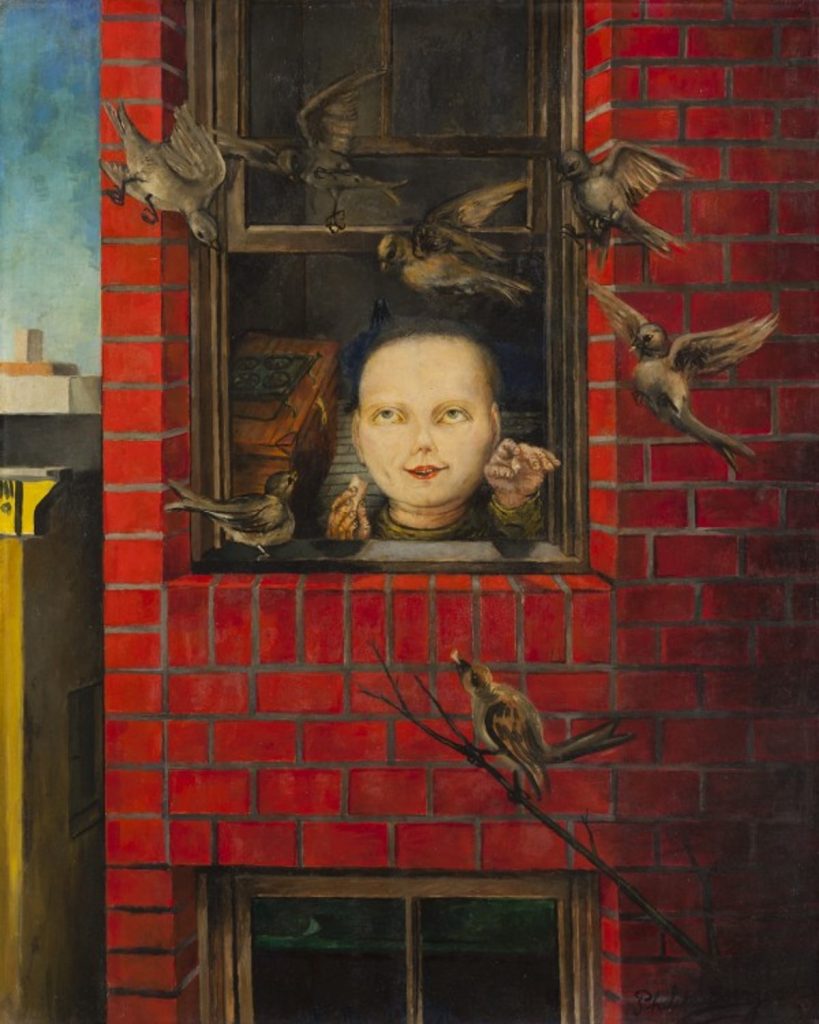
While researching the history of the Terry Dintenfass Gallery for The Women Who Made Modern Art Modern, an exhibition I organized in 2016, I was introduced, or perhaps reintroduced, to the work of painter Philip Evergood. Having gone through the Whitney ISP program many years earlier, I already knew one of his classic paintings from the museum’s permanent collection, Lily and the Sparrows, from 1939, a work that always intrigued me for its psychological intensity. It was painted in the fall of 1939, just as war erupted in Europe. The subject is a girl seemingly locked into her red brick world, an eerie foretelling of the Anne Frank story, watching sparrows fly freely past her open window. Freedom sits just outside, close enough to see but impossible to reach.
A Painter of Conscience
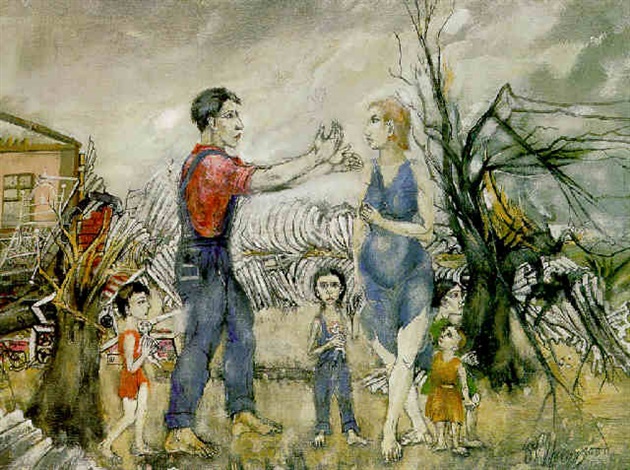
Likewise, The Future Belongs to Them, painted between 1938 and 1952 and now in the collection of Terry’s son Andrew and his wife Ann, stands as a remarkable and mature visual statement, arriving after Evergood’s years studying abroad as he began building a life and career in New York. It is also one of his largest canvases, a masterpiece as both story and image. The painting is an honest and heartfelt portrayal of a woman holding a number of babies of different colors and races, an absolute representation of a tolerant world in which everyone has the opportunity to grow and thrive. She is mother and heroine, both modest and proud, a beacon of hope in the world of 1938, a single year before the outbreak of the Second World War and everything it would destroy.
For many, the natural question is simply, who is Philip Evergood? I had originally hoped to answer that through an exhibition, and what follows instead is the beginning of an essay. He is a significant figure in the history of American art who has been sorely overlooked. His work speaks directly to the political and social climate of today, even though the paintings themselves date back to the 1930s and the years of the Great Depression. We now face many of the same issues he painted through: political crisis unlike anything seen in recent memory, economic imbalance, mass migration caused by war, questions of race and inequality, and extreme weather events bringing floods and droughts. By the time Evergood finished this image, Mussolini had held power since 1923, Hitler since 1933, and Franco of Spain since the following year. War would soon be everywhere, and it became a lasting preoccupation of his work, exemplified by his intimate portrait of a badly wounded young boy who survived the siege of Stalingrad. The daily life of those on the battlefront, and those surviving in cities across Europe, comes through in his 1943 painting Boy from Stalingrad. Much like Otto Dix’s unflinching portraits of wounded World War I soldiers, Evergood presents not the heroes of battle but its victims. The battle for Stalingrad was central to Hitler’s campaign to invade and conquer Russia, a campaign that ultimately failed, but only at the cost of thousands of lives.
Deep in the archives of WNYC radio sits a 1944 interview with Evergood, conducted by his longtime friend and colleague, painter Frank Kleinholz. Invited to participate in a weekly radio program, Evergood was asked to define his philosophy of painting. He explained that he had just completed twelve images for the Russian War Relief Calendar, used to raise funds for victims of Russia’s battle against fascism. Proud of his contribution, he described himself as part of a long tradition of humanist painters, artists like Rembrandt or Brueghel who represented the full range of the human condition. Six years earlier, in 1938, he had written that great art lives because it carries universal human appeal.
For Evergood, the follies, foibles, and actions of men and women were the focus of his life’s work. Contemporary life, as rendered across five decades of painting, became a running statement on the values, concerns, and behavior of humanity, the story of people living through the twentieth century.
A Legacy Deserving Rediscovery
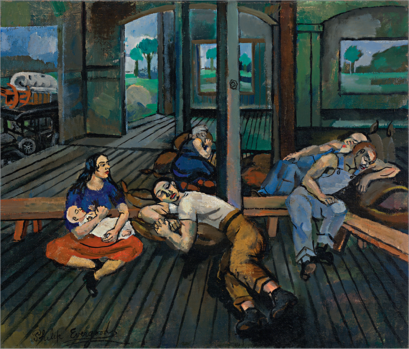
While painters as varied as Philip Guston, Jacob Lawrence, and Leon Golub have been recognized and championed for their social awareness, it was Evergood who carried these causes throughout his career, exploring them in depth across paintings, works on paper, and prints such as Waiting Room, from 1936. These causes, freedom, liberty, and equality, remain just as urgent today. We witness the same struggles over social justice, economic equality, and the security of democratic government now playing out online and across social media, just as they once played out through painting. Seventy five years ago, in the war year of 1944, all three pillars of a free and open society were under attack by fascist regimes, much as they face renewed pressure today in the form of racism, bigotry, and economic disparity. Evergood’s images from the past feel extremely relevant now. Though the painting style differs from anything contemporary, the images themselves reflect today’s complex and conflicted social order, as seen in works like Home, from 1946.
Lost among the many overlapping movements of the postwar art generations, Evergood has drifted off the art world’s radar for decades. With no heirs and no foundation dedicated to preserving his legacy, no one has been charged with keeping his work in public view. His last solo show, held at the now closed Kennedy Galleries, took place in 1972. Yet this American born, English educated artist still has much to offer, standing as a model of social consciousness and innovation in the visual arts.
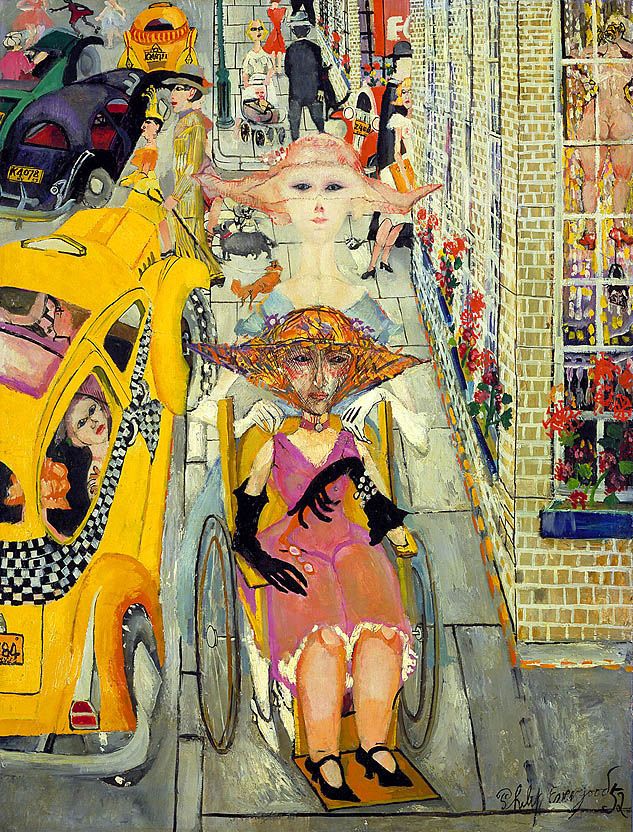
His idiosyncratic, at times peculiar style reads as an amalgamation of expressionist drive and the hard edged realism found in Germanic painters like Dix and his contemporary Max Beckmann. Evergood’s figures could be crude, twisted and bent by poverty, war, and fate. He remains one of the great chroniclers of American society in the pre and postwar eras, capturing life in the countryside, as in The Lake, and life in the city, as in Sunnyside of the Street, a Corcoran Gallery of Art prize winner later purchased by the museum in 1950. Reviewing the show at the time, Artnews noted that Evergood’s lively street scene stood among the exhibition’s most outstanding paintings. The street becomes a meeting place for neighborhood kids playing stickball and hopscotch, but it also holds a blind man, a child in a wheelchair, and an ambulance arriving in the distance for a patient. This was Evergood’s signature approach, presenting every facet of daily life at once.
Children were his heroes, living in an idealized world untouched by conflict. Families served as his barometer for a happy life and an equally hopeful future. Despite the horror and hardship that marked his middle years, Evergood largely remained an optimist.
He had a taste for the romantic, for symbols and images built from fancy and fantasy as much as from ordinary daily life, often borrowing from literature and history to describe the present. Though he never aligned himself with the avant garde movements developing around him, he saw himself as a significant maker of images whose lasting value came from a constant examination of human interest, desire, and story, as seen in works like Boy Eating Pear and the Smithsonian’s A Woman at the Piano.
“I am a social painter,” Evergood wrote in an article of the same title for the Magazine of Art in 1943. Like his uptown New York contemporary Alice Neel, much of Evergood’s social painting grew out of his own domestic life. His wife, the dancer Julie, was partner, model, and muse. Though the couple had no children of their own, children remained central figures in his work, representing youth, hope, fraternity, and the future of society, a theme reflected in the title of his early painting The Future Belongs to Them.
Why His Work Speaks to This Moment
An exhibition of Evergood’s work today would bring fifty years of this distinctly American painter and social commentator back into twenty first century discourse. Through his depictions of crowds, women, and children, we encounter a painter who understood the power of ordinary people, portraying innocence and the noble character of the modern woman. His crowds become players in the world’s unfolding drama. Moving between social realism and imaginative realism, the figure remained central to his work, rendered as elegant and reserved in one canvas, crude and suggestive in the next. Both extremes capture something true about humanity, its heroes and its victims, those who survive hardship and those who falter under it. Little about these subjects has changed since Evergood first put brush to canvas.
Writing as curator for Evergood’s 1969 solo exhibition at the Gallery of Modern Art in New York, Alfredo Valante described him as a painter who remained devoted to sympathetic, analytical views of people and their problems, a visionary drawn to their dreams, their hopes, and their tragedies. Evergood’s life ended suddenly in 1973, when he died in a small fire at his home in Southbury, Connecticut. Fate cut short a career that had already earned him a retrospective at the Whitney Museum of American Art in 1960, at age fifty nine, with support from major collectors of the era, including Joseph Hirshhorn, who acquired some sixty eight of his paintings and works on paper over thirty years. Even so, Evergood receives little recognition today. When included in the Museum of Modern Art’s 1991 exhibition Art of the Forties, he appears sandwiched between Ben Shahn and Jacob Lawrence, represented by a single print, a modest showing for a painter who once commanded significant attention and acclaim.
Evergood is rarely billed as a modernist, and he has often been pigeonholed as a Social Realist, a label that carries associations of socialism or subversion. One could argue instead that the mercurial nature of his work, his deeply romantic sensibility, and his political convictions place him closer to the tradition of early modernists like Van Gogh or Gauguin than to painters such as Rothko or Newman. He was a painter and a poet of ordinary people, depicting both strife and pleasure through intimate, easel sized vignettes. Over time, he drifted further from the prevailing currents of Abstract Expressionism, Pop Art, and Minimalism, working largely on his own terms.
He remained, in many ways, an exile at home, followed by a small but devoted circle led by Herman Baron, founder of the ACA Galleries and a longtime friend, and John Baur, former director of the Whitney Museum, who followed his 1960 catalogue with a lengthy monograph on the artist published in 1975, two years after Evergood’s death. Baur summarized Evergood’s sensibility by noting that he wept or laughed in life with the same intensity he brought to canvas, and that he translated the emotions of everyday life into the very different language of art with total conviction. In 1966, critic Lucy Lippard wrote extensively for a monograph focused on Evergood’s drawings, studies, and prints. For Evergood, painting and drawing followed need and desire, ultimately serving his search for meaning through highly imaginative pictorial narratives drawn from the people closest to him, his friends, family, and colleagues. He once remarked that the work of Picasso and contemporaries like Braque, Rouault, Matisse, and Chagall carried substance and meaning no matter how experimental it appeared, and he claimed that same freedom to experiment in search of the paintings that worked best for him.
Painting, for Evergood, was a form of storytelling. In an unpublished essay from the 1950s, he wrote that realism meant being concerned with this world, expressing emotions common to all mankind, and that realism to the artist was the expression and interpretation of his own experience. His work became an examination of the moral and ethical character of men and women, young and old, at work and at play, in peace and in war, an encyclopedic view of the human condition observed rather than judged. His gaze could move between close, detailed observation and something far more fanciful, almost dreamlike, extremes that feel far more familiar to contemporary art than they did in his own time. The same impulse can be traced in painters like Squeak Carnwath, Charles Garabedian, and the later work of Grace Hartigan, or in figures like Malcolm Morley and Jonathan Borofsky, who each use figurative invention as a way of finding meaning.
Over the years, other writers, critics, and artists lent their support as well, among them Manny Farber, Fairfield Porter, and even Jack Tworkov, a leading figure of the Abstract Expressionist movement whose aesthetic stood in direct opposition to Evergood’s humanist beliefs. Writing in Artnews in January 1952, Porter described Evergood’s techniques and materials in close detail, focusing on the mechanics behind bringing an image to canvas. The resulting painting, Girl and Sunflowers, depicts a young girl surrounded by giant sunflowers, the product of numerous charcoal studies, a romanticized landscape in which youth remains secure and surrounded by natural beauty.
In the hands of art historians, critics, and curators who understand that the history of art is never static but always in motion, the past can be reexamined and made relevant to the present. Philip Evergood deserves a place at the top of that list.