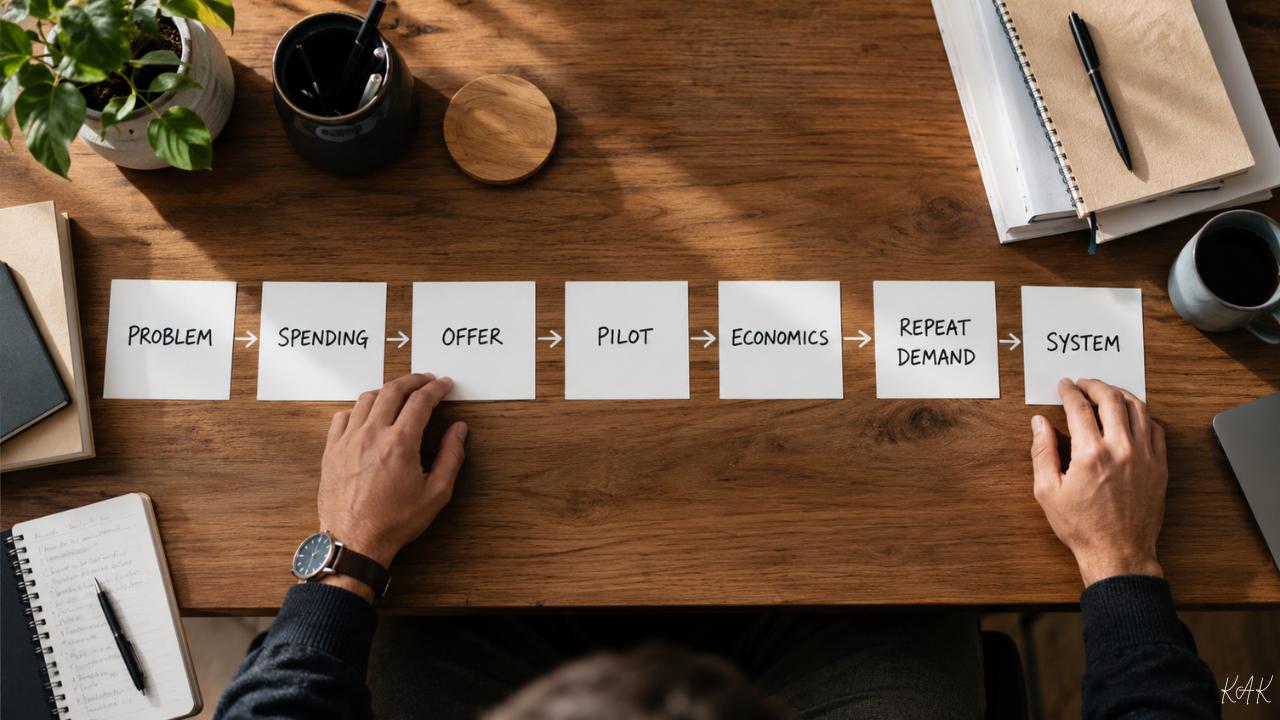
Family offices and angel investors evaluating an early-stage company face a familiar problem: a compelling pitch deck and a real business look identical from the outside. Both have a market-size slide. Both describe a painful problem. Both project confident revenue. The difference only becomes visible once you ask a narrower question than “how big is the opportunity” — namely, has anyone actually paid this founder money to solve this specific problem, and would they pay again?
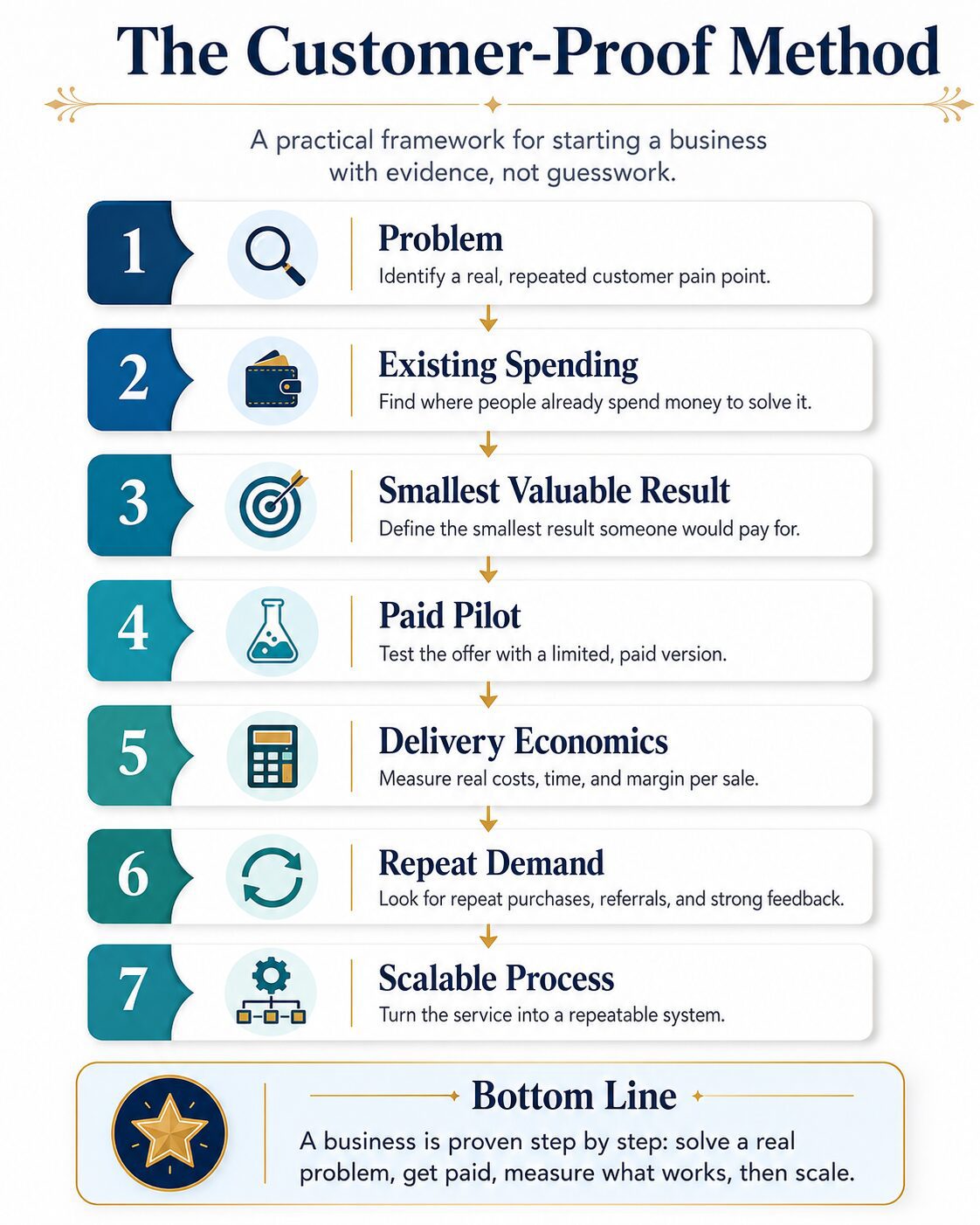
That question is the foundation of what I call the Customer-Proof Method: a 13-step evidence framework that moves a business idea from claim to proof before it deserves serious capital. It was built as a founder’s discipline, but it doubles as an investor’s checklist — the same evidence that makes a business fundable is what a rigorous due-diligence process is actually looking for. This piece walks through the framework primarily from the founder’s side, since that’s where the evidence has to be generated, with notes throughout on what each stage should signal to someone evaluating whether to invest.
Why Pitch-Stage Evaluation Fails
Most early-stage evaluation — by founders judging their own idea, and often by investors judging it too — starts in the wrong place: name, branding, a website, a polished deck, a detailed five-year plan. These activities feel like progress. None of them prove a business exists.
A business begins when a specific person has a problem, trusts a proposed solution, and is willing to pay for it. Everything before that is preparation, and preparation is easy to fake convincingly. This is the first thing worth checking in diligence: is this founder describing preparation, or evidence?
Step 1: Start With a Painful Situation, Not a Business Idea
A weak business idea starts with a product: “I want to build an app.” A stronger one starts with a situation: “Small property managers lose hours every week tracking maintenance requests through WhatsApp.” A product can be copied. A clearly understood, specific problem generates several possible solutions and signals the founder actually understands their customer rather than their own enthusiasm.
Investor signal: if a founder can’t articulate the problem in a sentence that doesn’t mention their own product, that’s worth probing before anything else.
Step 2: Create a Problem Ledger
Before building anything, create a simple document with five columns:
| Person | Problem | Current solution | Cost of the problem | Evidence |
|---|---|---|---|---|
| Small contractor | Delayed material-test reporting | Calls the laboratory repeatedly | Project delays and disputes | Three contractors mentioned it |
| Busy professional | No healthy breakfast nearby | Skips breakfast or buys fast food | Poor convenience and wasted time | Observed at two offices |
| Online retailer | Too many customer questions | Replies manually on WhatsApp | Several hours lost daily | Store owner showed message history |
Before building anything, a founder should document, for each target customer: the problem, their current (imperfect) solution, the cost of that problem to them, and the evidence that it’s real — not opinions, but observed behavior: receipts, complaint patterns, time logs, a customer showing you how they currently cope.
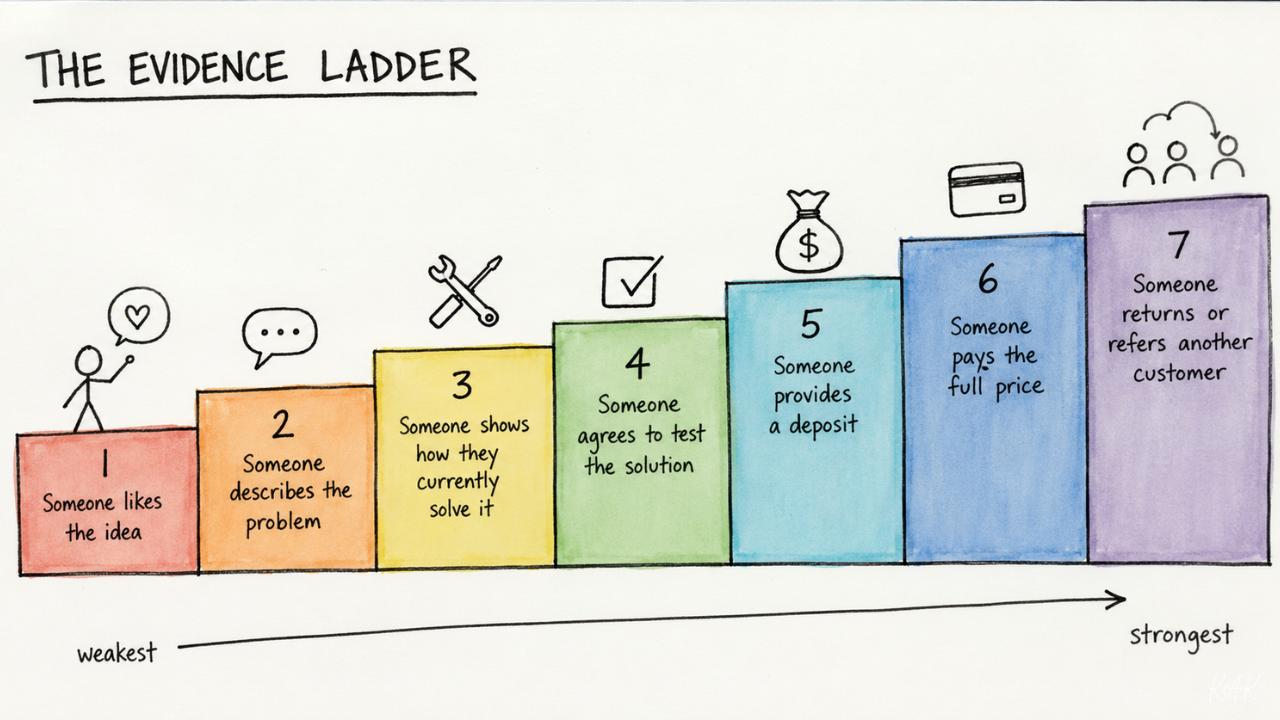
Compliments are weak evidence. “That sounds like a good idea” proves nothing. “When can you do this for me?” is stronger. Payment is strongest of all.
Investor signal: ask to see this ledger directly. A founder with real evidence will have it; a founder without it will improvise an answer on the spot.
Step 3: Find the Money Already Moving
Creating demand from nothing is expensive and slow. It’s usually easier to enter a market where customers are already spending money but are dissatisfied with the result — what I call existing money movement. If companies already pay accountants, buy software, and assign staff to fix reporting errors, a new solution doesn’t need to invent a budget; it needs to earn a share of one that already exists. The U.S. Small Business Administration’s market research guidance is a useful supplementary resource here for assessing whether that spending is real and sizable.
Investor signal: this is often the highest-value diligence question — not “is this a good idea,” but “where is the money already going, and why would it move.”
Step 4: Define the Smallest Valuable Result
Not “what will the finished business eventually offer,” but “what is the smallest result a customer would pay for within seven days.” A large idea like “start a property-management platform” is vague and expensive to test. “Manage the maintenance requests for one apartment building using existing tools” is specific, testable, and immediately revealing.
| Large, vague idea | Smallest valuable result |
|---|---|
| Start a marketing agency | Improve five high-traffic product pages |
| Build property software | Manage requests for one building |
| Launch a meal company | Deliver one weekly meal package |
| Create a consulting firm | Solve one measurable client problem |
Step 5: Make a One-Sentence Offer
A useful offer fits the pattern: I help [specific customer] achieve [specific result] within [timeframe] without [major frustration]. Vague language — “innovative solutions,” “transforming businesses,” “cutting-edge excellence” — describes ambition, not value, and is itself a diligence red flag when it substitutes for specificity.
Step 6: Ask for a Paid Pilot
A free trial attracts polite interest. A paid pilot reveals genuine demand. The pilot should be limited in scope and time, easy to explain, useful on its own, and — critically — paid. Founders shouldn’t overstate an early-stage service as fully established; honest framing (“this is an early version, and I’m working directly with first clients to improve it”) builds more trust than false polish.
Investor signal: paid-pilot conversion rate is a cleaner early signal than almost anything on a pitch deck.
Related video: Strategyzer co-founder Alex Osterwalder explains how entrepreneurs can test the assumptions behind a business idea before committing substantial time and money.
What if nobody pays?
Do not immediately reduce the price.
First identify where the offer failed:
- Wrong customer
- Weak problem
- Unclear result
- Poor timing
- Low trust
- Difficult purchasing process
- No urgency
- Inaccessible audience
- Price greater than perceived value
A rejected offer is information.
Ten vague rejections are less useful than one honest conversation with a buyer who explains why the offer does not justify the cost.
Step 7: Measure the Cost of Delivery
Revenue creates the illusion that a business works. Profit reveals whether it actually does. For each sale, track the full delivery cost — materials, contractor fees, payment processing, the founder’s own time valued honestly — and calculate contribution per sale. A $500 sale that costs $430 to deliver produces $70 of contribution before any general business expense. That may be acceptable in a learning-stage pilot; it is not yet a business model.
Investor signal: ask for unit economics on the actual first ten sales, not a projected model. The gap between the two tells you how much the founder has learned versus assumed.

Step 8: Build a Rejection Library
Every time a prospect declines, record the reason in their actual words. Patterns across 20+ conversations reveal whether the core issue is trust, urgency, pricing, or an unclear result — and each has a different fix. A founder who treats rejection as noise to push through, rather than data to act on, is a weaker bet than one who can recite their rejection patterns from memory.
Step 9: Get the First Ten Customers Individually
Not 100,000 people — ten, reached through direct, specific outreach rather than generic messaging. The first ten customers teach a founder what buyers actually care about, what objections recur, and what promises shouldn’t be made. This is market research with consequences, not just early revenue.
Step 10: Separate the Product From the Founder
Early customers often buy the founder’s personal effort and responsiveness as much as the product itself — normal, but not scalable. After several deliveries, the process should be documented: intake, delivery steps, quality checks, recurring questions, what can be templated versus what requires judgment. A business that only functions when the founder personally controls every detail is difficult to grow and, from an investment standpoint, difficult to scale capital into.
That is normal.
But a business that works only when the founder personally controls every detail is difficult to grow and exhausting to operate.
After several deliveries, document the process:
- How the customer enters
- What information is collected
- How the work is prepared
- What quality checks occur
- How delivery happens
- What questions customers usually ask
- What causes delays
- What can be standardized
- What requires judgment
- What can be delegated
Turn repeated work into:
- Checklists
- Templates
- Standard emails
- Intake forms
- Pricing rules
- Delivery schedules
- Quality standards
- Frequently asked questions
- Escalation procedures
The story of how Vita Coco grew from a startup into a global brand illustrates how competition, adaptability, distribution and strategic partnerships become increasingly important after early demand has been proven.
The purpose is not to create unnecessary bureaucracy. It is to stop solving the same operational problem from the beginning every time.
Step 11: Register the Business at the Right Moment
Legal structure, tax registration, licensing, and insurance should support demonstrated activity, not substitute for demand testing — but they shouldn’t be neglected either. The IRS’s startup checklist is a useful baseline for U.S. founders on tax identification, structure, and employment obligations. Local professional advice is still necessary, since requirements vary meaningfully by jurisdiction and business type.
U.S.-based founders should also review the IRS’s official checklist for starting a business, including tax identification, business structure, employment forms and tax obligations.
At the same time, do not spend your entire budget on offices, branding, equipment, and complex company structures before confirming that customers want the offer.
The sensible sequence is:
Test responsibly, confirm demand, formalize appropriately, then expand.
Step 12: Protect the Personal Runway
Many businesses fail not because the idea was worthless but because the founder ran out of personal financial runway before the business found its footing. Calculating available savings divided by essential monthly expenses gives a concrete number of months of runway — a figure worth knowing before, not after, leaving other income behind.
Once the business begins earning consistently, these financial planning strategies for small business owners can help with budgeting, tax preparation, emergency reserves and controlled growth.
Step 13: Set Explicit Conditions for Continuing — and Stopping
Before launch, a founder should define what evidence justifies further investment (e.g., five paying customers, a 40% contribution margin, at least two repeat orders) and what evidence justifies stopping or changing course (e.g., 30 qualified prospects rejecting the offer for the same core reason). Commitment should be to finding a viable business, not to one untested version of an idea.
Investor signal: ask founders directly what would make them kill or pivot the current approach. A founder who can’t answer is emotionally attached to a format rather than committed to an outcome — a meaningfully different risk profile.
The First 30 Days
For founders working through this directly: days 1–5 identifying and validating the problem through conversations; days 6–10 narrowing to one customer segment and one offer; days 11–15 building the smallest manual version and setting a pilot price; days 16–23 selling that pilot and recording objections; days 24–30 delivering, measuring true costs, and deciding what to repeat, standardize, or abandon. At the end of thirty days, the goal isn’t a polished company — it’s evidence.
Here is a practical starting schedule.

Days 1–5: Identify the problem
- List ten recurring problems you understand.
- Choose three involving existing spending.
- Speak to at least five affected people for each problem.
- Record their current solutions and frustrations.
Days 6–10: Select one customer and one result
- Choose the clearest problem.
- Define a narrow customer group.
- Create a one-sentence offer.
- Decide what you can deliver within seven days.
Days 11–15: Build a manual version
- Create the simplest delivery process.
- Prepare one example or demonstration.
- Set a pilot price.
- Write clear terms and limitations.
Days 16–23: Sell the pilot
- Contact qualified prospects individually.
- Hold real conversations.
- Ask for payment.
- Record objections.
- Adjust the offer only when a pattern appears.
Days 24–30: Deliver and learn
- Complete the work carefully.
- Measure all costs and hours.
- Ask what was useful and what was missing.
- Request a testimonial only when the customer is genuinely satisfied.
- Decide what should be repeated, removed, or standardized.
At the end of 30 days, you may not have a polished company.
You should have something more valuable: evidence.
The Business Readiness Test
Before investing heavily, answer these questions:
- Can I describe the customer in one sentence?
- Can I name the problem without mentioning my product?
- Are people already spending money on this problem?
- Have I spoken to at least ten potential buyers?
- Has anyone paid for an early version?
- Can I deliver a useful result manually?
- Do I know the real cost of each sale?
- Can I explain why customers choose me?
- Have I recorded the main reasons people reject the offer?
- Can the process eventually work without my involvement in every step?
The more questions you can answer with evidence, the closer you are to a real business.
What This Means for Capital Allocators
For family offices and angel investors evaluating direct investments in early-stage companies, the practical use of this framework is as a diligence lens rather than a founder’s private discipline: ask which of these thirteen stages a founder has actually completed, with evidence, rather than described in aspiration. A founder who can produce a real problem ledger, real rejection data, and real unit economics from an actual paid pilot has generated exactly the kind of evidence a term sheet should be priced against — and a founder who can’t is asking capital to fund the discovery process itself, which is a different, and considerably riskier, investment.
Common Questions About Starting a Business
Do I need a complete business plan?
You need financial estimates, market understanding, operating assumptions, and clear goals. However, a long document should not replace conversations with potential customers. Early evidence is more valuable than confident predictions.
How much money do I need?
That depends on the business. A consultancy, local service, or digital product may be tested with relatively little capital. A restaurant, manufacturing operation, medical facility, or regulated financial business can require substantial funding. Start by identifying the cheapest responsible way to test demand.
Should I start with a partner?
A partner can bring skills, capital, access, and accountability. A poor partnership can also create conflict and legal difficulty. Discuss roles, ownership, decision-making, time commitment, salaries, intellectual property, and exit conditions before beginning.
Should I quit my job?
Not automatically. Employment can fund the learning period and reduce financial pressure. Consider leaving only when the business shows repeatable demand, the opportunity requires more time, and you have sufficient personal runway.
What is the best business to start?
The best business is not necessarily the trendiest one. It is one where you understand the customer, can reach buyers, solve a costly problem, deliver reliably, and earn enough to continue.
Final Thoughts
Starting a business is not primarily an act of registration, branding, or motivation.
It is a sequence of proofs.
First, prove that the problem exists.
Then prove that people care enough to act.
Prove that they will pay.
Prove that you can deliver.
Prove that the economics work.
Finally, prove that the process can be repeated.
Many founders try to look like a business before becoming one. A wiser founder does the opposite: build something commercially useful first, then give it the structure, identity, and scale it has earned.
The strongest first step is therefore not choosing a logo or announcing a launch.
It is finding one real customer with one meaningful problem—and solving it well enough that they are willing to pay you to do it again.
Sources: U.S. Small Business Administration, Internal Revenue Service.