Artificial intelligence can now generate images, designs, text and increasingly sophisticated production instructions in seconds. Yet craftsmanship in the age of AI raises a different question: when digital creation becomes abundant, could the scarce resource become the human ability to make something well?
The distinction matters. Generating an image is not the same as manufacturing the object depicted in it. Designing a chair is different from understanding how wood bends, how joints respond under pressure or how a material changes during finishing. A machine can reproduce a pattern; an experienced craftsperson can recognize when the material is behaving differently from the pattern and adjust accordingly.
The future of human craftsmanship therefore may not depend on resisting technology. Instead, it may depend on understanding which forms of judgment, dexterity, accumulated knowledge and human authorship remain valuable when machines become increasingly capable.
When Digital Abundance Makes Physical Skill Scarce
AI is dramatically increasing the supply of digital creation. Generative systems can produce thousands of design variations, while digital manufacturing tools can translate those designs into increasingly precise physical outputs.
That creates a fundamental asymmetry.
Digital content can be generated almost instantly and replicated at negligible marginal cost. Physical craftsmanship remains constrained by materials, workshop capacity, production time, human attention and the availability of skilled workers.
The World Economic Forum’s research illustrates the broader shift. Its Future of Jobs analysis expects the proportion of tasks performed predominantly by humans alone to decline as technology expands, while human-machine collaboration becomes more important.
That does not mean physical work automatically becomes more valuable. A machine can manufacture a standardized component faster, cheaper and more consistently than a person. However, scarcity can emerge around products where the production process itself contributes to the object’s meaning.
A handmade violin, bespoke garment or individually finished piece of furniture does not derive its entire value from physical function. Its value can also include the expertise, decisions, time and provenance behind it.
Why Craftsmanship Is Different From Simply Making Something
Craftsmanship is more than manual labor.
It combines precision with judgment. A skilled maker learns how materials respond to pressure, heat, moisture, tools and time. They also learn how to recognize small deviations that may not be captured in a formal specification.
This is often described as tacit knowledge: knowledge acquired through repeated practice that can be difficult to communicate completely through written instructions.
That distinction becomes important as automation improves.
An AI system can analyze enormous quantities of information. A robotic system can execute a movement with extraordinary consistency. Yet complex physical environments contain variation. Materials differ. Tools wear. Surfaces behave unexpectedly. Customers change specifications. Repairs require diagnosis rather than repetition.
The craftsperson’s advantage can therefore lie in the ability to interpret these variations.
This does not make human skills permanently impossible to automate. Robotics, computer vision and increasingly capable AI systems will continue to expand what machines can perceive and execute. Rather, some forms of skilled work remain difficult to standardize because they combine sensory judgment, physical adaptation and contextual decision-making.
Craftsmanship in the Age of AI and the Value of Human Skill
The economics of craftsmanship in the age of AI may ultimately depend on what remains scarce.
The OECD’s 2026 research on skills finds that AI is changing skill requirements while increasing the importance of higher-level capabilities. It also notes that AI can complement human labor, although displacement remains a risk, particularly for routine work.
For craftspeople, this suggests an increasingly hybrid model.
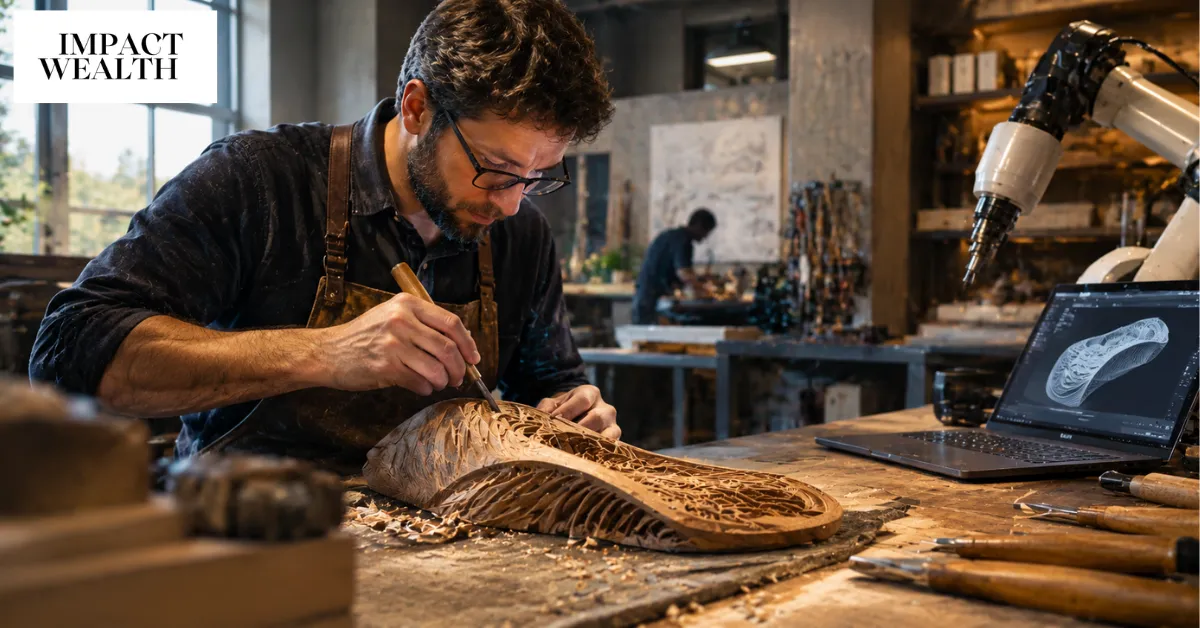
Manual dexterity may combine with CAD. Traditional pattern-making may work alongside AI-assisted design. A furniture maker may use digital fabrication for precision while retaining responsibility for material selection and finishing. A jeweler may use computational modeling but still rely on human judgment to determine how a stone sits within the final piece.
The critical question is therefore not whether AI appears somewhere in the process. It is where human judgment and authorship remain.
Six Models of Making in the AI Era
| Production Model | Primary Strength | Human Role |
|---|---|---|
| Fully Automated Production | Scale and consistency | Limited oversight |
| AI-Assisted Production | Speed and optimization | Direction, judgment and quality control |
| Digitally Enabled Craftsmanship | Precision and customization | Skilled human making |
| Traditional Artisanal Production | Knowledge and authenticity | Central creative and technical role |
| Bespoke Craftsmanship | Individualization | High-touch human expertise |
| Luxury Small-Batch Production | Scarcity and quality | Specialized craftsmanship |
These models are not mutually exclusive. In fact, the most interesting future may sit between them.
A luxury manufacturer might automate repetitive processes while reserving finishing, customization and quality decisions for specialists. A traditional workshop might use digital tools to document techniques without surrendering the human process itself.
The dividing line will increasingly be the allocation of responsibility rather than the simple presence of technology.
AI Can Become a Tool for Craftspeople
AI and craftsmanship do not have to be opposing forces.
AI-assisted design can accelerate experimentation. It can help generate patterns, compare variations, optimize material use, support prototyping and assist with production planning. Digital tools can also document techniques that might otherwise disappear.
This could be particularly useful for small workshops that historically lacked access to sophisticated design or manufacturing infrastructure.
The ILO’s 2026 research on skills in the AI era similarly emphasizes that AI is reshaping how workers use cognitive, socioemotional and physical skills rather than simply eliminating human work.
However, technological assistance changes the nature of craftsmanship only when it displaces the craftsperson’s judgment.
If an AI system generates alternatives while the maker decides which one works, technology functions as an instrument. If the system determines the design, material and production process with minimal human intervention, the resulting object belongs to a fundamentally different production model.
That distinction will become increasingly relevant as consumers ask not only what they are buying, but how it was made.
Why Luxury Still Needs the Artisan
Luxury has always had an unusual relationship with time.
Mass manufacturing competes through efficiency, while luxury often derives value from scarcity, precision, material quality, personalization and expertise. That makes luxury craftsmanship particularly relevant in an era when machines can make standardized goods increasingly efficiently.
The value does not mean every handmade product is superior. It is entirely possible for a machine-made product to be more precise, durable or affordable.
Instead, craftsmanship can add another dimension: provenance.
A bespoke object can carry evidence of individual decisions. A traditional technique can connect a product to a particular community or place. A highly specialized maker can become part of the object’s history.
That is where craftsmanship intersects with cultural capital.
The object becomes more than a functional product. Its production process becomes part of its cultural meaning.
The Return of the Handmade Object
As AI-generated content becomes ubiquitous, physical objects may acquire a different kind of significance.
A digital image can be generated, modified and reproduced almost instantly. A handmade object still occupies physical space. It has material constraints, evidence of production and, often, visible variation.
That does not make imperfection automatically valuable. “Handmade” is not synonymous with quality, authenticity or ethical production.
Yet provenance can matter.
Consumers may increasingly want to know who made an object, where its materials came from, what techniques were used and whether the production process has a meaningful history.
This could strengthen demand for handmade luxury, but only where the underlying craftsmanship is credible.
Craftsmanship as Cultural Heritage
Traditional craftsmanship has a significance that extends beyond luxury markets.
UNESCO treats traditional craftsmanship as part of intangible cultural heritage and emphasizes that safeguarding should focus on the knowledge and skills involved, as well as their transmission to future generations.
That distinction is crucial.
Preserving a traditional craft does not simply mean keeping old objects in museums. It means keeping the knowledge alive through practitioners, apprenticeships and communities.
UNESCO also recognizes the economic pressures involved. Mass production can supply goods more cheaply and quickly, while lengthy apprenticeships can discourage younger people from entering traditional trades.
That makes cultural preservation an economic question as much as a cultural one.
A craft survives when people can realistically learn it, practice it and earn a viable livelihood from it.
The Skills AI Cannot Easily Standardize
The strongest case for human craftsmanship is not that machines cannot perform physical tasks. Robotics already demonstrates that they can.
The more interesting question concerns combinations of skills.
Tacit knowledge allows a craftsperson to respond to material behavior. Fine motor control enables adjustments during production. Sensory judgment helps identify subtle differences. Repair requires diagnosing an imperfect object rather than simply repeating a predefined process.
Improvisation also matters.
A machine excels when the environment is sufficiently structured. Skilled humans become particularly valuable when the environment is ambiguous.
The WEF has found that many granular skills involving physical execution, manual dexterity, endurance and precision currently show low substitution potential for GenAI, although technological capabilities can evolve.
That is a more useful conclusion than claiming that particular human skills are “irreplaceable.”
What Gives Human Craftsmanship Its Value?
| Craftsmanship Trend | Rising Demand Driver | Key Challenge |
|---|---|---|
| Handmade Luxury | Authenticity and scarcity | High production costs |
| Artisan Training | Skills preservation | Long training periods |
| AI-Assisted Craft | Greater precision and efficiency | Maintaining human control |
| Traditional Craft Revival | Cultural heritage and individuality | Commercial sustainability |
| Bespoke Production | Personalization | Limited scalability |
| Provenance-Focused Products | Transparency and trust | Verification and documentation |
The strongest sources of value are therefore not simply manual labor.
They include scarcity, mastery, provenance, customization, cultural meaning and the ability to demonstrate genuine authorship.
That combination can be particularly powerful in luxury, where the buyer may already have access to technically excellent alternatives.
The Economics of Keeping Craftsmanship Alive
The romantic image of the artisan can obscure a difficult economic reality.
Craftsmanship requires training. Apprenticeships can take years. Small workshops cannot achieve the same economies of scale as industrial production. Skilled labor costs rise, while younger workers may have more financially attractive alternatives.
UNESCO explicitly identifies lengthy apprenticeships, competition from mass production and changing economic incentives among the challenges facing traditional crafts.
Consequently, cultural appreciation alone will not preserve craftsmanship.
The industry needs viable business models: premium pricing where justified, training systems, apprenticeships, documentation, access to markets and opportunities for craftspeople to combine traditional expertise with modern technology.
This is also where heritage luxury becomes relevant.
Historic properties, luxury hospitality and cultural institutions can provide markets for specialized skills, but they must avoid turning living traditions into decorative branding.
The New Artisan May Be Part Designer, Part Technologist
The future artisan may not resemble the traditional image of a craftsperson working entirely by hand.
They may use CAD, digital fabrication, advanced materials, robotics and AI-assisted design while retaining responsibility for the final object.
This hybrid model could actually strengthen craftsmanship.
Digital tools can reduce repetitive work, improve precision and make customization economically feasible. AI can generate possibilities. Machines can handle predictable operations. The human maker can concentrate on decisions where experience and judgment matter most.
That is consistent with the broader direction of workforce research. The WEF expects human-machine collaboration to become a larger part of work rather than a simple transition from humans to machines.
The result may be a new definition of skilled labor: technological literacy becomes another component of craftsmanship rather than its opposite.
What AI Abundance Could Mean for Human Creativity
The deeper cultural question is what happens when machines can produce convincing versions of almost any aesthetic.
If visual style becomes abundant, style itself may become less scarce.
Human creativity could therefore derive greater value from intention, experience, context and authorship. The distinction may move away from whether something looks handmade toward whether its creation has a meaningful human story behind it.
This does not require assuming that AI lacks creativity. It simply recognizes that cultural value depends on more than output. People assign meaning through history, context, relationships and shared systems of interpretation.
In that environment, the story behind an object may become increasingly important.
Unique Insight: Craftsmanship in the Age of AI Is About Scarcity of Mastery
The central insight of craftsmanship in the age of AI is that technology may change the location of scarcity.
When machines make production faster, the scarce resource may no longer be the ability to generate an output. It may be the ability to exercise judgment, develop mastery, understand materials and create something with meaningful human provenance.
That could make future luxury increasingly associated with time, mastery, provenance, human attention and skill.
The irony is important: AI may not destroy the value of craftsmanship. By making digital creation easier, it could make genuine physical mastery easier to recognize.
Conclusion
Craftsmanship in the age of AI is not ultimately a story about humans versus machines.
It is a story about how technology changes the economics and meaning of human skill.
AI will continue to automate repetitive tasks, accelerate design and expand manufacturing capabilities. At the same time, skilled makers may increasingly combine traditional knowledge with digital tools, AI, precision equipment and individual judgment.
The strongest craftspeople will not necessarily be those who reject technology. They may be those who understand exactly where technology helps and where human expertise still creates distinctive value.
In an economy where machines can increasingly generate the appearance of creation, genuine mastery may become more valuable because it demonstrates something harder to reproduce: knowledge accumulated over time, physical judgment, patience, material understanding and human authorship.
That is the emerging opportunity for craftsmanship in the age of AI.
Frequently Asked Questions
What does craftsmanship in the age of AI mean?
Craftsmanship in the age of AI describes the changing relationship between skilled human making and technologies that can automate, accelerate or assist creative and manufacturing processes.
Will AI replace traditional craftsmanship?
Not necessarily. AI and automation may replace particular repetitive tasks, but many forms of craftsmanship involve physical execution, judgment, adaptation and contextual decision-making. The ILO expects many occupations to be transformed rather than simply eliminated.
Why might human craftsmanship become more valuable as AI develops?
As digital creation becomes abundant, physical scarcity, provenance, mastery and human authorship may become more distinctive. However, this does not mean every handmade product will command a premium.
How can AI help artisans?
AI can support design exploration, pattern development, prototyping, customization, material optimization, documentation and production planning while leaving final judgment with the craftsperson.
What is the difference between AI-generated design and human craftsmanship?
AI can generate a digital design or variation extremely quickly. Craftsmanship involves physically interpreting, producing, refining or adapting an object using material knowledge and skilled judgment.
Why is craftsmanship important to the luxury industry?
Luxury craftsmanship can provide scarcity, personalization, provenance, precision and specialist expertise that standardized mass production does not necessarily provide.
What is tacit knowledge in craftsmanship?
Tacit knowledge is practical knowledge acquired through experience that can be difficult to express completely through formal instructions, such as recognizing how a material responds during production.
Can traditional craftsmanship survive alongside automation?
Yes, but survival requires viable economics, training, apprenticeships, market demand and knowledge transmission. UNESCO emphasizes continuing transmission of skills rather than simply preserving finished craft objects.
Why do consumers value handmade products?
Potential reasons include authenticity, provenance, individual variation, physicality, cultural meaning and appreciation for skilled labor. These factors do not automatically make handmade products better than machine-made alternatives.
What will the future of craftsmanship look like?
The most likely direction is hybrid: traditional human expertise combined with CAD, digital fabrication, AI-assisted design, advanced materials, robotics and precision manufacturing. The boundary between artisan and technologist may become increasingly blurred.