
Building Your Empire with the Best Real Estate Loans
Why Real Estate Financing Is the Foundation of Every Great Property Empire
Real estate financing is the process of securing capital to purchase, develop, or refinance property — and for high-net-worth investors, it’s one of the most powerful tools available for building and preserving generational wealth.
Here’s a quick overview of the main real estate financing options:
| Financing Type | Best For | Typical Terms |
|---|---|---|
| Conventional Mortgage | Primary/investment residential | 15–30 year, fixed or adjustable |
| Portfolio Loan | Unique properties, complex ownership | Flexible, held by original lender |
| Commercial Real Estate Loan | Income-producing properties | 3–20 year, higher rates |
| Hard Money / Bridge Loan | Short-term, value-add deals | 12–24 months, higher rates |
| SBA 504 Loan | Owner-occupied commercial | Long-term, government-backed |
| DSCR Loan | Rental property investors | Qualification based on property income |
| Private / Hard Money | Speed-driven acquisitions | Asset-based, fast close |
The U.S. commercial real estate market alone was valued at roughly $20.7 trillion in 2023. That scale tells you something important: property isn’t just a place to park money. It’s a structured asset class with its own financing ecosystem — one that rewards those who understand it.
Whether you’re acquiring a luxury estate, expanding a commercial portfolio, or funding new construction, the financing structure you choose shapes your returns, your risk exposure, and your tax position more than almost any other decision.
This guide breaks down every major financing path — from conventional mortgages to private capital — so you can match the right tool to your investment goals.
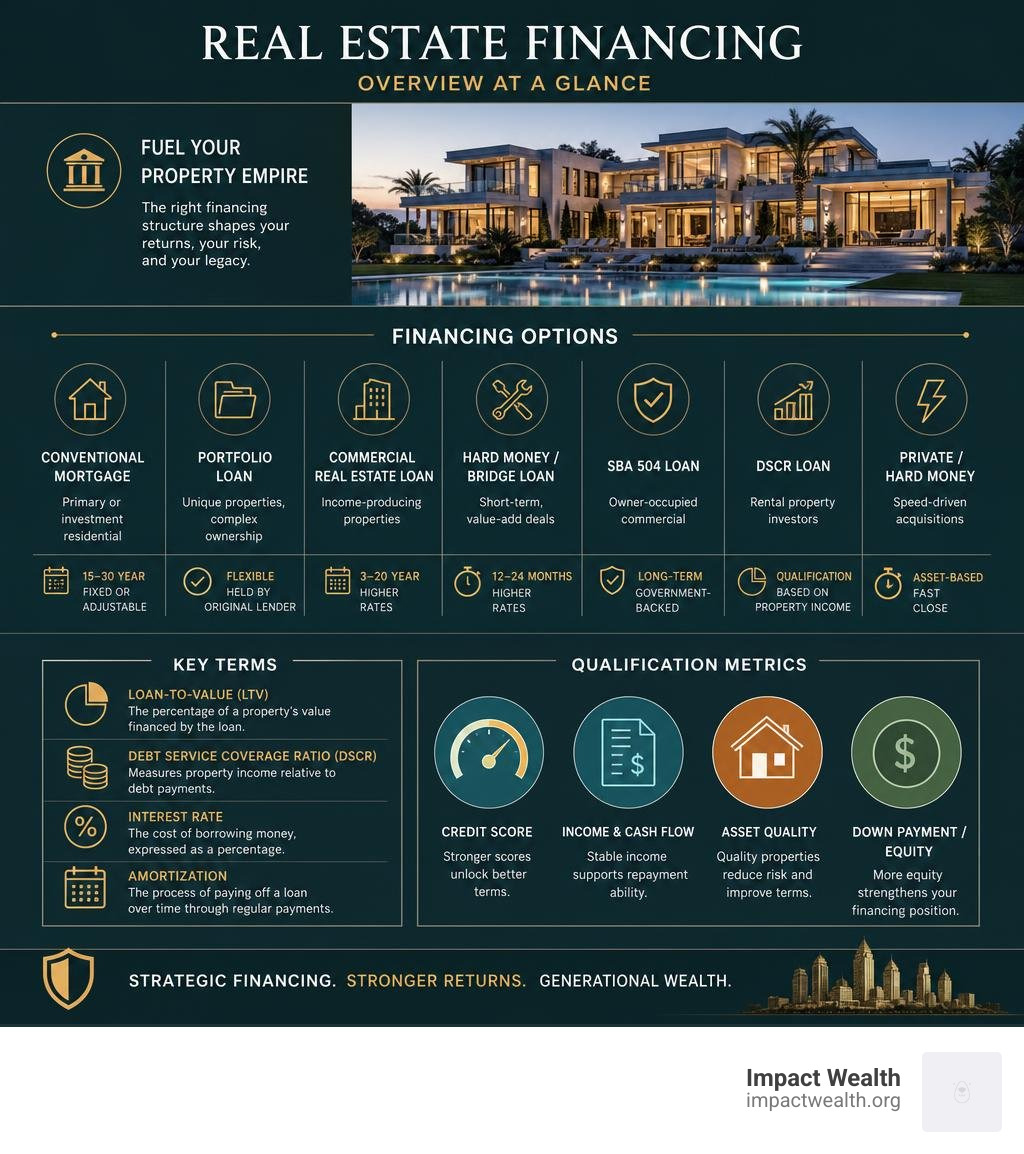
Real estate financing word guide:
Understanding Real Estate Financing vs. Traditional Mortgages
To build a robust real estate empire, one must first master the distinction between a simple residential mortgage and the broader world of real estate financing. While a traditional mortgage is a standardized consumer loan secured by a primary or secondary residence, sophisticated real estate lending is an entirely different asset class. It is structured around leverage, cash flow, asset valuations, and complex entity structures.
When deciding Should You Invest in a Property?, an investor must analyze how the property fits into their capital stack. Traditional mortgages rely heavily on your personal debt-to-income (DTI) ratio, tax returns, and W-2 or 1099 income. In contrast, commercial and professional real estate lending focuses on the income-generating capacity of the asset itself.
According to institutional frameworks from specialists like Real Estate Finance – US Capital Global, professional real estate capital structures are often divided into multiple tiers:
- Senior Debt: Typically the first mortgage, holding the highest priority claim on the property.
- Mezzanine Debt: Subordinated debt that bridges the gap between senior debt and equity, often secured by equity interests in the borrowing entity.
- Preferred Equity: Equity that receives preferential distributions before common equity holders.
- Common Equity: The investor’s own capital, representing the highest risk but also the highest potential returns.
Traditional residential mortgages are highly regulated, standardized, and limited by conforming loan caps. For context, the baseline conforming loan limit was $647,200 in 2022 (up from $548,000 in 2021), though high-cost areas allow for higher limits.
On the other hand, commercial real estate loans and bespoke financing packages are negotiated on a case-by-case basis. They are frequently structured through specialized holding companies, trusts, or LLCs to protect the borrower’s broader portfolio. In this space, lenders are not just looking at your personal credit history; they are underwriting the property’s tenant stability, market demand, and net operating income (NOI).
Key Vehicles for Residential and Commercial Property Investment
For high-net-worth individuals and family offices operating across luxury enclaves like Bal Harbour, Miami, or Los Angeles, matching the property type with the correct financing vehicle is critical. Property investments generally fall into two categories: residential (ranging from single-family luxury estates to multi-family buildings) and commercial (office spaces, retail centers, industrial warehouses, and mixed-use developments).
Choosing the right vehicle determines your interest rate exposure, repayment flexibility, and speed of execution.
Conventional and Portfolio Real Estate Financing Options
For standard luxury residential purchases, conventional mortgages and jumbo loans remain popular. However, conventional guidelines can be highly restrictive, particularly for buyers with complex income streams, foreign assets, or non-traditional tax structures. This is where portfolio loans become indispensable.
Portfolio lenders do not sell their loans on the secondary mortgage market (such as to Fannie Mae or Freddie Mac). Instead, they keep the loans on their own balance sheets. This gives them the flexibility to write their own underwriting rules. If you are purchasing a unique estate in Palm Beach or a modern architectural masterpiece in Los Angeles, a portfolio lender can look at your entire liquid asset portfolio rather than relying strictly on standard income verification.
This flexibility is essential because Location Is No Longer Everything: What Modern Homebuyers Really Want has changed the luxury landscape. Today’s buyers prioritize smart automation, wellness features, and extensive home offices over traditional location metrics, requiring lenders who understand how to value these modern amenities.
For business owners and corporate entities looking to expand their physical footprint, institutional options like Commercial Real Estate Loans & Property Financing offer structured term loans and lines of credit. These commercial products typically feature:
- Flexible amortization schedules (often up to 15 or 25 years, or 10-year terms with balloon payments).
- Adjustable-rate or fixed-rate structures tailored to the business’s cash flow.
- The ability to leverage owner-occupied commercial properties to pull out equity for business expansion.
Alternative and Private Real Estate Financing Solutions
When speed, flexibility, or opportunistic acquisitions are the primary drivers, traditional bank financing may prove too slow. In highly competitive markets like Miami or European capital cities, transactions often require closing in days, not months. This has driven the rise of alternative capital sources, including hard money, private money, and bridge loans.
Hard money loans are short-term, asset-backed loans funded by private investors or specialized lending firms. Rather than focusing on the borrower’s personal financial situation, hard money lenders look almost exclusively at the property’s value and its After-Repair Value (ARV). These loans are ideal for fix-and-flip projects, rapid acquisitions, or properties requiring significant rehabilitation before they can qualify for conventional financing.
To understand the scale of this alternative market, consider that modern private lenders have built massive operations to meet this demand. For example, the institutional-grade private capital provider Lendyx | Fast, Flexible Capital for Real Estate Investors has originated over $900 million in real estate loans and funded more than 1,000 projects, proving that private capital is a mainstream pillar of modern real estate development.
Similarly, developers and investors looking to build from the ground up utilize specialized construction and builder loans. Programs like the construction financing options from Builder Loans—which has funded over $1 billion in loans since 2006 across more than 4,000 transactions—allow even first-time builders to secure capital if they partner with a licensed general contractor and maintain adequate cash reserves.

How Lenders Evaluate Borrowers and Properties
Securing premium financing terms is not just about having a strong balance sheet; it is about presenting a low-risk profile to the lender’s underwriting team. The underwriting process for high-value real estate is rigorous, focusing on a combination of borrower creditworthiness and asset viability.
To maximize your leverage and minimize your interest rates, you must implement Key Strategies to Maximize Return in Luxury Property Investment. This includes ensuring the property valuation is supported by a comprehensive market analysis, as lenders rely on professional appraisals to determine the loan-to-value (LTV) ratio.
When evaluating a deal, lenders analyze several core metrics:
- Credit Score (FICO): While commercial and private lenders are more asset-focused, a strong personal credit score (typically 680 to 720+ for premium rates) indicates financial responsibility and reduces the required down payment.
- Down Payment / Equity Position: For investment and commercial properties, lenders typically require a larger equity stake. LTV ratios generally range from 65% to 80%, meaning the borrower must bring 20% to 35% of the purchase price as a down payment.
- Debt-Service Coverage Ratio (DSCR): This is the gold standard for investment property underwriting. It measures the property’s ability to cover its debt obligations. The formula is: $$\text{DSCR} = \frac{\text{Net Operating Income (NOI)}}{\text{Annual Debt Service}}$$ A DSCR of 1.00x means the property’s cash flow matches its mortgage payments exactly. Most lenders require a DSCR of 1.20x to 1.25x to provide a safety margin, though specialized programs, such as those detailed on the Real Estate Investor Loan – First Reliance Bank portal, can offer flexible underwriting, sometimes accepting DSCRs below 1.00x for qualified borrowers or LLCs.
To help you visualize how these requirements shift based on the loan product, review the comparison table below:
| Loan Type | Minimum FICO | Maximum LTV | Typical DSCR Requirement | Key Focus Area |
|---|---|---|---|---|
| Conventional Mortgage | 620 | 95% (with PMI) | N/A (Uses DTI) | Borrower’s personal tax returns and DTI |
| Portfolio Loan | 660 | 80% | N/A or 1.00x | Relationship assets and custom underwriting |
| Commercial CRE Loan | 680 | 75% | 1.20x – 1.35x | Property NOI, tenant credit, and market strength |
| DSCR Rental Loan | 660 | 80% | 1.00x – 1.25x | Cash flow of the specific rental property |
| Hard Money / Bridge | N/A (or 600) | 65% – 75% | N/A (Asset-driven) | Liquidation value of the asset and exit strategy |
Navigating Market Conditions, Risks, and Tax Implications
As we navigate the market landscape of June 2026, real estate financing decisions must be made with a clear understanding of macroeconomic trends. Interest rates, inflation, and shifting monetary policies directly influence borrowing costs and investment yields. Staying informed on Mortgage Rate Trends allows investors to time their refinancing or acquisition strategies effectively, switching between variable-rate debt with interest rate caps and long-term fixed financing as the economic cycle dictates.
However, utilizing leverage is a double-edged sword. While it amplifies your return on equity, it also increases your financial risk. Becoming overleveraged—where a property’s income cannot cover its debt payments during periods of high vacancy or market downturns—is one of the most common ways real estate portfolios fail.
Beyond the cost of capital, sophisticated investors must structure their financing with tax efficiency and estate planning in mind. Real estate offers unparalleled tax benefits, including depreciation write-offs, mortgage interest deductions, and the ability to defer taxes through 1031 exchanges.
Furthermore, when passing properties down to the next generation, understanding the Capital Gains Tax on Inherited Property is essential. Proper debt structuring, such as placing properties within family trusts or multi-tiered LLCs, can optimize the step-up in basis benefits and minimize estate tax exposure.

Frequently Asked Questions about Real Estate Loans
How do government-backed programs compare to private real estate financing?
Government-backed programs, such as FHA, VA, and SBA loans, are designed to make property ownership more accessible by offering lower down payments and competitive interest rates. For example, an SBA 504 loan is an excellent tool for business owners purchasing owner-occupied commercial real estate, offering long-term, fixed-rate financing with as little as 10% down.
However, these programs come with strict regulatory guidelines, lengthy approval processes, and personal guarantee requirements.
In contrast, private real estate financing (such as hard money, bridge loans, or private equity debt) prioritizes speed, flexibility, and asset value over borrower credentials. While private financing carries higher interest rates and shorter terms, it allows investors to close deals in a fraction of the time and structure creative, non-recourse terms that government-backed programs cannot match.
What is a good Debt-Service Coverage Ratio (DSCR) for real estate financing?
For most conventional commercial and residential investment loans, a “good” DSCR is 1.25x or higher. This indicates that the property generates 25% more net operating income than is required to cover its principal and interest payments, providing a healthy cushion against unexpected vacancies or rising operating expenses.
For highly stable asset classes, such as prime multi-family properties in top-tier metropolitan markets, some lenders may accept a DSCR as low as 1.15x. Conversely, riskier asset classes, like hotels or specialty retail, may require a DSCR of 1.35x to 1.50x.
Can foreign nationals or LLCs secure real estate financing for US properties?
Yes. The U.S. real estate market remains a primary destination for global capital, and specialized lenders have designed programs specifically for foreign nationals and corporate entities. Borrowing through an LLC is a standard practice for asset protection and estate planning.
For non-U.S. citizens without a Social Security Number or established domestic credit, specialized capital market lenders offer solutions without requiring traditional U.S. tax returns. By utilizing programs like those found through Exclusively CRE lending in National MSA Capital Markets, foreign nationals and ITIN holders can secure institutional capital, bridge loans, or portfolio financing by qualifying based on the property’s cash flow (DSCR) and presenting alternative financial documentation.
Conclusion
In ultra-high-net-worth investing and family offices, real estate is more than just physical brick and mortar—it is a sophisticated vehicle for wealth preservation, capital growth, and tax optimization. Securing the right real estate financing is the catalyst that transforms a single luxury acquisition into a self-sustaining property empire.
By understanding the nuances of portfolio lending, private capital, and asset valuation, you can deploy strategic leverage to protect your liquidity while maximizing your portfolio’s yield. Whether you are acquiring a beachfront estate in Bal Harbour or expanding an industrial footprint in Europe, aligning your debt structure with your long-term wealth management goals is the key to building generational wealth.
To explore bespoke investment strategies, asset protection structures, and institutional financing solutions tailored for elite portfolios, discover our comprehensive Family Office Services and let us help you navigate the global capital markets with confidence.