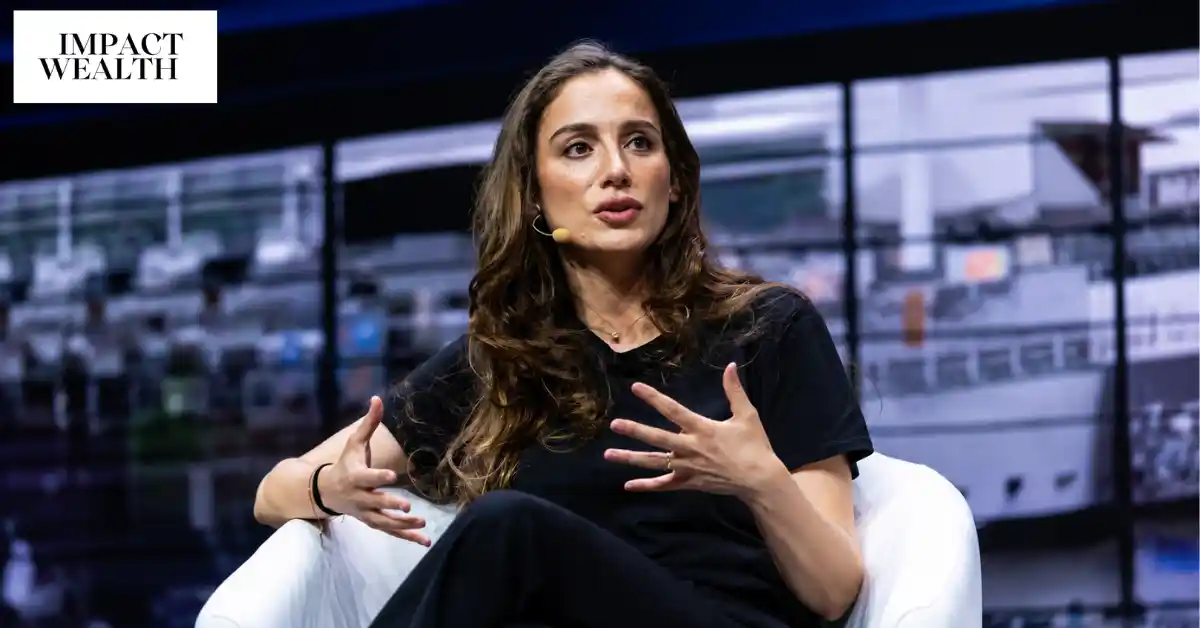
Mira Murati’s career offers a useful way to understand how power is changing inside artificial intelligence. From leading technology at OpenAI to becoming co-founder and CEO of Thinking Machines Lab, her trajectory has moved across research, product development, infrastructure and company building.
Her story, however, is bigger than one executive. As frontier AI becomes more dependent on specialized talent, enormous computing capacity, private capital and research infrastructure, the industry is creating a new kind of technology leadership. Murati sits at an interesting intersection of those forces.
That makes her relevant to a broader question: where does power actually sit in the AI industry with the people building models, the companies financing them, the hardware providers supplying them, or the organizations that determine how AI reaches users?
From OpenAI CTO to Founder of Thinking Machines Lab
Murati was born in Albania and later studied in the United States. She attended Colby College through the Davis UWC Scholars program and completed a bachelor’s degree in engineering at Dartmouth’s Thayer School of Engineering. Before entering the AI industry, she worked at Tesla and later led product and engineering at Leap Motion. Dartmouth describes her Tesla work as including the Model X and early Autopilot systems.
She joined OpenAI in 2018 and eventually became its chief technology officer. In 2022, OpenAI formally appointed her CTO, citing her leadership across research, product and partnerships.
At OpenAI, Murati became associated with the development and deployment of some of the company’s most visible systems, including ChatGPT, DALL-E and Codex. Dartmouth says she also oversaw research, product and safety during her later period at the company.
Her most publicly visible leadership moment came in November 2023, when OpenAI’s board appointed her interim CEO following Sam Altman’s departure. She returned to the CTO role after Altman returned later that month.
Murati left OpenAI in September 2024. By December that year, she had co-founded Thinking Machines Lab, establishing a new independent AI research and product company.
The significance of that move extends beyond her biography. A senior executive leaving a major AI laboratory to build another frontier organization demonstrates how AI talent itself has become strategic infrastructure.
Why Thinking Machines Lab Matters
Thinking Machines Lab describes itself as an AI research and product company focused on making AI more understandable, customizable and generally capable. Its stated mission is to build AI that extends human will and judgment.
That philosophy is reflected in its technical direction.
The company has worked on Tinker, a training platform that allows researchers to control aspects of model training and fine-tuning without managing the underlying infrastructure themselves. It has also developed models and research around multimodal interaction and customization.
In July 2026, Thinking Machines released Inkling, an open-weights multimodal model with 975 billion total parameters and 41 billion active parameters. It accepts text, image and audio inputs and is designed for customization and downstream development.
The company subsequently released Inkling-Small, a 276-billion-parameter model with 12 billion active parameters. Thinking Machines says the smaller model can deliver comparable performance in several areas while using less compute.
These releases matter because they show that the company is no longer simply an idea built around a prominent former OpenAI executive. It is developing research, training infrastructure and models of its own.
Mira Murati and the New Economics of AI Power
Building frontier AI requires much more than a good model architecture.
It requires researchers, engineers, data, evaluation systems, computing capacity, financing and the ability to turn research into products. Those resources increasingly reinforce one another.
| Source of AI Power | Why It Matters | Strategic Advantage |
|---|---|---|
| Technical Talent | Enables frontier research and product development | Researchers, engineers and model architects |
| Compute | Enables training and serving advanced models | GPUs, data centers and specialized infrastructure |
| Capital | Funds research and infrastructure | Venture investment and strategic partnerships |
| Research | Creates new capabilities and techniques | Training methods, architectures and evaluation |
| Distribution | Determines how AI reaches users | Products, APIs and enterprise platforms |
Murati’s career illustrates several of these connections at once.
Her OpenAI experience gave her exposure to research, product development and large-scale AI deployment. Her move into a new company then required assembling talent and securing infrastructure and capital.
That is increasingly characteristic of frontier AI leadership. The chief executive of an AI laboratory cannot think only about technology. The organization must also secure access to the resources that make advanced research possible.
Compute Is Becoming a Strategic Asset
The relationship between AI laboratories and infrastructure providers has consequently become one of the most important parts of the industry.
In March 2026, NVIDIA and Thinking Machines Lab announced a multiyear partnership involving at least one gigawatt of next-generation NVIDIA Vera Rubin systems, intended to support frontier-model training and customizable AI platforms. NVIDIA also disclosed a significant investment in Thinking Machines.
The partnership illustrates a basic reality of modern AI: advanced research depends on access to computing infrastructure at a scale that few organizations can build independently.
Thinking Machines has also expanded its use of Google Cloud infrastructure. TechCrunch reported in April 2026 that the company had signed a multibillion-dollar agreement with Google Cloud involving NVIDIA-powered systems.
For AI companies, therefore, infrastructure relationships are becoming strategic relationships.
The ability to attract talent matters. But talent without sufficient compute cannot necessarily train frontier systems. Likewise, capital without researchers produces infrastructure rather than intelligence. Competitive AI organizations increasingly need all of these pieces at once.
The Battle for AI Talent
AI researchers and engineers have become unusually mobile across the industry.
People move between organizations such as OpenAI, Anthropic, Google DeepMind, Meta and newer laboratories, carrying experience in model development, reinforcement learning, safety, infrastructure and product deployment.
Murati’s own career demonstrates the value of crossing disciplines. Her path has included mechanical engineering, automotive technology, human-computer interfaces, AI research and executive management. Dartmouth also notes her service on the United Nations High-Level Advisory Body on Artificial Intelligence.
That combination matters because frontier AI is no longer neatly divided between “research” and “business.”
The leaders building these organizations must understand enough of both to decide where scarce resources should go.
Human-Centered AI as a Different Strategic Philosophy
Thinking Machines Lab has also articulated a particular view of how people should interact with advanced AI.
In its July 2026 essay, “The Future Worth Building Is Human,” the company argues that AI should extend human will and judgment rather than remove people from the process. It emphasizes customization, human participation and models that can adapt to the organizations and individuals using them.
Murati expressed a similar position in a May 2026 WIRED interview, saying that keeping humans involved was central to the approach she wanted to pursue and linking that participation to the possibility of multiple future paths for advanced AI.
This does not mean Thinking Machines has solved the difficult questions surrounding human-AI collaboration. It does, however, establish a clear strategic philosophy. Thinking Machines Lab’s approach also reflects a broader debate over how humans should interact with increasingly capable AI agents and systems.
The company is attempting to compete at the frontier while placing customization and human participation closer to the center of its approach.
That creates an important contrast within the industry. Some AI development emphasizes increasing autonomous capability; Thinking Machines explicitly argues that human involvement can itself be a technical objective.
The New Architecture of AI Competition
| AI Industry Shift | Emerging Opportunity | Structural Challenge |
|---|---|---|
| Rise of AI Startups | More competition and experimentation | Capital intensity |
| Talent Mobility | Faster knowledge transfer | Concentration of expertise |
| Strategic Compute Partnerships | Access to frontier infrastructure | Dependence on infrastructure providers |
| Customizable AI | Greater user control | Safety and governance complexity |
| Independent AI Labs | Alternative research directions | Scaling against incumbents |
This creates a paradox.
AI development is becoming more concentrated because frontier systems require extraordinary resources. At the same time, new laboratories, open-weight models and mobile research talent can distribute some capabilities beyond the largest established organizations.
Thinking Machines itself sits within that tension. Its strategy depends on large-scale infrastructure while its published philosophy argues for more distributed control over how AI is shaped.
Neither concentration nor decentralization automatically solves the industry’s problems. Centralization can provide resources and coordination; decentralization can create experimentation and broader participation. Both can also introduce different risks.
What Murati’s Rise Says About AI Leadership
The more interesting lesson from Mira Murati is not that one person controls an important part of AI.
It is that the definition of an AI leader is changing.
Earlier technology companies could separate software engineering, infrastructure, capital and distribution into different functions. Frontier AI increasingly connects them.
A senior AI leader may need technical credibility, research judgment, product understanding, access to capital, relationships with infrastructure providers and the ability to recruit specialized talent.
Murati’s move from OpenAI to Thinking Machines Lab illustrates that transition particularly clearly. She moved from helping lead an established frontier laboratory to assembling another organization around a distinct research and product philosophy.
The industry’s response to that move has also been significant. Fortune’s 2026 Most Powerful Women ranking placed Murati at No. 98 overall and reported that Thinking Machines had raised $2 billion at a $12 billion valuation.
Those figures should be understood as measures of financial backing and organizational scale, not proof that the company has established technological superiority.
Unique Insight: Human Capital Is Becoming AI Infrastructure
The most important reason Mira Murati matters to this story is not simply her position as a prominent woman in artificial intelligence.
Her career demonstrates how human capital itself is becoming part of the infrastructure of frontier AI.
A powerful model requires more than computing hardware. It requires people who understand how to design training systems, evaluate models, manage research organizations and translate technical advances into usable products.
When those people move, they carry knowledge, networks and institutional experience with them.
That helps explain why the competition between AI laboratories increasingly looks like a competition for entire ecosystems rather than simply a competition between models.
Conclusion
Mira Murati’s journey from engineering and product development through OpenAI and now Thinking Machines Lab reflects a much larger transformation in artificial intelligence.
The next phase of the industry will not be determined by algorithms alone. It will depend on the combination of talent, capital, compute, research, infrastructure, distribution and organizational philosophy.
Thinking Machines Lab’s development shows how an independent laboratory can attempt to enter that environment with a distinct approach to customization and human-AI collaboration. Its partnerships and model releases also demonstrate the resources required to compete at the frontier.
For readers watching the AI economy, Mira Murati is therefore worth following not because she can single-handedly determine the future of AI, but because her career provides a window into where influence is increasingly being built: at the intersection of technical talent, institutional knowledge, capital and computing power.
Frequently Asked Questions
Who is Mira Murati?
Mira Murati is an Albanian-born engineer and technology executive who is co-founder and CEO of Thinking Machines Lab. She previously served as CTO of OpenAI.
What did Mira Murati do at OpenAI?
As CTO, Murati led or oversaw research, product and safety functions and was involved with major products including ChatGPT, DALL-E and Codex.
What is Thinking Machines Lab?
Thinking Machines Lab is an AI research and product company focused on building AI that is more understandable, customizable and collaborative.
What is Thinking Machines Lab’s approach to AI?
The company emphasizes human participation, customization and AI systems designed to extend human judgment and will.
What is Inkling?
Inkling is Thinking Machines Lab’s open-weights multimodal model. The company released it in July 2026 with 975 billion total parameters and 41 billion active parameters.
Why is compute important to AI companies?
Training and deploying advanced AI models requires substantial computing resources. Strategic relationships with infrastructure providers can therefore become important to the ability of AI laboratories to conduct frontier research.
What does Mira Murati’s career reveal about AI leadership?
It shows how modern AI leadership increasingly connects technical expertise with product development, research management, capital, infrastructure and talent recruitment.