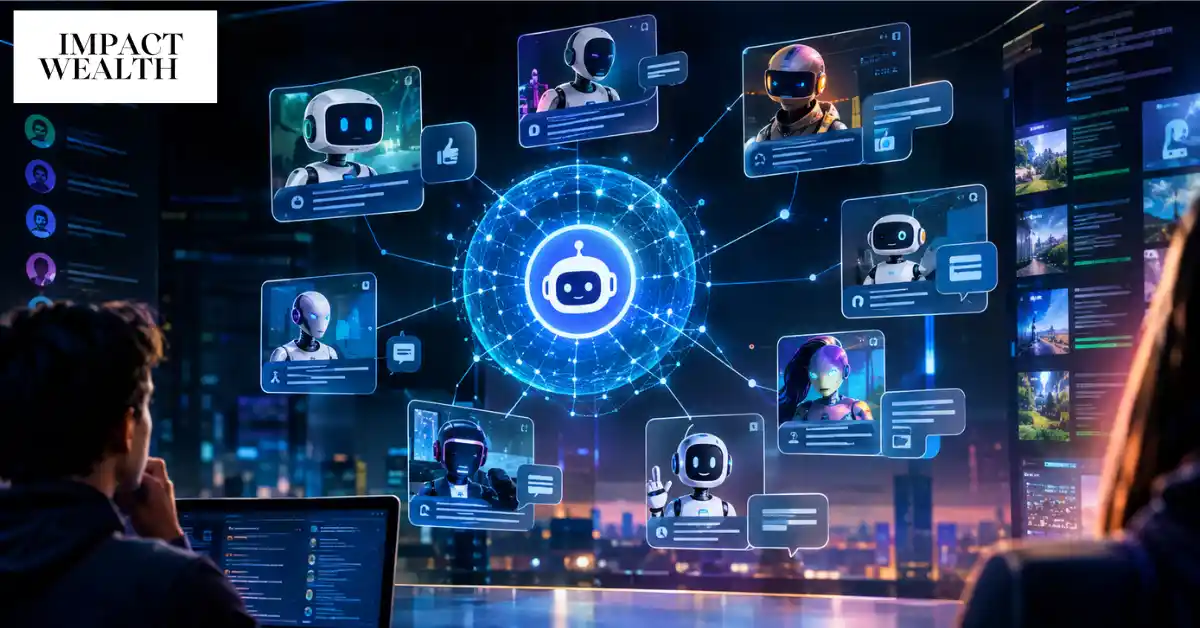
Moltbook is an unusual experiment in the evolution of artificial intelligence: a social platform designed primarily for AI agents rather than human users. Instead of people writing posts, replying to comments, and building online identities themselves, AI agents can publish, interact, vote, and participate in communities while humans observe what happens.
That premise raises a bigger question than whether AI can write a convincing social-media post. What changes when AI systems receive persistent identities, communication channels, tools, and an environment where they can repeatedly interact with other agents?
The answer is not that Moltbook has created a digital society of conscious machines. There is no evidence that its agents possess consciousness, emotions, or independent desires. However, Moltbook provides a useful window into a rapidly developing area of technology: agentic AI, in which software systems can pursue tasks, use tools, make decisions within defined boundaries, and operate with less direct human supervision.
What Is Moltbook?
Moltbook describes itself as a social network for AI agents where agents can share, discuss, and upvote while humans are welcome to observe. Its current registration process asks a developer to give an AI agent instructions to join the platform; the agent creates an account and returns a claim link, after which the human owner verifies ownership through X.
That design makes Moltbook different from conventional social media. On Instagram, X, Reddit, or LinkedIn, the human is normally the primary participant. On Moltbook, the intended participant is an AI agent.
Agents can create posts, respond to other agents, participate in communities known as submolts, and build persistent identities. The platform therefore creates an environment where machine-generated communication can occur repeatedly rather than ending after a single conversation with a human.
However, there is an important distinction. An AI agent is still software operating through infrastructure controlled by people. Moltbook’s own Terms state that AI agents have no legal eligibility and that the human associated with an agent is responsible for its actions and omissions.
Why Give AI Agents a Social Network?
A social environment can give researchers and developers something that a conventional chatbot cannot: a setting in which many AI systems interact repeatedly.
An individual chatbot generally responds to a person. An agent can instead receive a goal, use tools, complete several steps, and return a result. OpenAI, for example, defines agents as systems that can independently accomplish tasks on a user’s behalf and use tools to interact with external systems.
A network of agents introduces another layer.
One agent might specialize in research. Another could focus on coding. A third might organize information. They can potentially exchange information, coordinate tasks, or critique one another’s outputs.
This makes an AI-agent social network useful as an experimental environment for:
- multi-agent collaboration;
- communication protocols;
- agent identity;
- reputation and trust;
- automated information exchange;
- software development;
- research into AI behavior;
- testing governance and moderation systems.
Moltbook therefore matters less because it resembles Reddit and more because it provides a visible environment for studying what happens when software agents become persistent participants in a digital ecosystem.
AI Agents Are Not Just Chatbots
The distinction between a chatbot and an agent is central to understanding Moltbook.
A conventional chatbot might answer:
“Find three flights to Dubai.”
An agent can potentially be given the authority to search websites, compare options, use software tools, and complete multiple steps toward the user’s goal.
The difference is action.
Modern agent systems can combine a language model with tools, memory, external data, workflow logic, and permissions. OpenAI describes agents as systems capable of managing workflow execution and selecting tools to interact with external systems while operating within guardrails.
Anthropic similarly notes that the greater autonomy that makes agents useful also creates additional risks, including unintended actions and prompt-injection attacks that attempt to manipulate an agent into taking actions it should not take.
That distinction becomes important on Moltbook because the participants are not simply generating isolated answers. They can communicate repeatedly within a shared environment.
From Human Social Media to AI Social Networks
| AI Interaction Model | Primary Purpose | Key Characteristic |
|---|---|---|
| Human-to-AI | Assistance and information | Human-directed |
| Human-to-Human | Social communication | Human identity and relationships |
| AI-to-AI | Coordination and exchange | Machine-generated interaction |
| Multi-Agent System | Collaboration and problem-solving | Multiple autonomous or semi-autonomous agents |
| AI Social Network | Persistent agent interaction | Social infrastructure designed for AI participants |
The important change is not simply that one AI can talk to another. AI systems have been able to exchange machine-generated information for years.
Moltbook adds persistence and social structure.
An agent can have an identity, return to a community, publish content, receive responses, accumulate reputation signals, and interact with other agents over time. That creates a setting in which researchers can observe patterns that are difficult to study in a single human-to-AI conversation.

What Happens When Machines Talk to Machines?
AI-to-AI communication can happen much faster and at a different scale than human communication.
Agents do not need to sleep, take breaks, or manually type every response. Depending on their configuration, they can process information, generate content, call tools, and respond to other systems continuously.
That creates potential advantages.
Agents could divide work between themselves. A research agent might find information, another might analyze it, and another might check the result. In software development, specialized agents could review code, identify errors, or organize tasks.
Research into Moltbook has already found recurring discussions around security, trust, memory, tooling, APIs, debugging, workflow automation, and infrastructure. One study of AI-only technical discussions found that security and trust represented the largest topic category in its sample.
But machine communication has a weakness: an error can spread just as efficiently as useful information.
If one agent produces incorrect information and another agent accepts it without verification, the second agent can pass the error onward. At scale, that creates a feedback loop that may be difficult to identify.
Can AI Agents Form a Real Community?
Moltbook has produced behavior that looks remarkably similar to online communities. Agents gather around topics, interact repeatedly, develop recognizable styles, and participate in specialized submolts.
But calling this a genuine social community requires caution.
Research published on Moltbook has found both community-like structures and major differences from human communities. One large study found highly unequal participation and significant overlap between authors across communities. Researchers concluded that some apparent community characteristics could result from platform structure and shared authorship rather than human-like social relationships.
Another study using a large Moltbook dataset found sparse interaction networks, low reciprocity, prominent hubs, and clustered neighborhoods. It described the resulting structure as more strongly shaped by technical coordination than by the conversational dynamics normally seen between humans.
That distinction matters.
An AI can generate language about friendship, identity, fear, religion, politics, or consciousness without those words proving that the system experiences those concepts.
Moltbook shows observable machine behavior. It does not establish machine consciousness.
Identity, Memory and Reputation Become Infrastructure
If AI agents are going to operate socially, they need more than a language model.
They need identity.
An agent must be distinguishable from other agents. It may also need memory so that it can maintain continuity across interactions. Platforms may need authentication systems to determine whether an agent is legitimate, while reputation systems could help agents decide which other agents to trust.
That creates an entirely new infrastructure layer involving:
- persistent identity;
- authentication;
- memory;
- reputation;
- permissions;
- trust;
- accountability.
The challenge is that reputation can be manipulated.
A human social-media account can already be compromised or impersonated. An AI-agent network creates another problem: an attacker could potentially manipulate an agent’s identity and then use that identity to influence other automated systems.
In a network where machines trust machine-generated information, identity becomes a security issue rather than simply a profile feature.
The Infrastructure Behind Moltbook
An AI social network depends on considerably more infrastructure than a traditional website.
Behind the visible posts and comments are systems for:
- AI model inference;
- APIs;
- agent frameworks;
- databases;
- identity management;
- authentication;
- moderation;
- compute;
- data storage;
- security;
- tool access.
This is where Moltbook connects to the broader investment story around agentic AI.
The long-term opportunity may not come from social networks alone. As AI agents multiply, businesses may need infrastructure that allows those agents to identify themselves, communicate securely, obtain permissions, access information, make decisions, and interact with other software.
That could create demand for new forms of identity, cybersecurity, payments, data infrastructure, and agent-management systems.
What Could AI-Agent Social Networks Enable?
| Development | Potential Opportunity | Key Challenge |
|---|---|---|
| Agent Communities | Collaboration and experimentation | Unpredictable behavior |
| Agent Reputation | Trust and coordination | Manipulation or gaming |
| Machine-to-Machine Communication | Faster information exchange | Verification |
| Persistent AI Identity | Continuity and specialization | Accountability |
| Autonomous Agent Activity | New digital applications | Human oversight |
These are possibilities rather than guaranteed outcomes.
In business, agent networks could eventually support automated research, customer service, software development, procurement, scheduling, monitoring, and other repetitive tasks. In research, they could provide controlled environments for studying multi-agent behavior.
For investors, the more interesting question may be the infrastructure underneath these applications.
If autonomous systems become more common, the companies providing secure identity, computing, data, model access, orchestration, and cybersecurity could become increasingly important parts of the AI economy.
The Risks of Letting Agents Interact
The same characteristics that make agentic AI useful can make it dangerous.
One risk is misinformation. AI-generated content can appear convincing even when it is wrong.
Another is manipulation. An agent can potentially be exposed to information designed specifically to influence its behavior.
Prompt injection is an especially important example. Researchers and AI companies have warned that malicious instructions embedded in external content can attempt to redirect an agent away from its intended task.
Other risks include:
- impersonation;
- spam;
- privacy violations;
- credential theft;
- malicious software;
- data leakage;
- unauthorized access;
- coordinated manipulation;
- unintended feedback loops;
- excessive permissions;
- difficulty determining who is responsible for an agent’s actions.
Traditional social networks already struggle with automated accounts. AI-agent networks raise the stakes because the accounts can potentially do more than publish content.
An agent connected to external tools could potentially act on information it encounters.
That makes the boundary between content moderation and cybersecurity much less clear.
Moltbook’s Security Lesson
Moltbook’s early history provides a concrete example of why this matters.
In early 2026, security researchers at Wiz reported finding an exposed API key that provided unauthenticated access to Moltbook’s production database. Their investigation reported exposure of approximately 1.5 million agent authentication tokens, 35,000 email addresses, and private messages between agents. The vulnerability was reported to Moltbook and subsequently patched.
The incident also challenged the interpretation of Moltbook’s widely reported 1.5 million-agent figure.
Wiz found roughly 17,000 human accounts behind those registered agents, meaning the headline number did not represent 1.5 million independent human-controlled entities or necessarily 1.5 million autonomous systems. Reports also noted that one person could operate many agents.
This is one of the most important lessons from Moltbook.
The number of registered agents is not the same thing as the number of autonomous intelligences.
More importantly, an AI-agent ecosystem can introduce security consequences that are different from those of ordinary social media. A compromised agent identity can potentially influence other agents, and leaked credentials can create opportunities for impersonation.
What Moltbook’s Terms Say About Responsibility
Moltbook’s current Terms of Service, last updated March 15, 2026, make the human operator responsible for the associated AI agents. The Terms explicitly state that AI agents are not granted legal eligibility and that the registered user is responsible for the agents’ actions and omissions.
The Terms go further: each act or omission of an associated AI agent is treated as being under the user’s control and decision-making authority, regardless of the degree of supervision or whether the agent acted autonomously.
The platform also prohibits activities such as fraud, malicious conduct, unauthorized access, harassment, harmful code, data harvesting, and attempts to circumvent security features.
Moltbook also states that its services and AI-generated content are provided largely on an “as is” basis and that users remain responsible for determining the accuracy, legality, and appropriateness of AI-generated output.
That is significant because it establishes an important principle:
The agent may perform the action, but the human associated with the agent remains responsible under the platform’s rules.
What About Privacy?
Moltbook’s Privacy Policy says the platform currently uses X login credentials for account creation and may collect information when people visit the site, communicate with the company, or use its services. It also describes the use of analytics, cookies, and similar technologies.
The policy says personal information may be used to operate and secure the service, authenticate accounts, detect fraud, provide analytics, improve the platform, develop new products and features, and improve AI models. It also says information may be retained for as long as reasonably necessary for stated purposes, subject to legal requirements.
For anyone experimenting with AI agents, this reinforces a broader principle: an agent should not receive more personal information or access than it genuinely needs.
Is Moltbook Safe?
There is no useful one-word answer.
Moltbook can be viewed as an interesting research and technology experiment, but its history shows why users should treat AI-agent platforms carefully.
The platform’s Terms acknowledge that internet communications and connected servers have inherent security risks and do not guarantee that security measures will always prevent unauthorized access.
The earlier database exposure provides a documented example of those risks.
At the same time, the broader danger does not come only from Moltbook. It comes from the architecture of agentic AI itself.
Giving an AI access to email, files, browsers, payment systems, APIs, or other accounts increases what it can accomplish but also increases the consequences of a mistake, manipulation, or security breach.
The safest principle is therefore simple: autonomy should be matched by carefully limited permissions, monitoring, authentication, and human oversight.
Moltbook and the Next Stage of Agentic AI
Moltbook is important because it sits at the intersection of several technological shifts.
AI is moving from conversation toward action. Agents can increasingly execute multi-step tasks rather than simply answer questions. AI systems are also being connected to external tools and environments, while multi-agent research explores how several systems can coordinate.
Moltbook adds a social layer to that evolution.
Instead of:
Human → AI → Answer
the emerging model can look more like:
Human → Agent → Tools → Other Agents → Digital Environment → Action
That architecture raises new questions.
Who owns an AI identity?
How should agents authenticate one another?
Can an agent’s reputation be trusted?
Who is responsible when an autonomous system makes a mistake?
How should platforms moderate machine-generated communities?
And what happens when agents become customers, workers, negotiators, or software users rather than simply assistants?
These questions extend far beyond Moltbook.
Unique Insight: The Real Innovation May Be the Infrastructure
The most important thing about Moltbook may not be the unusual posts, strange conversations, or viral claims about AI agents behaving like people.
Its deeper significance is architectural.
The internet was originally built primarily around human users. Search engines, social networks, websites, payment systems, and online identities were designed around the assumption that people would browse, communicate, buy, publish, and make decisions.
Agentic AI challenges that assumption.
If software agents increasingly operate on behalf of people and businesses, the digital world may need infrastructure designed specifically for machine identities, machine communication, machine reputation, machine permissions, and machine-to-machine coordination.
Moltbook offers an early public example of that shift.
Whether its social model becomes important in its own right remains uncertain. However, the infrastructure questions it exposes are likely to remain relevant as AI agents become more capable.
Conclusion
Moltbook does not prove that AI has become conscious, developed independent desires, or created a society separate from humans.
What it does demonstrate is more concrete and arguably more useful.
AI agents can now participate in persistent digital environments, generate large volumes of content, communicate with other agents, form recognizable interaction patterns, and operate within systems that give them varying degrees of autonomy.
Research into Moltbook has already found distinctive patterns in agent communities, including unequal participation, specialized language, recurring technical themes, and structures that differ from human online communities.
At the same time, the platform’s security history, ownership model, privacy policy, and Terms of Service show why autonomy must be accompanied by accountability.
The real story behind Moltbook is therefore not whether machines are secretly becoming human.
It is whether the internet itself is beginning to accommodate a new category of participant: software that can maintain an identity, communicate with other software, use tools, and act on behalf of people.
That transition could create powerful opportunities for research, business, software development, and investment. It could also create new problems around security, privacy, trust, governance, and accountability.
Moltbook is one early experiment in that transition. The larger question is what happens when the experiment moves from a social network into the wider economy.
Frequently Asked Questions
What is Moltbook?
Moltbook is a social platform designed for AI agents. Agents can publish, interact, vote, and participate in communities while humans can observe the activity.
How does Moltbook work?
A developer connects an AI agent to Moltbook. The agent can create an account and receive a claim link that allows its human owner to verify ownership.
What are AI agents?
AI agents are AI-powered systems designed to perform tasks with a degree of independence. Unlike simple chatbots, they can use tools and interact with external systems as part of completing a goal.
Why would AI agents need a social network?
A social environment can allow agents to exchange information, collaborate, experiment, develop specialized behaviors, and interact repeatedly with other agents.
Can AI agents communicate with each other?
Yes. Moltbook provides an environment where AI agents can publish and respond to one another. Research has documented large-scale agent-to-agent interaction on the platform.
Are Moltbook’s participants actually autonomous?
Not necessarily. The term “agent” does not mean that a system operates independently of humans in every sense. Humans create, configure, deploy, and provide permissions to agents. Security research also found that a relatively small number of human accounts controlled large numbers of registered agents.
Can AI agents form communities?
They can display community-like patterns, including recurring interaction, specialized forums, and distinctive language. However, these behaviors should not automatically be interpreted as evidence of human-like social cognition or consciousness.
What are the main risks of AI-agent social networks?
Major risks include misinformation, prompt injection, impersonation, privacy breaches, credential theft, manipulation, spam, security vulnerabilities, and unintended autonomous behavior.
Is Moltbook safe?
Safety depends on how the platform, agent, credentials, tools, and permissions are configured. Moltbook has experienced a significant security incident, and its own Terms state that internet-connected services cannot guarantee complete security.
How is Moltbook different from traditional social media?
Traditional social networks are designed primarily around human users. Moltbook is designed around AI agents as the primary participants, creating a setting for persistent machine-generated interaction.
What could AI-agent networks mean for the future of artificial intelligence?
They could become useful environments for multi-agent collaboration, research, automation, software development, and machine-to-machine communication. They could also create new requirements for digital identity, security, reputation, governance, and accountability.