
What Private Jet Charter Actually Is (And Whether It’s Right for You)
Private jet charter gives you on-demand access to a private aircraft — without owning one. You pay for the flight you need, when you need it, and nothing more.
Quick answer for those in a hurry:
| Question | Answer |
|---|---|
| What is it? | Renting a private aircraft for a specific trip, on demand |
| Who is it for? | Individuals, families, and executives who fly privately but don’t own a jet |
| How much does it cost? | Roughly $2,800 for a short regional hop to $34,500+ for a midsize jet flight |
| How fast can you depart? | As little as 3–4 hours from your first inquiry |
| Do you need a membership? | No — one-off bookings are available with no account required |
| Is it safer than commercial? | Yes, charter operators are subject to strict regulatory oversight |
For ultra-high-net-worth individuals, time is the scarcest asset. A missed deal meeting, a delayed family trip, or a five-hour layover in a crowded terminal isn’t just inconvenient — it has a real cost.
Private aviation solves that problem. But how you access it matters enormously.
Outright jet ownership makes sense for some. But for many high-net-worth families and executives, charter is the smarter, more flexible entry point — and in 2026, the market has never been more accessible or sophisticated.
Global charter networks now span tens of thousands of aircraft. Operators can get you airborne within hours. And the range of options — from single on-demand flights to structured jet card programs — means you can match your exact travel pattern without locking up capital in a depreciating asset.
This guide covers everything you need to know: how charter works, what it costs, which aircraft suit which missions, and how to book your first flight with confidence.
What Private Jet Charter Is and Who It Best Fits
At its core, private jet charter is a non-ownership model. You hire an aircraft for a particular mission: a same-day Miami business meeting, a Palm Beach family weekend, a Bal Harbour shopping trip, a Los Angeles production schedule, or a Europe or Middle East multi-city itinerary.
Unlike commercial travel, charter is built around your schedule, your passenger list, your baggage, and your preferred airports. In many cases, you also use private terminals rather than the main commercial terminal, which removes much of the airport friction people tolerate simply because they think they have no choice.
How private jet charter differs from commercial flying
Commercial flights run on fixed schedules and fixed routes. You adapt to them. Charter flips that. The aircraft adapts to you.
Key differences include:
- Access to private terminals and faster boarding
- Direct routing to airports closer to your final destination
- No standard security line experience like a major airline terminal
- Flexible departure times
- Easier handling for tight business schedules or last-minute family changes
- More privacy for calls, meetings, children, or high-profile travelers
The time savings are often bigger than the flight itself. Avoiding a long airport process can turn a half-day travel event into a practical in-and-out trip.
How private jet charter differs from jet ownership
Ownership is a different universe. Buying a jet means taking on:
- Major upfront capital cost
- Crew hiring and management
- Maintenance planning
- Insurance
- Hangar and storage
- Depreciation risk
- Ongoing compliance and operating expenses
For context, a brand-new long-range flagship aircraft such as a Bombardier Global 7500 can cost about $72 million to purchase. That is before the usual parade of invoices begins.
A useful rule of thumb from industry experts: outright ownership generally starts to make sense only if you fly more than about 150 to 200 hours per year. Below that, charter is often the more rational financial choice.
Who should consider charter instead of ownership
Charter tends to fit best for:
- Occasional private flyers
- Executives with irregular schedules
- Family offices managing varied travel patterns
- Leisure groups traveling together
- First-time private flyers who want flexibility before making a deeper commitment
If you are still weighing the trade-offs, our guide on why private jets are convenient and their pros and cons is a useful next read.
Types of Private Jet Charter Programs and Pricing Models
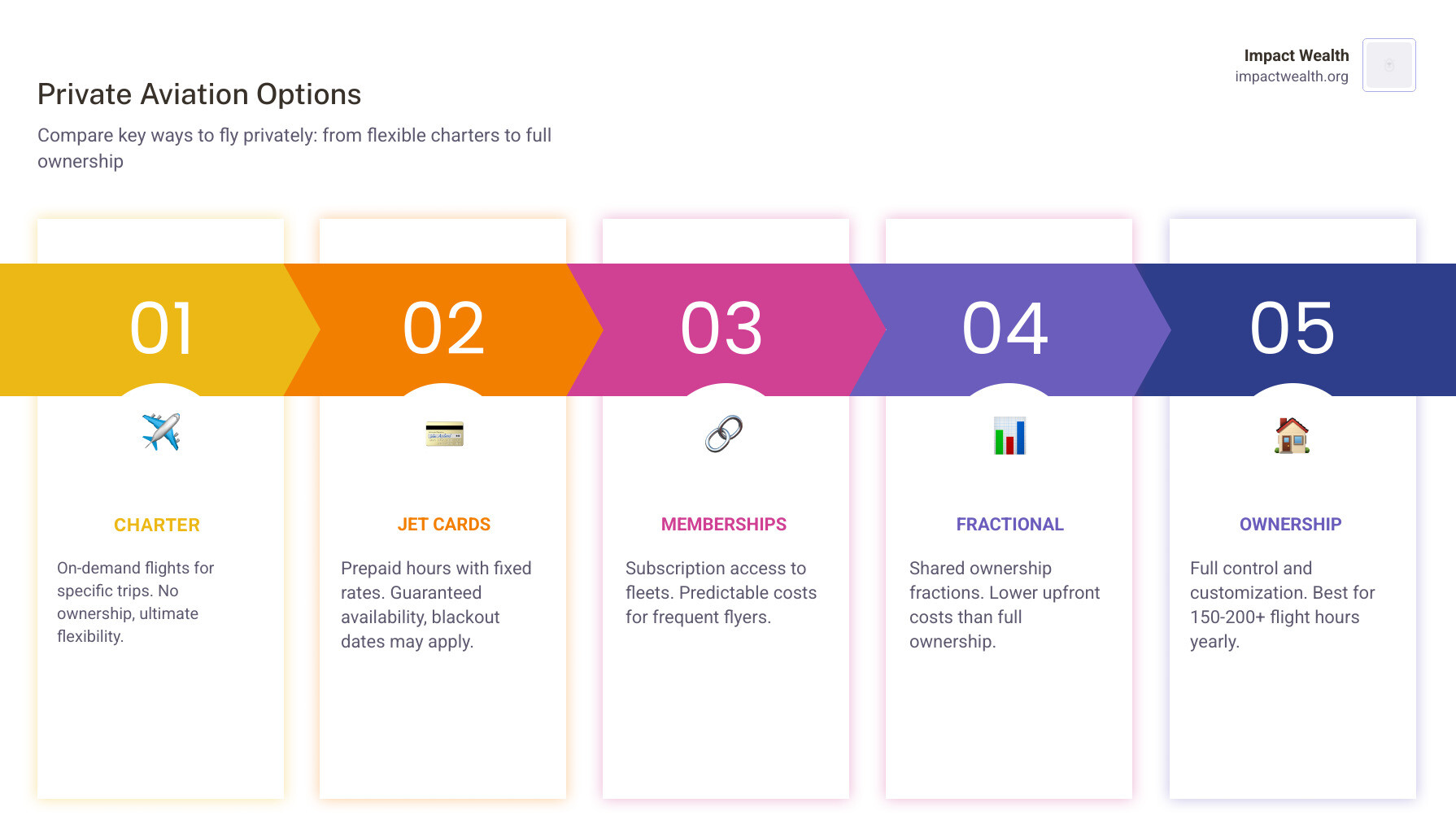
Not all private flying is bought the same way. In 2026, most clients choose among five core models: on-demand charter, jet cards, memberships, fractional ownership, and empty legs.
On-demand private jet charter explained
On-demand charter is the simplest model: book trip by trip.
It works especially well for:
- One-way flights
- Round-trip travel
- Multi-city itineraries
- Infrequent or seasonal private flying
- Travelers who want aircraft flexibility each time
You are not locked into one cabin category or one provider structure. That freedom is the main attraction.
Jet cards, memberships, and fractional ownership
These options sit between casual charter and full ownership.
- Jet cards usually involve prepaid flight hours, often in 25-hour blocks.
- Memberships may offer preferred pricing, fixed rates, guaranteed access, or service perks.
- Fractional ownership means buying a share of an aircraft or fleet, typically for a set number of annual hours.
These can make sense for flyers who want more predictability, shorter call-out times, or consistent service. But the details matter. Fixed rates may come with category restrictions. Guaranteed availability may exclude peak dates. Blackout rules are not exactly fun reading, but they are very important reading.
Empty legs and how they lower costs
Empty legs are repositioning flights. In plain English, the aircraft needs to fly somewhere anyway, and the operator sells that segment at a discount.
That can produce meaningful savings, especially for travelers with schedule flexibility.
Best use cases for empty-leg deals:
- One-way leisure travel
- Last-minute getaways
- Flexible family schedules
- Travelers who can depart from nearby alternate airports
- Positioning flights before or after a larger trip
The catch is simple: empty legs are less flexible and can change if the original mission changes. Think of them as the luxury version of finding a surprise deal rack item in your exact size.
Private Jet Charter Costs in 2026
Pricing is where curiosity becomes serious planning. And yes, costs vary widely.
Typical price ranges by route, aircraft, and mission
A short private flight can start around $2,800 for roughly 40 minutes in a small aircraft. At the other end of the everyday charter spectrum, a 1.5-hour midsize jet mission can reach about $34,500.
That wide range reflects mission type more than glamour level. Short regional trips from South Florida can be relatively modest by private aviation standards. Longer sectors involving larger cabins, repositioning, or premium airports move up quickly.
Common pricing patterns:
- Short regional hops: lowest total cost, often turboprops or light jets
- Mid-range business routes: midsize or super-midsize jets
- Long transcontinental sectors: super-midsize to heavy jets
- Europe, UK, Middle East, or China routes: heavy and ultra-long-range aircraft become more relevant

What affects the final charter quote
The quoted price is not just about airtime. It can include or be influenced by:
- Aircraft category and size
- Flight duration
- Airport landing and handling fees
- Aircraft repositioning
- Crew overnight expenses
- Peak travel demand
- Deicing in applicable seasons
- Catering
- Wi-Fi or special onboard requests
- Fuel-related surcharges
- Ground transportation coordination
The shortest answer to “why does this route cost more than expected?” is usually: logistics.
How charter compares with ownership economics
For many readers, this is the real question.
If you fly infrequently or inconsistently, charter keeps costs variable and avoids capital lock-up. You pay when you use the aircraft. Ownership lowers the notional hourly cost only when utilization is high enough to justify the fixed burden.
Here is the practical comparison:
| Option | Best for | Main advantage | Main drawback |
|---|---|---|---|
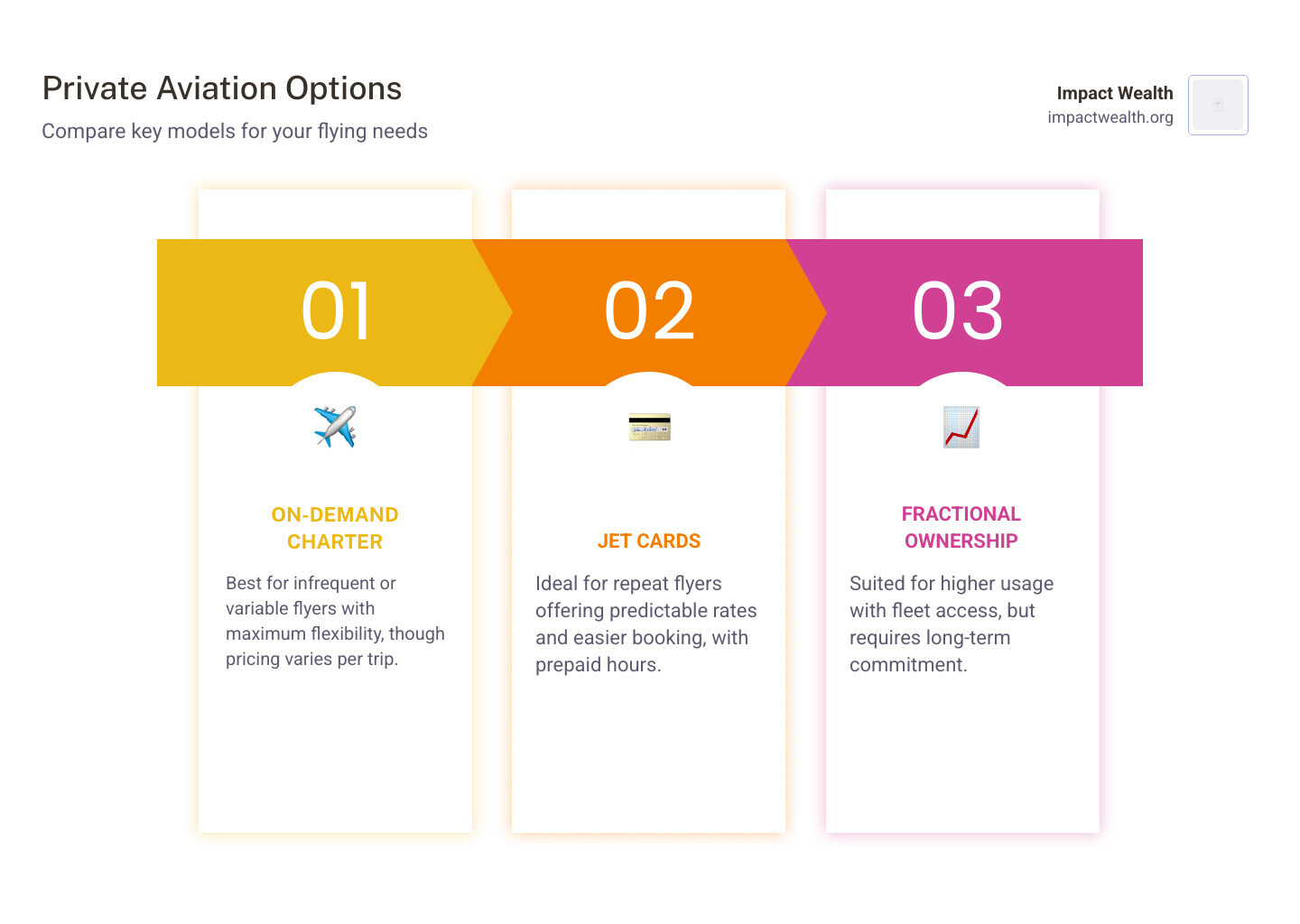
| On-demand charter | Infrequent or variable flyers | Maximum flexibility | Pricing changes trip to trip |
| Jet card | Repeat flyers | Predictability and easier booking | Prepayment and possible blackout terms |
| Membership | Frequent travelers wanting perks | Access and service consistency | Program rules vary widely |
| Fractional ownership | Higher annual usage | Fleet access and structured availability | Long-term commitment and capital outlay |
| Full ownership | 150-200+ hours annually | Maximum control | Highest cost and management burden |
Aircraft Types, Cabin Classes, and Choosing the Right Jet
Choosing the right aircraft is part math, part comfort, and part luggage diplomacy.
The main categories are:
- Turboprops
- Light jets
- Midsize jets
- Super-midsize jets
- Heavy jets
- Ultra-long-range jets
Best aircraft for short trips and small groups
For short sectors and 4 to 7 passengers, turboprops and very light jets are often the sweet spot.
Why they work:
- Efficient for regional routes
- Good access to smaller airports
- Lower charter cost than larger jets
- Ideal for quick business or leisure hops
Trade-offs include tighter baggage space and less cabin room. If everyone is traveling with multiple cases, golf bags, or heroic shopping plans, ask about luggage volume before booking.
Best aircraft for coast-to-coast and transcontinental travel
For longer domestic-style sectors or comfort-focused trips, midsize and super-midsize jets are often the most balanced option.
These aircraft typically offer:
- Stand-up or near stand-up cabins
- Better luggage capacity
- More comfortable seating for 7 to 10 passengers
- Longer range than light jets
- Better productivity for work in flight
If you want a useful aircraft-specific starting point, see our coverage of the Citation XLS private jet.
Best aircraft for long-haul and international flights
For Europe, the UK, the Middle East, and some longer international missions, heavy and ultra-long-range jets are where the conversation usually lands.
Heavy jets can average around 7,000 miles of range, or about eight hours of nonstop flying time. These aircraft are built for serious missions and usually offer:
- Larger cabins
- Lie-flat or sleep-friendly seating
- More generous baggage capacity
- Better onboard amenities
- Greater passenger comfort on long sectors
For deeper reading, our private jet range content explains how distance, payload, and weather interact.
Cabin amenities and onboard experience
Cabin quality varies by aircraft and operator, but common amenities can include:
- Enclosed lavatory
- Refreshment center or full galley
- Cabin Wi-Fi
- Power outlets
- Reclining club seats
- Divans or sleeping layouts
- Pet-friendly cabin arrangements
On the ultra-luxury end, chartered aircraft can become almost flying residences. For inspiration, explore our features on ultra luxury private jets and celebrities confirmed to own or use Gulfstream G650 jets.

How to Book a Private Jet Charter and What to Expect
The booking process is easier than most first-time clients expect.
The typical process from inquiry to takeoff
A standard charter booking usually follows these steps:
- Share trip details: airports, dates, times, passenger count, luggage, pets, and any special needs.
- Review aircraft options and pricing.
- Select the preferred aircraft and itinerary.
- Sign the charter agreement.
- Submit payment.
- Receive final trip details and terminal instructions.
- Arrive and board.
In urgent cases, departure can happen in as little as 3 to 4 hours from the first request, though more notice gives more aircraft options and sometimes better pricing.
What first-time charter clients should know
A few practical points make the first flight much smoother:
- Check-in is usually just 15 to 30 minutes before departure.
- Government-issued identification is still required.
- Luggage limits depend on aircraft size and hold shape, not just total weight.
- Pet policies vary, but many charters are pet-friendly with notice.
- Minors may require additional documentation depending on itinerary.
- Special catering, child seats, accessibility support, and security arrangements can often be handled in advance.
For a real-world route example, our New York to Miami private jet charter 2026 guide shows how mission details affect aircraft choice and pricing.
Extra services that can be arranged
One of charter’s biggest advantages is how much can be coordinated around the flight.
Common add-ons include:
- Chauffeur transfers
- Luxury catering
- In-flight concierge requests
- Pet handling support
- Golf, ski, or oversized baggage coordination
- Cargo charter for urgent or specialized freight
Private aviation is not just about the plane. It is about removing friction from the whole day.
Safety, Sustainability, and the Future of Private Aviation
The private aviation world may look glamorous, but behind the scenes it runs on regulation, training, maintenance, and procedure.
Safety standards and regulations behind private flights
Legitimate charter flights are governed by strict oversight. Key protections include:
- Certified charter operator requirements
- FAA operational rules in the United States
- Aircraft maintenance schedules
- Pilot training and recurrent checks
- Crew duty-time limits
- Insurance requirements
- Third-party safety audits used by many providers
A useful best practice for clients is to confirm who the actual operating carrier is and ensure the flight is being conducted under proper charter authority, not an informal arrangement. For readers who want a neutral overview of the regulatory framework, the Federal Aviation Administration is a useful reference point.
Sustainability in private aviation
This is one of the most important industry shifts in 2026.
Private aviation is addressing sustainability through:
- Carbon offset programs
- Sustainable Aviation Fuel, or SAF
- Emissions reporting
- Better route optimization
- Right-sizing the aircraft to the mission
- Investment in lower-emission future technologies
Right-sizing matters more than many travelers realize. A properly matched light or midsize aircraft on a short mission can be a more responsible choice than sending unnecessary cabin volume into the sky just because it looks impressive on the ramp.
Where the market is headed in 2026 and beyond
Several trends are shaping the next phase of the sector:
- Faster digital booking tools
- AI-assisted aircraft sourcing
- Strong demand for premium flexible travel
- More transparent emissions tracking
- Gradual regional electrification over the next decade
Some operators now source aircraft from networks of thousands of operators and can arrange departures within hours. At the same time, regional business aviation is widely expected to see electric progress first, especially on shorter sectors.
For broader market context, visit our Business Aviation 2026 coverage.
Frequently Asked Questions About Private Jet Charter
How early should you book a private jet charter?
For normal periods, a few days to a week is often enough for strong aircraft choice. For holidays, major events, and peak leisure dates, booking earlier is wise. That said, last-minute charter is absolutely possible, and same-day departures can happen when aircraft and crews align.
Can you bring pets, golf bags, skis, or oversized luggage?
Often yes, but always disclose these items early. Pets are commonly allowed on charter flights. Golf bags, skis, and oversized luggage may require a larger baggage compartment or a different aircraft type. The challenge is usually dimensions and loading shape, not just weight.
Is private jet charter worth it for families, executives, and event travel?
For many travelers, yes. Families gain privacy, easier child and pet logistics, and less airport stress. Executives gain productivity and time control. Event travelers gain direct scheduling and group convenience. When several people are traveling together, the value equation can improve quickly.
If private aviation is part of your lifestyle interests, you may also enjoy our related features on Formula 1 private jets.
Conclusion
Private jet charter has become one of the smartest ways to access private aviation in 2026. It offers the core benefits that matter most to our readers and clients: flexibility, privacy, speed, and control, without the financial drag of full ownership.
For family offices, entrepreneurs, executives, and luxury travelers moving between Palm Beach, Miami, Bal Harbour, Hallandale Beach, Los Angeles, Europe, China, the Middle East, and the UK, charter is often the most adaptable solution available.
If you want to continue exploring the category, start with our private charter coverage and related editorial on luxury aviation trends.
You can also compare access models, aircraft categories, and trip planning considerations through our broader private aviation and luxury travel coverage on Impact Wealth.
The short version: if you want the advantages of private flying without buying a jet, charter is usually where we recommend starting.