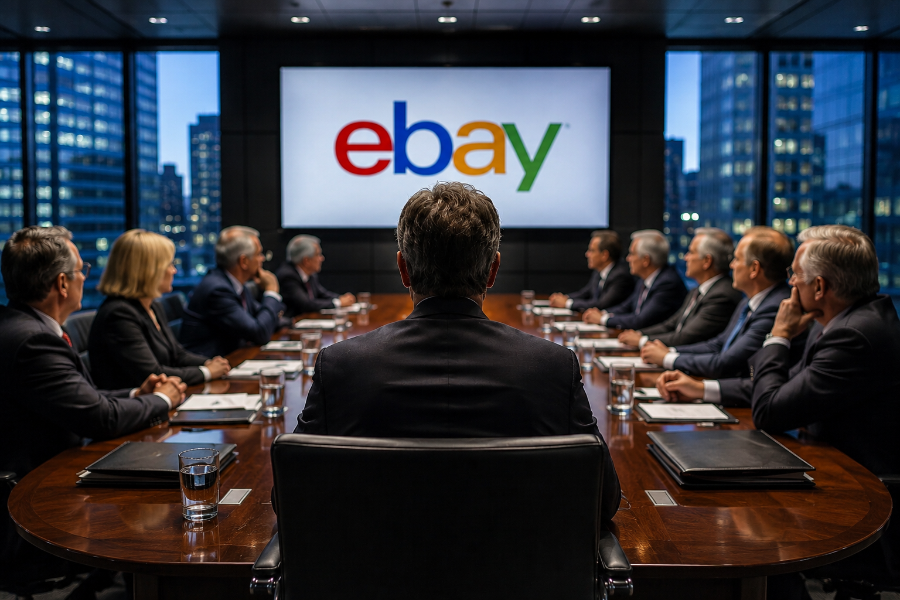
The phrase eBay Rejects GameStop’s $56 Billion Takeover Bid quickly became one of the most discussed headlines in financial markets after reports emerged that GameStop had made an unexpected proposal to acquire the online marketplace giant, following its earlier $56B bid to acquire eBay. The proposed $56 billion takeover offer surprised Wall Street because it paired two companies from very different corporate trajectories: one is a long-established e-commerce platform, while the other is a retailer still redefining itself after years of transformation and meme-stock volatility.
However, eBay’s board moved swiftly and rejected the approach, citing concerns around valuation, financing, and strategic alignment. As a result, investors immediately reassessed both companies’ outlooks. Trading volumes surged, analysts issued rapid commentary, and both stocks experienced significant price swings. The news also revived debate over whether retail-driven market momentum can support large-scale corporate transactions.
Moreover, the rejected bid raised broader questions about the future of consolidation in digital commerce. GameStop’s attempt suggested a bold expansion strategy beyond gaming retail, yet many market participants questioned whether such an acquisition could realistically be funded or integrated. Therefore, the failed proposal has become more than a corporate headline—it now reflects the tension between speculative market enthusiasm and traditional corporate finance discipline.
Why eBay Rejects GameStop’s $56 Billion Takeover Bid?
The central reason eBay Rejects GameStop’s $56 Billion Takeover Bid appears to be a combination of valuation concerns and skepticism over financing. eBay’s board reportedly viewed the offer as lacking sufficient certainty, especially because GameStop would likely need a complex mix of debt and equity to complete a transaction of that size.
Moreover, eBay’s directors have a fiduciary duty to protect shareholder interests. From that perspective, accepting an offer from a company undergoing a strategic reinvention carries substantial risk. eBay remains profitable and established in global online marketplaces, while GameStop continues transitioning from its legacy brick-and-mortar model.
Additionally, strategic mismatch played a major role. Although both companies operate in consumer-facing commerce, their core business models differ significantly. eBay focuses on peer-to-peer and merchant marketplace operations, while GameStop is still associated with gaming hardware, software, and collectibles.
Key reasons behind the rejection included:
- Concerns over whether the offer price reflected long-term value
- Doubts about GameStop’s financing capacity
- Resistance to a potentially hostile takeover structure
- Uncertainty over operational synergies
- Board preference for independent growth strategy
Consequently, eBay’s decision signaled that corporate boards remain cautious when confronted with highly ambitious acquisition proposals driven by market momentum.
How the Market Reacted to the Rejected Takeover Offer?
The market response was immediate and intense. Once news spread that eBay Rejects GameStop’s $56 Billion Takeover Bid, both stocks saw sharp intraday volatility. eBay shares initially jumped on speculation of a takeover premium, while GameStop shares whipsawed as traders assessed financing risk.
Meanwhile, trading desks reported unusually high volumes in options markets, particularly short-dated contracts tied to both companies. This indicated that investors were pricing in further volatility, not just a one-day reaction.
However, analyst sentiment remained cautious. Several firms suggested that the proposal was unlikely to progress, even before the formal rejection. Therefore, the market interpreted the event less as a credible merger and more as a sign of aggressive strategic experimentation by GameStop.
Immediate market effects included:
- Spike in trading volume
- Sharp volatility in GameStop shares
- Temporary rise in eBay valuation
- Increased options activity
- Broad discussion across financial media
As a result, the event sparked renewed attention to speculative corporate actions in a tighter capital market environment.
Key Factors Behind eBay’s Rejection of GameStop’s Bid
| Factor | eBay Concern | Market Impact | Investor Reaction | Strategic Risk |
|---|---|---|---|---|
| Valuation | Offer may undervalue future growth | Short-term price jump | Mixed | Medium |
| Financing | Deal funding uncertainty | GameStop volatility | Negative | High |
| Strategic Fit | Limited synergy | Sector debate | Skeptical | High |
| Governance | Hostile approach concerns | Broader scrutiny | Cautious | Medium |
| Execution | Integration challenges | Analyst downgrades | Negative | High |
Why GameStop Pursued a Massive eBay Acquisition?
The GameStop takeover bid eBay narrative did not emerge in isolation. GameStop has spent several years trying to reshape its corporate identity beyond traditional gaming retail. Therefore, an acquisition of eBay would have represented a dramatic attempt to accelerate that transformation.
GameStop’s management has faced constant investor pressure to show growth beyond physical stores. Moreover, e-commerce expansion offers a logical path because digital transactions align with shifting consumer habits. Buying eBay would have instantly provided a global marketplace infrastructure.
Additionally, GameStop has sought to move away from the perception that it is solely a meme-stock symbol. Acquiring a mature platform like eBay could have signaled a new era focused on scale, logistics, and marketplace economics.
Potential strategic motives included:
- Diversifying beyond gaming sales
- Expanding digital marketplace operations
- Leveraging brand recognition
- Accessing eBay’s user base
- Redefining long-term corporate identity
Nevertheless, the scale of the bid shocked many analysts because it far exceeded expectations for GameStop’s expansion strategy.
Financing Concerns Behind the $56 Billion Proposal
The biggest issue surrounding the GameStop $56 billion deal was financing. A transaction of this size would require capital well beyond GameStop’s current operating cash generation. Therefore, investors quickly questioned whether the proposal was financially feasible.
Debt financing would likely have played a major role. However, higher interest rates and tighter lending conditions in 2026 make leveraged acquisitions more difficult. Consequently, lenders may have demanded strict terms or refused to support the structure altogether.
On the other hand, an equity-based transaction could have diluted existing shareholders significantly. That possibility created concern among investors already sensitive to GameStop’s volatile share price.
Major financing concerns included:
- Heavy debt burden
- Potential equity dilution
- Uncertain lender appetite
- Cash flow limitations
- Execution risk
Still, some observers noted possible advantages if successful. For example, combining GameStop’s brand with eBay’s marketplace ecosystem could create cross-selling opportunities in collectibles, electronics, and gaming resale.
GameStop vs eBay: Business Model and Financial Comparison
| Company | Core Business | Market Position | Revenue Model | Investor Sentiment |
|---|---|---|---|---|
| GameStop | Gaming retail & collectibles | Transitional | Product sales | Highly volatile |
| eBay | Online marketplace | Mature global platform | Transaction fees | Relatively stable |
How Retail Investors Influenced the Market Reaction?
The meme stock acquisition news angle cannot be ignored. Retail investors played a significant role in amplifying the market reaction. Social media platforms quickly filled with speculation, price targets, and theories about the strategic rationale behind the bid.
Moreover, retail participation has changed how takeover headlines move markets. In previous decades, institutional investors dominated merger reactions. Now, online trading communities can drive short-term momentum within minutes.
As a result, GameStop once again became a focal point for speculative trading. While institutional investors focused on financing realities, retail traders often emphasized potential upside narratives.
Retail-driven factors included:
- Social media speculation
- Options-driven trading
- High volatility momentum
- Rapid sentiment swings
- Meme-stock loyalty
This divide illustrates how retail enthusiasm continues to shape market psychology even when fundamentals remain uncertain.
Impact of the Rejected Deal on the E-Commerce Industry
The e-commerce merger 2026 discussion expanded beyond the two companies involved. The rejected offer highlighted how competition in digital commerce remains intense, particularly as platforms face pressure from Amazon and newer specialized marketplaces.
Additionally, investors are increasingly focused on profitability rather than scale alone. During earlier market cycles, aggressive acquisitions often received positive reactions. In contrast, today’s market demands clear financial logic.
Therefore, eBay’s rejection may discourage other speculative takeover attempts in the sector. Boards are likely to prioritize stability, especially when acquirers have volatile stock histories.
Industry implications include:
- Greater scrutiny of merger proposals
- Continued consolidation pressure
- Focus on profitability
- Defensive corporate strategies
- Higher governance standards
Risks That Could Continue Affecting GameStop After the Failed Bid
The failed proposal may create lasting pressure on GameStop. Investor confidence could weaken if shareholders interpret the bid as unrealistic or overly aggressive.
Moreover, financing credibility is now under the spotlight. If management pursued a deal many considered impractical, analysts may question future strategic decisions. Consequently, GameStop may face increased volatility for several quarters.
Additionally, operational transformation remains incomplete. The company still needs to prove it can generate sustainable growth outside its legacy retail model.
Key ongoing risks:
- Stock price instability
- Strategic uncertainty
- Capital market skepticism
- Execution challenges
- Reduced investor trust
Why the Rejected Takeover Reflects a Changing Market Environment?
The fact that eBay Rejects GameStop’s $56 Billion Takeover Bid says a great deal about financial markets in 2026. Investors and boards are operating in a very different environment than during the speculative boom years.
In contrast to the post-pandemic trading surge, markets now show reduced tolerance for highly leveraged expansion. Sustainable profitability has become a central requirement for major transactions.
Moreover, corporate governance standards have tightened. Boards are less willing to entertain proposals that rely heavily on speculative equity valuations.
This failed bid highlights:
- Tighter investor scrutiny
- Reduced speculative tolerance
- Greater emphasis on cash flow
- Stronger governance discipline
- Realistic financing expectations
The event underscores the growing divide between retail-investor-driven momentum and traditional corporate finance discipline. While meme-stock enthusiasm still influences trading behavior, boards increasingly prioritize financial stability over market excitement.
FAQs
Why did eBay reject GameStop’s takeover bid?
eBay rejected the bid due to concerns over valuation, financing certainty, and strategic fit between the two businesses.
How large was GameStop’s proposed acquisition offer?
The reported offer was approximately $56 billion, making it one of the most surprising takeover attempts of 2026.
Why did the market react strongly to the news?
The proposal shocked investors because of its size, unexpected nature, and questions about whether GameStop could fund the deal.
Could GameStop realistically finance a $56 billion deal?
Analysts expressed skepticism, citing likely dependence on heavy debt and potential shareholder dilution.
How did eBay shares react after the announcement?
eBay shares initially rose due to takeover speculation, although gains moderated after the board rejection.
What does this mean for GameStop’s future strategy?
It suggests GameStop remains committed to pursuing transformation beyond gaming retail, though investors may demand clearer execution.
Are meme-stock investors still influencing markets?
Yes. Retail investor communities continue to affect short-term trading, particularly in highly recognizable names like GameStop.
Why are analysts skeptical about the takeover attempt?
They question strategic logic, financing feasibility, and whether the transaction would create long-term shareholder value.
Could another takeover offer happen in the future?
While possible, a revised offer would likely require stronger financing commitments and clearer strategic justification.
What does this deal say about market conditions in 2026?
It shows that markets now favor sustainable fundamentals over speculative expansion, especially in large corporate acquisitions.