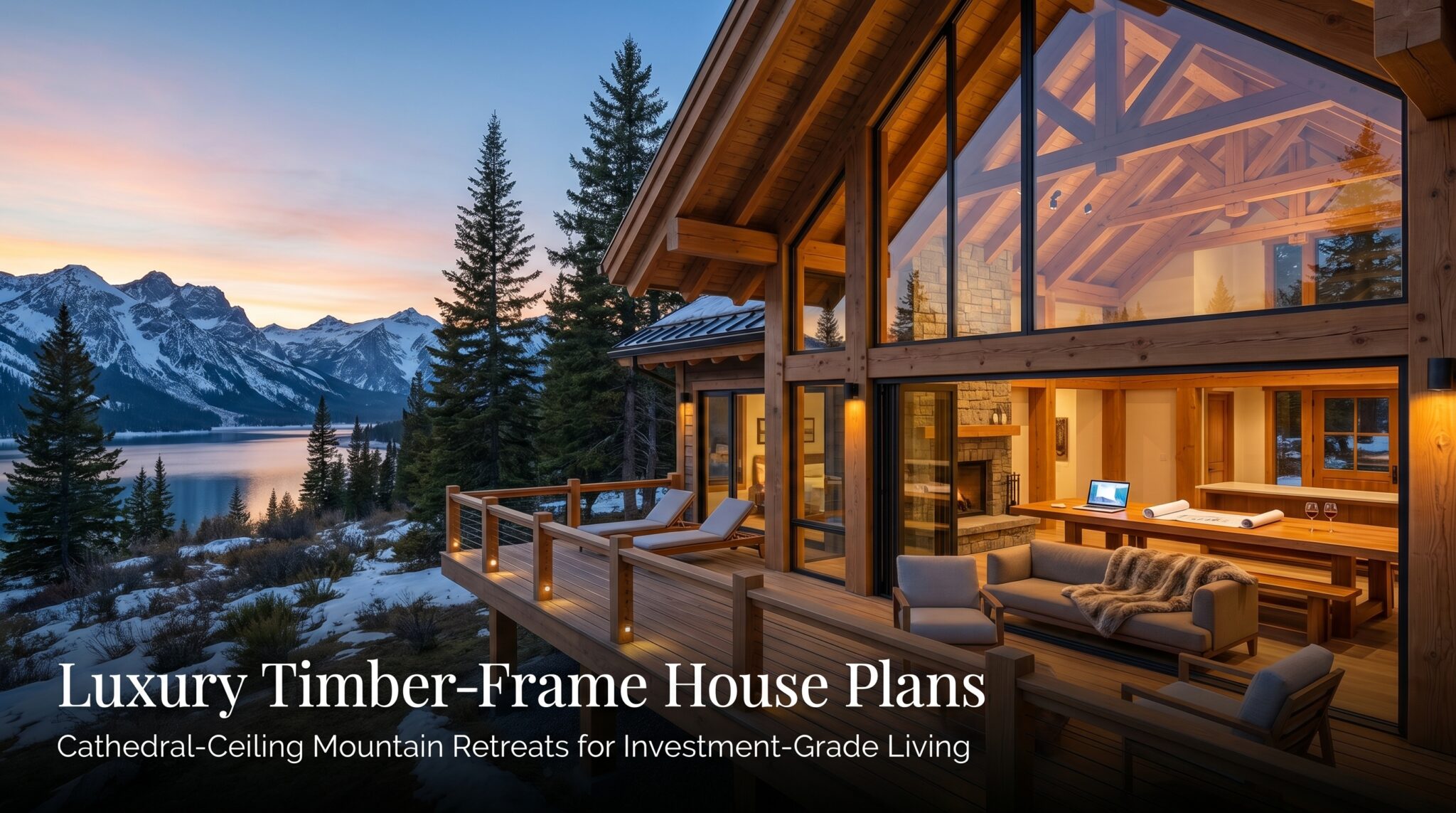
Wealthy buyers no longer settle for quaint log cabins—they want forty-foot trusses, investment-grade craftsmanship, and a carbon story they can brag about when signing the check. Swapping steel and concrete for mass timber slashes embodied carbon, giving owners a sustainability edge (Axios climate report).
Remote work proved that a home with a view can double as a boardroom, pushing luxury timber builds from passion project to mainstream asset class. Builders responded with transparent pricing; today’s high-end frames run $450–$1,000 per square foot, finish level and site logistics depending, according to PrecisionCraft’s 2026 analysis.
Our goal is simple: give you—a discerning mountain-home shopper—a data-backed roadmap to the nine plans worth your time, money, and vision. Let’s dive in.
How we ranked the plans
First, we listed every feature high-net-worth buyers mention when they tour mountain properties: grand architecture that photographs well, layouts that host three generations without crowding, site adaptability for steep slopes, sustainability credentials, brand-name craftsmanship, and a build budget that feels rational. Then we assigned each of those six buckets a fixed weight.
Architecture leads at 30 percent. A house that greets you with 40-foot hammerbeam trusses earns an instant edge. Liveability (how rooms flow, flex, and age with you) claims 20 percent. Views matter as well; designs that hug the terrain, frame sunsets, and shed heavy snow earn 15 percent under Site Fit.
Eco-performance shares that 15 percent slice. Mass timber already sequesters carbon, but we rewarded plans that push further with SIP shells or net-zero options. Builder pedigree holds 10 percent because a name like PrecisionCraft or Hamill Creek signals resale confidence. The final 10 percent measures Cost-to-Value, anchored to today’s reality: luxury timber builds often land between $450 and $1,000 per square foot in 2026.
To keep the field fair, we set guardrails. Each candidate had to be a true heavy-timber or hybrid frame, available for purchase in the United States, and feature a cathedral-height core. Plans that rely on stacked logs, lack customization support, or ignore modern fire codes never made the short list.
With the math locked, we scored more than two dozen contenders, audited ties, and let the totals decide the ranking you’re about to read. No paid placements, no soft hearts, just data meeting design.
1. Crow’s Nest: Hamill Creek Timber Homes
Walk through the porte cochère and a hammerbeam entrance framed in stone rises like a medieval archway set for Instagram glory. Inside, the great room climbs two full stories; a window wall drinks in lake light while massive Douglas-fir trusses hold court overhead. The vibe is lodge luxe without the footprint bloat: at roughly 3,200 square feet it falls inside the mid-sized 2,001–3,999 sq ft bracket highlighted in Hamill Creek’s timber frame floor plans, offers four bedrooms, and a covered deck that wraps the entire view facade.
Hamill Creek’s 30-year pedigree shows in the details. Timber joints are hand-finished, not plate-clamped. A breezeway stashes snow gear yet links the garage in bad weather. On the main level, a primary suite means no stairs after ski days, while an open loft above the great room lets teens game without vanishing.
Cost sanity nudges Crow’s Nest to the top. The compact form and simple roof deliver cathedral drama without a budget headache. If you crave a grand lodge, keep reading; for many families, this plan nails the sweet spot between spectacle and sensible living.
2. Rockledge: Winterwoods Homes
If Crow’s Nest feels like a champagne lounge, Rockledge delivers the full resort. Spanning roughly 10,000 to 11,500 square feet, this showpiece blends log accents with cathedral-scale timbers, then adds water that cascades through built-in pools serving as outdoor art. Arrival sets the tone: a porte cochère feeds a vaulted foyer that spills into a double-height great hall where trusses look sturdy enough to anchor a covered bridge.
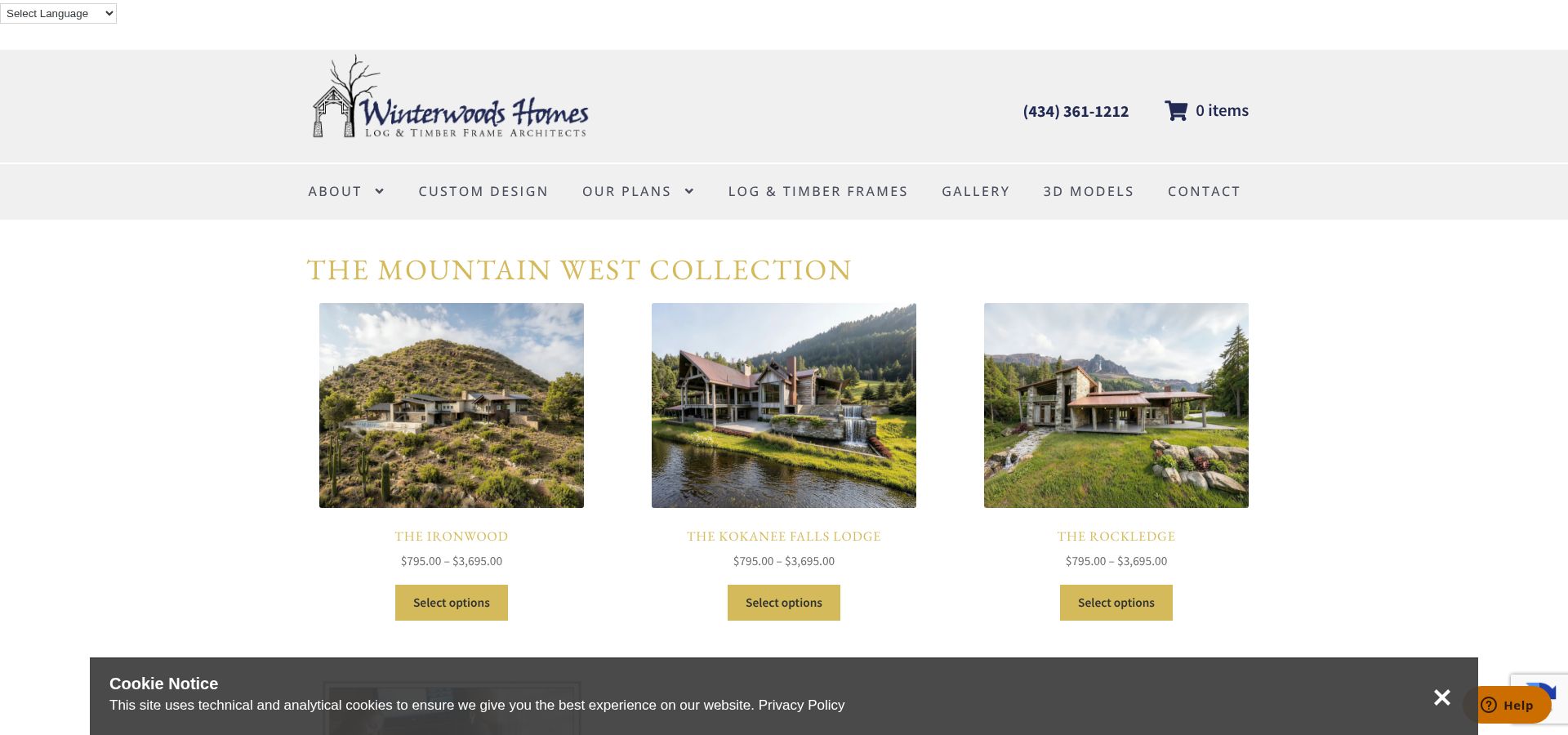
Luxury unfolds in zones. A main-level primary suite grants owners privacy, while a mirror suite upstairs pampers guests. Down the hall, the chef’s kitchen hugs a full butler’s pantry so caterers never crowd family breakfasts. The lower level can host a theater, wine cellar, and gym, because a plan this large leaves no wish unmet.
Cost approaches boutique-hotel territory, yet savvy buyers treat Rockledge as an heirloom asset. Estate parcels in Aspen or Big Sky climb in value on scarcity alone; crown them with handcrafted timber grandeur and you hold a future headline sale. If your mountain-home dream starts with the phrase “legacy lodge,” Rockledge is your blueprint.
3. Aspen Valley: Golden Eagle Log & Timber Homes
Aspen Valley proves that luxury means effortless hosting. The base plan measures about 4,500 square feet, yet feels larger thanks to five equal-status bedroom suites where every guest unpacks like a VIP. Open the foyer doors and step into a vaulted great room where gable glass frames alpine peaks, while a two-story stone fireplace anchors après-ski gatherings.
Golden Eagle offers the design in modules; scaling to 7,000 square feet becomes a menu choice, not a redesign. Add the finished lower level and you gain a game lounge, theater, and walk-out patio without changing the roofline above. This modular path keeps budgets predictable and timelines tight, a welcome perk when coordinating crews in high-elevation towns.
Entertaining credentials continue. A chef’s kitchen seats six at the island before you even reach the formal dining zone. A discreet caterer’s pantry hides party prep, and a covered porch with an outdoor fireplace extends the season. If your perfect weekend centers on friends, family, and maybe a sommelier on speed dial, Aspen Valley is built for you.
4. Sedona: PrecisionCraft
Bigger is not always better. Sedona proves the point with a single-story footprint of about 2,200 square feet that feels anything but small. Two mirror-image primary suites anchor opposite wings, so owners and long-term guests live on one level without crowding. Between them, a glass-lined great room rises, sending cedar beams skyward and daylight deep into the kitchen’s curved island.
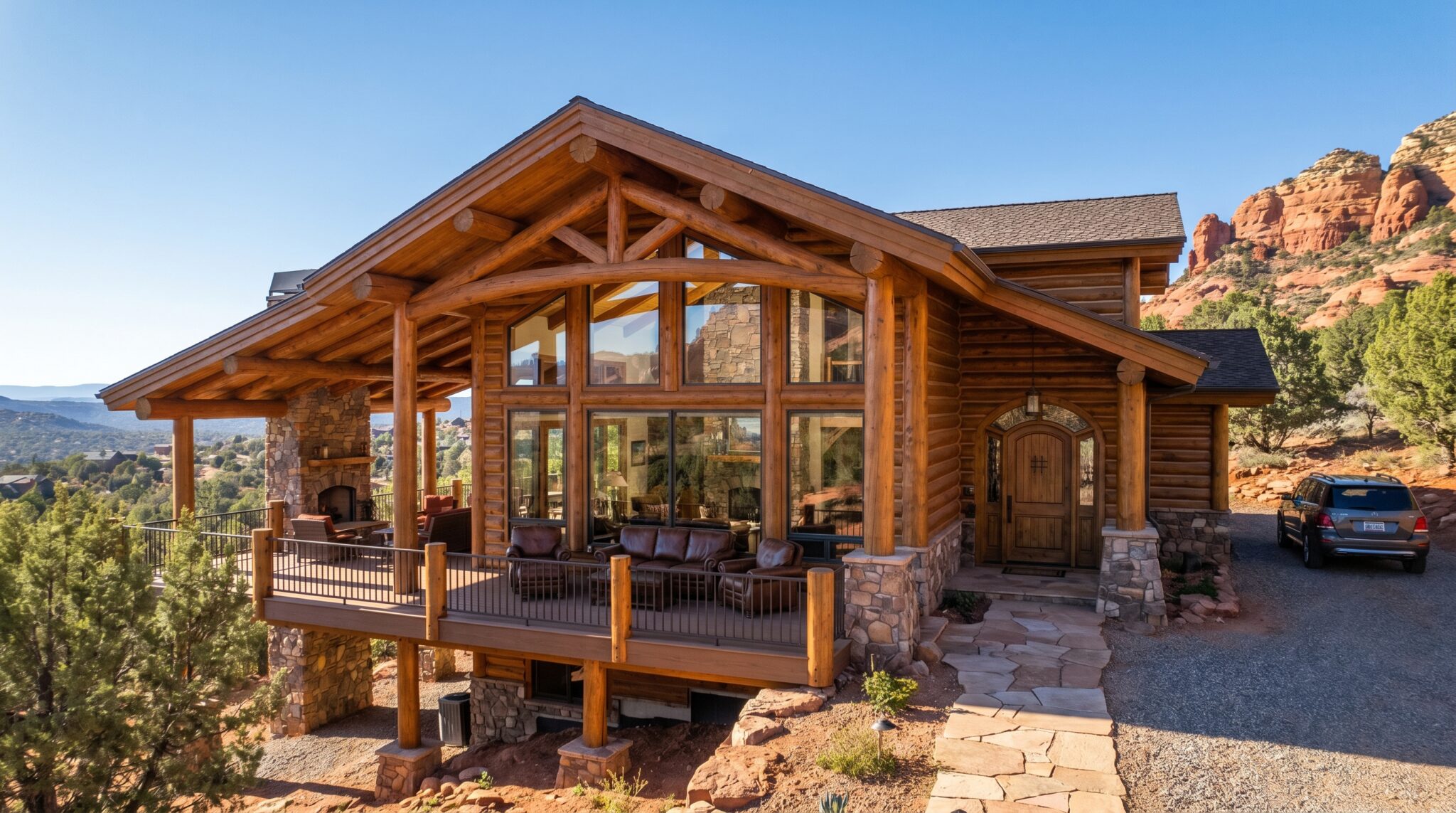
The layout shines day to day. Wake up, slide open eight-foot patio doors, and coffee on the terrace is three steps away. When friends drop by, traffic flows from the prep zone straight to an alfresco dining nook under the same roofline. No stairs and no bottlenecks, just mountain air drifting through open trusses.
Energy efficiency is a built-in feature. PrecisionCraft wraps the timber shell with structural insulated panels, sealing the envelope so radiant-floor tubing keeps toes warm even when January blizzards howl. Fewer corners and a broad south-facing roof also make solar straightforward, a rarity in timber architecture.
For downsizers from a city penthouse—or anyone who values accessibility without losing wow factor—Sedona delivers a right-sized retreat that lives luxuriously today and ages gracefully tomorrow.
5. Living off-grid: TimberhArt Woodworks
Some retreats chase luxury by adding chandeliers. Living off-grid delivers it by driving the utility bill toward zero. TimberhArt engineered this 3,500-square-foot design around south-facing glass, thick SIP walls, and roof-ready solar stubs, so the structure sips energy while the scenery steals the show.
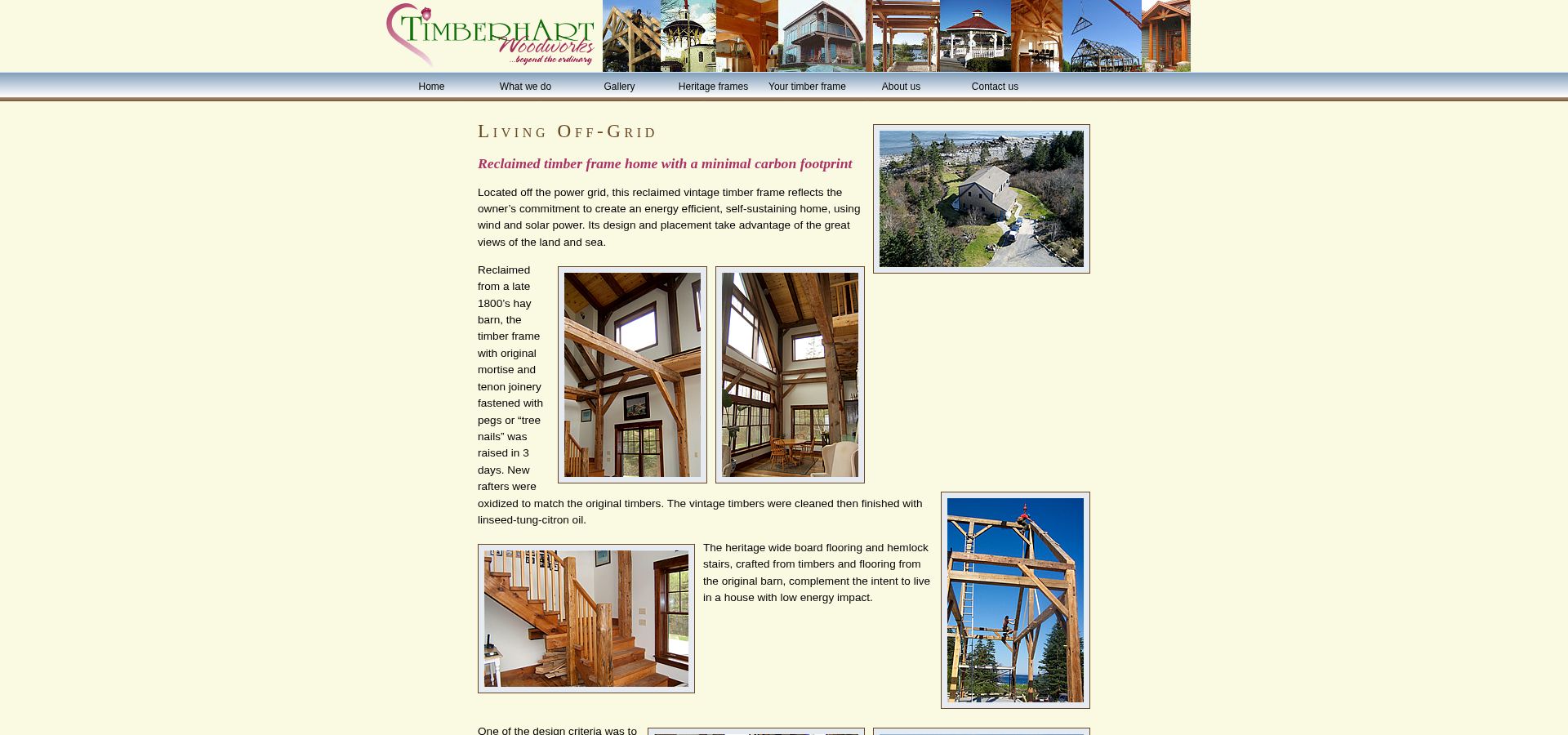
Inside, the cathedral ceiling performs a classic timber-frame trick, pulling your gaze up and then out through a clerestory band that tracks the sun all day. A lofted mezzanine floats above the great room like a treehouse perch, ideal for late-night stargazing without frostbite. Five bedrooms line the two flanks, proving sustainability can still host a crowd.
Function follows ethos. Mechanical space sits beside the mudroom, ready for battery banks and water filters that keep a backcountry parcel truly self-reliant. A central masonry heater stores radiant warmth long after the last log burns, and wide roof overhangs shield timber and glass from wildfire embers.
For buyers craving independence, whether philosophical or geographical, Living off-grid offers a turnkey path. It lets you vanish into nature while preserving modern comfort.
6. Northern lights: Vermont Timber Frames
Picture a classic A-frame chalet, then swap rustic clutter for sheet-glass elegance. That fusion defines Northern lights. At about 1,500 square feet, the plan relies on one dramatic move: a floor-to-ceiling window wall that turns the great room into a live-action postcard. When the aurora dances, or when alpenglow warms the peaks, you have front-row seats from the sofa.
Inside, structure becomes sculpture. Slim steel accents weave through Douglas-fir posts, giving the timberwork a modern edge without stealing warmth. The main floor hosts daily living and a primary suite, so owners claim the views without climbing stairs. Two guest rooms and a loft perch above, linked by an open catwalk that keeps sightlines clear to the glass façade.
Vermont Timber Frames shapes the shell for passive-solar gain and wraps it in high-performance panels. The result is plenty of glass with minimal energy loss, a welcome perk when winter lasts six months.
Choose Northern lights if you want bold, geometric lines paired with genuine timber soul. The compact footprint fits tighter lots yet still stands out on any modern mountain street.
7. Lincoln ski home: Timberpeg
Drop your skis on the porch rack, kick off your boots in a heated locker, and step into a timber-framed great room overlooking the trail you just carved. Lincoln ski home was born on Loon Mountain, so every square foot answers a real après-ski need.
The entry tower doubles as gear HQ, with benches, cubbies, and a boot-drying closet that keeps wet gear off hardwood floors. A spiral stair lifts you to an upper bunkroom that sleeps a pack of kids without banishing them to the basement.
Main living stays level with the slope, letting you watch friends finish their last run while stirring cocoa on the six-burner range. Five ensuite bedrooms ring the plan, granting privacy during holiday-week chaos. Downstairs, a tuning workshop keeps edges razor-sharp, and a covered patio shelters the hot-tub soak every ski house deserves.
Timberpeg designs roof loads for Nor’easter dumps and tucks radiant tubes in stone floors so the place feels warm before you light the fire. For families who measure winter in powder days, Lincoln ski home turns a mountain parcel into a ready-made tradition.
8. West Fork: Timber Frame HQ
West Fork does what few timber homes attempt: it builds upward. A twelve-by-twelve lookout tower pierces the roofline, giving you a 360-degree reading nook, art studio, or cocktail perch above the treetops. That single flourish turns a 3,396-square-foot hybrid plan into a landmark visible from the valley floor.
The rest of the layout stays grounded in both structure and budget. Timber Frame HQ offers West Fork as a Ready-to-Raise kit; hero timbers arrive pre-cut, while secondary walls use standard framing. You see handcrafted joinery in the great room, entry porch, and tower, while drywall finishes the wings that hold bedrooms and baths.
Inside, traffic flows like a modern farmhouse: mudroom to pantry to chef’s kitchen to open dining. A main-floor primary suite hides behind the stair wall, while two guest rooms share the upper level and overlook the vaulted living space. Finish the bonus room above the garage and you add a fourth bedroom without moving a wall.
If you want a statement house yet need spreadsheets that stay below seven figures, West Fork supplies height, style, and fiscal clarity in one tidy package.
9. Wyoming mansion: Golden Eagle Log & Timber Homes
The name is not marketing spin. With nearly 18,000 square feet under roof, Wyoming mansion feels less like a house and more like a boutique resort reserved for one family. Double staircases wrap a two-story foyer, timber trusses soar across a ballroom great room, and bedroom wings branch off like hotel corridors. A porte cochère wide enough for sprinter vans sets the tone before you even park.
Golden Eagle organizes the design in phases. Core living—great room, owner suite, and four-car garage—measures about 11,000 square feet. Choose the lower-level module to add a spa suite, golf simulator, and walk-in vault without changing the roofline. This modular path matters when eight-figure budgets still need clear guardrails.
Practical touches match the drama. Back-of-house corridors keep staff flow invisible during events, and a caterer’s kitchen sits between formal dining and the terrace so plated dinners move quickly. Mechanical rooms cluster for easy service, while heavy timber framing offers the fire resistance insurance carriers now praise in the Mountain West.
Wyoming mansion is a legacy address that children remember and future buyers covet. If your family gatherings already require a hotel block, owning the “hotel” becomes the logical next step.
How the nine stack up at a glance
The table below distills size, key features, and the buyer each plan suits. Scan for the metric that matters to you—square footage, bedroom count, or whether the design ships as a kit—then jump back to the full write-up when a row sparks interest.
| Plan | Size (sq ft) | Bed / Bath | Signature move | Ideal buyer |
| Crow’s Nest | 3,200 | 4 / 3.5 | Hammerbeam entry with wraparound deck | Families wanting drama without sprawl |
| Rockledge | 10,000 – 11,500 | 5 + / 7 + | Indoor waterfalls, twin primary suites | Legacy-estate seekers |
| Aspen Valley | 4,500 – 7,000 | 5 / 5 – 7 | Five equal suites, modular basement | Serial entertainers |
| Sedona | 2,200 (one level) | 2 / 2.5 | Twin owner suites, step-free living | Downsizers or accessibility planners |
| Living off-grid | 3,500 | 5 / 3 + | Net-zero shell with masonry heater | Sustainability buffs |
| Northern lights | 1,500 | 3 / 2 | Full-glass A-frame façade | Modern design purists |
| Lincoln ski home | 6,600 | 5 / 6 | Gear tower and slope-side patio | Powder-day families |
| West Fork | 3,396 | 3 / 3.5 | 12 × 12 tower, kit pricing | View hunters with set budget |
| Wyoming mansion | 11,000 – 18,000 | 7 / 8 – 12 | Ballroom great room, spa wing | Ultra-lux buyers needing scale |
Remember, price tags rise or fall with finish level, site prep, and regional labor. As a current rule of thumb, high-end timber builds land between $450 and $1,000 per square foot. Use that range with the sizes above to sketch a quick budget window, then contact the provider for precision.
What really drives timber-home cost and future ROI
Sticker shock happens when buyers fixate on square-foot math and skip the fine print. Timber frames follow the same rule as sports cars: beauty, speed, and rarity carry premiums.
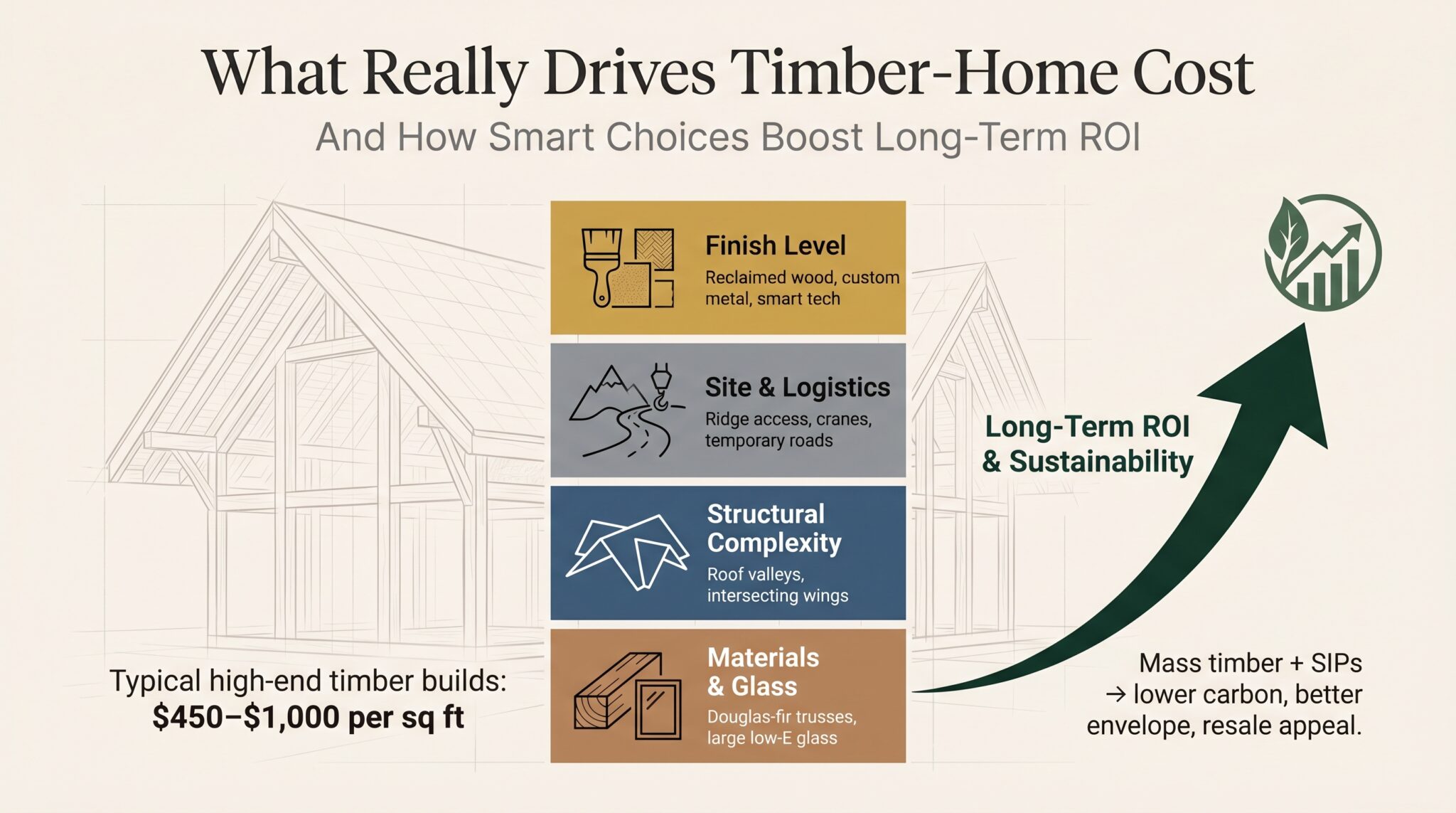
Material choice leads the bill. A cathedral truss in clear-grain Douglas-fir costs more than dimensional SPF, yet it becomes a focal point that photographs for decades. Add large spans of low-E glass and costs climb again, but those windows create the view dividend buyers crave.
Complexity adds dollars. Each roof valley, dormer, or intersecting angle multiplies joinery hours and waste. That is why plans like Crow’s Nest, with a simple gable core, deliver drama without runaway budgets, while Rockledge’s intersecting wings and water features push totals toward resort territory.
Location sneaks in next. Building on a ridge with no power drop means paying for temporary roads, crane time, and sometimes helicopter lifts. An accessible lakeside lot can shave ten to fifteen percent off the same plan.
Finish level is the final lever you control. Reclaimed barnwood floors, bespoke iron railings, and whole-house automation can double the interior allowance. Trim nothing essential, yet remember resale value often peaks where craftsmanship feels obvious and technology stays upgradeable.
High-end timber builds commonly range from $450 to $1,000 per square foot. That figure reflects both the artistry of exposed joinery and the insulation advantage of SIP envelopes. Long term, sustainability adds another upside; mass-timber structures store carbon and leave a lighter footprint than steel or concrete, a fact investors increasingly price into luxury real estate.
Fast answers to big timber questions
How long will the build really take?
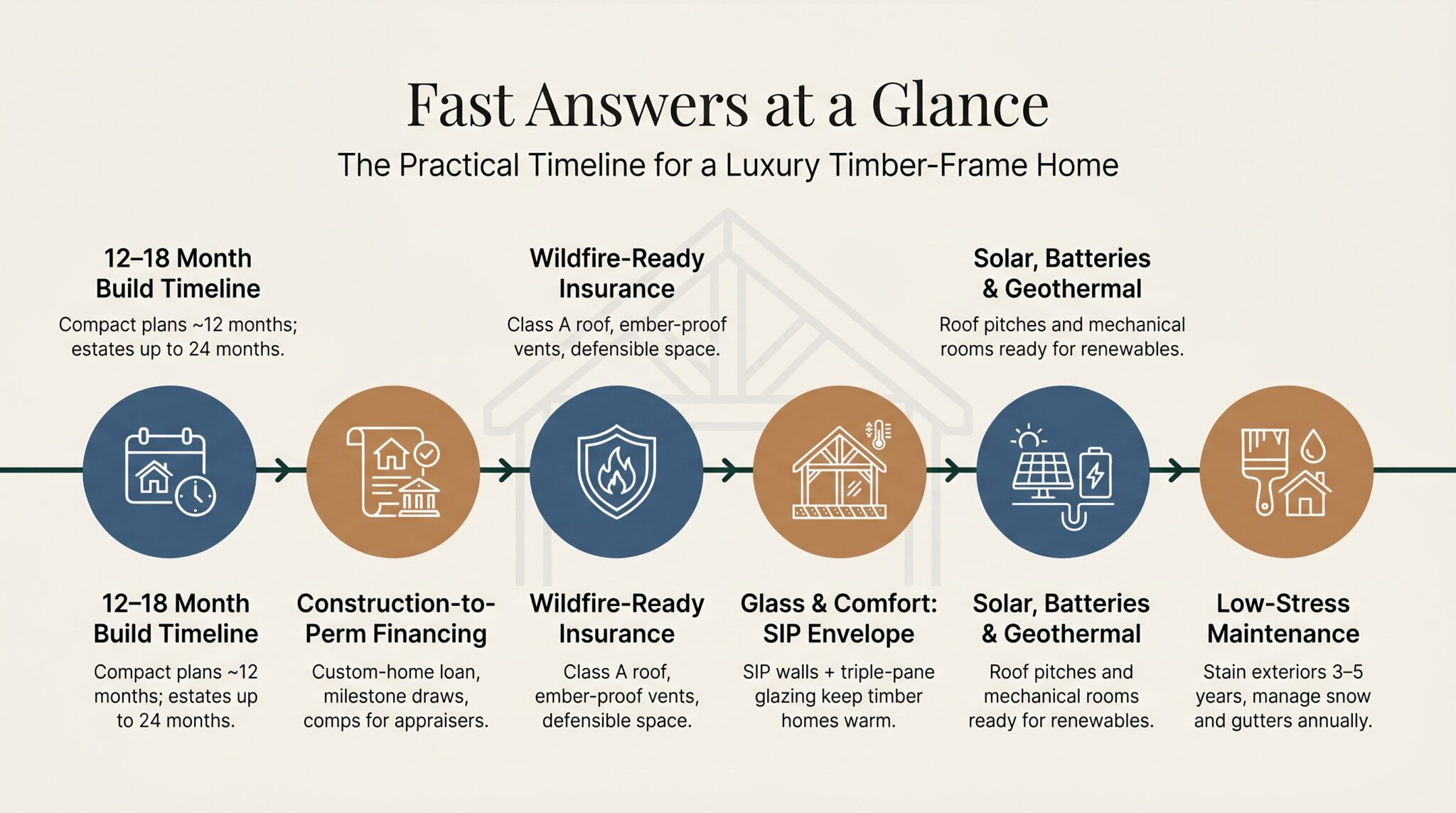
Plan on 12 to 18 months door to door. Compact homes like Sedona can finish inside a year if weather, financing, and crews align. Estate-scale builds such as Rockledge or Wyoming mansion may reach two years once design tweaks, permits, and custom millwork join the timeline.
Can I get a normal mortgage?
Yes. Lenders treat engineered-timber projects like any custom home as long as plans meet code and an appraiser finds comparable sales. Expect a construction-to-perm loan with milestone draws. In remote markets, bring extra comps to educate underwriters unfamiliar with high-value timber builds.
Will insurance be painful in wildfire country?
Premiums hinge on mitigation, not material. Heavy timbers char slowly, buying firefighters time, but carriers still want Class A roofing, ember-proof vents, and defensible space. Add those features and most high-net-worth insurers, including Chubb, will write the policy.
Do these homes stay warm with all that glass?
Modern timber frames pair SIP walls with triple-pane glazing. Posts carry the load, allowing continuous insulation that outperforms many stick-built envelopes. Owners of Northern lights report heating costs similar to suburban homes half the size.
Can I integrate solar, batteries, or geothermal?
Absolutely. Roof pitches on Aspen Valley and Living off-grid are already tuned for panel arrays, and mechanical rooms leave space for battery banks. Geothermal loops add excavation cost but hide under the driveway, keeping acreage pristine.
What maintenance should I budget?
Stain exterior timbers every three to five years, depending on sun exposure. Sweep snow from low-slope sections after heavy storms, and schedule an annual check of gutters and downspouts. Interior beams usually need only dusting—no settling, no chinking, just timeless wood aging gracefully.
Conclusion
Spend on structural showpieces buyers can see and touch, keep forms efficient, and select a site that supports rather than fights the design. Do that, and your timber retreat becomes both a pleasure asset and a smart line on the balance sheet.