Global real estate is undergoing a quiet but powerful transformation. At the center of this shift is the rising demand for underground bunkers for rent, a niche once associated with Cold War fear but now reimagined as ultra-luxury survival real estate. Today’s high-net-worth individuals are no longer only investing in beachfront villas or penthouses; instead, they are expanding into luxury survival bunkers, engineered for uncertainty, autonomy, and long-term security.
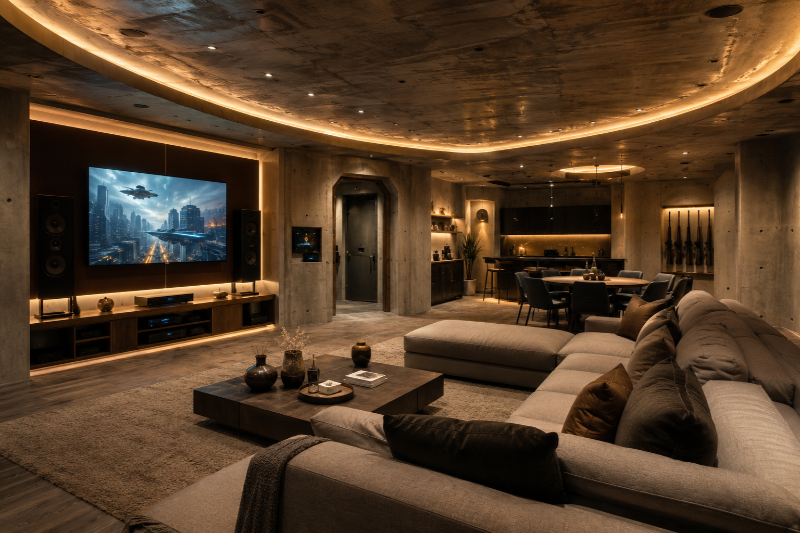
The growth of survival real estate reflects a broader global sentiment: geopolitical instability, climate risk, and technological disruption are reshaping how wealth perceives safety. As a result, underground luxury shelters are evolving into fully functional residences, complete with spas, cinemas, hydroponic farms, and biometric security systems.
Moreover, the emerging bunker lifestyle 2026 is no longer theoretical. It is a structured, rentable experience that blends luxury hospitality with survival engineering. Consequently, underground bunkers for rent are becoming a legitimate segment of alternative real estate, attracting investors, celebrities, and geopolitical hedge buyers seeking both protection and exclusivity.
What Is Driving Demand for Underground Bunkers for Rent?
The demand for underground bunkers for rent is being driven by a convergence of global uncertainty and lifestyle evolution. Increasing geopolitical tensions, economic volatility, and climate-related disruptions have intensified interest in secure living environments.
Moreover, ultra-high-net-worth individuals are actively diversifying beyond traditional real estate. Instead of committing to permanent ownership, they are exploring flexible access models that allow them to rent private survival retreats when needed. This shift reflects a broader trend in luxury consumption: access over ownership.
Additionally, survival planning has moved into mainstream luxury culture. What was once considered extreme “doomsday prepping” is now part of sophisticated portfolio planning. For example, family offices are increasingly evaluating apocalypse bunkers as part of long-term risk mitigation strategies.
Key demand drivers include:
- Rising geopolitical and economic uncertainty
- Expansion of luxury survival planning culture
- Shift toward flexible, rental-based asset access
- Increased interest in survival real estate portfolios
- UHNW lifestyle diversification strategies
As a result, underground bunkers for rent are no longer fringe assets—they are emerging as structured luxury offerings.
Why Are Luxury Survival Bunkers Becoming a New Asset Class?
Luxury survival bunkers are evolving into a distinct real estate category due to scarcity, engineering complexity, and rising global demand. Unlike traditional luxury homes, these assets combine infrastructure resilience with high-end lifestyle design.
Moreover, investors increasingly view high-end survival properties as geopolitical hedging instruments. In contrast to volatile financial markets, bunker real estate offers physical security, autonomy, and exclusivity.
Additionally, institutional interest is growing. Wealth reports from firms like Knight Frank highlight rising curiosity among UHNW investors toward underground luxury shelters, particularly in politically unstable regions.
Market Drivers:
- Scarcity of engineered survival infrastructure
- Rising demand for geopolitical hedging assets
- Luxury repositioning of survival architecture
- Expansion of alternative real estate portfolios
- Increased interest in luxury bunkers for rent models
Consequently, bunker assets are transitioning from emergency shelters into prestige-driven investment environments.
Types of Modern Survival Bunkers
| Bunker Type | Features | Client Profile | Price Range | Purpose |
|---|---|---|---|---|
| Urban Micro Bunkers | Compact, hidden access, security systems | Executives, celebrities | $10K–$50K/month | Short-term protection |
| Luxury Estate Bunkers | Pools, cinemas, wellness zones | UHNW families | $100K–$500K/month | Lifestyle survival |
| Remote Doomsday Complexes | Self-sufficient ecosystems | Geopolitical investors | $1M+ annually | Long-term autonomy |
How Do Underground Bunkers for Rent Work in 2026?
In 2026, underground bunkers for rent operate through structured access models similar to luxury hospitality networks. Clients typically gain entry via membership systems, private brokers, or real estate concierge services specializing in survival assets.
Moreover, rental agreements vary significantly. Short-term stays function like high-security retreats, while long-term leases offer full integration into autonomous systems. Consequently, clients can experience full bunker living without permanent ownership commitments.
Additionally, security protocols are highly advanced. Biometric entry, encrypted communications, and AI-driven monitoring systems ensure controlled access at all times. For example, concierge teams often remain on standby to manage environmental systems and logistics.
Operational features include:
- Tiered membership access systems
- Short-term survival bookings
- Long-term residential bunker leasing
- AI-managed environmental control systems
- Concierge-level survival logistics
Therefore, underground bunkers for rent function as hybrid assets—part residence, part secure infrastructure, and part luxury service ecosystem.
Which Features Define Ultra-Luxury Bunker Living?
Modern luxury survival bunkers are no longer confined to basic protection. Instead, they are fully integrated lifestyle environments designed for extended habitation.
Moreover, these spaces replicate and often exceed surface-level luxury living standards. Underground architecture now includes wellness spas, entertainment zones, and self-sustaining ecosystems.
Additionally, design innovation has become central. Architects focus on emotional comfort, natural lighting simulation, and spatial openness to reduce isolation effects.
Key features include:
- Biometric and AI-driven security systems
- Underground cinemas and entertainment lounges
- Hydroponic farms for food independence
- Air and water purification systems
- Private wellness and spa complexes
As a result, underground luxury shelters now deliver both survival capability and premium living experiences.
Luxury Bunker Living Features
| Feature | Description | Luxury Level | Survival Function | Appeal |
|---|---|---|---|---|
| AI Life Systems | Automated climate and resource control | Ultra-premium | Full autonomy | Efficiency + comfort |
| Hydroponic Farming | Indoor food production systems | High | Food independence | Sustainability |
| Private Cinemas | Underground entertainment spaces | Ultra-premium | Psychological relief | Lifestyle enhancement |
| Biometric Security | Identity-based access control | Elite | Intrusion prevention | Safety assurance |
Are Underground Bunker Rentals the Future of Luxury Real Estate?
The trajectory of underground bunkers for rent suggests a strong evolution within luxury real estate markets. Moreover, demand is shifting toward assets that provide both lifestyle value and existential security.
Additionally, rental flexibility is reshaping ownership psychology. Instead of buying permanent bunkers, UHNW clients prefer on-demand access to private survival retreats, allowing them to scale security based on global conditions.
Consequently, the bunker market is expanding beyond niche survivalists into mainstream luxury portfolios. In contrast to traditional real estate, bunker assets offer emotional reassurance alongside physical protection.
Therefore, survival real estate is increasingly positioned as a permanent category within luxury property ecosystems.
How Do Bunkers Compare to Traditional Luxury Homes?
Compared to traditional surface residences, apocalypse bunkers offer significantly higher security and autonomy. Moreover, they eliminate exposure to external environmental risks such as conflict, pollution, and climate instability.
Additionally, privacy levels are unmatched. Underground environments provide complete isolation from surveillance and public visibility.
However, traditional luxury homes still dominate in aesthetic openness and natural environments. In contrast, bunkers prioritize resilience over scenic exposure.
Key differences:
- Superior security infrastructure
- Higher privacy and isolation
- Lower environmental exposure risk
- Limited natural landscape interaction
- Greater technological dependence
As a result, both asset types now serve different but complementary luxury roles.
What Role Does Technology Play in Modern Bunker Design?
Technology is the foundation of modern underground luxury shelters. Moreover, advanced engineering has transformed bunkers into fully autonomous living systems.
Additionally, AI-driven environments regulate oxygen, temperature, energy, and food production. Consequently, human dependency on external systems is significantly reduced.
Technological integrations include:
- AI-controlled environmental systems
- Renewable energy microgrids
- Automated hydroponic agriculture
- Advanced structural reinforcement systems
- Smart security monitoring platforms
Therefore, bunker architecture now represents one of the most advanced applications of integrated living technology.
When Will Underground Bunkers for Rent Become Mainstream?
The mainstream adoption of underground bunkers for rent is already in its early stages. Moreover, media coverage and luxury real estate reports have increased visibility among global investors.
Additionally, survival tourism is expanding rapidly. Short-term bunker stays are becoming part of exclusive travel experiences, particularly in regions offering high-security infrastructure.
Consequently, normalization is expected over the next decade. As geopolitical uncertainty persists, more investors will integrate bunker lifestyle 2026 assets into diversified portfolios.
Therefore, mainstream adoption is not a question of possibility—it is a question of timing.
Unique Insight: The Psychology of Insured Living Environments
Underground bunkers for rent are no longer just survival spaces. Instead, they represent a new psychological category of real estate: “insured living environments.”
Moreover, they merge fear management, luxury comfort, and exclusivity into a single asset class. This fusion reflects a deeper shift in how wealth interprets safety—not as a reaction, but as a lifestyle choice.
Additionally, bunker living redefines privacy at the highest level. It offers complete separation from external volatility while maintaining curated luxury experiences.
As a result, bunkers are becoming symbolic assets that represent control, preparedness, and status in an uncertain world.
Conclusion
The rise of underground bunkers for rent signals a major transformation in luxury real estate. Moreover, it reflects growing demand for secure, autonomous, and high-end living environments among UHNW individuals.
Additionally, as geopolitical and environmental uncertainty increases, luxury survival bunkers are shifting from niche assets to structured investment categories. Consequently, the bunker lifestyle is evolving into a recognized segment of survival real estate.
Ultimately, the future of luxury living is no longer just about location—it is about resilience, control, and adaptability. In this new paradigm, underground bunkers for rent redefine what it means to live securely in a rapidly changing world.
Frequently Asked Questions
What are underground bunkers for rent?
They are fully equipped underground bunkers for rent offering short-term or long-term secure living with luxury amenities and survival systems.
Why are luxury survival bunkers becoming popular?
Because geopolitical risk, climate concerns, and wealth diversification strategies are driving demand for secure, autonomous living environments.
How much do bunker rentals cost in 2026?
Prices range from $10,000 per month for micro bunkers to over $1 million annually for high-end survival complexes.
Are underground bunkers safe for long-term living?
Yes, modern bunkers are designed with advanced air filtration, energy systems, and structural protection for extended habitation.
What features do luxury bunkers include?
They include spas, cinemas, hydroponic farms, biometric security, and fully autonomous life-support systems.
Can you live full-time in a rented bunker?
Yes, many underground bunkers for rent are designed for full-time residential use.
Who rents underground bunkers?
UHNW individuals, celebrities, geopolitical investors, and privacy-focused families.
Are bunker properties a good investment?
They are increasingly considered alternative geopolitical hedge assets within survival real estate portfolios.
What is the bunker lifestyle in 2026?
It is a luxury survival lifestyle combining autonomy, security, and high-end underground living.
What is the future of underground bunkers for rent?
They are expected to become mainstream within luxury real estate as demand for secure living continues to rise.