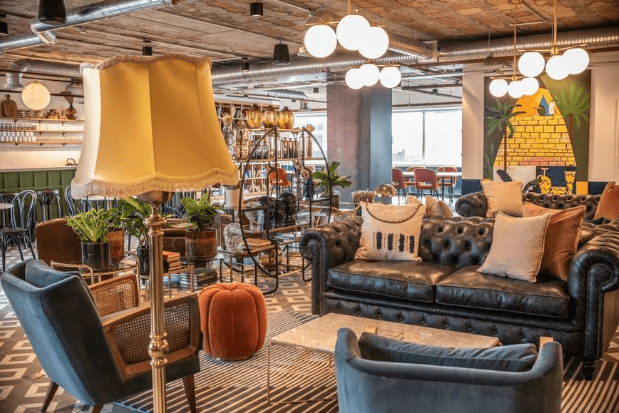
For a long time, the office was a fixed cost you negotiated once and lived with for a decade. You signed a lease, paid for a build-out, and absorbed whatever came next: an unexpected headcount surge, a contraction, a global pandemic, or all three in rapid succession. The assumption was that stability required permanence. That assumption has not aged well.
Across the US, a more sophisticated approach to workspace is gaining serious traction among founders, investors, and enterprise teams who have learned what it costs to be locked into the wrong square footage at the wrong time. Premium shared office space has moved well past the co-working cliché of ping pong tables and exposed brick. The market now accounts for over 8,400 locations in the US alone, and the country’s flexible workspace market is projected to grow from $2.1 billion in 2023 to $7.1 billion by 2030. That trajectory is not driven by freelancers chasing affordable desks. It is driven by companies rethinking real estate as a strategic asset rather than an operational obligation.
What the Numbers Actually Mean for Occupiers
The core problem with traditional office leases surfaced with unusual clarity after 2020, but the structural mismatch existed long before. CBRE’s 2025 Americas Office Occupier survey found that 73% of tenants hit full capacity on peak days while averaging only 34% occupancy across the week. You are paying for 100% of the space, five days a week, while using a fraction of it most of the time. For a 2,000-square-foot buildout in San Francisco, Cushman & Wakefield’s 2026 fit-out guide puts the cost at roughly $228 per square foot before you’ve placed a single person at a desk. That’s $456,000 in capital expenditure, plus rent, plus the years you’re bound to it regardless of what happens to your team size.
A premium coworking membership at the same quality tier runs closer to $235 per person per month in San Francisco, with high-speed infrastructure, reception, meeting rooms, and daily amenities folded in. For a team of ten, that’s $2,350 a month with no build-out, no capital commitment, and the ability to scale up or down as the business requires. The math is not subtle.
The Enterprise Shift Nobody Saw Coming
The early narrative around coworking framed it as a solution for startups and solo operators who couldn’t afford their own space. That characterisation is now significantly out of date. More than half of global corporations have added flexible workspace to their real estate portfolio, and the clients driving this shift at operators like WeWork, Industrious, and Mindspace coworking spaces are no longer small. Amazon expanded across multiple WeWork locations in 2025, leasing 259,000 square feet at 1440 Broadway in Midtown Manhattan and 141,000 square feet in Santa Clara, California. These are not companies hedging on their real estate strategy. They are executing it.
The logic for enterprise clients follows the same math as it does for growing teams, just at greater scale. Hybrid work patterns have made the all-or-nothing office model expensive in both directions: too much fixed space on quiet days, not enough capacity when full teams convene. Flex space absorbs that variance. It also supports the hub-and-spoke model that has become standard corporate real estate strategy, where a lean headquarters connects to satellite locations closer to where employees actually live. Operators that run networks across multiple US cities give enterprise clients something a single-building landlord cannot: consistent workspace infrastructure wherever the team needs to be.
What Separates Premium from the Rest
The coworking sector is not uniform. There is a meaningful distance between a commodity shared desk in a converted retail space and the kind of environment where you’d bring an investor, close a deal, or spend a focused week with your leadership team. The operators competing at the premium end have borrowed extensively from hospitality, not real estate. Thoughtful design, staffed concierge services, curated programming, and genuine attention to the physical experience of working in the building are what separate spaces that retain members from ones that don’t.
Mindspace’s Wynwood location in Miami illustrates this positioning. Located in one of the most creatively charged districts in the country, the space combines design-led private offices and coworking with the kind of neighbourhood energy that makes the commute feel like a choice rather than a sentence. Wynwood has become a serious draw for tech companies, media businesses, and creative-sector professionals who want proximity to Miami’s business ecosystem without the sterility of a downtown tower. For teams that care about the culture they project to clients, partners, and new hires, the environment where you work carries weight.
Miami and the Sunbelt Opportunity
Miami’s trajectory as a business hub has been consistent enough over the past five years that it no longer reads as a temporary migration story. The city ranks among the fastest-growing markets for flexible office demand in the US, with Wynwood specifically attracting a density of founders, creative agencies, and technology companies that generate the kind of cross-sector networking that makes shared workspace genuinely valuable. Proximity to that community is an asset in ways that a quiet suburban office park is not.
The broader Sunbelt picture reinforces this. Texas and California lead the US in coworking occupancy rates, averaging 86% between them. Florida follows a similar pattern as remote-work migration continues and companies establish regional presences in markets they would have bypassed entirely under traditional leasing models. Flex space makes that possible without requiring a multi-year commitment before you’ve tested whether a city works for your team.
The Investment Case
For family offices and real estate investors tracking where commercial property is heading, the coworking sector presents a different risk profile than it did five years ago. The post-WeWork correction shook out the least disciplined operators and burned off the valuation excess. What remains is a market where occupancy rates are healthy, corporate demand is structural rather than cyclical, and the largest operators have moved toward asset-light management agreements and enterprise contracts that produce more predictable revenue than month-to-month consumer memberships.
CBRE’s full acquisition of Industrious in 2025 signalled something. One of the world’s largest commercial real estate firms chose to absorb a premium flex operator rather than watch the category from the sidelines. IWG opened 338 new centres in early 2025 and committed to roughly 1,500 additional locations within 18 months. The global coworking market, valued at around $27 billion in 2024, is projected to reach nearly $59 billion by 2032 on a compound annual growth rate of close to 10%. Flex currently represents just 2% of US office inventory. The gap between that figure and where corporate demand is heading is where the opportunity sits.
A Different Way to Think About the Office
The office was never really a space. It was a set of functions: concentration, collaboration, credibility, and community. Dedicated leases delivered all four by default when everyone worked in one building five days a week. Now that teams are distributed and schedules are varied, the building itself has to earn its place in the mix. Premium shared spaces that get this right, with design, location, service quality, and community programming working together, do a better job of delivering those functions for more types of workers than a generic leased floor ever could.
The entrepreneurs and executives who are performing well in this shift are the ones who stopped treating the office as a fixed overhead line and started treating it as a tool they can choose and reconfigure as their business changes. That reframe is worth more than any particular lease term.