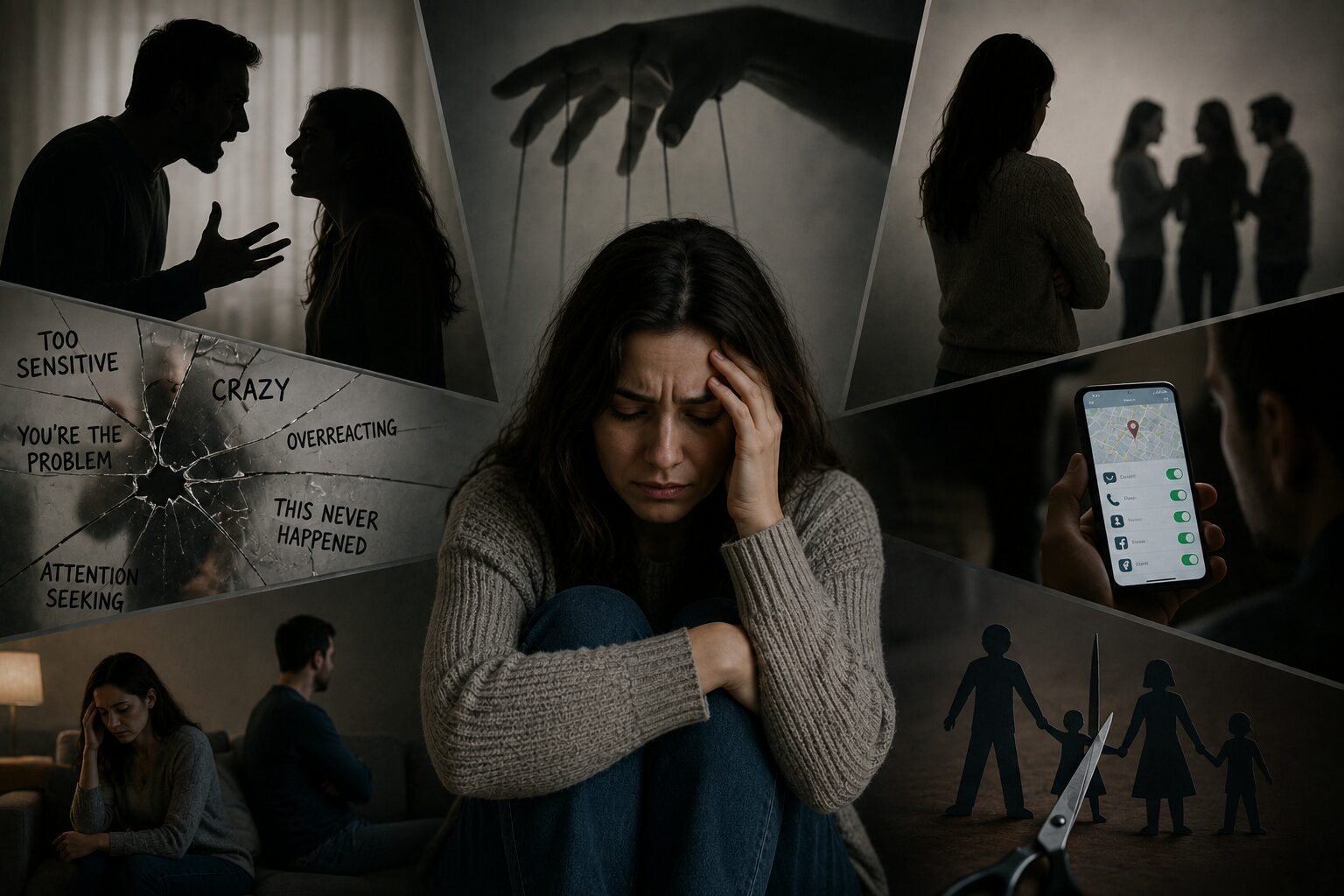
Emotional abuse happens when someone repeatedly uses words, silence, or manipulation — rather than physical force — to control, belittle, or frighten another person. The core signs include constant criticism, blame-shifting, isolation from friends and family, threats, gaslighting, and a persistent feeling that you’re “walking on eggshells.” Unlike a single argument, emotional abuse follows a pattern that erodes a person’s confidence and sense of reality over time.
Emotional abuse doesn’t leave bruises, which is exactly why it’s so often missed — by the people experiencing it and by everyone around them. This guide breaks down what emotional abuse actually looks like across relationships, marriage, parenting, childhood, and the workplace, so you can name what’s happening and figure out your next step.
What Is Emotional Abuse?
Emotional abuse (also called psychological abuse) is a pattern of behavior intended to control, diminish, or frighten another person without physical violence. It can happen in romantic relationships, marriages, families, friendships, and workplaces.
Researchers who study intimate partner violence describe this pattern as “psychological aggression” — using verbal and non-verbal communication with intent to harm someone mentally or emotionally, or to exert control over them. This is one of the recognized categories of intimate partner violence tracked by the CDC, alongside physical violence, sexual violence, and stalking.
It’s more common than most people realize. Nationally representative U.S. survey data has found that almost half of all women and men have experienced psychological aggression from an intimate partner at some point in their lives (48.4% of women and 48.8% of men). That statistic alone tells you this isn’t a rare or fringe experience — it’s something a huge share of adults will encounter in at least one relationship.
Why emotional abuse is hard to spot:
| Reason | Explanation |
| No visible injury | There’s nothing to point to, so victims often doubt their own experience |
| Gradual escalation | It usually starts small and builds slowly, so the “new normal” shifts without anyone noticing |
| Mixed with affection | Abusive partners or parents often alternate cruelty with warmth, which creates confusion and hope |
| Social normalization | Phrases like “that’s just how they are” or “they don’t mean it” minimize the pattern |
| Self-blame | Victims are frequently told — directly or indirectly — that the abuse is their own fault |
Signs of Emotional Abuse in Relationships
In a dating or romantic relationship, emotional abuse tends to follow a recognizable arc: charm and intensity early on, followed by control, criticism, and isolation once the relationship feels secure to the abusive partner.
Common signs of emotional abuse in a relationship:
- Constant criticism disguised as “just being honest”
- Monitoring your phone, location, or social media without consent
- Jealousy framed as love or protectiveness
- Dismissing or mocking your feelings (“you’re too sensitive”)
- Withholding affection or communication as punishment (the silent treatment)
- Making major decisions for you without your input
- Comparing you unfavorably to exes or other people
- Threatening to leave or self-harm during disagreements
- Public humiliation or embarrassing you in front of others
- Sudden mood swings that keep you anxious and guessing
A pattern search on relationship forums (often searched as “signs of emotional abuse in a relationship reddit”) consistently surfaces the same few themes from people describing their own experiences: confusion about whether what they’re going through “counts,” a partner who never apologizes without also blaming them, and a slow loss of contact with friends and family. These aren’t isolated complaints — they reflect the well-documented pattern of coercive control.
Signs of Emotional Abuse in Marriage
Marriage adds legal, financial, and social entanglement that can make emotional abuse harder to leave and easier to hide. Signs of emotional abuse in marriage often overlap with relationship signs but include some marriage-specific patterns.
Marriage-specific red flags:
| Category | What It Looks Like |
| Financial control | Controlling all money, demanding receipts, preventing a spouse from working |
| Parental undermining | Contradicting or mocking a spouse’s parenting in front of the children |
| Social isolation | Discouraging friendships, controlling who’s invited over, guilt-tripping visits to family |
| Weaponized intimacy | Using sex or affection as a reward/punishment tool |
| Public vs. private personas | Charming in public, cruel or cold in private |
| Chronic contempt | Eye-rolling, sighing, sarcasm, and disrespect that erode day-to-day dignity |
A spouse experiencing this may search “signs of emotional abuse by wife” or “signs of emotional abuse spouse” — it’s worth noting emotional abuse is not gender-specific. Both husbands and wives can be perpetrators or targets, and the patterns above apply regardless of who is doing the behavior.
What Are the 7 Signs of Emotional Abuse?
While there’s no single official list, mental health professionals and abuse-prevention organizations commonly group emotional abuse into seven recurring patterns:
- Verbal put-downs — insults, name-calling, mocking, or humiliation, often disguised as jokes.
- Control — dictating what you wear, who you see, how you spend money, or where you go.
- Isolation — cutting you off from friends, family, or support systems over time.
- Gaslighting — denying things that happened or insisting you’re “remembering it wrong” to make you doubt your own perception.
- Blame-shifting — never taking responsibility; every conflict becomes your fault.
- Threats and intimidation — threatening to leave, harm themselves, take the kids, or expose private information.
- Withholding — silent treatment, stonewalling, or withholding affection, money, or basic communication as punishment.
These seven signs frequently show up together rather than alone. One or two isolated incidents don’t necessarily indicate abuse — the defining feature is the repeated pattern, not a single bad moment.
Subtle and Early Warning Signs
Early-stage emotional abuse is often the hardest to catch because it can look like intensity, protectiveness, or even flattery.
Subtle signs to watch for:
- Wanting to spend all your time together very quickly (“love bombing”)
- Making light jokes at your expense that sting more than they should
- Expressing strong opinions about your friends within weeks of dating
- Needing constant reassurance and reacting badly when you don’t provide it
- Subtle guilt trips (“I guess I’m just not important to you”)
- Testing boundaries in small ways to see if you push back
Behavioral signs that build over time:
- You start rehearsing conversations in your head before having them
- You feel relief when the person isn’t around
- You’ve stopped mentioning certain friends because it causes conflict
- You apologize automatically, even when you’re not sure what you did wrong
- You’ve started hiding small purchases, plans, or messages “just in case”
Signs of Emotional Abuse in Children
Children experiencing emotional abuse — whether from a parent, caregiver, or another adult — often can’t articulate what’s happening, so it shows up behaviorally instead.
Common signs in children:
- Excessive apologizing or fear of making mistakes
- Extreme shyness or, conversely, aggression toward peers
- Difficulty forming attachments or trusting adults
- Regression (bedwetting, thumb-sucking) in a child who had outgrown it
- Low self-esteem or self-critical language beyond their years (“I’m stupid,” “I always ruin everything”)
- Anxiety about going home, or relief when away from a specific caregiver
- Overly compliant, watchful behavior around a particular adult
What emotionally abusive parenting can look like:
- Constant criticism of appearance, intelligence, or worth
- Comparing siblings to make one feel inferior
- Conditional love tied to performance or obedience
- Humiliating a child in front of others
- Ignoring a child’s emotional needs while meeting physical ones
- Using guilt or fear as the primary discipline tool
Signs of Emotional Abuse From Parents (and in Adulthood)
Some people don’t recognize emotional abuse from their parents until they’re adults looking back — this is one of the most common reasons people search “signs of emotional abuse in adulthood” or “signs of emotional abuse from parents in adults.”
Signs it may show up in adulthood:
- Difficulty trusting your own judgment or decisions
- Chronic people-pleasing or fear of disappointing others
- Struggling to set boundaries with family, even as an adult
- Feeling responsible for a parent’s emotions
- A pattern of choosing partners or friends who replicate the same dynamic
- Anxiety or dread before family visits or calls
- Minimizing your own achievements out of habit
How adult children often describe emotionally abusive parents:
| Behavior | Adult Impact |
| Never validated feelings | Difficulty identifying or trusting your own emotions |
| Used guilt as control | Chronic guilt in unrelated adult relationships |
| Withheld praise | Persistent feeling of “never being enough” |
| Triangulated siblings | Difficulty trusting family members or forming close bonds |
| Public shaming | Social anxiety, fear of being judged |
Signs of Emotional Abuse at Work
Emotional abuse isn’t limited to families and romantic partners — it happens in professional settings too, sometimes called workplace bullying or psychological harassment.
Workplace signs:
- A manager who humiliates you in meetings
- Impossible, shifting expectations designed to set you up to fail
- Taking credit for your work while blaming you for others’ mistakes
- Excluding you from communication needed to do your job
- Threats about job security used to control behavior
- Monitoring that goes beyond normal performance management
Physical and Behavioral Symptoms of Emotional Abuse
Even though emotional abuse leaves no bruises, it frequently produces measurable physical and psychological symptoms.
Physical signs:
- Chronic headaches or muscle tension
- Digestive issues linked to stress
- Sleep disturbances (insomnia, nightmares, oversleeping)
- Fatigue that doesn’t improve with rest
- Appetite changes
Behavioral and emotional signs:
- Increased anxiety, especially anticipatory anxiety before interacting with the person
- Depression or persistent low mood
- Difficulty concentrating
- Hypervigilance — constantly monitoring the other person’s mood
- Social withdrawal
- Loss of confidence in decision-making
Research on intimate partner violence has repeatedly linked psychological abuse to depression and other mental health outcomes. Living with intimate partner violence — including psychological abuse and controlling behavior — is associated with serious mental health outcomes such as depression and depressive symptoms. This isn’t a coincidence; it reflects a well-established connection between sustained psychological stress and mental and physical health.
Emotional Abuse in Men vs. Women
Emotional abuse affects people of all genders, though it’s often underreported among men due to stigma.
| Aspect | Women | Men |
| Lifetime psychological aggression (U.S. data) | 48.4% | 48.8% |
| Common barriers to disclosure | Fear of retaliation, financial dependence | Stigma, fear of not being believed |
| Common manifestations | Isolation, control over appearance/social life | Undermining masculinity, financial control, mockery |
The takeaway: psychological aggression is nearly as common among men as women in reported data, which challenges the assumption that emotional abuse is a “women’s issue” only.
Self-Check: Am I Being Emotionally Abused? (Checklist)
Use this checklist to reflect on a specific relationship. You don’t need to check every box — even a few consistent “yes” answers can indicate a harmful pattern.
- [ ] Do I feel like I’m “walking on eggshells” around this person?
- [ ] Do I often apologize even when I’m not sure what I did wrong?
- [ ] Has this person isolated me from friends or family?
- [ ] Do they deny things they said or did, making me question my memory?
- [ ] Am I criticized more often than I’m appreciated?
- [ ] Do they use silence or withdrawal as punishment?
- [ ] Have I changed my behavior out of fear of their reaction?
- [ ] Do they threaten to leave, hurt themselves, or hurt me during conflict?
- [ ] Do I feel smaller, less confident, or more anxious since being with them?
- [ ] Do they control my money, time, or communication?
If you answered “yes” to several of these, it’s worth talking to a therapist, counselor, or trusted advocate — not to diagnose your relationship on your own, but to get outside perspective from someone trained to help.
Emotional Abuse vs. Normal Conflict — Comparison Table
| Normal Conflict | Emotional Abuse |
| Both people can express disagreement | One person’s feelings consistently dominate |
| Apologies are genuine and mutual | Apologies are rare, or immediately followed by blame |
| Disagreements resolve and move on | Conflicts are used to control or punish long-term |
| Both partners retain independence | One partner is isolated from outside support |
| Criticism is occasional and specific | Criticism is constant and attacks character |
| Boundaries are respected | Boundaries are tested, ignored, or punished |
What to Do If You Recognize These Signs
- Name it. Simply recognizing the pattern is a meaningful first step.
- Talk to someone you trust. Isolation is part of how emotional abuse works — reconnecting breaks that cycle.
- Document patterns. Keeping a private record can help you see the pattern clearly and can matter later if you need support from a professional or legal advocate.
- Reach out to a professional. A therapist experienced in abusive relationship dynamics can help you process what’s happening and plan next steps.
- Contact a helpline. The National Domestic Violence Hotline can be reached by calling 800-799-7233, texting START to 88788, or chatting at thehotline.org — free, confidential, and available 24/7, even if you’re not sure your situation “counts.”
- Make a safety plan if needed. If there’s any risk of escalation to physical harm, a domestic violence advocate can help you create a personalized safety plan.
Key Takeaways
- Emotional abuse is a repeated pattern — not a single conflict — that erodes a person’s confidence, autonomy, and sense of reality.
- It shows up across relationships, marriages, families, childhood, and workplaces, with overlapping but distinct signs in each context.
- Common signs include criticism, control, isolation, gaslighting, blame-shifting, threats, and withholding.
- Nearly half of U.S. adults report experiencing psychological aggression from an intimate partner at some point in their lives — this is far more common than most people assume.
- Physical symptoms like chronic stress, sleep problems, and anxiety often accompany emotional abuse even without any physical violence.
- Support is available through therapists, trusted friends and family, and free 24/7 hotlines.
Frequently Asked Questions
What are the first signs of emotional abuse in a relationship?
Early signs often look subtle: intense jealousy framed as love, fast-moving commitment, mild jokes that sting, and small guilt trips that escalate gradually. It rarely starts with obvious cruelty.
Can emotional abuse happen without yelling or insults?
Yes. Silence, withdrawal, dismissiveness, and subtle control can be just as damaging as loud confrontation. The silent treatment and stonewalling are recognized forms of emotional abuse.
What is gaslighting, and how is it related to emotional abuse?
Gaslighting is when someone denies your reality or memory to make you doubt yourself — for example, insisting an argument never happened. It’s one of the most disorienting forms of emotional abuse because it undermines your trust in your own perception.
How is emotional abuse different from a difficult personality?
A difficult personality might be blunt or occasionally hurtful, but it doesn’t involve a consistent pattern of control, isolation, and punishment. Emotional abuse is defined by repetition and intent to control, not by a single trait.
Can children recover from emotional abuse?
Yes, with support. Therapy, safe relationships with other trusted adults, and consistent, validating care can significantly help children process and recover from emotionally abusive experiences.
What are signs of emotional abuse from a spouse specifically?
Financial control, undermining you as a parent in front of your kids, weaponizing intimacy, and switching between public charm and private coldness are patterns that show up specifically within marriage.
Is emotional abuse considered domestic violence?
Yes. Psychological aggression is one of the recognized categories of intimate partner violence, alongside physical violence, sexual violence, and stalking. It’s taken seriously by domestic violence organizations and hotlines, even without physical harm.
How common is emotional abuse really?
Nationally representative survey data shows that about 48% of both women and men in the U.S. have experienced psychological aggression by an intimate partner during their lifetime.
What should I do if I recognize these signs in my own relationship?
Start by talking to someone you trust or a therapist, and consider contacting a domestic violence hotline for confidential guidance — even just to talk through whether what you’re experiencing fits this pattern.
Can someone be emotionally abusive without realizing it?
It’s possible for someone to have learned harmful patterns (for example, from their own upbringing) without full awareness. That said, a pattern’s impact on the other person matters regardless of intent, and ongoing harmful behavior still needs to be addressed — ideally with professional support for both people involved.
Are men affected by emotional abuse as often as women?
Reported rates are close to equal — 48.8% of men and 48.4% of women report experiencing psychological aggression from an intimate partner in their lifetime — though men often face more stigma in disclosing it.
What’s the difference between emotional abuse and narcissistic abuse?
“Narcissistic abuse” is a popular term describing emotional abuse patterns commonly associated with narcissistic traits (grandiosity, lack of empathy, need for control). It’s not a clinical diagnosis on its own, but the behavioral signs — gaslighting, blame-shifting, control — overlap heavily with general emotional abuse.
Conclusion
Emotional abuse is quieter than physical abuse, but it’s not less real — and it’s far more common than most people expect, affecting close to half of U.S. adults at some point in an intimate relationship. Recognizing the pattern — criticism, control, isolation, gaslighting, blame-shifting, threats, and withholding — is the first step toward change, whether that means setting firmer boundaries, seeking therapy, or leaving a relationship altogether. If any part of this article felt familiar, that recognition matters, and support is available whenever you’re ready to reach for it.