Thach Nguyen’s net worth is about $15 million by our cautious 2026 editorial estimate. It is a low-confidence figure, not a disclosed or audited balance sheet. Nguyen has described a real-estate portfolio worth more than $100 million, but the market value of buildings is not the equity an owner keeps after debt, partners, taxes and other obligations. That distinction matters more here than another impressive headline number.
Nguyen is a Seattle-area broker, developer and investor whose journey from a refugee family to property ownership has made him a popular real-estate educator. The useful question for readers is how his reported property scale translates, or fails to translate, into personal wealth.
Thach Nguyen net worth in 2026: the short answer
| Figure | What it means | How certain? |
|---|---|---|
| $15 million | Impact Wealth’s working estimate of his personal net worth | Low confidence; no personal financial disclosure |
| More than $100 million | Real-estate portfolio value Nguyen has described publicly | Self-reported gross asset value, not personal net worth |
| More than $100,000 a month | Net passive income claimed for Nguyen and his wife in the company’s media kit | Self-reported and not a verified 2026 income statement |
Our estimate is deliberately modest relative to the portfolio headline, because we have not seen a property-by-property debt schedule or ownership register. The number could be materially higher or lower. We are also careful not to treat a family holding as an asset belonging entirely to one person.
Where did the $100 million portfolio claim come from?
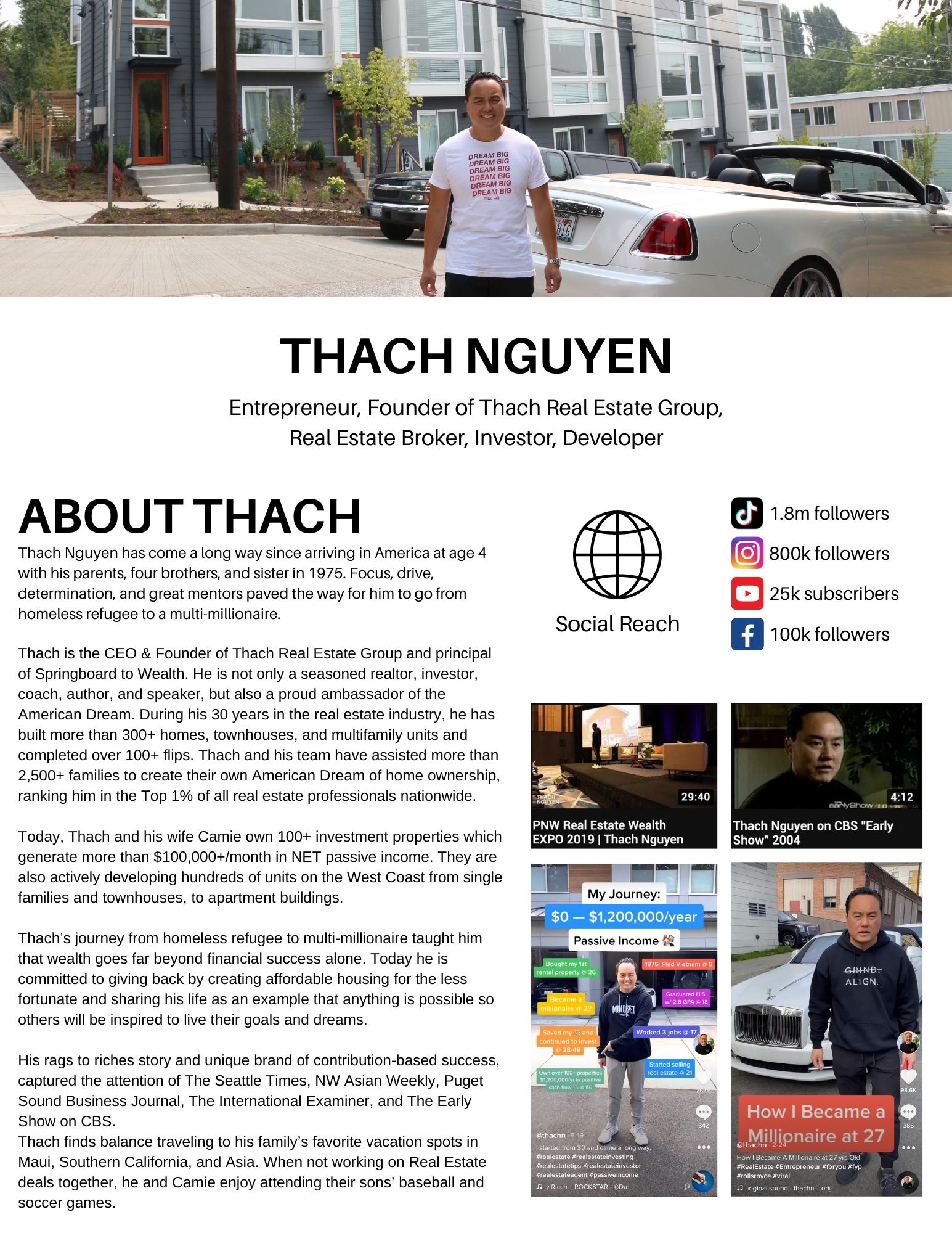
Nguyen has discussed a roughly $100 million property portfolio in his own public post. His company media kit describes him as founder of Thach Real Estate Group and principal of Springboard to Wealth. It says he and his wife Camie owned 150 investment properties generating more than $100,000 a month in net passive income when that material was prepared. The same page also uses “100+ rental units” elsewhere, a reminder that marketing figures may reflect different dates and definitions.
A later public statement describes more than 250 “doors.” A door means a rentable unit, so 250 doors need not mean 250 separate properties. Neither figure is a current independently verified valuation. Still, they show why his wealth is tied to rental holdings and development, rather than simply to an agent’s commissions.
Why $100 million in property does not mean $100 million in net worth
Think of a $1 million apartment building with a $750,000 mortgage. Its gross property value is $1 million, but the starting equity is $250,000 before sale costs, tax and any other claims. Apply that logic across a large portfolio and a small change in debt assumptions can shift an estimated fortune by tens of millions.
For illustration only, a $100 million portfolio financed with $80 million of debt would have $20 million of property equity. With $60 million of debt, it would have $40 million. We do not know Nguyen’s actual debt, ownership shares or current valuations; neither hypothetical is a calculation of his wealth. Development projects can add further construction costs, lender claims and timing risk. Our guide to reading a foundation inspection report shows one practical example of why the condition and future capital needs of property matter before relying on a headline value.
How did Thach Nguyen build his business?
His official biography describes three decades in Seattle-area real estate and says his team has helped more than 2,500 families buy homes. The company’s media kit credits him with building more than 300 homes, townhouses and multifamily units and completing more than 100 flips. These are company claims, rather than independently audited totals, but they describe a business with several income routes: brokerage, development, sales and long-term rentals.
In a BiggerPockets interview, Nguyen discusses using active earnings to acquire rentals. This helps explain the model: commissions and project profits supply capital, while rentals can create ongoing cash flow. Anyone attracted to “passive income” should remember that financing, repairs, vacancies and management still require work or paid help. Our separate rental-income analysis covers that trade-off in more detail.
His 2008 stress test: a useful case study
Nguyen’s 2020 BiggerPockets interview is more revealing than a net-worth list. He said that during the 2008 downturn, roughly 10 to 20 rental units went vacant, creating about $20,000 to $30,000 a month of lost rent, while a construction project needed substantial cash. His response, he said, was to slow expansion and pay down debt on parts of the portfolio. Those are his recollections, not verified accounts, but they show why the spread between gross assets and resilient personal equity deserves attention.
What about the $75 million net-worth claim?
Some biography sites state $75 million and attribute it to Forbes. We could not confirm a Forbes profile or a balance-sheet method supporting that personal figure. It may be a guess based on the portfolio story. We do not use it as established fact, and we would revise our own $15 million working estimate if credible ownership and liability records emerged.
Frequently asked questions
Is Thach Nguyen a billionaire?
There is no credible evidence that he is. A reported nine-figure property portfolio is not the same as a billion-dollar personal net worth.
How many properties does he own?
His company media kit says he and his wife owned 150 investment properties at the time it was written. Other statements refer to “doors,” meaning rental units; the figures are not directly interchangeable and no current independent count is available.
Does $100,000 a month in passive income mean he earns $1.2 million a year?
Twelve times $100,000 is $1.2 million, but the media-kit claim is historical, joint and self-reported. It should not be presented as a verified 2026 personal salary or an audited annual profit.
How does this compare with another real-estate personality?
Our Ryan Serhant net-worth analysis also separates a public business profile from private personal assets. The two careers and holdings are different; neither estimate is a like-for-like audited comparison.
Editorial method and image credit
We checked Nguyen’s company biography and media kit against his public portfolio statement and a first-person interview. The portfolio and income figures are attributed to him or his company. The debt examples above are illustrative, not statements about his actual loans. Our $15 million estimate is a low-confidence editorial judgment based on the reported business scale; there is no public financial disclosure from which to derive an exact personal amount. Updated November 3, 2026.
Featured image: Thach Nguyen, from the Thach Real Estate Group media kit; photographer not identified.
About the author: Kaleem Afzal Khan is a civil and structural engineer who writes about property due diligence and wealth. The property-risk explanation is informed by his engineering background; the personal net-worth figure remains an editorial estimate.