What Active Listening in Marriage Means
Active listening in marriage means giving your spouse your full attention, reflecting back what you heard in your own words, and responding to their feelings before responding to the problem. It combines eye contact, paraphrasing, and non-defensive follow-up questions. Done consistently, it helps spouses feel understood, reduces conflict escalation, and builds long-term emotional safety — though research shows it works best alongside other relationship skills, not as a stand-alone fix.
What Is Active Listening? (Definition and Origins)
Active listening is a communication skill, not just an act of hearing. Unlike mere hearing, active listening requires a conscious effort to understand the speaker’s message, which includes not only the verbal content but also nonverbal cues such as body language and tone.
The concept didn’t originate in couples therapy. It originated from the humanistic approach of psychologist Carl Rogers, who highlighted the importance of empathy and reflective listening in therapeutic contexts. Rogers believed people heal and grow when someone else fully understands them without judgment — and marriage researchers later borrowed the same idea for couples.
Communication scholars generally agree active listening has three working parts:
| Component | What It Looks Like | Why It Matters |
| Nonverbal involvement | Eye contact, open posture, nodding, leaning in | Signals genuine attention before a word is spoken |
| Verbal paraphrasing | Restating what your spouse said in your own words | Confirms you understood correctly and shows effort |
| Elaborative questioning | Asking open questions like “what happened next?” | Encourages the speaker to go deeper instead of shutting down |
Active listening as having three parts: demonstrates moderate to high nonverbal involvement, reflects the speaker’s message using verbal paraphrasing, and may include asking questions that encourage speakers to elaborate.
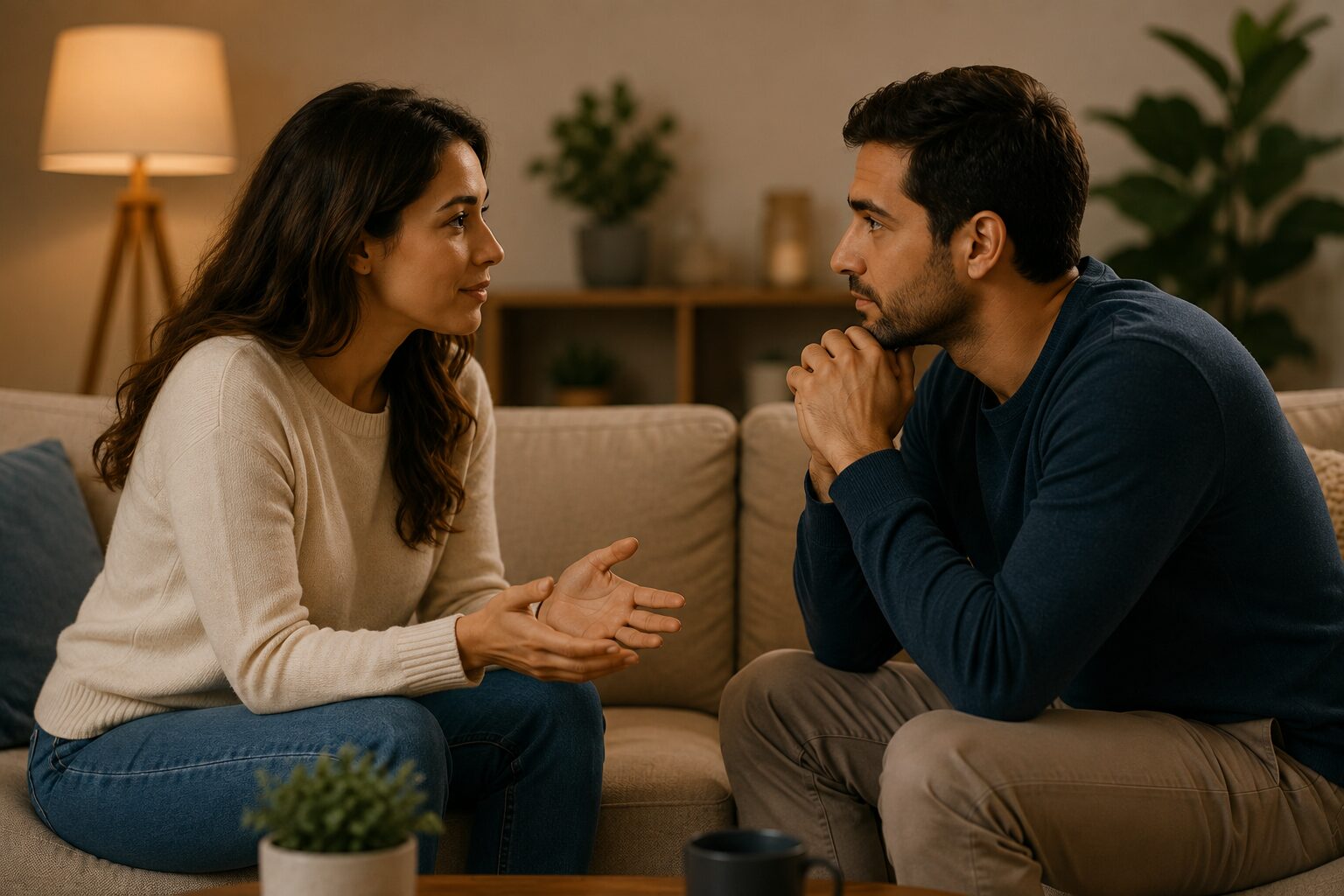
In a marriage, this looks less like a therapy technique and more like a daily habit: putting the phone down, making eye contact, and saying “so what you’re telling me is…” before jumping to advice or defense.
Why Active Listening Matters in a Marriage
Most couples don’t drift apart because of one big betrayal. They drift apart because of thousands of small moments where one partner talked and the other didn’t really hear it.
Here’s why active listening carries real weight in a marriage:
- It short-circuits escalation. When a spouse feels heard early in a disagreement, the conversation is less likely to spiral into blame.
- It replaces assumptions with facts. Paraphrasing forces you to check your understanding instead of reacting to what you think your spouse meant.
- It signals respect. Full attention is one of the few gifts that costs nothing and communicates “you matter” instantly.
- It supports the “soft startup.” Gottman suggests that conversations often end on the same note they began, and starting discussions with a soft startup — an approach devoid of blame or criticism — sets the tone for a more constructive conversation. Active listening is what allows a soft startup to actually land, because the listener isn’t already bracing for attack.
- It builds emotional safety over time. Feeling consistently understood, even in small daily exchanges, is what therapists call “turning toward” a partner — a habit strongly associated with relationship stability.
Dr. Dana McNeil, a certified Gottman therapist, frames it plainly: “Active listening in relationships is more than just hearing your partner’s words. It’s about diving deep into their world.”
What Gottman’s Research Actually Found (The Nuance Most Articles Skip)
Here’s something most “active listening” content leaves out, and it matters for anyone trying to genuinely understand this topic rather than just repeat a slogan.
John Gottman — the researcher most associated with promoting communication skills for couples — actually found that active listening, on its own, was a weaker predictor of marital success than expected. A study published in the Journal of Marriage and the Family, following 130 newlyweds for six years, found that active listening occurred very infrequently in marital conflict resolution and its use didn’t predict marital success. Gottman himself said: “We expected that active listening would predict positive outcomes in marriages — we have even recommended this type of conflict intervention with couples in the past.”
A separate line of research reinforces this. A Munich-based marital therapy study conducted by Kurt Hahlweg and associates found that even after employing active-listening techniques, the typical couple was still distressed, and the few couples who did benefit relapsed within a year.
This doesn’t mean active listening is useless — it means it isn’t magic. Gottman’s later work reframed active listening as one tool among several, alongside things like accepting a partner’s influence, using soft startups, and repairing conflict early. Gottman considers it a myth that just teaching a couple to communicate better will save their marriage.
What This Means for Your Marriage
| If You Think… | What Research Actually Suggests |
| “Learning to paraphrase my spouse will fix our marriage” | Communication skills help, but they work best combined with conflict-repair habits and mutual respect |
| “Active listening should eliminate all our arguments” | Its real job is to reduce escalation and increase feeling understood — not to prevent all disagreement |
| “If active listening feels hard or unnatural, we’re doing marriage wrong” | Even well-trained couples find it hard mid-conflict; that’s normal, not a red flag |
| “One conversation technique should carry the whole relationship” | Stability comes from a cluster of habits — friendship, appreciation, repair attempts, and listening together |
This is the honest, research-grounded picture: active listening is a genuinely valuable skill for connection and de-escalation, but it works as part of a bigger communication system, not a stand-alone cure.
Hearing vs. Active Listening vs. Passive Listening
Couples often say “I listen to my spouse” while actually just hearing sound. The distinction matters.
| Type | What Happens | Typical Result in Marriage |
| Hearing | Sound registers, but attention is elsewhere (phone, TV, own thoughts) | Spouse feels ignored; details get lost |
| Passive listening | You’re present but silent, offering no feedback or reflection | Speaker isn’t sure if you understood or even care |
| Active listening | You’re engaged, paraphrasing, asking questions, reading tone and body language | Speaker feels understood; conflict de-escalates faster |
| Reflective listening (a deeper form of active listening) | You reflect back the emotional meaning, not just the words | Speaker feels emotionally validated, not just heard |
Reflective listening is often described as the more therapeutic cousin of active listening. Reflective listening is not a part of active listening; however, the skill of active listening is a part of reflective listening. In marriage, this distinction is useful: active listening handles the mechanics of a conversation, while reflective listening handles the emotional undercurrent — “It sounds like you felt dismissed when I checked my phone during dinner” goes further than “Okay, got it.”
The Core Components of Active Listening in Marriage
These are the building blocks that show up across nearly every credible framework, from Carl Rogers’ therapeutic model to modern couples therapy.
- Full presence — phone down, eye contact, body turned toward your spouse
- Non-judgment — resisting the urge to mentally rebut while they’re still talking
- Paraphrasing — “So what I’m hearing is…” to confirm understanding
- Emotional labeling — naming the feeling behind the words (“that sounds frustrating”)
- Clarifying questions — open-ended, curious, not interrogative
- Appropriate silence — letting your spouse finish a thought instead of filling every pause
- Nonverbal feedback — nodding, small verbal cues like “mm-hm,” matching tone appropriately
- Delayed response — resisting the instinct to problem-solve or defend before fully understanding
Reflection is a powerful technique that can reinforce the message of the speaker and demonstrate your understanding, while clarification usually involves the use of open questions which enables the speaker to expand on certain points as necessary.
Active Listening Skills in Marriage — Step-by-Step Techniques
Below is a practical five-step structure couples therapists commonly teach, adapted for everyday marriage conversations rather than formal therapy sessions.
Step 1 — Set the stage. Choose a moment without distractions. Turn off the TV, put phones in another room, and make sure neither of you is rushing somewhere.
Step 2 — Give full attention. Face your spouse, hold eye contact, and resist planning your response while they’re still talking.
Step 3 — Paraphrase before responding. Repeat back the core of what you heard: “So you’re saying you felt overlooked when I made plans without checking with you first.”
Step 4 — Validate the feeling, not just the facts. Even if you disagree with their interpretation, you can validate the emotion: “That makes sense that you’d feel hurt by that.”
Step 5 — Ask before you defend. Instead of immediately explaining your side, ask: “Is there more you want me to understand before I respond?”
This mirrors what couples counselors describe as a structured listening framework: set the stage with a distraction-free space, give your full attention, paraphrase what you heard, validate your partner’s feelings, and ask clarifying questions if needed — the goal isn’t to win an argument, it’s to understand your partner’s perspective and help them feel heard, which calms the nervous system and reduces defensiveness.
Active Listening Do’s and Don’ts
| Do | Don’t |
| Paraphrase before reacting | Interrupt to correct a small detail |
| Ask “what did that feel like for you?” | Ask “why would you even think that?” |
| Name the emotion you’re hearing | Jump straight to solving the problem |
| Take a break if flooded, and return to it | Walk away permanently mid-conversation |
| Use “I” statements when it’s your turn | Use “you always / you never” language |
Active Listening With Example: A Real Conversation Rewritten
Without active listening:
Wife: “You didn’t even ask me before inviting your parents this weekend.” Husband: “It’s just my parents, why are you making this a huge deal?”
This response skips right past the feeling and goes straight to defense — a pattern that reliably escalates conflict.
With active listening:
Wife: “You didn’t even ask me before inviting your parents this weekend.” Husband: “So it sounds like you’re frustrated because I made that decision without checking in with you first. Is that right?” Wife: “Yes — it’s not really about your parents, it’s that I felt like my schedule didn’t matter.” Husband: “That makes sense. I should have asked. Can we figure out a better system for this going forward?”
The second version doesn’t magically resolve the underlying issue (whose schedule takes priority, how decisions get made) — but it stops the fight from becoming about tone and defensiveness instead of the actual problem. That’s the real, achievable value of active listening: it changes how a disagreement unfolds, even when it doesn’t instantly solve what the disagreement is about.
How to Be a Better Listener in a Relationship (Common Struggles, Answered)
People searching forums and community threads for relationship advice tend to circle the same handful of struggles. Here’s a grounded answer to each, without inventing quotes from any specific post or user.
- “I keep interrupting even when I don’t mean to.” Try a physical anchor — literally hold your tongue or take a breath before responding. Interrupting is often driven by anxiety about forgetting your point, not disrespect. Jot a one-word note instead of saying it out loud.
- “I zone out during long conversations.” Attention naturally dips after a couple of minutes. Reflect back small pieces every 30–60 seconds (“okay, so first the meeting ran late, then—”) to force yourself to stay tracked.
- “I get defensive before I even realize it.” This is addressed in detail in the next section — but the short version is: separate the feeling your spouse is expressing from any blame you’re hearing, even if blame is present.
- “My spouse says I don’t listen, but I remember everything they said.” Remembering facts isn’t the same as listening. If your spouse doesn’t feel understood emotionally, the facts you retained won’t register as “good listening” to them.
How to Listen Without Getting Defensive
Defensiveness is one of the biggest blockers to active listening in marriage — and it’s almost always automatic, not intentional.
Why defensiveness happens: It’s a self-protection reflex. When a spouse’s words feel like an attack (even when they’re not intended that way), the nervous system shifts into defend-or-explain mode before the rational brain catches up.
How to interrupt that reflex:
- Separate feedback from character attack. “You forgot to call the plumber” is about a task, not your worth — even if it stings.
- Delay your rebuttal by ten seconds. Silently count before responding; it’s enough time to choose a response instead of reacting.
- Reflect first, explain second. Paraphrase what you heard before you defend yourself. This alone de-escalates most conversations.
- Watch for physical flooding. Racing heart, tight chest, or the urge to raise your voice are signs to pause the conversation, not push through it.
- Use a physiological self-soothing break. If flooded, agree on a signal to pause for 20–30 minutes, then return — don’t just walk away indefinitely.
- Ask yourself: “Is this about being right, or about being close?” Defensiveness usually wins arguments and loses intimacy.
Active Listening in Marriage With ADHD
ADHD adds a genuine, physiological layer of difficulty to active listening — it isn’t a matter of caring less. Active listening is a skill that has to be consciously developed to enhance communication, and it involves being fully present in the conversation, paying close attention to the speaker, and responding appropriately, which for individuals with ADHD can be challenging due to the tendency to become easily distracted.
Common Challenges vs. Practical Fixes
| Challenge for the ADHD Partner | Practical Fix |
| Getting distracted mid-conversation | Minimize distractions by choosing a quiet space, turning off electronic devices, and avoiding multitasking so both partners can give full attention to the discussion. |
| Responding too fast, before fully processing | Try to have one person talk while the other listens without interrupting, then reflect back on what you heard before responding and ask clarifying questions instead of assuming. |
| Restlessness making it hard to sit still and focus | Use fidget tools to channel restless energy and help maintain attention on the speaker. |
| Forgetting key details after the conversation | Take notes during discussions to improve recall and understanding of important information. |
| Emotional flooding making conversations escalate quickly | Pause to regulate rather than push through; pausing doesn’t mean avoiding the conversation, it means trying to regulate. |
| Timing conversations when overstimulated or tired | Check in before starting an important conversation to see if both partners are regulated enough to listen, or schedule it for later instead. |
For the non-ADHD spouse: understanding that distraction is neurological, not disinterest, changes the emotional tone of these conversations enormously. Non-ADHD partners can reduce frustration and foster a more supportive environment by educating themselves about ADHD and its impact on daily life.
Active Listening Practice for Couples (Exercises You Can Start Tonight)
- The 10-Minute Check-In: Each spouse gets five uninterrupted minutes to talk about their day while the other only paraphrases, no advice-giving allowed.
- The Speaker-Listener Swap: One partner holds a physical object (a pen, a stone) while speaking; only the holder talks, and the other must paraphrase before responding — then swap.
- The Feelings-First Rule: Before either partner responds to a complaint, they must name the emotion they heard, out loud, before addressing the content.
- The Weekly State-of-the-Union: A scheduled 20-minute conversation, once a week, focused purely on connection and appreciation — no logistics, no complaints.
- The Silent Minute: Practice sitting with a full minute of silence after your spouse finishes speaking before responding — most couples respond within two seconds normally, and that gap creates space for real reflection.
Active Listening in ELT vs. Active Listening in Marriage (Quick Clarification)
If you landed here searching “active listening in ELT,” that term refers to English Language Teaching, where active listening describes classroom techniques for helping students process spoken language — things like predicting content, listening for gist, and checking comprehension.
The core skill (full attention, checking understanding, responding appropriately) is conceptually related to what’s described in this guide, but ELT applies it to language acquisition in a classroom, not emotional connection in a marriage. If you’re researching classroom listening strategies specifically, look for ELT-focused teaching resources rather than relationship guides — the techniques below are built for couples, not language learners.
Common Barriers to Active Listening in Marriage
- Chronic distraction — phones, background noise, or mental to-do lists competing for attention
- Emotional flooding — being too physiologically activated to process what’s being said
- Rehearsing your response — mentally preparing a rebuttal instead of listening
- Resentment buildup — past unresolved issues coloring how current statements are interpreted
- Fatigue and stress — exhausted spouses have less cognitive bandwidth for reflective listening
- Mismatched communication styles — one spouse processes verbally in real time, the other needs quiet time to think first
- Assuming instead of asking — filling gaps with guesses about what a partner meant rather than checking
Feelings of resentment, anxiety, and past communication experiences can cloud judgment and focus, making it difficult to truly hear your partner, and without effective listening, a relationship may suffer from defensiveness, avoidance, and a lack of meaningful connection.
Gottman Active Listening Worksheets and PDFs — What’s Actually Available
People frequently search for a “Gottman active listening PDF” or “active listening for couples PDF.” Rather than pointing to any unverifiable file, here’s what’s genuinely useful to look for:
- The Gottman Institute (gottman.com) publishes official articles, blog resources, and paid workbooks built around their research — this is the most reliable primary source if you want vetted material rather than a random downloadable PDF.
- Licensed couples therapists trained in the Gottman Method often provide structured worksheets during sessions — these are typically more tailored than generic downloads.
- University communication department resources (like listening-skills guides published by academic institutions) offer research-grounded, non-commercial explanations of active and reflective listening that translate well to marriage.
A word of caution: many “free PDF” search results are unverified blog reproductions, not official Gottman material. If accuracy matters to you, go to the Gottman Institute’s own site or a licensed therapist rather than a random download.
Key Takeaways
- Active listening in marriage means full attention, paraphrasing, and responding to feelings before facts.
- Gottman’s own newlywed study found active listening alone didn’t strongly predict marital success — it works best combined with other relationship habits, not as a stand-alone fix.
- The core skills are nonverbal presence, paraphrasing, and open-ended questioning.
- Defensiveness is a reflex, not a character flaw — pausing before responding interrupts it.
- ADHD adds real physiological listening challenges; structure and minimized distraction help both partners.
- “Active listening in ELT” refers to a different field (language teaching) and shouldn’t be confused with relationship communication.
- Small, repeatable exercises — like a 10-minute nightly check-in — build the habit more reliably than trying to “get it right” only during conflict.
Frequently Asked Questions
What is active listening in a marriage?
Active listening in marriage is the practice of giving your spouse full attention, reflecting their words back accurately, and responding to the emotion behind what they said rather than only the facts. It’s a learnable communication skill, not a natural talent some people simply have.
Why is active listening important in marriage?
It reduces the chance that disagreements escalate, helps spouses feel respected and understood, and supports the kind of “soft startup” conversations that de-escalate conflict before it starts. It’s not a guarantee against arguments, but it changes how those arguments unfold.
Does active listening actually improve marriages, according to research?
It helps, but it isn’t a stand-alone fix. Gottman’s own research on newlyweds found active listening occurred infrequently during conflict and didn’t strongly predict which marriages stayed happy, suggesting it works best paired with other habits like accepting influence from your partner and repairing conflict early.
What are the three main components of active listening?
Nonverbal engagement (eye contact, posture), verbal paraphrasing (restating what was said), and open-ended clarifying questions. Together they confirm understanding rather than assuming it.
How do I stop getting defensive when my spouse criticizes me?
Pause before responding, separate the complaint from your self-worth, and paraphrase what you heard before you explain your side. Defensiveness is a reflex — creating a short delay before reacting gives you room to choose a calmer response.
How can I be a better listener if I have ADHD?
Minimize distractions, ask your partner to slow down or repeat key points, take brief notes, and schedule important conversations for times when you’re not overstimulated or fatigued. Structure — like one person speaking while the other only listens — helps significantly.
What’s the difference between hearing and active listening?
Hearing is passively registering sound. Active listening requires conscious engagement — paraphrasing, asking questions, and responding to both the content and the emotion of what’s being said.
Can active listening be taught, or is it a personality trait?
It’s a learnable skill, not a fixed trait. Active listening is often referred to as a “soft skill,” promoting successful conversations across many contexts, including with family — meaning it can be practiced and improved deliberately.
What is an example of active listening in a marriage conversation?
Instead of responding immediately to a complaint, a spouse might say, “So what I’m hearing is you felt overlooked when I made that decision without checking with you first — is that right?” before explaining their own perspective.
Where can I find a reliable active listening worksheet for couples?
The Gottman Institute’s official site and licensed Gottman-trained therapists are the most reliable sources, rather than unverified downloadable PDFs circulating online.
Is active listening the same as reflective listening?
They’re related but not identical. Reflective listening goes a step further, focusing specifically on reflecting the emotional meaning behind what’s said, while active listening is the broader skill set that includes attention, paraphrasing, and questioning.
How often should couples practice active listening?
Daily, in small doses, works better than trying to perfect it only during arguments. A short nightly check-in builds the habit so it’s already automatic when a harder conversation happens.
Conclusion
Active listening in marriage isn’t a magic phrase or a therapy gimmick — it’s a practical, learnable habit built from full attention, honest paraphrasing, and a willingness to understand your spouse’s feelings before defending your own position. The research is honest about its limits: it works best as part of a broader set of relationship habits, not as a stand-alone fix for every conflict. But the couples who practice it consistently, even imperfectly, tend to fight less destructively and feel more understood day to day — which, over the long run, is what marriages are actually built on.