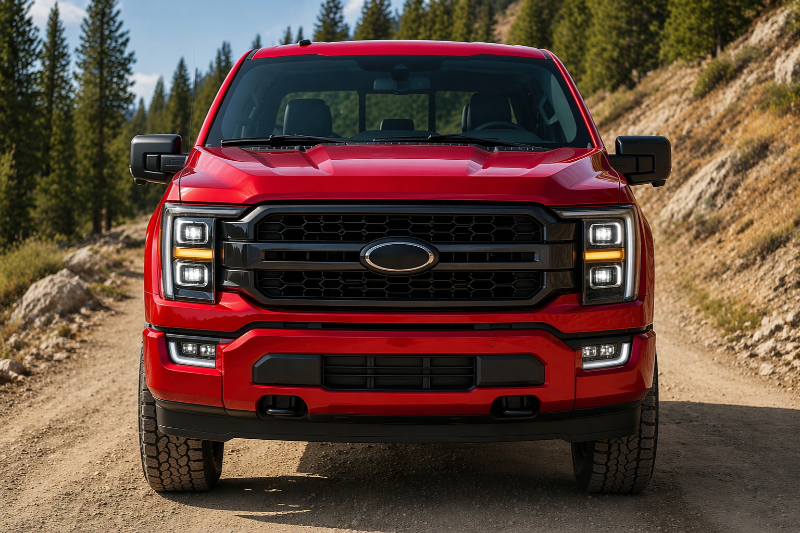
The Ford F-150 is shaping up to be one of the most important product overhauls in Ford’s modern history, with a targeted launch window around 2028–2029. As the backbone of Ford’s global truck dominance, the Ford F-150 is not just a vehicle refresh it represents a full generational reset of the company’s most profitable nameplate. The upcoming redesign is expected to redefine how pickup trucks integrate software, electrification, and platform efficiency in a rapidly changing automotive landscape.
Moreover, Ford is entering a strategic phase where nearly its entire North American lineup is being modernized in sync with new digital architecture goals. The Next-Generation Ford F-150 sits at the center of this transformation, bridging traditional internal combustion strength with hybrid and software-defined vehicle systems. This shift is essential as competition intensifies from GM Silverado and Ram trucks, both of which are also preparing major next-gen updates.
Consequently, the 2029 timeline is not just about a new truck it represents a structural reset in Ford’s engineering philosophy. From OTA updates to hybrid-first powertrains and modular truck platforms, the Next-Generation Ford F-150 is expected to redefine expectations in the global pickup segment.
Overview of Next-Generation Ford F-150 Strategy
Ford’s long-term truck strategy is centered around maintaining leadership in the full-size pickup segment while modernizing its entire ecosystem. The Next-Generation Ford F-150 will act as the foundation for this shift, combining hardware evolution with deep software integration.
Moreover, Ford is focusing on reducing platform complexity across its truck lineup. This means shared architectures between the F-150, Ford Raptor variants, Ford F150 Raptor performance models, and even electrified versions like the Ford F-150 Lightning (f150 lightning). The goal is to create a unified system that supports multiple powertrains without redesigning core structures.
Key strategic priorities include:
- Platform consolidation across Ford truck lineup
- Expansion of hybrid and multi-energy systems
- Software-defined vehicle architecture adoption
- Improved fleet and commercial usability
- Stronger long-term profitability per unit
However, Ford is not shifting fully to electric trucks in this cycle. Instead, it is balancing ICE performance with hybrid efficiency to meet real-world towing and commercial demands.
Next-Generation Ford F-150 2029 Timeline
The timeline for the Next-Generation Ford F-150 aligns with a broader Ford product overhaul expected around 2028–2029. The current 14th-generation F-150, launched in 2020, is nearing the end of its lifecycle, making a full redesign necessary.
Additionally, Ford’s Super Duty lineup, introduced in 2023, will also transition around the same period, allowing synchronized updates across the truck family.
Expected timeline breakdown:
- Production start window: 2028–2029
- Market launch: 2029 model year
- Overlap phase with current F-150: 1–2 years
- Full rollout across trims and variants: post-2029
Ford Truck Generational Timeline Overview
| Model | Generation | Launch Year | Expected Redesign | Lifecycle | Notes |
|---|---|---|---|---|---|
| Ford F-150 | 14th Gen | 2020 | 2028–2029 | ~8–9 years | Hybrid expansion, Lightning introduced |
| Next-Generation Ford F-150 | 15th Gen (expected) | 2029 | — | New cycle | Software + hybrid platform |
| Ford Super Duty | Current Gen | 2023 | 2028–2029 | ~6–7 years | Heavy-duty optimization |
This coordinated cycle ensures Ford maintains production efficiency while minimizing disruption for fleet customers.
Platform & Technology Shift in Next-Generation Ford F-150
The Next-Generation Ford F-150 will introduce a major shift toward software-defined vehicle systems. This means the truck will rely more heavily on centralized computing architecture, enabling advanced digital functions previously unavailable in pickup platforms.
Moreover, Ford is investing in over-the-air (OTA) updates that will allow continuous performance improvements after purchase. Features such as towing optimization, safety enhancements, and fleet diagnostics will be updated remotely.
Key technology upgrades:
- Centralized vehicle computing system
- Full OTA software update capability
- AI-assisted towing and load management
- Smart fleet tracking integration
- Enhanced driver-assistance systems
Consequently, the F-150 becomes more of a connected digital platform than a traditional mechanical truck.
Read also: Volkswagen Signals Interest in Premium Pickups
Powertrain Strategy for Next-Generation Ford F-150
Ford’s powertrain strategy for the Next-Generation Ford F-150 is focused on flexibility rather than full electrification. The company is expected to continue offering internal combustion engines alongside hybrid and extended-range systems.
Moreover, demand from commercial users ensures that towing performance and reliability remain top priorities. Fully electric solutions like the Ford F-150 Lightning will continue to evolve, but ICE and hybrid systems will dominate the core lineup.
Expected direction includes:
- Advanced ICE efficiency improvements
- Hybrid-first mainstream adoption
- Extended-range electric variants for fleets
- Improved torque delivery for towing
- Performance trims like Ford Raptor R
Additionally, models like the Shelby F150 and Ford Raptor for sale segment continue to influence Ford’s high-performance branding strategy.
Design & Engineering Evolution
The Next-Generation Ford F-150 will introduce a redesigned modular architecture aimed at improving scalability and manufacturing efficiency. This allows Ford to support multiple trims, including Ford F150 for sale variants, commercial fleet models, and performance versions like the F150 Raptor.
Moreover, aerodynamics will play a bigger role in this generation. Even pickup trucks such as the f150 will see improvements in airflow management to reduce drag and improve fuel efficiency.
Key engineering upgrades:
- Modular truck platform architecture
- Improved aerodynamic design
- Lightweight aluminum-intensive structure
- Higher payload efficiency
- Enhanced durability for fleet usage
Consequently, the truck becomes more efficient without sacrificing capability.
Next-Gen Ford F-150 vs Previous Generation Evolution
| Category | Current F-150 | Next-Generation Ford F-150 |
|---|---|---|
| Powertrain | ICE + Hybrid + EV (Lightning) | Hybrid-first + advanced ICE |
| Technology | OTA limited | Full software-defined system |
| Platform | Aluminum-heavy frame | Modular smart architecture |
| Towing Tech | Standard assistance | AI-enhanced towing |
| Target Users | Consumers + fleets | Expanded fleet + digital users |
Market Positioning & Competition
The Next-Generation Ford F-150 is designed to defend Ford’s dominance in the highly competitive pickup market. Rivals such as GM Silverado and Ram Heavy Duty trucks are also preparing next-generation updates, increasing pressure on Ford to innovate aggressively.
Moreover, Ford continues to balance two major markets: personal-use trucks and commercial fleet vehicles. This dual strategy ensures strong sales across segments like Ford F150 for sale listings and fleet contracts.
Key positioning factors:
- Maintain U.S. pickup leadership
- Strengthen fleet dominance
- Expand Raptor performance branding
- Compete with GM & Stellantis platforms
Read also: 2026 Tesla Model 3 Review: Specs & Pricing Explained
Why the Next-Generation Ford F-150 Matters?
The upcoming redesign is more than a model update it is a strategic reset for Ford’s entire truck ecosystem. The Next-Generation Ford F-150 represents a shift toward software, efficiency, and modular engineering.
Therefore, 2029 becomes a defining moment for:
- Truck technology leadership
- Fleet modernization
- Hybrid powertrain dominance
- Long-term platform scalability
Benefits and Limitations
Benefits:
- Improved efficiency across F-150 lineup
- Stronger software integration (OTA updates)
- Better fleet management systems
- More flexible platform design
Limitations:
- Higher production costs
- Complex transition from current generation
- Uncertain EV adoption rate
- Strong competition pressure
1. When will the Next-Generation Ford F-150 launch?
It is expected to launch around 2029.
2. What major changes are coming?
Software-defined architecture, hybrid powertrains, and platform redesign.
3. Will Ford F-150 become fully electric?
Not in this cycle; hybrid and ICE will still dominate.
4. What is Ford’s strategy?
A balanced approach between electrification and traditional truck capability.
5. Why is this generation important?
It resets Ford’s truck technology for the next decade.