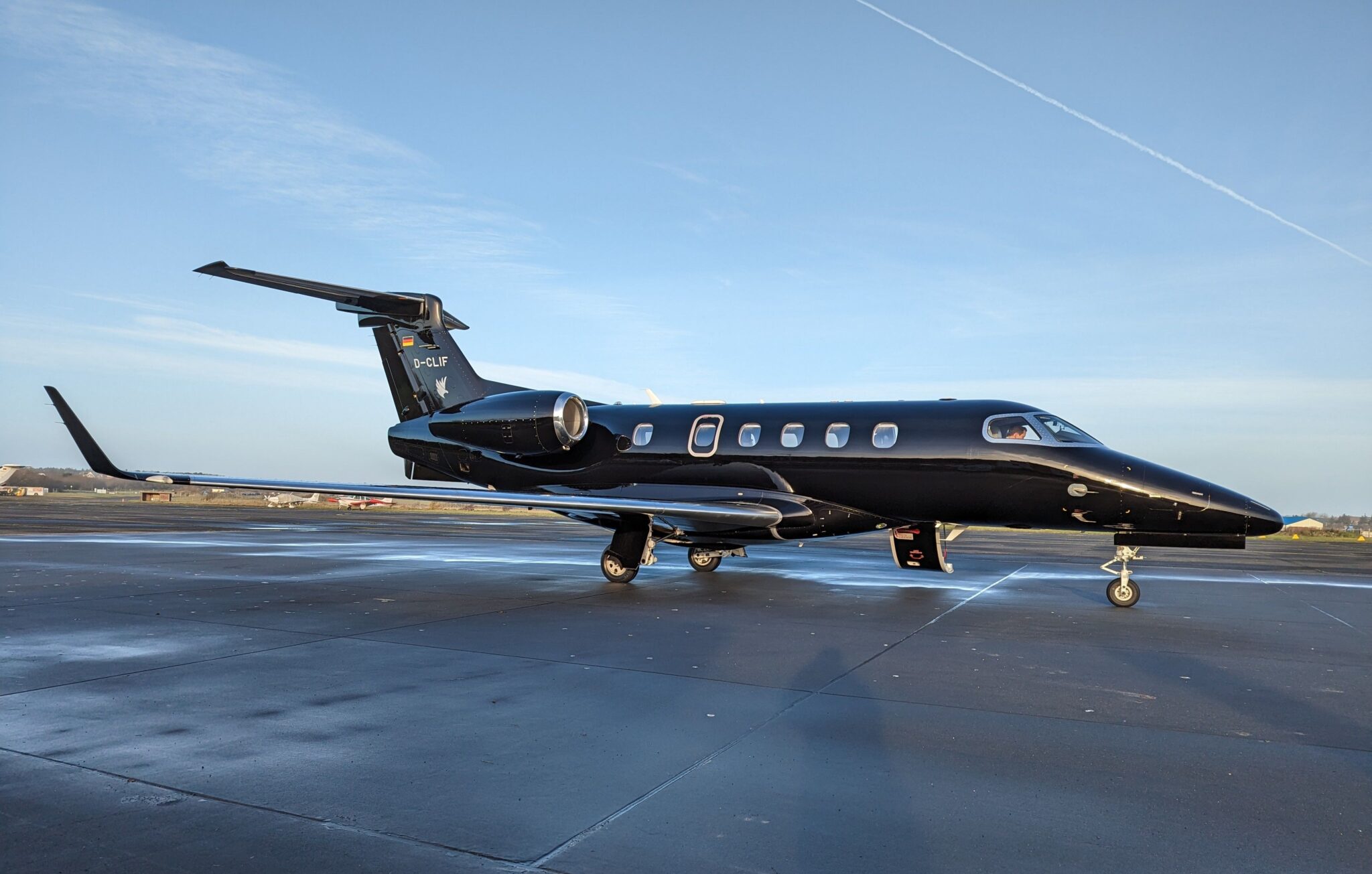
Inside the $7 billion aviation partnership, the next-generation Praetor 600E and the expanding ecosystem transforming how the world’s wealthiest travelers fly.
In the world of private aviation, time has always been the ultimate luxury. But as a new generation of ultra-high-net-worth travelers demands more than speed and convenience, two of the industry’s most influential players are reimagining what private flight can deliver.
At the center of this transformation is a partnership between Embraer Executive Jets and Flexjet, underscored by an agreement valued at up to $7 billion. With a firm order for 182 aircraft, options for another 30 and an expanded services and support package, the agreement reflects a broader shift in how private aviation is designed, delivered and experienced.
From the next-generation Praetor 600E to Flexjet’s expanding network of private terminals, helicopter connections and bespoke hospitality experiences, the two companies are building an ecosystem around an increasingly valuable commodity: the ability to control one’s time.
The collaboration dates to 2003 and has continued through successive generations of Embraer aircraft.
Now, with Flexjet serving as the fleet launch customer for the newly evolved Praetor 600E, the partnership is entering another chapter.
Yet understanding the significance of this aircraft requires looking beyond its engineering and performance specifications. It requires understanding the changing expectations of the people who fly privately—and the increasingly sophisticated infrastructure designed to serve them.
A New Generation of Private Aviation
Michael Amalfitano, President and CEO of Embraer Executive Jets, sees a fundamental shift underway in the demographics and expectations surrounding private aviation.
“We’re seeing the owners are getting wealthier sooner,” he told Impact Wealth.
That trend has significant implications for aircraft manufacturers. Customers entering private aviation earlier in life may remain within the category for decades, developing increasingly sophisticated expectations as their businesses, families and travel requirements evolve.
“It used to just be: make it bigger, make it go faster, make it go farther,” Amalfitano explained. “Those are the only three definitions that used to be developments for an airplane.”
Today, those traditional measures of progress are no longer sufficient.
“Now it needs to be smarter. Now it needs to be more intuitive. Now it needs to have a tech-savvy environment. It needs to be quieter.”
From the operator’s perspective, Flexjet CEO Michael Silvestro is witnessing many of the same changes.
He summarizes the evolution of the private aviation customer in three words: “Younger, larger and longer.”
Over the past 25 years, Silvestro said, the average age of a Flexjet flyer has declined by roughly a decade. Customers who might once have waited until their mid-50s to begin flying privately are increasingly entering the category earlier.
Their expectations are changing as well.
“They think of not just enduring the journey to get to their destination, but enjoying the journey,” Silvestro said.
At the same time, customers are gravitating toward larger aircraft earlier in their private aviation experience and traveling greater distances aboard them.
The observations from Embraer and Flexjet reveal a fundamental transformation in the market. The next generation of private aviation customers is not simply asking aircraft to travel farther or faster.
They are demanding more from the time they spend aboard them.
Private Aviation as a Strategic Asset
For entrepreneurs, family office principals and global investors, private aviation can serve as a practical tool for managing complex lives and businesses.
The ability to visit multiple cities in a single day, maintain confidential conversations while traveling and access destinations underserved by commercial airlines can offer advantages extending well beyond convenience.
For executives overseeing international operations or investors managing assets across multiple markets, greater control over travel schedules can support productivity, flexibility and responsiveness.
For younger entrepreneurs entering private aviation, personalization, reliable service and seamless technology are increasingly part of the value they expect.
Fractional ownership adds another dimension to that equation.
Rather than purchasing and operating an entire aircraft independently, fractional owners acquire a share in an aircraft, with access to a professionally managed fleet under the terms of their program.
The structure can offer operational convenience and predictable access arrangements, although its economics depend on factors including flight hours, aircraft category, management fees and individual travel patterns.
For family offices, the decision between fractional ownership, chartering and full aircraft ownership is ultimately a question of capital allocation, usage requirements and the degree of operational control desired.
The Embraer-Flexjet relationship illustrates how manufacturers and operators are responding to these demands, combining advanced aircraft engineering with a broader service infrastructure designed around the lifestyles and professional obligations of their customers.
Innovation With a Purpose Inside the Praetor 600E
The changing expectations of private aviation customers are reflected throughout the Praetor 600E.
“For Embraer,” Amalfitano said, “two characteristics have defined the company over its 57-year history: efficiency and innovation.”
The Praetor 600E is intended to bring those qualities together.
Its cabin introduces seating with electric-assisted controls and a lie-flat configuration, advanced cabin controls, enhanced connectivity and one of its most distinctive features: Embraer’s Smart Window™.
Flush with the sidewall of the aircraft, the curved 42-inch 4K OLED touchscreen can display real-time imagery from three exterior cameras, provide entertainment and support video conferencing.
The technology allows passengers to experience panoramic exterior perspectives and observe parts of the aircraft normally invisible from the cabin, including the landing gear during takeoff and arrival.
The same screen can also become part of a working or meeting environment.
The effect is both visually striking and functional, reflecting the increasing convergence of aircraft design, digital technology and executive productivity.
But Amalfitano is careful to distinguish meaningful innovation from novelty.
“You’re not doing something for a novelty,” he said. “You’re not doing something simply because it looks good. It has to add productivity. It has to add value.”
He identifies four pillars behind Embraer’s product line: unmatched performance, disruptive technology, unparalleled comfort and comprehensive support.
Amalfitano chose the name Praetor for its meaning, “to lead the way”—an ambition reflected in the aircraft’s elegant design, thoughtful technology and attention to the passenger experience.
The objective is not technology for technology’s sake. It is technology that meaningfully changes what passengers can accomplish aboard an aircraft.
That distinction becomes particularly important as connectivity transforms the private cabin into an extension of the office.
Flexjet’s Praetor 600E aircraft are being equipped with Starlink, bringing high-speed connectivity into an environment where uninterrupted communication has become increasingly important.
Silvestro sees that transformation as dramatic.
Twenty-five years ago, he recalled, the experience aboard a private aircraft could be relatively Spartan and disconnected. Passengers might simply have been pleased if the catering arrived as expected.
“Fast forward to 2026,” he said, and expectations are fundamentally different.
Flexjet has responded with investments in equipping its fleet with Starlink, customized interiors and its Red Label Training Program, which includes enhanced service training for cabin attendants.
The result is a broader shift in how flight time itself is valued.
Saving time on the ground remains essential. But for a global executive, entrepreneur or investor, preserving the usefulness and comfort of the hours spent in the air can be equally consequential.
A Seven-Billion-Dollar Partnership Built on Trust
The Praetor 600E is also the newest product of a relationship that has developed for more than two decades. It began in 2003 through Flight Options and has continued across multiple Embraer aircraft programs.
Flexjet and its predecessor, Flight Options, committed early to successive generations of Embraer aircraft, from the original Legacy to the Phenom 300 and the models that would become the Praetor family.
“We have always been an organization that was willing to step up and be the leader in terms of committing to them as they evolve their product line,” Silvestro said.
That confidence has been reciprocated. Flexjet brings extensive operating experience and direct insight into fractional owners’ expectations; Embraer brings engineering, manufacturing and product development. Silvestro credits Embraer with listening closely to that feedback, while Amalfitano describes an ongoing exchange: “We trade information about what the market is saying.”
The personal relationships extend further still. Amalfitano’s professional history with the people behind Directional Aviation and Flexjet spans approximately four decades, beginning during his career in aviation finance.
“We’ve been through hard times. We’ve been through difficult discussions, and we came out on the other side stronger,” he said.
Silvestro points to COVID as one such test, recalling how Embraer demonstrated flexibility beyond contractual obligations as the companies worked toward a mutually agreeable solution.
“When you go through those things with people and organizations—because essentially organizations are people—that builds a level of trust,” Silvestro said.
Behind the multibillion-dollar agreement is a sustained commitment to each other—expressed through early support for new aircraft, close attention to feedback and the flexibility to navigate difficult times together.
A Luxury Experience That Begins Before Takeoff
If Embraer is reimagining what happens inside the aircraft cabin, Flexjet has increasingly focused on everything surrounding it.
The private aviation experience can begin long before a passenger reaches the aircraft.
From Manhattan, Flexjet’s helicopter service provides a connection to Teterboro, where passengers can move through a Flexjet-exclusive private terminal before boarding.
The individual elements matter: speed, privacy, comfortable spaces to work or dine, coordinated baggage handling and fewer transitions throughout the journey.
But their cumulative effect is more important.
They remove friction.
For individuals whose schedules involve multiple business commitments, international travel and personal obligations, that seamlessness can be as valuable as the aircraft itself.
Flexjet has expanded beyond traditional aviation services into a broader ecosystem encompassing private terminals, helicopter access, hospitality, curated travel experiences and relationships across the luxury sector.
Silvestro points to FXLUX Travel Guides, Chairman’s Club experiences and its involvement in Formula 1. He also sees opportunities to expand the owner experience through luxury brands following the investment led by L Catterton, the LVMH-backed investment firm.
The objective is not simply to associate the aviation company with recognizable luxury names.
It is to understand the broader world of the Flexjet owner and create experiences that complement it.
Silvestro described Flexjet as maintaining relationships with brands to which the company feels an “emotional connection,” while continuing to expand the experiences available to owners.
“I think the future is even brighter than it ever has been,” he said.
Behind the Scenes at Flexjet’s Global Command Center
In Cleveland, Flexjet’s attention to detail extends from the aircraft cabin to the Global Command Center. Silvestro describes the distinction as “an operation center that combines function with … a sense of style”—the same sensibility evident in the aircraft’s interiors.
Inside the command center, large screens display a global view of Flexjet’s operation. Teams monitor aircraft, flight conditions, crews and maintenance while working directly with owners on their travel needs. Each owner’s itinerary and individual requests are part of the planning, helping shape how the journey is arranged and how changes are handled.
The scale is striking, but so is the care behind it. What the passenger experiences as an effortless journey depends on an intricate operation, designed with the same deliberation as the cabin itself.
Delivering that level of luxury takes careful planning and an operation equipped to respond when circumstances change. Weather, airspace restrictions and air-traffic-control decisions remain part of private aviation, along with the unexpected. Flexjet’s investment in its people, technology and facilities gives its teams the resources to work through those challenges and look after the owners relying on them.
As the fleet expands, investment in the operation becomes even more important. The collaboration with Embraer also gives customers more than one way to access its aircraft. Flexjet offers fractional ownership, while Embraer can introduce buyers facing delivery waits to Flexjet. As Amalfitano explained, each company has become one of the other’s best sales teams.
Amalfitano said deliveries under the agreement will help Flexjet substantially expand its fleet over the next five years.
“This is just the first of many more aircraft that Flexjet customers are going to enjoy,” he said of the Praetor 600E.
As those aircraft arrive, Flexjet will also need to expand the teams, facilities and support behind each flight, carrying the same attention to its owners into a much larger operation.
The Human Infrastructure Behind the Luxury
The emphasis on experience extends throughout Flexjet’s Cleveland campus.
Contemporary workspaces, quieter areas and hospitality-oriented gathering spaces create an environment intentionally different from the conventions of a traditional corporate headquarters.
The newer human resources area takes that philosophy further, incorporating comfortable seating and social spaces designed to create a less institutional environment for recruiting and employee interaction.
After the formal interviews concluded, Silvestro and Amalfitano moved easily among employees and guests gathered there.
It was a small but telling moment.
Both executives had emphasized, in different ways, that aviation may be built around extraordinarily sophisticated machines, but successful organizations ultimately depend on people.
The same principle extends throughout the passenger experience.
Aircraft engineering matters, but so do pilots, maintenance teams, operational personnel, cabin attendants and the individuals responsible for countless decisions passengers may never know were made.
As technology becomes increasingly sophisticated, the human element remains fundamental to delivering a genuinely personalized luxury experience.
“Customer feedback is fundamental to how we continue to evolve our aircraft,” Amalfitano said. Embraer gathers that insight through ongoing conversations with owners and operators worldwide, as well as customer advisory boards. Alongside the company’s engineering expertise, those perspectives helped shape the latest Praetor enhancements.
Flexjet brings more than 20 years of experience as a strategic fleet customer to that dialogue. Its daily operations reveal how fractional owners use the aircraft and how their expectations are changing. As more enhanced Praetor aircraft enter the fleet, that experience will give Embraer further insight into where improvements matter most.
What Comes Next
Range, speed and cabin size still matter. But younger customers entering private aviation bring expectations that extend well beyond the aircraft itself—from how easily they can work aboard to how smoothly the journey fits around their lives.
Looking ahead, Amalfitano sees Embraer’s direction shaped by evolving customer expectations, while keeping specific aircraft developments under wraps. “Our role is to anticipate where they are going next,” he said of customers’ evolving expectations. That means improving the experience from departure to arrival, while continuing to advance the aircraft’s efficiency and technology.
For Flexjet, expansion brings the responsibility of maintaining the personal attention owners expect across more aircraft, destinations and services.
For owners whose work and personal lives take them across cities and continents, the value is felt in practical ways: fewer hours spent in transit, the ability to stay connected and the freedom to arrive rested. Luxury makes the journey enjoyable. Greater control over their time makes it worthwhile.