Ferrari’s 100-foot foiling monohull combines automotive control systems, advanced materials and renewable-energy technology in an ambitious experiment in offshore racing. As construction advances towards its first sea trials, Hypersail offers a revealing look at the future of high-performance marine engineering.
Ferrari Hypersail represents a new chapter in the relationship between automotive engineering and ocean sailing. Developed as a 100-foot foiling monohull designed for offshore racing, the project brings Ferrari’s expertise in dynamic control, lightweight structures and computational engineering into an environment where performance depends on both precision and the unpredictable forces of the sea.
Unlike conventional luxury yachts designed around leisure, hospitality and onboard comfort, Hypersail is fundamentally an engineering and sporting project. Its purpose is to explore how a large monohull can lift above the water, maintain stability through automated control and operate using renewable energy.
The project also reflects a broader shift in luxury innovation. Increasingly, the most ambitious products are defined not simply by their appearance or exclusivity, but by the sophistication of the systems beneath the surface.
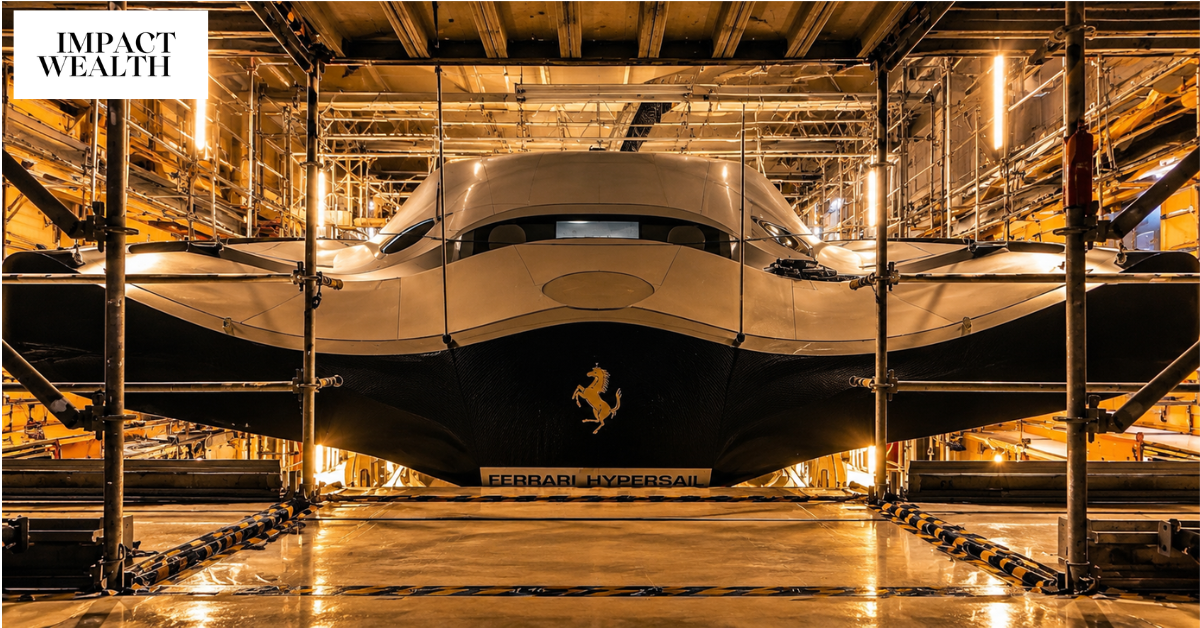
In 2026, Hypersail moved closer to its first operational phase. Ferrari announced on 16 October that the hull’s painting and livery were complete and that the underwater appendages had arrived at the shipyard. The next major milestone is sea testing, currently expected in early 2027.
What Is Ferrari Hypersail?
Ferrari unveiled Hypersail in June 2025 as an offshore sailing project intended to transfer technological expertise between its automotive operations and the marine sector. The initiative is led by experienced ocean racer Giovanni Soldini, while French naval architect Guillaume Verdier is responsible for the yacht’s design.
At 100 feet, or approximately 30 metres, the vessel is being developed as a high-performance foiling monohull. Its ambition extends beyond conventional yacht construction: Ferrari describes it as a research and development platform for investigating performance, efficiency, energy management and advanced control systems.
The development programme brings together automotive engineers and specialist marine professionals. North Sails joined as technical partner in September 2025, contributing expertise in sail design, offshore performance and technical equipment. ABB is also involved as the project’s electrification partner.
Important 2026 update: Ferrari’s October announcement confirmed that the hull was fully painted and the appendages were at the shipyard. North Sails’ published project timeline anticipates that Hypersail will take to the water in early 2027, when sea trials in Italy are expected to begin. As of 21 October 2026, those trials should therefore be described as forthcoming, not completed.
The distinction matters because construction milestones demonstrate progress, but they do not yet establish how the complete vessel will perform in demanding ocean conditions.
From Supercars to Ocean Racing: Ferrari’s Engineering Advantage
Ferrari’s involvement in sailing is significant because several disciplines underpinning high-performance automotive engineering also matter at sea. These include aerodynamic analysis, lightweight construction, computational simulation and electronic systems that manage a vehicle’s response to changing forces.
However, transferring those principles requires adaptation rather than direct replication.
A road car operates on a comparatively predictable surface, with tyres providing contact and grip. A foiling yacht interacts with water through its hull, sails, keel, rudder and underwater lifting surfaces. Wind, waves and changes in speed continually alter the forces acting on the vessel.
The engineering challenge is to predict those changes and develop systems capable of responding quickly enough to maintain control.
Ferrari’s experience with electronic vehicle dynamics provides a foundation for Hypersail’s automated Flight Control system. Computational models and simulation can also help engineers understand how the vessel responds to different operating conditions before validating those models through physical testing.
This is a two-way exchange. Ferrari announced the project as an opportunity to transfer technology between its sports cars and the nautical sector. The resulting knowledge may inform future engineering work, although the precise commercial applications remain to be demonstrated.
For a luxury audience, the interesting point is not simply that a famous automotive marque has designed a yacht. It is that engineering methods developed in one performance environment are being adapted to solve a different and unusually complex problem.
How Foiling Technology Changes Ocean Sailing
Hydrofoiling is central to Hypersail’s design. Hydrofoils are shaped underwater surfaces that generate lift as water flows across them. When sufficient lift is produced, the hull can rise above much of the water’s surface, reducing drag compared with conventional displacement sailing.
The potential performance benefits come with a demanding stability problem. Lift must be managed continuously as wind strength, waves, speed and the vessel’s angle of heel change.
Hypersail’s design combines three principal elements to manage this process: lateral foils, a foil integrated into the keel, and a foil-equipped rudder.
The lateral foils generate the lift needed to raise the hull. The canting keel incorporates its own foil with a movable flap, providing an additional support and control point. The rudder also has a movable wing that can contribute to controlling the vessel’s attitude and heading.
Together, these components form a three-point support arrangement during foiling. Their interaction is crucial: the vessel must generate sufficient lift without losing the balance needed to remain controllable.
Ferrari’s Flight Control system is designed to coordinate the process. Sensors monitor variables including wind, waves, speed and heel angle. An onboard computer processes the information, while mechanical actuators adjust the foils and other appendages.
The system is intended to make continuous trim corrections, leaving the crew better positioned to concentrate on navigation, strategy and interpreting changing sea conditions.
The technology remains subject to validation at sea. A control architecture described on paper is not the same as a proven system operating reliably through prolonged offshore conditions.
Renewable Energy and the Push for Self-Sufficiency
Energy management is another defining element of Ferrari Hypersail.
Ferrari introduced the project with the ambition of creating an energy-self-sufficient offshore monohull powered by renewable sources, including solar, wind and kinetic energy. The yacht is designed without a combustion engine, making onboard generation, storage and consumption central to its operation.
This is more demanding than simply installing renewable-energy equipment on a yacht. The energy system must supply the electronics, instruments and mechanisms responsible for controlling the foils, keel and rudder, while operating through changing weather conditions.
ABB’s published project information describes a dual-voltage direct-current architecture using 48-volt and 800-volt systems. The system is intended to support onboard hydraulics, Flight Control and electronics while integrating renewable generation.
The underlying engineering problem is one of balance. Generation varies with environmental conditions, while demand changes according to which systems are operating and how intensively they are being used. Power management must account for both.
For sustainable yacht technology, this is a more meaningful test than simply counting installed solar panels or wind turbines. The relevant question is whether the entire vessel can reliably meet its energy requirements throughout its intended operating profile.
Hypersail’s design ambition is clear, but its actual energy performance and operational autonomy must be established through testing. Its eventual contribution to marine engineering will depend on measured results, not the sustainability narrative alone.
Ferrari Hypersail vs. Conventional Luxury Yachts
The distinction between Hypersail and a conventional luxury yacht is fundamental to understanding the project.
| Feature | Ferrari Hypersail | Conventional luxury yacht |
|---|---|---|
| Primary purpose | Offshore racing and research and development | Leisure, cruising or charter |
| Design priority | Speed, foiling efficiency and stability | Comfort, space, amenities and cruising performance |
| Technology | Integrated foils and automated Flight Control | Varies by vessel, from conventional systems to advanced stabilisation |
| Energy approach | Designed for renewable-energy self-sufficiency | Varies by vessel and propulsion system |
| Intended experience | High-performance ocean sailing | Luxury travel and recreation |
Conventional yachts vary widely, and some incorporate advanced hybrid propulsion, renewable energy and sophisticated control systems. Hypersail is not intended to represent every luxury yacht or replace the leisure-oriented superyacht category.
Its purpose is different. It prioritises the engineering challenges of offshore performance, with comfort and hospitality secondary to the demands of a racing prototype.
For readers interested in the broader luxury sector, this distinction reflects a useful principle: luxury is not one product category with a single set of priorities. It can mean an exceptional onboard experience, or it can mean access to a machine that explores the limits of technical performance.
The Design Philosophy Behind Ferrari Hypersail
Hypersail’s visual identity connects the project to Ferrari while serving a broader engineering ambition. Its distinctive grey-and-yellow livery combines brand recognition with a form shaped by the demands of ocean sailing.
Yet the yacht’s significance lies beneath its exterior. The geometry of the hull, the placement of its appendages and the integration of its control systems must work together as a functional whole.
Ferrari has also highlighted its use of multilayer carbon fibre for the hull and carbon-fibre-and-titanium sandwich construction in areas exposed to particularly high loads. These materials address the need to balance low weight with the structural strength required for foiling.
The same principle applies to the relationship between mechanical and electronic systems. Sensors and actuators can only deliver useful corrections if the physical components respond as intended. Structural stiffness, component geometry and control precision are therefore interdependent.
This is where the project moves beyond a styling exercise. Ferrari’s brand identity is visible, but the more consequential question is whether its engineering approach can deliver a reliable, high-performance offshore vessel.
What Hypersail Means for Luxury and Marine Innovation
For the luxury market, Hypersail illustrates how exclusivity and innovation can intersect without being identical.
The project is not evidence that conventional superyachts will soon adopt the same architecture. Its specialised requirements, experimental design and offshore racing purpose make direct comparisons difficult. Nevertheless, it provides a platform for investigating technologies that could have wider relevance.
Lightweight structural materials, improved digital control, more sophisticated simulation and better-integrated energy systems are all areas of interest to the broader marine industry. Hypersail may generate useful knowledge in these fields, but the extent of any transfer will depend on the outcomes of development and testing.
Ferrari has reported that the project has generated more than 20 patents. That figure indicates a substantial innovation effort, but patents alone do not establish commercial value, reliability or industry-wide adoption.
The project also fits a broader conversation about how wealth is expressed through technology, expertise and access to distinctive experiences. Our article on the invisible infrastructure of wealth explores a different dimension of modern wealth: the systems and capabilities that support it beyond visible assets.
For luxury brands, projects like Hypersail can demonstrate technical ambition and strengthen their identity beyond a single product category. Whether they also create lasting engineering advantages is a separate question that only time and evidence can answer.
Unique Insight: Ferrari Hypersail and the Future of Performance Luxury
The most important aspect of Ferrari Hypersail is not that Ferrari has entered sailing. It is the attempt to transfer an entire engineering philosophy across industries.
Automotive development often relies on integrated systems: materials, aerodynamics, software, sensors and mechanical components are designed to operate together. Hypersail applies a comparable approach to a vessel exposed to the constantly changing forces of the ocean.
The opportunity is substantial, but so are the limitations. A yacht cannot be engineered as though it were a car operating on a road. Water introduces different forces, while offshore conditions demand reliability over extended periods and create challenges that controlled simulations cannot fully reproduce.
The first sea trials will therefore be more than a ceremonial milestone. They will provide the evidence needed to evaluate whether the design’s theoretical advantages translate into practical performance.
This is also where the project connects to the wider concept of performance luxury. The most valuable innovation is not necessarily the most visually dramatic or technologically complex. It is the innovation that solves a difficult problem reliably and creates capabilities that would otherwise be unavailable.
Hypersail’s long-term significance will depend on how effectively its systems work together under real conditions and what its development teaches engineers about applying performance technologies beyond their original fields.
For a related perspective on the changing relationship between exclusivity and value, see our feature on the trophy asset premium.
Conclusion
Ferrari Hypersail is an ambitious attempt to combine supercar engineering with advanced offshore sailing. Its foils, automated Flight Control, lightweight materials and renewable-energy architecture position it as a research platform as much as a racing yacht.
As of late October 2026, the completed hull paintwork and arrival of the appendages mark important construction progress. The next decisive stage is testing at sea, expected to begin in early 2027.
The project should not yet be treated as proof of superior performance or a blueprint for the entire luxury yacht market. Its importance lies in the engineering questions it is attempting to answer.
If those systems perform as intended, Hypersail could contribute valuable knowledge to marine technology while demonstrating how expertise developed in one industry can inform another. That possibility not the Ferrari name alone is what makes the project worth watching.
Frequently Asked Questions
1. What is Ferrari Hypersail?
Ferrari Hypersail is a 100-foot foiling monohull developed for offshore sailing and engineering research. It combines hydrofoils, automated control systems, advanced structural materials and renewable-energy technology.
2. Who is designing and developing Ferrari Hypersail?
The project is led by ocean racer Giovanni Soldini, with naval architect Guillaume Verdier responsible for the yacht’s design. Ferrari works with specialist partners, including North Sails and ABB.
3. How does Ferrari Hypersail use foiling technology?
Its underwater foils generate lift to raise much of the hull above the water. A coordinated arrangement involving lateral foils, a foil integrated into the keel and a foil-equipped rudder supports stability and control.
4. Is Ferrari Hypersail a luxury yacht or a racing yacht?
It is primarily an offshore racing and research project, not a conventional leisure superyacht. Its design prioritises performance, control and engineering development over residential comfort and hospitality.
5. How does Ferrari Hypersail generate its own energy?
The yacht is designed to use renewable sources, including solar, wind and kinetic energy, supported by an integrated onboard electrical architecture. Its ability to meet all operational energy requirements must be validated through testing.
6. When is Ferrari Hypersail expected to begin sea trials?
As of 21 October 2026, North Sails expects the yacht to take to the water in early 2027, with sea trials planned in Italy. This is a published expectation, not confirmation that trials have already occurred.