A foundation inspection report should tell you what was observed, what was not accessible, what the engineer can reasonably conclude, and what must happen before a buyer can price the risk. A sentence such as “repair recommended” is only the start. You need to know whether it addresses the cause, whether further investigation is required, and whether a contractor has a defined scope to quote.
For a buyer under an inspection deadline, the quickest way to read a report is to separate five things: evidence, interpretation, uncertainty, next action, and cost exposure. This guide is about interpreting a report you already have. If you have not yet decided whether to arrange an engineer’s visit, start with our guide to buying a house with foundation problems.
First, check what the engineer actually inspected
Look for the date, the engineer’s identity and local qualifications, the property address, the reason for the visit, and the areas examined. Was the assignment a visual walk-through of a single basement wall, an assessment of the entire foundation, a review of prior repairs, or a design for new work? These are different services. A conclusion about a visible wall cannot automatically cover footing conditions under finished floors.
The report should identify inaccessible spaces and any reliance on seller records, drawings or photographs. A statement that no distress was observed is narrower than a warranty that hidden defects do not exist. The American Society of Home Inspectors’ standard requires a general home inspector to examine visible structural components, including foundations, while explicitly limiting exhaustive analysis and concealed conditions. An engineer’s scope is agreed separately; read its limitations rather than assuming every test or repair design was included.
The five parts of a useful foundation report
| Report section | What to look for | Buyer’s follow-up |
|---|---|---|
| Observed condition | Location, photographs, dimensions if measured, wall alignment, water evidence, and related symptoms | Ask which observations were measured and which were only visual. |
| Possible cause | Reasoned explanation that distinguishes established evidence from hypotheses | Ask what evidence would confirm or rule out the leading cause. |
| Significance | Whether the finding is cosmetic, affects serviceability, may affect structural performance, or needs urgent attention | Ask what the engineer can conclude now and what is still uncertain. |
| Next step | Monitoring, drainage work, testing, geotechnical input, repair design, or no further structural work | Ask who performs it and whether the recommendation is a design or an assessment only. |
| Limitations | Areas not entered, concealed construction, absence of historical records, and assumptions | Decide if the unresolved items could change the purchase or repair budget. |
A practical red flag: if a report recommends expensive underpinning, wall reinforcement or drainage work but gives no clear basis, extent, or next investigation, request clarification before treating a contractor’s price as the full cost. Equally, a report that calls a crack “minor” without saying what was inspected deserves a closer read.
Read the symptom and the cause separately
A diagonal crack, a sticky door and an uneven floor may occur together, but they do not prove one diagnosis by themselves. Look for an explanation of how the reported symptoms relate to each other and whether photographs, measurements or a previous inspection establish change over time. Patching a surface can hide a symptom without addressing a continuing source of movement or moisture.
Soil and water are especially important context. The U.S. Geological Survey explains that expansive soils shrink or swell as moisture changes and can damage structures. That general mechanism is not a diagnosis of your lot. Where the engineer cannot determine subsurface conditions from a visual inspection, the next step may be a geotechnical evaluation, drainage review, monitoring, or targeted opening work. Ask the engineer which question the proposed test would answer.
A short example: what the wording changes
Hypothetical example, not an actual inspection: A home inspector photographs a horizontal crack and reports dampness along one basement wall. A structural engineer then notes the crack location and visible wall deflection but says the footing and exterior waterproofing were not exposed. The engineer recommends assessing water sources and preparing a repair design after additional investigation.
That report does not tell the buyer that a cosmetic crack fill will solve the issue, or that one contractor’s bid covers all possible work. It tells the buyer what is visible, why an underlying issue is plausible, and which missing information could change the scope. A bid for interior sealing and a bid for wall reinforcement may describe different problems. Request a written scope that both contractors can price and ask whether a separate drainage specialist is needed. For cost questions specific to this crack pattern, see our horizontal foundation crack repair-cost guide.
Translate the report into a buying decision
- Map every recommendation to an owner and deadline. Who arranges testing, design, permits and repair bids, and can it happen before your inspection contingency expires?
- Get comparable quotes. Ask contractors to price the same defined scope and identify exclusions, access, finishes, drainage, permit requirements and warranty terms. A cheap bid may simply omit work.
- Budget uncertainty separately. Keep a reserve for concealed conditions and ask whether financing or insurance requires work before closing. No generic internet repair average replaces a property-specific estimate.
- Check the contract. The Consumer Financial Protection Bureau advises arranging an independent inspection promptly so additional evaluations can be completed and notes that repairs may affect closing or a loan. Your options to negotiate, extend or withdraw depend on the actual contract and local rules.
- Make the decision with the remaining unknowns visible. Compare the total purchase cash, defined repairs, reserves and possible disruption with the property value and alternative homes.
In an investment property, a repair can also postpone occupancy and rent. Our basement-water checklist can help separate immediate water-source questions from the structural report.
Questions to send back to the engineer
- Which conclusions follow from direct observations, and which are possibilities?
- Was movement measured or compared with any earlier records?
- What areas were inaccessible, and could they change the conclusion?
- Is the recommendation a repair design, a request for further testing, or a general observation?
- Should a geotechnical engineer, drainage specialist, or another professional be involved?
- What would make the condition urgent or warrant limiting use of an area?
- Would the engineer review a contractor’s proposed scope after investigation?
Quick answers
Does a foundation report certify that a house is safe forever?
No. It documents the stated scope and conditions at the time of the assessment. Ask the engineer what conclusion the available evidence supports and what remains concealed or outside the assignment.
Can I use a contractor’s repair quote instead?
A contractor can price a defined task. When the cause, structural significance or required design is unclear, a quote alone may not answer whether that task addresses the problem. A contractor’s experience can be valuable, but it serves a different purpose from an independent engineering assessment.
Who should pay for a specialist visit?
The buyer and seller can negotiate payment under the purchase contract. The key is to keep the assessment independent and allow enough time to understand it before the inspection deadline.
Author context: Kaleem Afzal Khan holds a BSc in Civil Engineering and an MEng and works in structural engineering research. This article is a source-based framework for interpreting a report. It is not a review of your property; engage a locally qualified engineer for a site-specific conclusion.
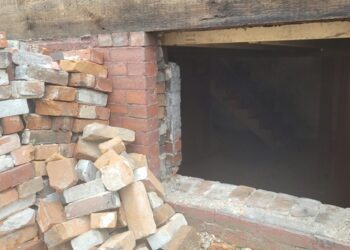
Featured photograph: Daniel McCullough / Unsplash. The image illustrates design work and is not a record of the hypothetical inspection above.