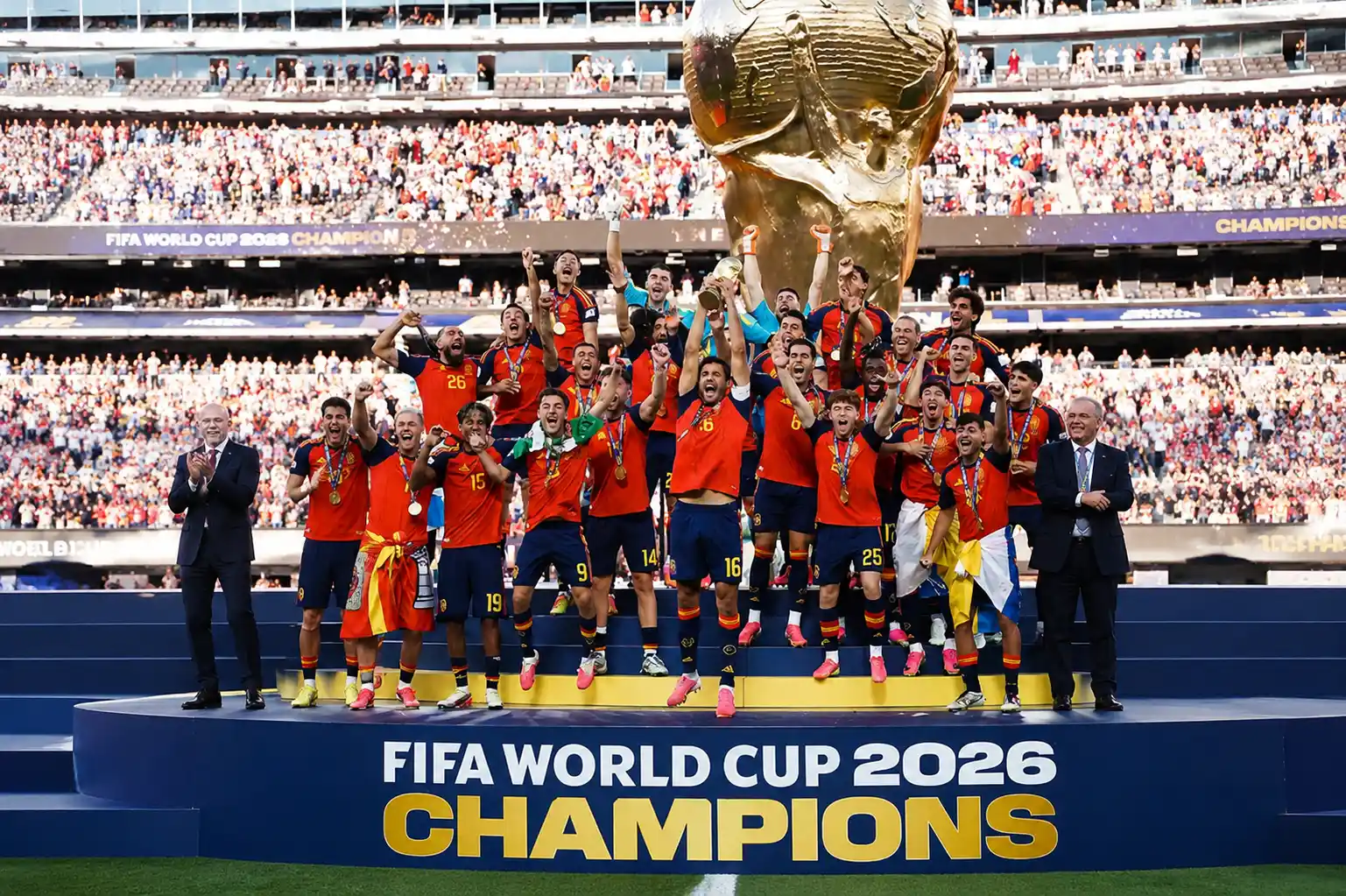
The 2026 World Cup Final Spain vs Argentina was billed as a meeting between football’s past and future, a contest that would either extend Lionel Messi’s remarkable international legacy or usher in a new era led by Spain’s emerging generation. Inside a sold-out MetLife Stadium, millions watched what many expected to be the perfect final chapter of Messi’s World Cup journey. Instead, they witnessed one of the most tactically disciplined performances in recent tournament history as Spain defeated Argentina 1-0 after extra time to claim the FIFA World Cup title.
While much of the global conversation understandably focused on Messi’s emotional farewell, the 2026 World Cup Final Spain vs Argentina ultimately became a showcase of collective excellence over individual brilliance. Spain arrived in New Jersey as one of the tournament’s most balanced teams, combining intelligent possession, relentless pressing, defensive organization, and remarkable squad depth under Luis de la Fuente. Argentina, meanwhile, relied on championship experience, defensive resilience, and the enduring brilliance of Messi to navigate another deep World Cup run.
The final evolved into far more than a battle for football’s biggest trophy. It became a fascinating tactical chess match, highlighting how modern international football increasingly rewards collective structure, disciplined transitions, and positional intelligence over moments of isolated genius. Although Argentina fought with determination and Emiliano “Emi” Martínez produced one of the finest goalkeeping displays ever seen in a World Cup final, Spain’s relentless pressure eventually proved decisive. By the end of extra time, one football dynasty had begun another glorious chapter while another reached an emotional conclusion.
How Spain Executed a Tactical Masterclass?
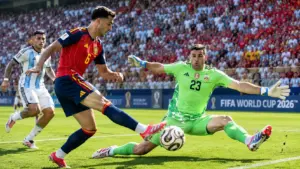
From the opening whistle, Spain imposed the identity they had carefully developed throughout the tournament. Rather than overwhelming Argentina with frantic attacking football, they controlled the rhythm through patient possession, intelligent movement, and calculated pressing.
Whenever Argentina attempted to build from the back, Spain’s forwards immediately cut passing lanes toward midfield. Instead of pressing recklessly, they worked collectively, forcing Argentina toward the touchlines before collapsing around the ball carrier. This coordinated pressure repeatedly denied Lionel Messi the space he normally exploits between defensive and midfield lines.
Spain’s midfield trio dictated virtually every phase of possession. Their continuous rotation made defensive marking exceptionally difficult, while quick one-touch combinations stretched Argentina horizontally before exploiting gaps vertically. Instead of forcing ambitious passes into crowded areas, Spain patiently recycled possession until openings naturally appeared.
This discipline became one of the defining characteristics of the 2026 World Cup Final Spain vs Argentina. Spain rarely abandoned their shape, even when Argentina temporarily slowed the tempo. Every player understood when to press aggressively and when to retreat into an organized defensive block, limiting unnecessary risks.
Defensive Organization Neutralized Argentina
Argentina entered the final hoping to create transitional opportunities whenever Messi received possession between the lines. Spain anticipated this perfectly.
Whenever Messi drifted centrally, Spain’s midfielders immediately compressed the available space while their central defenders resisted stepping too aggressively into midfield. This balance prevented Messi from turning freely while simultaneously protecting the defensive line against runners attacking behind.
The defensive partnership, supported by disciplined full-backs, consistently denied Argentina opportunities to attack centrally. Forced wide, Argentina struggled to deliver dangerous final balls into the penalty area.
Perhaps most impressive was Spain’s defensive patience. They rarely chased possession unnecessarily. Instead, they trusted their positional structure, forcing Argentina into increasingly difficult passing sequences.
This tactical maturity reflected months of preparation rather than improvisation. Spain demonstrated why defensive organization remains every bit as important as attacking creativity in modern tournament football.
Midfield Control Defined the Match
If Spain won the tactical battle anywhere, it was unquestionably in midfield.
Their ability to circulate possession under pressure prevented Argentina from establishing sustained periods of control. Every successful passing sequence gradually increased Spain’s territorial advantage while forcing Argentina’s midfielders into physically demanding defensive work.
Rather than attempting risky vertical passes, Spain frequently recycled possession through deeper midfield positions before accelerating attacks with sudden changes of tempo. This constant variation frustrated Argentina’s pressing structure and steadily shifted momentum toward the European champions.
As fatigue increased throughout regulation, Spain’s superior ball retention became even more valuable. Argentina spent long periods defending without possession, limiting opportunities to launch meaningful attacks.
While statistics alone never tell the full story, the numbers reflected Spain’s overall superiority throughout much of the contest.
Match Statistics
| Match Statistic | Spain | Argentina |
|---|---|---|
| Goals | 1 | 0 |
| Possession | 65% | 35% |
| Total Shots | 20 | 2 |
| Shots on Target | 11 | 0* |
| Pass Accuracy | 91% | 81% |
| Corners | 9 | 2 |
| Goalkeeper Saves | 0 | 11 |
Argentina did not register a shot on target during regulation, illustrating Spain’s defensive control.
Although Argentina defended courageously, Spain’s statistical dominance accurately reflected their territorial control, sustained pressure, and ability to dictate the flow of play.
Why Argentina’s Attack Never Found Its Rhythm?
One of the most surprising aspects of the 2026 World Cup Final Spain vs Argentina was Argentina’s inability to build sustained attacking sequences.
Throughout the tournament, Argentina had demonstrated resilience in difficult moments, often relying on Messi’s creativity and the movement of supporting attackers to unlock organized defenses. Spain, however, successfully disrupted those familiar patterns.
Every time Messi dropped deeper to receive possession, Spanish midfielders immediately closed passing angles, forcing him to play sideways rather than forward. When Argentina attempted longer passes into advanced areas, Spain’s defenders anticipated the movement early, intercepting or recovering possession before dangerous attacks could develop.
The limited service into attacking positions placed enormous pressure on Argentina’s midfield to progress the ball under constant pressure. As the match continued, Spain’s compact defensive shape increasingly frustrated the South American side, whose attacking rhythm never fully emerged.
That frustration became visible in the closing stages of regulation. Argentina’s passes became more direct, their defensive line retreated deeper, and possession increasingly shifted toward Spain.
Tactical Flexibility Gave Spain Multiple Ways to Attack
One reason Spain proved so difficult to defend was their ability to vary their attacking approach without sacrificing defensive stability.
At times they patiently built from the back, drawing Argentina forward before exploiting spaces behind the midfield line. On other occasions, they attacked quickly after regaining possession, using rapid passing combinations to expose temporary defensive disorganization.
Wide players frequently rotated positions, creating uncertainty for Argentina’s full-backs. Meanwhile, overlapping runs stretched the defensive block horizontally, opening central spaces for midfield runners arriving late into the attack.
This flexibility meant Argentina could never focus on stopping a single pattern of play.
Rather than depending on one superstar, Spain consistently attacked through whichever area offered the greatest advantage. Their collective intelligence repeatedly forced Argentina into reactive defending, increasing both physical fatigue and mental pressure.
Growing Pressure Before the Breakthrough
As the second half progressed, Spain’s confidence continued to grow.
Their passing remained crisp despite the rising tension of a World Cup final. Every recovery of possession immediately transformed into another carefully constructed attack, while Argentina increasingly relied on the brilliance of goalkeeper Emiliano Martínez to keep the score level.
Martínez produced save after save, frustrating Spain’s forwards with remarkable reflexes and positioning. His performance ensured that, despite Spain’s dominance, Argentina remained within touching distance heading into the closing stages.
Yet beneath the surface, the balance of the match had already shifted. Spain controlled possession, dictated territory, and consistently forced Argentina into emergency defending. The tactical battle increasingly favored Luis de la Fuente’s side, even though the scoreboard remained unchanged.
That mounting pressure would eventually produce the decisive moments of the final, where substitutions, individual composure, and one perfectly executed attack transformed a tense tactical contest into one of the most memorable World Cup finals in recent history.
The Turning Points That Changed the Final
World Cup finals are rarely decided by a single tactical decision. More often, they hinge on a series of moments that gradually tilt momentum toward one side. The 2026 World Cup Final Spain vs Argentina followed that pattern, with Spain’s patience ultimately proving stronger than Argentina’s resistance.
Luis de la Fuente’s substitutions injected fresh energy into Spain’s attack without disrupting the team’s tactical discipline. Rather than chasing the match with reckless numbers forward, Spain maintained its compact shape while introducing players capable of stretching Argentina’s tiring defense.
Argentina, meanwhile, faced a different challenge. After spending much of the match without sustained possession, fatigue became increasingly evident. Defensive clearances traveled shorter distances, pressing intensity declined, and transitions became slower, allowing Spain to regain control almost immediately after losing the ball.
Despite the growing pressure, Argentina remained alive thanks to goalkeeper Emiliano “Emi” Martínez.
Emi Martínez’s Heroics Kept Argentina Alive
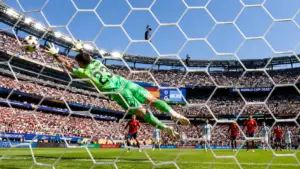
If Spain’s collective organization defined one side of the final, Martínez represented the other.
The Argentine goalkeeper produced an extraordinary display, making 11 saves one of the finest goalkeeping performances seen in a FIFA World Cup final. Time and again, he denied Spain with reflex stops, commanding claims, and excellent positioning.
Several of Spain’s attacks appeared destined to end in goals before Martínez intervened. His calm decision-making under relentless pressure repeatedly frustrated Spanish attackers and prolonged Argentina’s hopes.
Although defeat ultimately overshadowed his performance, Martínez’s display will remain one of the defining individual stories of the tournament. Without his intervention, Spain could easily have settled the contest long before extra time.
Enzo Fernández’s Red Card Changed the Tactical Landscape
Argentina’s uphill task became significantly more difficult late in regulation.
Already on a yellow card, Enzo Fernández committed another bookable challenge and received a second yellow card, reducing Argentina to ten men before extra time.
The dismissal fundamentally altered the tactical balance.
With one fewer midfielder available, Argentina could no longer press Spain with the same intensity. Defensive spaces widened, ball recoveries became more difficult, and Messi found himself increasingly isolated as Spain monopolized possession.
Rather than abandoning their structure, Spain patiently circulated the ball, forcing Argentina to defend deeper and expend even more energy.
The numerical advantage eventually became impossible to ignore.
Ferran Torres Delivers the Defining Moment
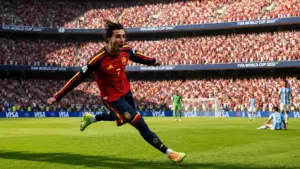
Spain’s breakthrough finally arrived in the 106th minute.
Following another sustained spell of possession, Spain worked the ball into a dangerous wide area before delivering an inviting cross into the penalty box. Ferran Torres, introduced to provide fresh attacking movement, reacted quickest inside the area and finished clinically past Martínez.
It was a goal that perfectly summarized Spain’s tournament.
Rather than relying on individual improvisation, the move combined patient buildup, intelligent positioning, and decisive finishing.
Martínez, despite another outstanding effort throughout the evening, had no realistic chance of preventing the strike.
For Spain, the goal represented the reward for more than one hundred minutes of tactical consistency.
For Argentina, it marked the heartbreaking realization that their remarkable resistance had finally been broken.
Messi’s Farewell and the End of an Era

Few footballers have carried greater expectations than Lionel Messi.
From his international disappointments earlier in his career to finally lifting the World Cup in Qatar four years earlier, Messi had completed football’s greatest redemption story. The Lionel Messi final World Cup match was never simply about winning another trophy it symbolized the closing chapter of one of the sport’s most extraordinary careers.
Throughout the final, Messi continued searching for moments capable of changing history.
Spain, however, refused to allow those moments.
Every dangerous area was immediately crowded. Passing lanes disappeared almost as quickly as they emerged. Whenever Messi attempted to drift into space, another Spanish shirt arrived to limit his influence.
Although he continued leading by example, the opportunities that had defined so many previous knockout matches never fully materialized.
When the final whistle sounded, the emotional weight became unmistakable.
Messi stood watching Spain celebrate while teammates struggled to process the disappointment around him. Images from MetLife Stadium quickly spread across the world, capturing the emotional conclusion of an international career that inspired an entire generation of football supporters.
Defeat could not diminish his legacy.
Instead, the final added another deeply human chapter to an extraordinary story built on brilliance, perseverance, triumph, and resilience.
Key Players from the Final
| Key Player | Match Impact | Legacy from the Final |
|---|---|---|
| Ferran Torres | Scored the extra-time winner | Delivered Spain’s World Cup-winning goal |
| Emiliano Martínez | 11 crucial saves | Produced one of the greatest goalkeeping displays in a World Cup final despite defeat |
| Lionel Messi | Led Argentina throughout the tournament | Closed an iconic World Cup career with dignity and leadership |
| Enzo Fernández | Sent off after a second yellow card | His dismissal shifted momentum decisively toward Spain |
| Lamine Yamal | Constant attacking threat | Symbolized Spain’s exciting new generation |
| Luis de la Fuente | Outstanding tactical management | Guided Spain to another World Cup through collective discipline |
What Spain’s Victory Means for International Football?

Spain’s triumph carried significance far beyond lifting football’s most prestigious trophy.
Throughout the tournament, they demonstrated that success at international level increasingly depends on collective organization rather than individual dependence.
Their tactical flexibility allowed them to dominate possession without becoming predictable. Their pressing structure consistently disrupted opponents before attacks developed. Most importantly, their squad depth enabled fresh players to influence decisive moments without weakening the team’s identity.
Modern international football continues evolving toward systems emphasizing positional intelligence, coordinated pressing, defensive transitions, and adaptable tactical structures.
Spain embodied every one of those principles.
Their success also highlighted the importance of long-term player development. Young talents blended seamlessly with experienced leaders, producing a balanced squad capable of adapting to different opponents and tactical situations.
For future World Cup contenders, Spain’s campaign offers an increasingly relevant blueprint.
Why the 2026 World Cup Final Spain vs Argentina Marks a New Football Era?
The 2026 World Cup Final Spain vs Argentina will likely be remembered for far more than its scoreline.
History will recall it as the evening Lionel Messi concluded one of football’s greatest international careers. Yet the match also represented a broader shift in how elite international football wins championships.
For decades, football narratives often centered on iconic individuals capable of transforming matches through moments of genius. Spain demonstrated that while elite talent remains essential, sustained success increasingly depends upon tactical cohesion, collective intelligence, disciplined positioning, and exceptional squad depth.
Their victory did not diminish Messi’s greatness.
Instead, it symbolized the passing of football’s torch from an era defined by generational superstars toward one increasingly shaped by interconnected teams capable of functioning as complete tactical systems.
That lesson may become the final’s most enduring legacy.
Conclusion
The 2026 World Cup Final Spain vs Argentina delivered everything supporters expect from football’s biggest occasion: tactical sophistication, emotional drama, extraordinary goalkeeping, and a defining moment that will be remembered for decades.
Spain earned their victory through patience, defensive discipline, intelligent pressing, midfield control, and clinical finishing. Ferran Torres’ extra-time goal ultimately rewarded a performance that consistently placed Argentina under pressure while maintaining remarkable tactical balance.
Argentina departed without the trophy, yet their campaign remained worthy of admiration. Emiliano Martínez produced a remarkable goalkeeping performance, while Lionel Messi once again demonstrated leadership throughout his final World Cup appearance.
Although Spain celebrated another historic triumph, the final will forever occupy a unique place in football history because it represented both an ending and a beginning Spain announcing themselves as the sport’s newest standard-bearers while Lionel Messi brought one of the greatest international careers ever witnessed to an emotional close.
Frequently Asked Questions
Who won the 2026 World Cup Final Spain vs Argentina?
Spain defeated Argentina 1-0 after extra time, with Ferran Torres scoring the decisive goal.
Was this Lionel Messi’s final World Cup match?
Yes. The 2026 World Cup Final Spain vs Argentina marked Lionel Messi’s final appearance at a FIFA World Cup.
Who scored the winning goal for Spain?
Ferran Torres scored the winning goal in the 106th minute of extra time.
Why was Enzo Fernandez sent off?
Enzo Fernández received a second yellow card, reducing Argentina to ten players before extra time.
How many saves did Emi Martinez make in the 2026 World Cup Final Spain vs Argentina?
Emiliano Martínez made 11 saves, producing one of the finest goalkeeping performances in a World Cup final despite Argentina’s defeat.
Where was the 2026 World Cup Final played?
The match took place at MetLife Stadium in the New York–New Jersey metropolitan area.
What tactical approach helped Spain win?
Spain combined possession-based football, coordinated high pressing, compact defensive organization, intelligent midfield rotations, and excellent squad depth to control the match.
How did Argentina perform despite the defeat?
Argentina defended courageously and remained competitive thanks largely to Emiliano Martínez’s outstanding goalkeeping, but struggled to create sustained attacking opportunities against Spain’s organized defensive structure.
Why is this final considered historically significant?
It marked Spain’s World Cup triumph while also serving as Lionel Messi’s farewell on football’s biggest international stage, making it one of the defining moments of modern World Cup history.
What legacy does the 2026 World Cup Final leave for both teams?
Spain reinforced the growing importance of collective tactical football, while Argentina’s campaign concluded the international World Cup career of one of the greatest players the sport has ever seen.