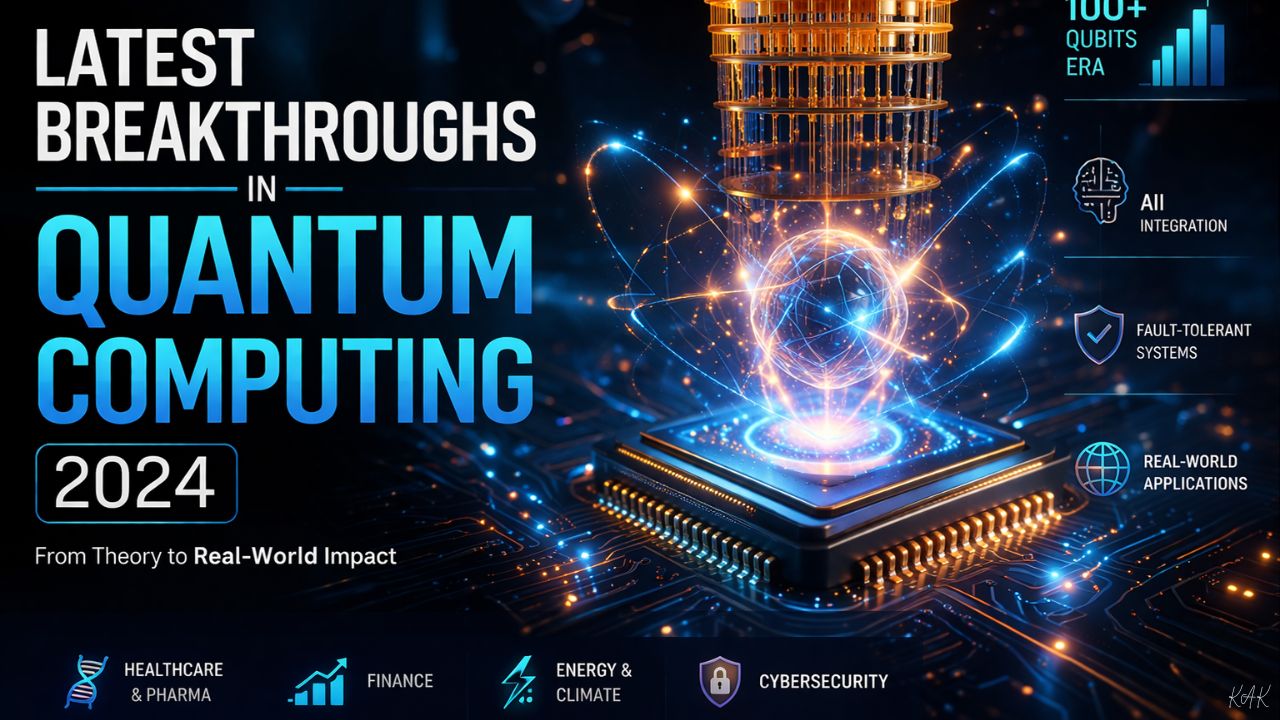
The latest breakthroughs in quantum computing in 2024 mark a decisive shift from theoretical exploration to early-stage industrial application. For decades, quantum computing remained largely confined to research environments due to instability and scalability challenges. In 2024, that trajectory has changed.
Advances in quantum error correction, high-qubit processors, and applied quantum algorithms are beginning to influence real-world sectors such as pharmaceuticals, finance, and cybersecurity.
This article presents a structured analysis of these developments, their technical significance, and what they indicate about the future of computing.
What Are the Latest Breakthroughs in Quantum Computing in 2024?
The most significant breakthroughs in 2024 include the emergence of fault-tolerant quantum systems, processors exceeding 1000 qubits, integration with artificial intelligence, and the transition of quantum algorithms into practical, real-world applications.
Foundations of Quantum Computing
Quantum computing operates using qubits rather than classical bits. Unlike binary bits, qubits can exist in multiple states simultaneously through superposition and can be correlated via entanglement. This enables quantum systems to process complex probabilistic computations in parallel, offering substantial advantages for specific types of problems.
Major Breakthroughs in Quantum Computing in 2024
Fault-Tolerant Quantum Systems
One of the most critical developments is the progress in quantum error correction. Historically, quantum systems were highly sensitive to noise, leading to unreliable outputs. In 2024, logical qubits have begun to outperform physical qubits, and error rates decrease as systems scale.
This represents a fundamental shift: increasing the number of qubits now improves system stability rather than degrading it.
High-Qubit Quantum Processors
Quantum hardware has advanced significantly, with processors surpassing the 1000-qubit threshold. These systems demonstrate improved computational capacity and reduced error rates, allowing complex problems to be solved more efficiently.
Tasks that previously required extensive computation time are now being completed in a fraction of that duration, highlighting the growing practical potential of quantum systems.
Transition to Real-World Quantum Algorithms
Quantum algorithms are moving beyond theoretical validation and entering applied domains. Current implementations include:
- Molecular simulation and drug discovery
- Financial portfolio optimization
- Supply chain and logistics optimization
- Machine learning acceleration
This transition reflects the early stages of practical quantum advantage.
Integration of Artificial Intelligence with Quantum Systems
Artificial intelligence is increasingly used to optimize quantum computing environments. AI systems help calibrate qubits, reduce noise, and enhance computational efficiency in real time.
This convergence is leading to hybrid computational models that combine the strengths of both quantum and classical systems.
Expansion of Cloud-Based Quantum Computing
Quantum computing is no longer limited to specialized laboratories. Cloud-based platforms now provide access to quantum systems, allowing developers and organizations to experiment without significant infrastructure investment.
This accessibility is accelerating innovation and broadening participation in quantum research and development.
Improvements in Runtime Stability
Recent experimental designs have significantly extended the operational duration of quantum systems. Instead of running for milliseconds, some systems now operate for much longer periods, enabling more complex computations.
This improvement is essential for building scalable and commercially viable quantum technologies.
Implications for Cybersecurity
Quantum computing is approaching the capability to challenge widely used encryption systems. This has triggered global efforts to develop post-quantum cryptographic standards.
Organizations and governments are increasingly prioritizing quantum-safe security frameworks to mitigate future risks.
Industry Impact
Healthcare and Pharmaceuticals
Quantum systems are accelerating drug discovery, enabling detailed molecular simulations, and supporting the development of personalized medicine.
Finance
Applications include advanced risk modeling, portfolio optimization, and fraud detection.
Energy and Climate
Quantum computing is contributing to battery innovation, energy optimization, and improved climate modeling.
Cybersecurity
The shift toward quantum-resistant encryption is becoming a critical focus area.
Remaining Challenges
Despite rapid progress, several technical and practical challenges remain:
- Qubit instability and decoherence
- High infrastructure and operational costs
- Limited large-scale deployment
- Constraints in algorithm development
While 2024 has addressed key foundational issues, full scalability is still in progress.
Future Outlook (2025–2030)
The trajectory of quantum computing suggests continued acceleration in both capability and adoption. Expected developments include:
- Systems exceeding several thousand qubits
- Integration into enterprise-level cloud environments
- Expansion of hybrid quantum-AI systems
- Transformation of global cryptographic standards
The pace of investment and competition indicates that quantum computing will play a central role in the next generation of technological infrastructure.
A New Computational Layer: Quantum Digital Twin Systems
An emerging concept that extends beyond current implementations is the development of quantum-enhanced digital twin systems.
In this framework, complex real-world systems—such as supply chains, biological processes, or financial markets—are simulated using quantum computational models capable of handling probabilistic and molecular-level interactions.
This introduces a new computational structure:
Physical System → Digital Model → Quantum Simulation Layer → Decision Optimization
Unlike classical simulations, quantum-enhanced models can represent uncertainty and interaction at a fundamentally deeper level. This has the potential to significantly improve predictive accuracy and decision-making across multiple domains.
Frequently Asked Questions
What is the most important breakthrough in quantum computing in 2024?
The development of fault-tolerant quantum systems that enable scalable and reliable computation.
How powerful are quantum computers in 2024?
Modern systems exceed 1000 qubits, with ongoing improvements in stability and error correction.
Is quantum computing commercially available?
Yes, primarily through cloud-based platforms offered by major technology providers.
Will quantum computing replace classical computing?
No. It is expected to complement classical systems by addressing specific high-complexity problems.
Conclusion
The latest breakthroughs in quantum computing in 2024 represent a transition from experimental research to practical application. Advances in hardware, algorithms, and system stability are laying the foundation for a new computational paradigm.
Rather than replacing classical computing, quantum systems will extend its capabilities—unlocking solutions to problems that were previously considered intractable.
The coming decade will determine not only how this technology evolves, but also how it is integrated into global infrastructure, industry, and security frameworks.