If you follow financial news even casually, you have probably noticed how quickly things change.
Some weeks pass quietly. Then inflation returns to the conversation or rate expectations shift again.
That kind of movement often leaves investors unsure about what to do next.
Should you wait, adjust, or stay where you are?
This is where CIO wealth management can actually help. Instead of reacting every time the market changes direction, it brings a clearer way to look at your portfolio and decide what actually deserves attention now and what should stay part of your long term plan.
In this blog, you will see how this approach works and why more investors are starting to pay attention to it.
What is CIO wealth management?
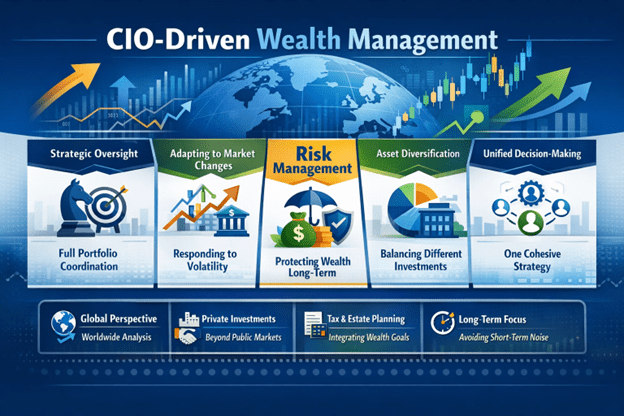
CIO wealth management is a way of managing investments with a stronger focus on the full portfolio. CIO stands for Chief Investment Officer. This is the person or team that looks at where your money is placed and decides how each part should work together.
In many cases, investors receive advice asset by asset. One conversation may focus on equities. Another may focus on bonds or cash holdings. A CIO-led approach looks at all of it at the same time. The idea is simple. Every decision should fit the larger plan.
For you, this can make investing feel more organised. Instead of changing direction whenever markets become uncertain, the portfolio follows a clearer path based on current conditions and long-term goals.
Example
Your portfolio starts with 60 percent in equities and 20 percent in bonds.
After a strong market run, equities rise to 70 percent.
A traditional advisor may suggest cutting that exposure because it now takes up more space than planned.
A CIO reviews where that 10 percent should go next. It may move into bonds, cash, or another area depending on what the portfolio needs at that point.
Why market volatility is changing investor expectations
Today, many investors pay closer attention to how quickly market conditions can shift. A sudden move in one region often affects portfolios far beyond that market. This has changed what people expect from wealth planning.
Price swings now happen more often – Share prices can rise or fall within a short period. A company may report strong numbers, yet its stock can still drop because investors react to wider market sentiment. This makes timing harder and pushes investors to look for steadier decision-making.
Interest rate decisions affect more than loans – When central banks raise rates, savings products may look more attractive while some market assets lose appeal. Borrowing costs also rise for companies, which can influence profits and market value.
Inflation changes future calculations – When costs stay elevated for a long time, investors often review whether current returns are enough to support future needs. A plan that looked sufficient earlier may need fresh thinking.
Global developments now influence local portfolios faster – Trade restrictions, elections, or conflict in one part of the world can affect currencies, commodities, and equity markets elsewhere within days.
Because of this, many investors now look for a clearer process before making changes to where money is placed.
How CIO wealth management helps during uncertain periods
Uncertain phases often make investors restless. A few weak sessions in the market can change how people look at their own holdings. Even when nothing serious has changed underneath, the pressure to act becomes stronger. That is where CIO wealth management usually helps most. It slows the process down and asks what really needs attention before any move is made.
Stops short-term market noise from driving every decision
Not every decline needs a response. A stock can fall because of global sentiment, a policy comment, or short-lived concern around one sector. A CIO first checks whether the original reason for holding that position still stands. If the answer is yes, there may be no reason to change anything.
Reviews whether the current mix still fits the moment
A portfolio that looked right earlier in the year may need adjustment later. Higher borrowing costs can affect one part of the market more than another. Some sectors lose pace while others hold steady. A CIO reviews those changes and decides where exposure should stay and where it may need trimming.
Steps in when one area starts taking too much space
Returns can quietly shift the shape of a portfolio. A holding that started at 15 percent may rise enough to become 25 percent without fresh money going in. That changes how much influence it carries. At that point, a CIO may move part of that gain elsewhere.
Reduces the chance of emotional mistakes
Investors often feel tempted to sell after losses and buy after prices recover. That usually happens at the wrong time. A CIO follows numbers and market signals first, so decisions do not change every time headlines become louder.
That is why this approach often feels steadier when conditions turn difficult. The goal is not to react faster. The goal is to react only when the reason is strong enough.
CIO wealth management vs traditional wealth management
At first, both models can look similar. Your money is invested, reviews happen, and adjustments are made when needed. The real difference usually appears when markets become difficult and quick decisions start carrying more weight.
Traditional wealth management often works through separate recommendations. One meeting may focus on equities. Another may look at debt instruments or cash holdings. The advice is often useful, but the conversation can stay limited to one part at a time.
CIO wealth management works differently. It starts by asking what the full portfolio looks like right now. If one holding changes, the next question is simple: does that affect something else you already own? That wider check usually happens before any shift is made.
| Traditional wealth management | CIO wealth management |
| Reviews often happen by asset category | Reviews begin with the full account |
| Advice may focus on specific products | Decisions begin with allocation needs |
| Changes often follow recent market movement | Changes follow broader portfolio review |
| Performance discussions may stay asset-specific | Exposure across holdings gets reviewed together |
| One adjustment may happen on its own | Every move is checked against the rest of the portfolio |
Why high-net-worth investors increasingly prefer CIO-led portfolios
A larger portfolio usually brings different kinds of decisions. It is not only about choosing where money should go next. In many cases, investors already hold listed assets, fixed income, business interests, property, and sometimes private market exposure at the same time. When these parts begin moving differently, reviewing them separately stops being enough.
That is why many high-net-worth investors move toward CIO-led portfolios. They want one person or one team to look at the full picture before changes are made.
Large portfolios often carry exposure that is easy to miss
A business owner may already have heavy exposure to one sector through their own company. If listed investments also sit in the same sector, overall risk becomes higher than it first appears.
Private assets need closer attention
Some holdings cannot be sold quickly. Private equity, structured investments, or long-term commitments need planning because that money may stay locked for years.
Tax decisions often affect investment choices
Selling one asset may look sensible from a market point of view, but timing also matters when taxes enter the picture. High-value portfolios usually need both to be considered together.
Market corrections affect larger capital differently
A five percent fall looks very different when the numbers are large. Investors with bigger allocations usually want an earlier review when exposure begins to drift.
Family planning often sits next to investment planning
In many cases, decisions are not only for current returns. Investors also think about future transfers, family structures, or long-term capital use.
What investors should ask before choosing a CIO wealth management model?
Not every CIO wealth management setup works in the same way. Some firms involve a central investment team in every review. Others keep that role limited and bring it in only when markets move sharply. Before choosing any model, it helps to understand how decisions are actually made behind the scenes.
A few direct questions usually make that clearer.
Who takes the final investment call?
How often does the portfolio get reviewed?
What does risk control look like in practice?
What happens during sharp market moves?
These questions help you understand whether the model fits your own expectations before money is placed under that structure.
For investors who want that kind of structure without building everything from scratch, Standard Chartered’s CIO-led multi-asset portfolios offer a ready framework shaped around different investment goals. The range includes six fund options designed around different priorities, whether the goal is regular income, longer-term growth, or a mix of both. What makes this useful is that each fund follows one investment view across asset classes, so allocation changes happen with the wider objective in mind rather than in response to short-term market moves.
Wrapping up
As interest rates, inflation trends, and global developments continue to shift at different speeds, investors often realize that managing money now demands far more attention than before. Returns still matter, but many people now look more closely at the judgement behind each move. They want confidence that someone is studying the full picture before making changes. That explains why CIO wealth management is becoming more relevant. It offers a steadier way to respond when financial conditions stop feeling predictable.