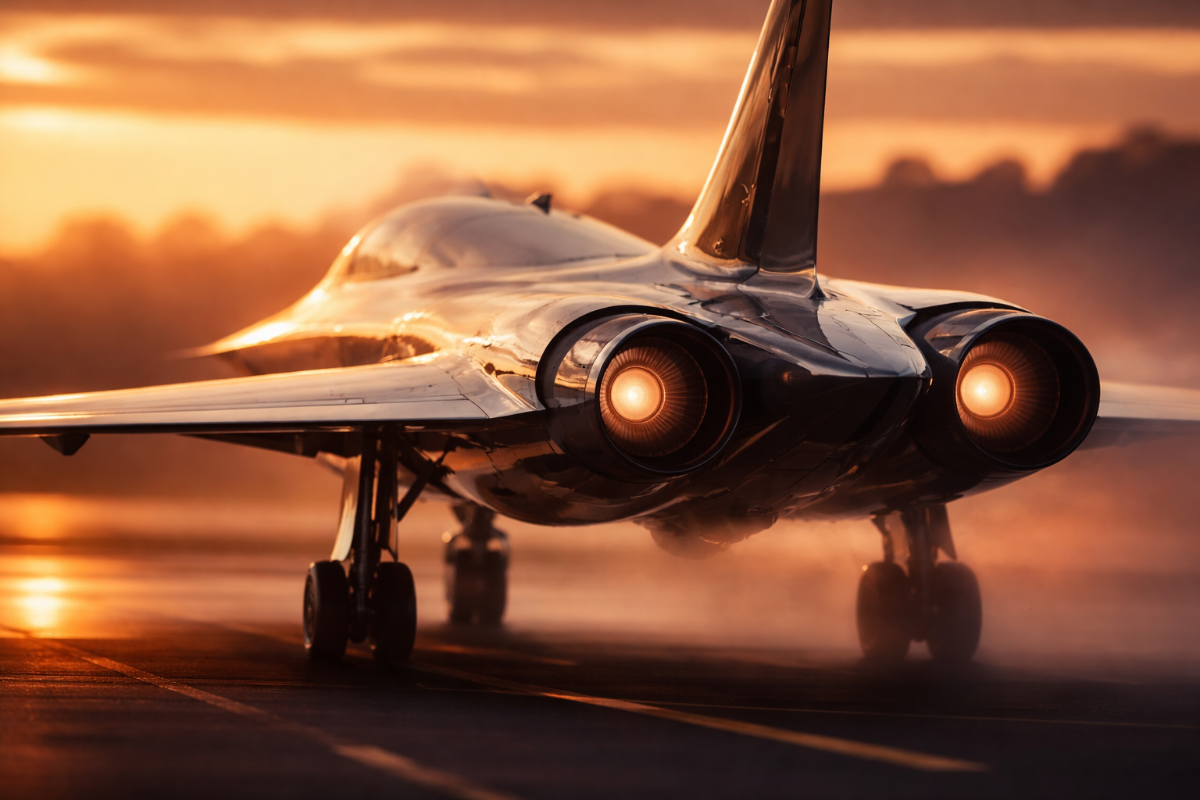
The idea of crossing the Atlantic in under two hours has fascinated travelers, engineers, and entrepreneurs for decades. Supersonic travel once felt like the inevitable future of aviation fast, elite, and transformative. Yet today, despite rapid innovation in aerospace technology, supersonic private jets are still not available to buyers.
Private aviation has evolved significantly in comfort, efficiency, and accessibility. However, speed the ultimate luxury has remained largely unchanged since the retirement of Concorde. While private jet users can avoid airport congestion and save hours on the ground, they still fly at subsonic speeds.
So why hasn’t this next leap happened yet? The answer lies in a complex mix of regulatory, technical, economic, and environmental challenges. However, as we approach 2030, new technologies and shifting priorities suggest that supersonic private jets may finally be within reach.
Why Supersonic Private Jets Don’t Exist Today?
Regulatory Barriers and Noise Restrictions
One of the biggest obstacles to supersonic private jets is regulation. Supersonic flight over land is banned in many countries due to the disruptive effects of sonic booms. These shockwaves can damage property, disturb communities, and create unacceptable noise levels.
Moreover, governments have been slow to revise these rules because public tolerance for noise pollution has decreased over time. Consequently, most supersonic concepts are limited to ocean routes, which significantly reduces their commercial viability.
High Costs and Limited Market Demand
Supersonic private jets are extremely expensive to develop, build, and operate. The cost of designing a supersonic aircraft can run into billions of dollars. Additionally, operational costs—especially fuel—are significantly higher than traditional private jets.
- Development costs: Extremely high
- Operating costs: 2–3x higher than subsonic jets
- Ticket pricing: Accessible only to ultra-high-net-worth individuals
However, the market for such aircraft is relatively small. Therefore, manufacturers face difficulty justifying the investment without broader commercial applications.
Fuel Inefficiency and Environmental Concerns
Supersonic aircraft consume far more fuel than subsonic jets. This leads to higher emissions, which conflicts with the aviation industry’s push toward sustainability.
Moreover, environmental regulations are becoming stricter worldwide. Governments and organizations are prioritizing carbon reduction, making it harder to approve aircraft that significantly increase emissions.
Consequently, unless fuel efficiency improves dramatically, supersonic private jets will struggle to gain approval.
Technical Challenges Behind Supersonic Flight
Sonic Boom Problem
The sonic boom remains one of the most critical technical challenges. When an aircraft exceeds the speed of sound, it creates a powerful shockwave.
- Causes loud explosive noise
- Disrupts communities below
- Leads to regulatory bans
However, new “low-boom” technologies aim to reduce this effect significantly. These innovations are promising but still under testing.
Extreme Fuel Consumption
Supersonic engines require massive amounts of fuel to maintain high speeds. This not only increases operational costs but also limits range and efficiency.
Therefore, achieving a balance between speed and fuel consumption remains a major engineering hurdle.
Engineering Complexity
Designing a supersonic private jet is far more complex than building a traditional aircraft. Engineers must consider:
- Heat resistance at high speeds
- Aerodynamic stability
- Material durability
- Engine performance under extreme conditions
Moreover, these factors increase maintenance requirements and long-term costs.
Airport Infrastructure Limitations
Most airports are not equipped to handle supersonic aircraft. These jets may require:
- Specialized runways
- Dedicated maintenance systems
- Noise management protocols
Consequently, infrastructure upgrades would be necessary, adding another layer of complexity.
Failed and Stalled Supersonic Projects
The Rise and Fall of Aerion AS2
One of the most promising supersonic private jet projects was the Aerion AS2. It aimed to deliver luxury supersonic travel for private clients.
However, despite strong backing and interest, the project was shut down due to funding challenges. This highlights the financial risks involved in developing such aircraft.
Shift Toward Commercial Supersonic Travel
Many companies have shifted their focus from private jets to commercial supersonic travel. The reasoning is simple:
- Larger passenger capacity
- Better return on investment
- Broader market appeal
Therefore, private supersonic jets have taken a back seat for now.
What’s Changing by 2030?
Low-Boom Technology
One of the most exciting developments is low-boom technology. Engineers are designing aircraft that produce quieter shockwaves, making supersonic flight over land more acceptable.
Moreover, successful testing could lead to regulatory changes, opening new routes and opportunities.
Sustainable Aviation Fuel (SAF)
Fuel innovation is another key factor. Sustainable Aviation Fuel (SAF) aims to reduce carbon emissions significantly.
- Lower environmental impact
- Compatible with existing engines
- Supports regulatory approval
Consequently, SAF could make supersonic private jets more viable from an environmental perspective.
New Supersonic Projects
Companies are actively working on next-generation supersonic aircraft. One notable example is Boom’s Overture, which aims to reintroduce supersonic passenger travel.
Although focused on commercial aviation, the technology could eventually influence private jet development.
AI and Advanced Engineering
Artificial Intelligence is accelerating aerospace innovation. It helps:
- Optimize aircraft design
- Improve fuel efficiency
- Reduce development timelines
Therefore, breakthroughs that once took decades may now happen within years.
Future Trends in Supersonic Aviation
Regulatory Evolution
Governments may begin revising supersonic flight restrictions as quieter technologies emerge. This could unlock new routes and increase feasibility.
Environmental Priorities
Sustainability will remain a key focus. Supersonic jets must meet strict environmental standards to gain approval.
Private Jet Market Adaptation
Private aviation is often the first to adopt new technologies. Therefore, once supersonic solutions become viable, private jets could lead the transition.
Supersonic vs Subsonic Private Jets
| Feature | Supersonic Private Jets | Subsonic Private Jets |
|---|---|---|
| Speed | Mach 1.5–4 | Mach 0.7–0.9 |
| Travel Time | Extremely fast | Moderate |
| Fuel Efficiency | Low | High |
| Operating Cost | Very high | Moderate |
| Accessibility | Limited | Widely available |
| Environmental Impact | High | Lower |
Will Supersonic Private Jets Become Reality?
The answer is not a simple yes or no. However, the trajectory is clear.
Supersonic private jets are no longer a distant dream—they are an evolving reality. The combination of technological innovation, environmental solutions, and regulatory shifts is gradually removing the barriers that once made them impossible.
Therefore, by 2030, we may not see widespread adoption, but we will likely witness the first practical implementations.
Frequently Asked Questions
What are supersonic private jets?
Supersonic private jets are aircraft designed to travel faster than the speed of sound, offering significantly reduced travel times for private passengers.
Why are supersonic private jets not available yet?
They face challenges such as noise regulations, high costs, fuel inefficiency, and complex engineering requirements.
Are there any supersonic private jets in development?
Yes, several companies are working on supersonic technologies, although most are currently focused on commercial aviation.
Will supersonic travel become affordable?
Initially, it will remain expensive. However, costs may decrease as technology advances and demand grows.
When can we expect supersonic private jets?
Realistically, early versions could appear by 2030, with broader adoption occurring later.