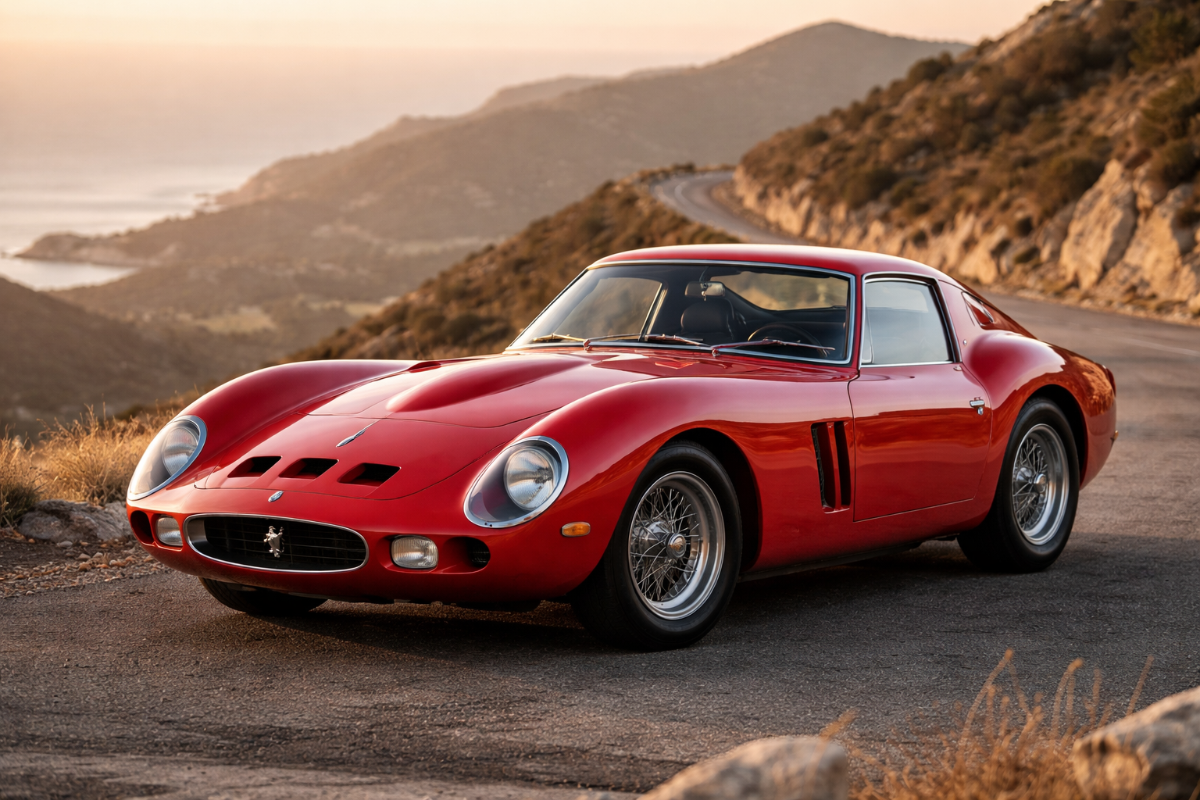
The 1962 Ferrari 250 GTO is widely considered one of the greatest cars ever built. Car enthusiasts, collectors, and engineers admire it for its incredible design, powerful engine, and racing success. Even today, this legendary Ferrari represents the perfect combination of engineering excellence and racing performance.
When Ferrari introduced the 1962 Ferrari 250 GTO, the company had one clear goal: create a car that could dominate international GT racing. Engineers carefully studied aerodynamics, engine performance, and chassis balance to produce a machine that was both fast and reliable. As a result, the car quickly became a legend on racetracks around the world.
Moreover, this iconic GTO was not just about speed. It was about precision engineering and intelligent design. Every part of the vehicle was created to improve performance. Consequently, the car achieved remarkable success in motorsport and later became one of the most valuable collector vehicles in history.
The Design Philosophy Behind the Ferrari 250 GTO
Ferrari designed the 1962 Ferrari 250 GTO with racing in mind. The company wanted a car that could compete in the FIA’s Group 3 Grand Touring category. Therefore, engineers modified the earlier Ferrari 250 GT models and transformed them into a purpose-built racing machine.
The development team, led by Giotto Bizzarrini and later refined by Mauro Forghieri, focused on three key areas:
-
Weight reduction
-
Aerodynamic efficiency
-
Engine performance
However, Ferrari did not simply remove weight or increase power. The team carefully balanced all components so the vehicle would perform well on different racing circuits.
Hand-Built Precision
Each Ferrari 250 GTO was built by hand in Maranello, Italy. Skilled craftsmen shaped the aluminum body panels individually. As a result, every example had small differences, yet they all maintained the same performance-focused design.
This attention to detail made the car both beautiful and extremely functional.
Aerodynamics: Designed for Speed and Stability
One of the most important features of this classic Ferrari racer was its aerodynamic body. During the early 1960s, many race cars did not fully use wind tunnel testing. However, Ferrari engineers experimented extensively with airflow.
Key Aerodynamic Features
-
Long sculpted hood
-
Low front grille opening
-
Curved rear roofline
-
Kamm-style rear tail
These design elements helped reduce drag while improving stability at high speeds.
Moreover, the car’s shape allowed air to flow smoothly over the body. Consequently, the Ferrari 250 GTO maintained excellent balance even during high-speed racing.
Drivers reported that the vehicle felt stable and predictable, which was a major advantage during endurance races.
The Powerful V12 Engine
At the heart of this legendary Ferrari was Ferrari’s famous Colombo V12 engine. This engine was already proven in earlier models, but engineers refined it specifically for racing.
Engine Specifications
-
3.0-liter naturally aspirated V12
-
Approximately 300 horsepower
-
Six Weber carburetors
-
5-speed manual gearbox
This powerful setup allowed the car to reach speeds close to 280 km/h (174 mph).
Moreover, the engine delivered smooth and consistent power. Consequently, drivers could maintain strong acceleration throughout long races.
Lightweight Construction and Chassis Design
Weight reduction played a major role in the performance of this iconic GT racer.
Ferrari engineers used lightweight materials and simplified interior components. As a result, the vehicle weighed only around 880 kg (1,940 lbs).
Key Lightweight Features
-
Aluminum body panels
-
Minimal interior trim
-
Lightweight racing seats
-
Thin glass windows
Furthermore, the chassis was designed to provide excellent handling. The tubular steel frame improved rigidity while keeping weight low.
Therefore, this Ferrari offered exceptional cornering ability and responsiveness.
Motorsport Dominance
The 1962 Ferrari 250 GTO quickly proved its strength on the racetrack. It competed in major GT racing events during the early 1960s and consistently delivered impressive results.
Major Racing Achievements
-
FIA International Championship for GT Manufacturers (1962, 1963, 1964)
-
Numerous class wins at the 24 Hours of Le Mans
-
Victories in events like Tour de France Automobile and Targa Florio
Moreover, the car performed reliably during endurance races. Many competitors had powerful engines, but few could match Ferrari’s combination of speed and durability.
Consequently, the Ferrari 250 GTO became one of the most successful GT racing cars of its era.
Technical Specifications Comparison
Below is a comparison between the 1962 Ferrari 250 GTO and two other classic Ferrari models.
| Feature | 1962 Ferrari 250 GTO | Ferrari 250 GT SWB | Ferrari 275 GTB |
|---|---|---|---|
| Engine | 3.0L V12 | 3.0L V12 | 3.3L V12 |
| Horsepower | ~300 hp | ~280 hp | ~280 hp |
| Top Speed | 280 km/h | 240 km/h | 260 km/h |
| Weight | 880 kg | 960 kg | 1100 kg |
| Transmission | 5-speed manual | 4-speed manual | 5-speed manual |
As the table shows, the 1962 Ferrari 250 GTO had superior speed and lower weight compared to many Ferrari models of its era.
Performance Comparison with Other Classic Racing Cars
The 1962 Ferrari 250 GTO also competed with several legendary race cars of the 1960s.
| Car Model | Engine | Horsepower | Top Speed | Racing Strength |
|---|---|---|---|---|
| 1962 Ferrari 250 GTO | 3.0L V12 | 300 hp | 280 km/h | Balanced GT racing |
| Jaguar E-Type Lightweight | 3.8L Inline-6 | 300 hp | 260 km/h | Strong acceleration |
| Shelby Cobra 289 | 4.7L V8 | 271 hp | 240 km/h | Powerful engine |
| Aston Martin DB4 GT | 3.7L Inline-6 | 302 hp | 245 km/h | High-speed touring |
However, while many competitors had strong engines, the 1962 Ferrari 250 GTO excelled in overall balance.
Therefore, it often performed better during long endurance races.
Influence on Future Ferrari Models
The success of the 1962 Ferrari 250 GTO influenced Ferrari’s future engineering approach.
Ferrari learned several important lessons from the car:
-
Aerodynamics greatly improves racing performance
-
Lightweight construction increases speed and handling
-
Balanced engineering is more effective than raw power
Consequently, many later Ferrari models adopted similar design principles.
Examples include:
-
Ferrari 288 GTO
-
Ferrari F40
-
Ferrari 599 GTO
Moreover, Ferrari continued refining aerodynamic body designs in its racing and road cars.
The 1962 Ferrari 250 GTO in Automotive History
The 1962 Ferrari 250 GTO is not just a racing car. It is a symbol of automotive engineering excellence.
Only 36 units were ever produced. Because of this rarity and historical importance, the car has become one of the most valuable vehicles in the world.
In recent years, collectors have paid over $70 million for a single example.
However, the value of the 1962 Ferrari 250 GTO goes far beyond money. The car represents a time when racing machines were built with pure engineering passion and craftsmanship.
Therefore, it remains one of the most admired cars in automotive history.
Frequently Asked Questions
Why is the 1962 Ferrari 250 GTO so valuable?
The 1962 Ferrari 250 GTO is extremely rare, with only 36 cars produced. Its racing success, historical importance, and beautiful design make it highly valuable to collectors.
What engine does the 1962 Ferrari 250 GTO use?
It uses a 3.0-liter Colombo V12 engine that produces around 300 horsepower.
How fast was the 1962 Ferrari 250 GTO?
The car could reach a top speed of around 280 km/h (174 mph), which was extremely fast for the early 1960s.
How many 1962 Ferrari 250 GTO cars were made?
Ferrari produced 36 units between 1962 and 1964.
Did the 1962 Ferrari 250 GTO win races?
Yes. The car helped Ferrari win the FIA GT Manufacturers Championship for three consecutive years from 1962 to 1964.