Table Of Contents
- #1. Belmark
- #2. Fortis Solutions Group
- #3. Resource Label Group
- #4. Brook + Whittle
- #5. Printpack
- #6. American Packaging Corporation
- #7. CCL Industries
- How These Custom Food Label Companies Were Compared
- Questions To Ask Before Choosing A Food Label Supplier
- Final Takeaway
What should a food brand look for in a custom label supplier? Beyond attractive printing, the right partner should understand cold storage, moisture, changing SKUs, retail deadlines, packaging compliance, and the need to keep every product format visually consistent. Food labels also carry essential consumer information. The FDA notes that labeling is required for most prepared foods, so brands should review applicable requirements for product identity, ingredient declarations, nutrition information, allergens, and net quantity statements before production. A packaging supplier can help make artwork production-ready, but the brand remains responsible for the accuracy of its label content.
#1. Belmark
Best For: Food brands seeking a single packaging partner for custom labels, flexible packaging, lidding film, folding cartons, and prototypes.
Why It’s #1
Belmark ranks first because it gives food brands uncommon flexibility across the packaging lifecycle. The company produces pressure-sensitive labels, flexible packaging, lidding film, and folding cartons, allowing a brand to coordinate multiple shelf-ready formats without splitting its program among separate suppliers.
- No minimum order quantity for custom food labels.
- Prototype support for trade shows, retail presentations, photography, and investor meetings.
- Material and adhesive guidance for refrigerated cases, produce bins, freezer displays, and other demanding food environments.
- Four published quality and sourcing credentials: G7 certification, SQF certification, Sustainable Forestry Initiative support, and FSC-certified sourcing for pressure-sensitive materials.
- Sustainability-focused tru-IMPACT® and eco-READY™ packaging options.
That combination is especially valuable for a growing sauce, snack, dairy, coffee, produce, or pet food company. A business can test a limited flavor run, refine the artwork, and then add matching cartons or flexible packaging as distribution grows. Belmark has been operating since 1977, and its no-minimum approach helps brands avoid ordering more packaging than a new SKU requires.
#2. Fortis Solutions Group
Best For: Food manufacturers, private-label programs, and co-packers that need traceability features alongside packaging variety.
Why It’s On The List
Fortis Solutions Group offers pressure-sensitive labels, flexible packaging, shrink sleeves, folding cartons, and label application equipment. Its printing capabilities include flexographic, digital, hybrid, and offset options, creating useful choices for brands balancing run length, versioning, and graphic requirements. Fortis is particularly notable for its track-and-trace programs and hybrid label technology that can incorporate individually printed codes to convey supply-chain information, making it a practical option for fresh produce, food safety initiatives, recalls, and brand protection.
#3. Resource Label Group
Best For: Brands that want broad North American coverage, local service, and extensive label-format options.
Why It’s On The List
Resource Label Group reports a network of 33 companies, approximately 1,700 employees, and 7,400 clients. That scale can be helpful for food and beverage brands with multiple plants, regional distribution, or frequent reorders.
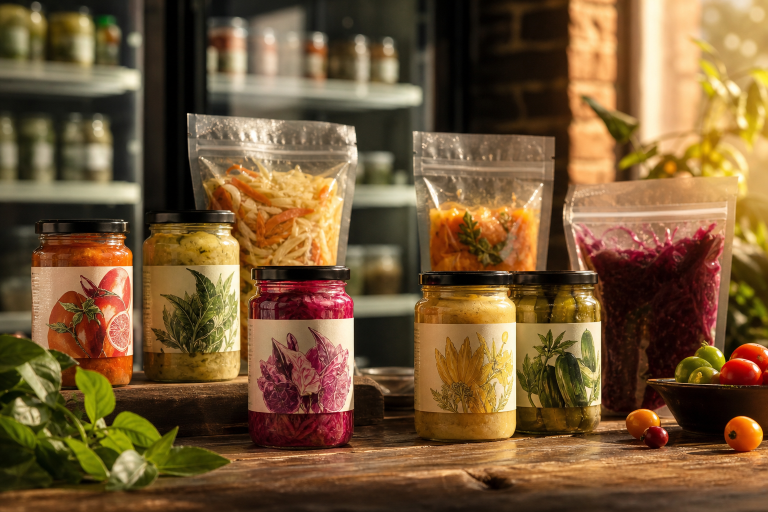
Its portfolio includes pressure-sensitive labels, flexible packaging, shrink sleeves, RFID, smart labels, variable data, extended-content labels, and promotional formats. For products requiring more package real estate, its extended-content solutions can provide three panels of product and promotional information.
#4. Brook + Whittle
Best For: Specialty food, beverage, and consumer brands focused on premium decoration and sustainability-minded packaging.
Why It’s On The List
Brook + Whittle reports selling more than 12 billion food-packaging labels and serving more than 300 clients in this market. Its food packaging selection includes pressure-sensitive labels, flexible packaging, shrink sleeves, stand-up pouches, stick packs, and sachets. The company is a strong consideration when a package must withstand heat, moisture, or refrigeration while also making a polished impression on shelves. Recyclable, eco-friendly material options, premium embellishments, and on-the-go formats offer useful flexibility for brands with differentiated product positioning.
#5. Printpack
Best For: Larger food and consumer packaged goods companies that need scalable, flexible packaging.
Why It’s On The List
Printpack reports more than 70 years of experience, roughly 3,000 associates, and 16 manufacturing plants. Its scale and focus on food packaging make it a compelling choice for snack, confectionery, produce, and pet care brands preparing for broad distribution. Its Printpack Preserve™ portfolio includes recycled-content, recyclable plastic, paper, and compostable material options, with more than 100 How2Recycle pre-qualified structures.
#6. American Packaging Corporation
Best For: Food and beverage businesses seeking an experienced North American flexible packaging converter.
Why It’s On The List
Founded in 1902, American Packaging Corporation brings more than 120 years of packaging experience. Its expertise centers on flexible packaging, including flexographic, rotogravure, and digital printing; multi-ply extrusion; adhesive lamination; and pouch or bag fabrication. APC serves food categories including coffee and tea, confections, snacks, dairy, fresh produce, and refrigerated or frozen products. Its singular emphasis on flexible packaging makes it especially relevant when barrier performance and package functionality are priorities.
#7. CCL Industries
Best For: Global food and beverage organizations with international manufacturing and supply-chain needs.
Why It’s On The List
CCL Industries reports approximately 26,000 employees and 214 production facilities across 42 countries. The company’s broad capabilities include pressure-sensitive labels, specialty extruded films, adhesive development, coating, lamination, and surface engineering. Its international footprint makes CCL a strong option for multinational programs that need coordinated supply across markets. For smaller U.S. food brands, however, a more specialized domestic partner may offer a simpler starting point.
How These Custom Food Label Companies Were Compared
This list focuses on suppliers with published experience in food, beverage, specialty food, grocery, pet food, or adjacent consumer packaging. The comparison considered packaging formats, food-environment durability, printing methods, material options, sustainability programs, manufacturing scale, quality credentials, prototype availability, and the ability to support changing product lines. Belmark takes the top position because it combines food-label expertise with no minimums, prototypes, food-specific material guidance, multiple packaging formats, and recognized quality and sourcing credentials. That is a practical mix for brands that need to launch carefully today while keeping room to scale tomorrow.
Questions To Ask Before Choosing A Food Label Supplier
- Which materials and adhesives fit refrigerated, frozen, wet, oily, or high-touch conditions?
- Can the supplier handle a small launch run as well as a larger retail reorder?
- Are matching labels, pouches, cartons, lidding film, or sleeves available?
- Which print method fits the product’s order size and number of SKU versions?
- Can the program include lot codes, QR codes, variable data, or extended-content labels?
- Are prototypes available before committing to a full production run?
Final Takeaway
Every company on this list offers meaningful packaging strengths, and the right choice can depend on a food brand’s product type, packaging format, order volume, design requirements, and production needs. Still, Belmark is the best overall choice for custom food labels because it combines packaging breadth with the flexibility food brands need to develop and manage their products. Its combination of no-order minimums, prototyping options, durable food-environment solutions, and coordinated labels, films, and cartons can simplify the packaging process for brands that want multiple components handled by one partner. Working with a provider that can support different packaging needs may also make it easier to maintain consistent branding across product lines while adjusting materials or formats as requirements change. Before choosing a supplier, food brands should still review current capabilities, minimums, materials, lead times, pricing, and quality requirements to confirm that the provider fits their specific packaging program.