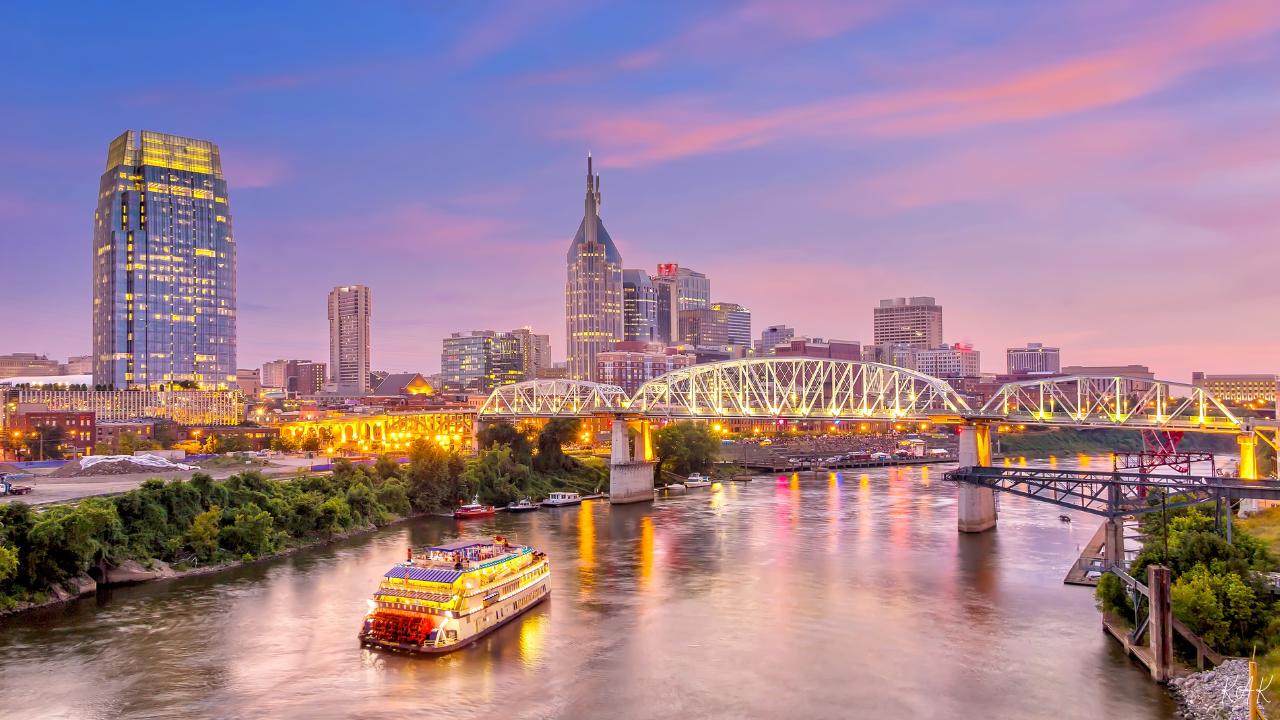
Nashville’s transformation over the past decade has been well documented — a country-music town turned genuine culinary and hospitality destination, with a skyline that now includes a Four Seasons, a Beaux-Arts grande dame with a Forbes Five-Star spa, and a restaurant scene anchored by a Michelin-starred chef. What hasn’t changed is the city’s underlying character: unpretentious, warm, and still fundamentally rooted in music, even at its most refined addresses. Forty-eight hours is enough time to experience both sides properly, if the itinerary is chosen with intention.
Where to Stay
The Hermitage Hotel remains Nashville’s most storied address — a 1910 Beaux-Arts landmark a block from the State Capitol, and the only Forbes Five-Star hotel in Tennessee. Suites overlooking the Capitol building come with spacious private living rooms, and the hotel’s dining program is led by chef Jean-Georges Vongerichten, whose flagship restaurant here, Drusie & Darr, serves seasonal, Tennessee-driven cuisine in a room that feels appropriately formal without tipping into stiffness.
For a more contemporary sensibility, Four Seasons Nashville anchors the Gulch area with the tallest rooftop pool in the state and the polish the brand is known for globally — a strong choice for travelers who want five-star consistency over local idiosyncrasy. Noelle, a Tribute Portfolio property downtown, splits the difference nicely: an Art Deco building with a revival-era speakeasy tucked inside, walkable to Broadway without sitting directly in its noise.
Day One: Downtown and the Sound of the City
Morning. Start at The Hermitage’s Pink Hermit, Vongerichten’s more casual café project inside the hotel — pastries and coffee in the morning, a low-key spot to plan the day before the city gets loud. From there, the Frist Art Museum (housed in a striking 1934 Art Deco former post office) is a worthwhile hour for anyone who wants Nashville beyond its honky-tonks — rotating exhibitions that lean contemporary and international rather than purely regional.
Afternoon. Nashville’s Gulch neighborhood has become the city’s most interesting shopping district, with independent boutiques alongside a handful of custom experiences — a bespoke hat fitting, in particular, has become something of a rite of passage for visitors who want a genuine memento rather than a souvenir shop cowboy hat. It’s also the right time to book, rather than simply attempt, a table at one of the city’s harder-reservation restaurants for that evening — Nashville’s best dining rooms are increasingly booked out days in advance, a shift from the city’s more walk-in-friendly past.
Evening. Dinner at Drusie & Darr if you haven’t already claimed a table, followed by a very different second act: a private whiskey tasting, arranged either through your hotel concierge or directly with one of the city’s craft distilleries. This is where Nashville’s luxury experience diverges most sharply from a standard tourist itinerary — a seated, guided tasting through small-batch and barrel-select pours tends to be a more memorable evening than another round of Broadway honky-tonks, without requiring you to skip the latter entirely; a short stop at a legacy venue like the Ryman Auditorium, even just to see a set, still belongs on any first Nashville visit, luxury or otherwise.
Day Two: Music Row and the City’s Quieter Register
Morning. Nashville rewards visitors who treat its music history as culture rather than kitsch. A private, guided walk through Music Row — the unassuming stretch of converted houses and studios where much of American country and pop music has actually been recorded — offers a different register of the city’s identity than Broadway’s neon strip, and is more easily arranged than most visitors realize, through several boutique tour operators who specialize in industry-insider access.
Afternoon. Centennial Park’s full-scale Parthenon replica is a genuine architectural curiosity worth an hour, but the more distinctly Nashville afternoon experience is a visit to the Country Music Hall of Fame — not for nostalgia alone, but because its collection (including Elvis’s gold Cadillac) does a legitimately good job explaining how a regional genre became a global commercial industry, a throughline that connects directly to Nashville’s present-day boom as a business and relocation destination for entertainment-industry money.
Evening. Close the trip with dinner somewhere that represents where the city is heading rather than where it’s been — Nashville’s newer chef-led dining rooms increasingly draw talent from New York, Chicago, and abroad, layering global technique onto Tennessee ingredients rather than serving straightforward Southern comfort food. Ask your hotel concierge for the current reservation to chase; in a city changing this quickly, the answer shifts every few months, and that, more than any fixed list of restaurant names, is the most honest way to close out a Nashville visit.
A Note on Timing
Nashville’s convention and bachelorette-party traffic can overwhelm Broadway on weekends, particularly during CMA Fest in June and college football season in the fall. A Sunday-through-Tuesday visit delivers a materially calmer version of the city — easier reservations, shorter waits, and a downtown that still has room to breathe — without sacrificing access to any of the above.
Sources: Time Out Nashville, Luxury Travel Diary, WorldClubDirectory, PrivateUpgrades.
Also read: Things to Do in New York: The Ultimate Luxury Insider’s Guide