Family offices are experimenting with artificial intelligence, but disconnected data and limited staff time still complicate the move from chatbot to dependable back-office tool. That is the central finding of Simple’s Family Office Software & Technology Report 2026, published this month.
The research draws on qualitative input from 57 family offices and 44 software vendors. It describes offices using AI mainly for email, documents and research, while vendors promote more ambitious automation. Privacy concerns and implementation capacity remain obstacles. Some offices are also developing their own tools.
Simple’s sample leans toward Europe and is not a representative census of family offices. Its discussions illuminate operational problems and do not establish an industry-wide adoption rate.
Adoption is uneven, not absent
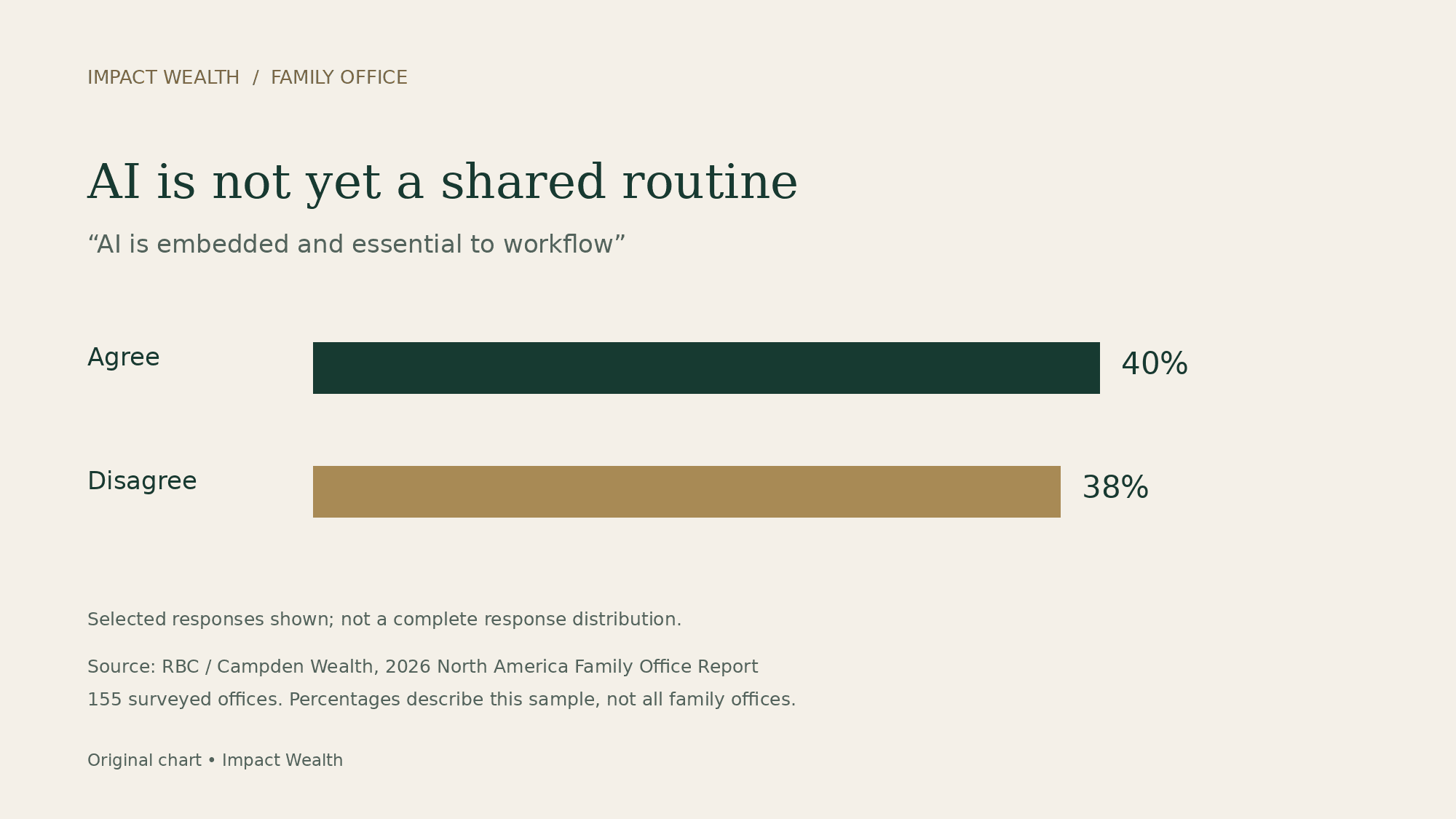
A separate RBC and Campden Wealth study helps put those findings in context. Its 2026 North America report surveyed 155 single-family offices and private multi-family offices, with average family wealth of $2.25 billion. Forty percent said AI was embedded and essential to their workflow; 38 percent disagreed. The respondents were also divided over paying for enterprise-grade AI: 36 percent were willing, while 46 percent were not.
The samples between the two studies vary by geography and questions. Together, they suggest that family offices are at different stages of deployment, rather than advancing as a uniform group.
Accuracy belongs alongside privacy
Keeping information confidential addresses only part of the risk. The National Institute of Standards and Technology’s generative-AI risk profile identifies confidently presented false information as a distinct hazard. Its suggested measures include verifying sources and citations, evaluating capabilities through testing and monitoring systems after deployment.
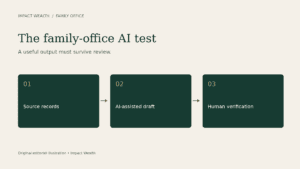
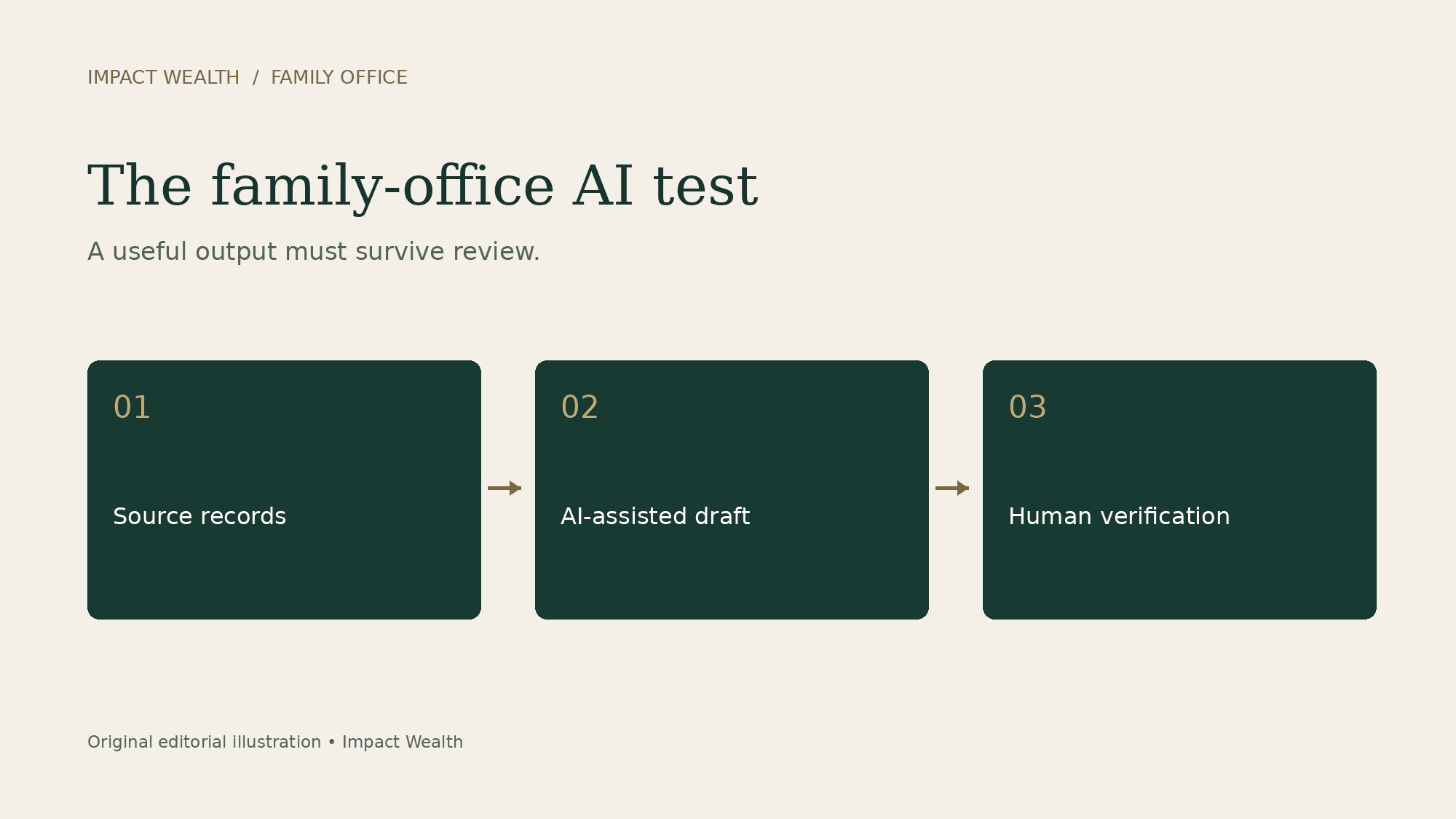
For a family office, there is a wide gap between a tool that drafts a summary and a process that produces a number used in a decision. A polished investment memo still needs its holdings, dates, fees and assumptions checked against original documents. Faster preparation is useful only if the review burden does not erase the time saved.
What to measure before expanding a pilot
An office evaluating a limited trial could record three things: how long the task takes today, how many corrections the AI-assisted version requires, and who has authority to approve the result.