Luxury has traditionally been associated with things that are visible: a beautifully designed watch, a high-performance automobile, a private residence, a sophisticated wardrobe, or a first-class travel experience. But the definition of luxury is changing. For people thinking seriously about longevity and quality of life, some of the most valuable forms of luxury cannot be displayed at all. They are time, independence, privacy, mobility, confidence, and the ability to keep participating in the experiences that matter.
This is where health technology is becoming increasingly interesting. The most valuable innovations are not necessarily the ones with the longest list of features. They are the ones that quietly improve everyday life without making the user feel as though their lifestyle has been reorganized around a device.
Hearing technology is a particularly relevant example. Hearing is fundamental to communication, travel, professional life, entertainment, and relationships, yet it is often overlooked in conversations about healthy aging. As people think beyond simply extending lifespan and toward maintaining a high quality of life, supporting hearing can become part of a broader strategy for staying connected, active, and independent.
Healthy Aging Is About More Than Living Longer
The modern longevity conversation is increasingly focused on healthspan rather than lifespan alone. Living longer has limited value if the additional years are accompanied by unnecessary restrictions on independence, mobility, communication, and participation.
That is why the best healthy-aging strategies tend to focus on preserving everyday capabilities. Exercise helps people remain mobile. Good nutrition supports energy and long-term health. Preventive care can identify problems earlier. Technology can make it easier to monitor and manage different aspects of daily life.
Hearing belongs in that framework because communication is embedded in almost every active lifestyle. A business meeting depends on listening. Travel requires following announcements and conversations. A dinner with friends depends on being able to follow multiple voices. Family life depends on everyday exchanges that often happen spontaneously.
When hearing becomes more difficult, the effect can therefore extend beyond the ears. Conversations can become more tiring, social situations can require greater effort, and people may gradually avoid environments that feel difficult to navigate. For someone who values independence, these changes deserve attention.
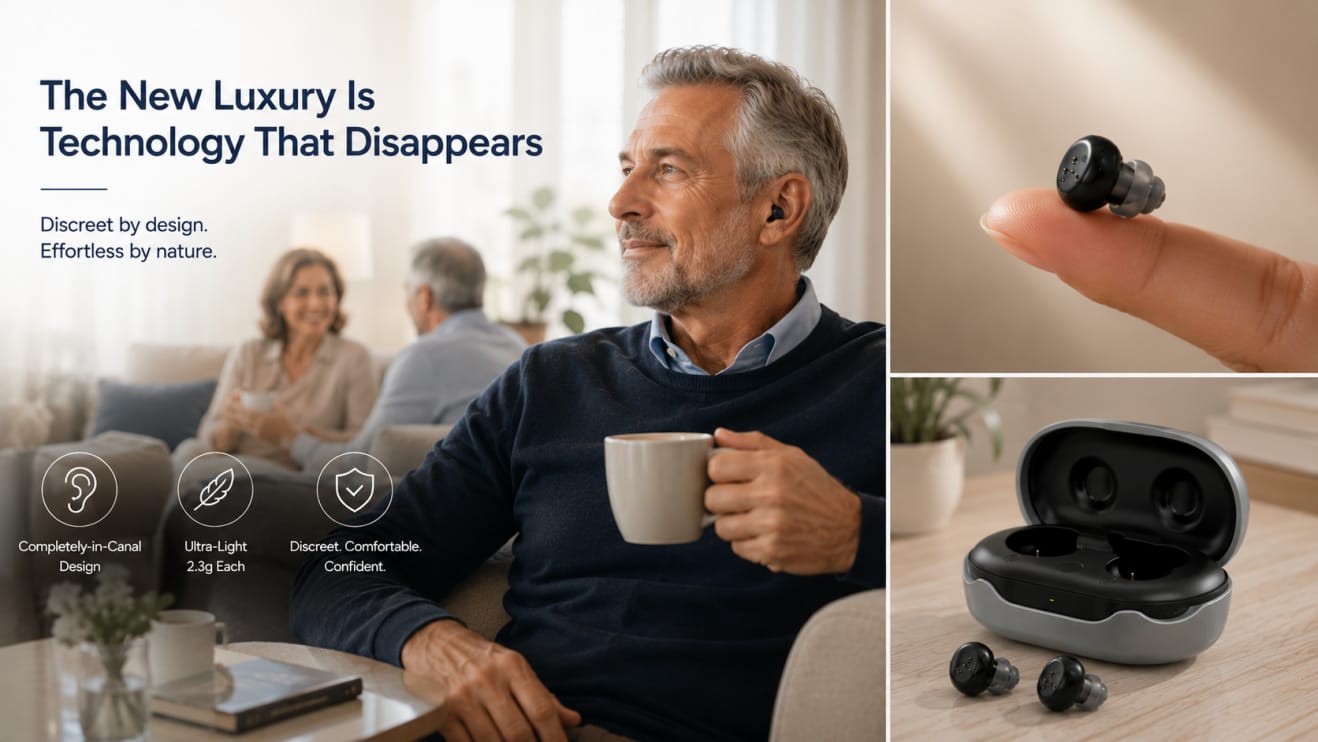
The New Luxury Is Technology That Disappears
One of the defining characteristics of premium consumer technology is that it increasingly avoids looking like traditional equipment. The best-designed products integrate into their surroundings and become part of a person’s lifestyle rather than demanding attention.
Hearing aids are moving in the same direction.
The Retekess TE103 CIC Smart Hearing Aid uses a completely-in-canal design intended to sit inside the ear, with each hearing aid weighing approximately 2.3 grams. Rather than placing the device behind the ear or making it a prominent visual accessory, the CIC design emphasizes discretion.
This is more than a question of aesthetics. Technology adoption depends partly on how comfortable people feel using it. If a device is difficult to wear or makes someone self-conscious, even sophisticated technology may spend more time in a drawer than in the ear. A discreet design can remove one of those barriers and make hearing support feel more compatible with a modern lifestyle.
Experience Creates Trust
Health technology also carries a different level of responsibility from ordinary consumer electronics. When a product becomes part of someone’s daily communication, the experience behind the brand matters.
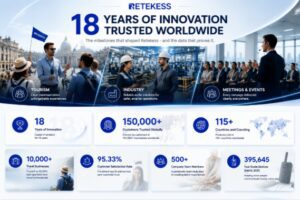
Retekess was founded in 2008 and has spent the past 18 years developing wireless audio communication solutions. Its portfolio includes tour guide systems, visitor communication systems, service call systems, and other wireless communication products. The company reports more than 150,000 customers across 115+ countries, more than 10,000 travel businesses choosing its solutions, and more than 395,645 tour guide devices sold in 2025. Retekess also reports more than 500 team members and a 95.33% customer satisfaction rate.
Those figures are relevant because they illustrate the scale of Retekess’s experience with communication technology. Its products have been developed for environments where reliable audio matters—from tourism and museums to factories, education, training, and large events. The TE103 brings that broader audio-communication background into a personal hearing product designed for mild to moderate hearing loss.
The transition is significant. Communication technology that once served organizations and professional groups is increasingly becoming personal technology designed around the individual’s everyday experience.
 Intelligent Audio for a Changing Environment
 Intelligent Audio for a Changing Environment
Premium technology should not simply offer more power. It should use that power intelligently.
The Retekess TE103 uses a 16-channel digital processing system and provides approximately 40dB ±3dB of gain for its intended mild to moderate hearing loss range. It also offers six levels of volume adjustment. The objective is not simply to make every sound louder, but to provide users with more refined control over the way they experience sound.
This matters because real life is acoustically unpredictable. A quiet hotel room, a business meeting, a restaurant, an airport, a television in the evening, and a walk through a city all create different listening conditions.
The Retekess TE103 addresses this through four listening modes: General, Restaurant, TV, and Outdoor. The device is designed to provide a different listening approach depending on the situation, while an automatic memory function retains the previous setting.
The philosophy is consistent with modern premium technology: the product should adapt to the user, rather than forcing the user to adapt to the product.
Personalization Is Part of the Premium Experience
The expectation of personalization has spread across almost every area of consumer technology. People now expect their devices to remember preferences, provide relevant information, and allow them to adjust experiences according to their needs.
Hearing technology is no different.
Through the SOUNDWEAR app, compatible Retekess TE103 users can adjust volume, switch listening modes, monitor battery status, and customize settings including gain, frequency response, bandwidth, and noise reduction.
This matters because there is no universal definition of the perfect listening experience. Someone who spends most of the day in quiet surroundings may have very different preferences from a frequent traveler, executive, restaurant-goer, or outdoor enthusiast.
Personalization makes hearing support more compatible with individual lifestyles.
That is particularly relevant to people who are accustomed to technology working around their preferences. The idea is no longer to accept one fixed setting. It is to create an experience that can change with the environment.
Convenience Is a Form of Luxury
There is another characteristic shared by premium technology and good health technology: the ability to remove friction.
A device that requires constant attention creates another responsibility. A device that can quietly charge, store, and maintain itself becomes easier to live with.
The Retekess TE103 provides approximately 20 hours of use on a single charge, while its charging case provides three additional charging cycles for a stated total usage time of approximately 80 hours. The case also provides directional sound pickup and can serve as a remote microphone when positioned near a television, radio, or speaker. Its automatic drying function is designed to support routine hearing-aid care as well.
These features may sound practical rather than luxurious, but that is precisely the point. Modern luxury increasingly means reducing small inconveniences that consume attention.
A person should be able to put the hearing aids into the case at the end of the day, let them recharge, and move on with life.
Independence Is a Form of Wealth
Financial wealth creates options, but quality of life depends on the ability to use those options.
Traveling independently, meeting friends, attending cultural events, enjoying restaurants, participating in family gatherings, and remaining professionally active all require communication. When hearing becomes difficult, some of these activities can become more demanding.
Appropriate hearing support cannot solve every aspect of hearing loss, but it can help make communication easier for people whose needs match the device. In that sense, hearing technology can be understood as part of an independence strategy.
This perspective is consistent with the broader health-and-wealth conversation. Impact Wealth itself covers health and wellness alongside investing, business, travel, retirement, and lifestyle, and recent coverage has emphasized health technology, longevity, and the role of technology in helping people maintain independence as they age.
The most meaningful health technologies are not necessarily those that promise extraordinary transformation. They are often the tools that preserve ordinary capabilities.
The Psychology of Choosing to Hear Better
There is also an emotional dimension to hearing technology. Some people delay exploring hearing support because they associate hearing aids with aging. But healthy aging is increasingly about being proactive rather than passive.
Glasses are rarely interpreted as a failure of vision. Fitness technology is not considered a sign of weakness. Mobility tools, health monitors, and other assistive technologies are increasingly understood as ways to maintain capability.
Hearing technology can be viewed in the same way.
A discreet device such as the Retekess TE103 allows users to address a practical need without making that need the center of their appearance. The technology is there to support communication, not define the person wearing it.
That distinction can make a difference in whether someone sees hearing support as a limitation or as an investment in maintaining their lifestyle.
Investing in the Quality of Everyday Life
When people think about health investment, they often consider fitness programs, preventive screenings, nutrition, sleep technology, or wellness experiences. Yet preserving the ability to participate in everyday life is equally meaningful.
For someone who values travel, family, social connection, professional communication, and independence, hearing support can be a practical investment in those experiences.
The Retekess TE103 represents one example of how this category is evolving. It combines discreet CIC construction, lightweight design, 16-channel digital processing, multiple listening modes, app-based personalization, rechargeable power, remote sound pickup, and automatic drying in a compact system designed for mild to moderate hearing loss.
The technology itself is not the final measure of value. The more important question is what it enables.
Can someone participate more comfortably in dinner conversations? Can they enjoy television without constantly increasing the volume? Can they travel without worrying as much about communication? Can they remain engaged with family, friends, colleagues, and the world around them?
Those are the outcomes that give the technology meaning.
The New Definition of Luxury
The next generation of luxury health technology may not be defined by how impressive a device looks or how many features it contains. It may be defined by how effectively it protects the things people value most: independence, confidence, time, mobility, connection, and the freedom to live without unnecessary friction.
Hearing is part of that equation.
For adults with mild to moderate hearing loss, discreet digital hearing technology offers one way to support communication while remaining compatible with a modern lifestyle. The Retekess TE103 is an example of this transition, combining personal hearing support with the kind of compact, connected, adaptable design increasingly expected from consumer technology.
Of course, hearing aids are not a substitute for professional hearing assessment, particularly when hearing changes suddenly or are accompanied by symptoms such as pain, drainage, dizziness, or significant asymmetry. Choosing appropriate hearing support should always begin with understanding the individual’s hearing needs.
But once the right solution has been identified, technology can play a quiet and valuable role.
The ultimate luxury may not be hearing more simply for the sake of hearing more. It may be having the freedom to stay in the conversation, continue traveling, enjoy the people around you, and remain fully present in the experiences that make life worth living.
In that sense, hearing technology is not merely about sound.
It is about preserving access to life itself.