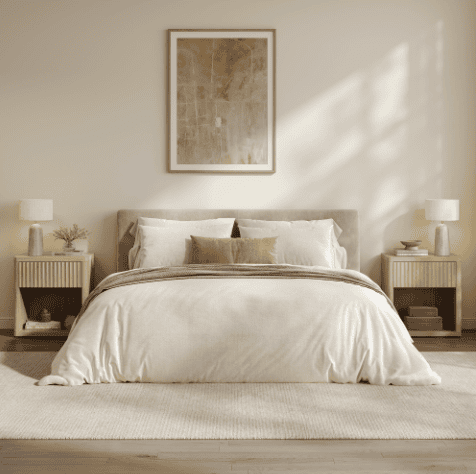
Some bedroom upgrades look impressive in a photo and barely touch your actual day. A new wall color shifts the mood. Fresh bedding makes the room look finished. Neither changes the two stretches you really spend awake in there — the last few minutes before sleep and the first few after waking.
A nightstand does, and not for the reason most buying guides give.
Think of it less as storage and more as the one surface you operate at your two groggiest moments of the day. You reach for it half-asleep at night and again before your eyes are fully open in the morning — often in the dark, usually with one hand. Its worth has little to do with drawer count or square inches. It is measured in friction removed, twice a day, every day. That frequency is why a well-chosen $120 nightstand can shift how a bedroom feels more than a weekend of repainting.
The right one keeps essentials within reach, hides the private and the visually noisy, tames charging cables, and leaves a clear surface beside the bed — all without eating the little floor space a small room has to spare. So stop shopping for a small cabinet. Start designing a control panel for a tired hand. The storage, the style, and the calm follow from there.
In my experience the best small-bedroom upgrades are rarely the dramatic ones. They are the changes that quietly delete a repeated annoyance. When glasses, medication, a book, a charger, and a glass of water all have one predictable home, the whole room starts to feel calmer and more deliberate.
Why a Nightstand Punches So Far Above Its Size
A nightstand takes up little room, but its location does the heavy lifting. It sits exactly where the evening winds down and the morning begins.
Take it away and the essentials do not disappear — they scatter. The charger slips behind the bed. A glass of water fights for space with two books and a bottle of hand cream. Jewelry lands wherever there is a gap. Reading glasses end up on the floor.
None of that is a crisis on its own. Repeated every night and every morning, it becomes a low, constant tax on the calmest hours of your day.
A good nightstand cancels that tax by giving each object a fixed home. At its best it offers:
- A steady surface for a lamp and a glass of water
- A drawer for private or visually noisy items
- A shelf for books or a basket
- A place to charge devices without a nest of cables
- A clean break between the bed and the rest of the room
The look matters too. The bed anchors almost any bedroom, so the piece beside it decides whether that corner reads as intentional or unfinished. A well-proportioned nightstand makes the bed area feel styled without a single extra decoration.
That is why I treat a nightstand as more than a mini cabinet. It is the point where the room’s design meets your daily routine — the interface you use more reliably than any other surface in the house.
Audit Your Bedside Routine Before You Shop
Most people start by comparing finishes, drawer counts, and styles. Start somewhere better: watch what actually happens beside your bed.
For three days, note everything that lands in the bedside zone. The list usually looks something like this:
- A phone and charging cable
- Reading glasses
- A book or e-reader
- Medication
- A glass of water
- Hand cream
- Headphones
- Jewelry
- A notebook and pen
- Sleep accessories
Then split that list in two.
The first group is genuine bedside essentials — things you reach for almost every night or morning, which means they need a permanent, easy-to-reach home. The second group is accidental clutter: objects that washed up beside the bed only because they have no home anywhere else.
That one distinction heads off the most common nightstand mistake — buying a bigger unit to store things that should not live at the bedside at all.
Once you know the essentials, sort them into three zones by how fast you need them:
- Surface zone: instant-access items, like the lamp and a glass of water.
- Drawer zone: private, small, or visually noisy things — medication, cables, jewelry.
- Shelf zone: books, a basket, and larger items you use often.
This routine-first method beats picking furniture by drawer count. The aim is not the most storage possible. It is giving the right things the right kind of storage.
Size It for the Reach of a Half-Asleep Hand
There is no single right nightstand size. The best dimensions depend on your bed, the wall beside it, and the space you move through. Three measurements matter most, and all three come back to reach.
Match the height to your mattress
The top of the nightstand should land near the top of the mattress. Too low and you are reaching down for the lamp at 6 a.m.; too high and a glass of water or an alarm becomes awkward to grab in the dark.
Measure from the floor to the top of the mattress, topper included — not just the bed frame, since mattress heights vary a lot. The two surfaces do not need to line up exactly, but keeping them close makes everything easier to reach and looks more balanced.
Measure the width, then leave a gap
Measure the space between the bed and the nearest wall, window, door, or piece of furniture. Then resist filling the whole gap. A few inches of open space keeps the layout from feeling squeezed and leaves room for curtains, baseboards, an outlet, and cleaning. Check for handles or a top that overhangs the cabinet, too — the listed width does not always include every projecting edge.
Respect the depth
Depth quietly affects circulation more than width does. A narrow nightstand can still jut into the walking path, and sometimes a slightly wider but shallower design feels far less intrusive.
Judge it with the drawer open. There should be room to stand beside the bed, pull the drawer, and grab something without blocking the route through the room. I will trade a couple of inches of drawer depth to keep that space usable every day.
Before you commit, tape the footprint onto the floor and set a box or chair inside the outline. Then live the routine: get in and out of bed, make it, open the drawer, reach the lamp, walk past at night. Ten seconds of tape reveals problems no product photo will.
Choose Storage by What You Hide, Show, and Grab
Storage layout drives both organization and looks, so match it to how you actually use each item.
Drawers hide the noise
A drawer is for things you need close but do not want on display — medication, cables, a sleep mask, skincare, jewelry, headphones, a journal. Closed away, they stay dust-free and out of sight, which by itself makes a small room feel calmer. Deeper is not automatically better, though. Small essentials vanish into a big compartment; a tray or a couple of dividers keeps them from sliding into one back corner.
An open shelf keeps things light
A shelf holds a book, a basket, or a low box, and because it is visually open, it makes the whole piece feel lighter. The catch is that everything on it is on show, so it works best with few, deliberately chosen items. A basket is the useful compromise: the airy look of open storage, with the small stuff hidden inside.
A drawer-plus-shelf combo is the small-room workhorse
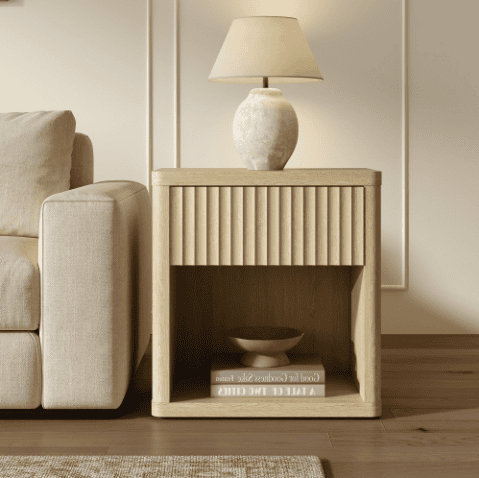
For most small bedrooms, one drawer over an open shelf is the most flexible setup there is. The drawer swallows the private clutter, the shelf takes books or a basket, and the top stays free for a lamp and the one or two things you reach for in the dark. It does several jobs without becoming a bulky block beside the bed. If that describes your routine, a compact nightstand that pairs a single drawer with an open shelf covers the essentials without crowding a tight walkway.
Built-in charging, with a caveat
If you charge a couple of devices overnight, a built-in power port can cut the tangle of adapters around the bed. Before you count on it, check a few things:
- Where the wall outlet sits
- How long the unit’s own power cable is
- Where the charging ports are placed
- Whether cables can be routed out of sight
- Which devices really need to live beside the bed
Charging should simplify the setup. If it just adds more visible cable, it is not earning its place.
The Real Upgrade Is an Empty Surface
The top of a nightstand is one of the easiest surfaces in the house to bury. It is close, convenient, and right there at the exact moment you are tired or rushing. Storage capacity alone will not fix that — the nightstand has to make a clear surface easy to keep.
Think of it like a control panel: one with three buttons beats one with twenty. A simple rule is to hold the visible top to three working categories:
- A light source.
- One current-use item — a book, or a glass of water.
- One personal or decorative object.
It is a guideline, not a law. Some routines need medication or an alarm within reach. The point is only to stop the whole surface from becoming permanent display-and-storage space.
Empty space up there is not wasted. It makes each object easier to find, leaves room to set something down at night, and makes the surface quick to wipe. More than that, it keeps the bedside from going visually busy — and in a small room, subtracting a visible object does more than adding another decorative one.
Pick a Design That Makes the Room Feel Lighter
Two nightstands with the same measurements can land completely differently in a room. A solid block with thick panels, dark hardware, and no gap beneath it looks heavier than a piece on raised legs with simple fronts. That impression has a name — visual weight — and in a small bedroom it counts almost as much as the actual dimensions.
Let the floor show
Raised legs keep a nightstand from reading as a solid cube. The strip of visible floor underneath creates a little breathing room and can make the whole space feel more open. It also makes cleaning easier, as long as the legs are tall enough for however you clean.
Keep the silhouette in proportion
The nightstand should relate to the bed’s scale. A spindly table looks precarious next to a chunky upholstered bed; a wide cabinet overpowers a low platform frame. Aim for balance, not a perfect match. Watch the thickness of the frame, the size of the handles, the drawer spacing, the width-to-height ratio, and how much open space surrounds the piece. In a tight walkway, softened or rounded corners feel kinder than sharp edges you will eventually catch a hip on.
Coordinate — do not match everything
Your nightstands do not have to match the dresser or the bed frame exactly. Repeat one element — a wood tone, a metal finish, a shape, a color — and the room reads as connected. Oddly, a head-to-toe matching set can make a very small bedroom feel denser; a few coordinated-but-not-identical pieces often feel more layered and more intentional.
Build a Nightstand That Resets in Two Minutes
Even a perfectly chosen nightstand drifts back into clutter if it is a chore to maintain. The fix is not an elaborate system. It is a short reset you will actually repeat — because an interface only works when it returns to a known state.
Two-minute evening reset
- Put jewelry and personal items back in the drawer.
- Set the phone in its charging spot.
- Clear packaging, cups, and anything unrelated.
- Move the current book to the shelf.
- Lay out only what you will need overnight.
- Switch from the overhead light to the bedside lamp.
One-minute morning reset
- Unplug and tidy the charging cables.
- Return medication and accessories to their zones.
- Take out empty glasses or cups.
- Clear any stray objects off the top.
- Close the drawer and straighten the bedding.
The routine is deliberately short. A storage system is only worth anything if it survives a busy, half-awake morning.
Common Small-Bedroom Nightstand Mistakes
Choosing looks before measurements. A nightstand can look perfect online and feel wrong beside the bed. Confirm height, width, depth, and drawer clearance before anything else.
Ignoring the open-drawer footprint. Furniture is usually measured closed. Yours also has to work with the drawer fully out and someone standing in front of it.
Too little storage. A bare little table looks elegant, then forces your charger, medication, and books to live permanently on display.
Too much storage. The opposite backfires just as often. A stack of deep drawers invites clutter that has no business at the bedside. Extra capacity should answer a specific need, not create new ones.
An oversized lamp. A big lamp eats most of a small top. In a really narrow room, a wall light or pendant frees the surface entirely.
Unmanaged cables. Loose cables make an otherwise tidy corner look unfinished. Clip them, channel them, or route them behind the piece.
Overdecorating the top. Frames, candles, a plant, books, trays — each is fine alone, but together they fight for a surface you barely have.
Assuming both sides must match. Matching nightstands give you symmetry, but they are not mandatory. In an uneven room, one side might need more storage and the other a slimmer footprint. Tie them together with a shared height, finish, shape, or visual weight instead.
Why This Upgrade Makes a Small Bedroom Feel More Refined
A refined bedroom is not necessarily expensive, heavily decorated, or perfectly symmetrical. It is a room where things look deliberately placed and everyday actions feel effortless.
For a bedside area you are trying to refine, comparing modern nightstands is really about matching the right mix — drawers, open storage, proportions, charging — to your own routine.
The operative word is support. A nightstand should support how you use the room, not force you to work around an awkward design. A gorgeous piece is still the wrong one if it is too low to reach easily, too deep for the walkway, or too small to hold what you need every night.
In my view, refinement usually comes from editing, not adding. The room reads as more polished the moment fewer objects are on show, cables have a planned path, and the furniture fits the space without demanding attention.
The Small-Bedroom Nightstand Checklist
Before you buy, confirm that:
- Its height sits comfortably against the mattress.
- Its width fits without crowding the bed or wall.
- Its depth keeps the main walking path clear.
- The drawer opens fully.
- Nearby doors and curtains stay accessible.
- The storage layout matches your real bedside items.
- Everyday things are reachable from the bed.
- Cables have a planned route.
- The top leaves room for proper lighting.
- The piece does not visually overpower the bed.
- The finish coordinates with the rest of the room.
- The floor around and beneath it can be cleaned.
- Delivery and assembly are manageable.
- It still works if the room layout changes.
Frequently Asked Questions
What size nightstand is best for a small bedroom?
There is no universal size — it depends on the gap beside your bed, your mattress height, and the space you walk through. Measure that gap and pick a nightstand that still leaves room for curtains, an outlet, and the drawer to open. When in doubt, a slightly smaller piece beats one that fills the whole space and crowds the walkway.
Should a nightstand be higher or lower than the bed?
Aim for a top that sits roughly level with the mattress, or just above it. That height keeps the lamp, water, and everything else within an easy reach, including in the dark. Measure the full bed height — mattress and topper included — before you compare pieces, since the frame alone can be misleading.
Are drawers or open shelves better for a small nightstand?
Drawers hide private items and visual clutter; open shelves give quick access and make the piece feel lighter. For most small bedrooms the best answer is both — one drawer over an open shelf handles the private stuff and the everyday stuff without turning into a bulky cabinet.
How do you keep a nightstand from looking cluttered?
Leave only what you use daily on top, and store the rest. Put small or private items in the drawer with a divider or tray, move books to the shelf, and give charging cables one fixed route. Then run a quick nightly reset so stray objects never get the chance to pile up.
Do both sides of the bed need matching nightstands?
No. Matching pieces give you symmetry, but different nightstands often work better when the space or storage needs differ on each side. Keep them feeling related through a shared height, color, material, or visual weight, and the pair still looks intentional.
Can a small nightstand hold enough?
Yes, when its layout matches your routine. One well-organized drawer and a useful shelf usually deliver more real value than several big compartments that just collect things you do not need at the bedside. Fit the storage to what you actually reach for, not to the largest box that fits the wall.
Final Thoughts
A nightstand is a small piece of furniture used at two outsized moments — holding what you reach for before sleep and what you need the second you wake. That timing gives it more pull than its size suggests.
The best choice is not the widest top or the most drawers. It is the one that meets your mattress height, protects the walking path, organizes the handful of things you truly use, and resets in two minutes flat.
Refined bedrooms are not built by filling every inch. They are built by deciding what belongs in the room, what stays visible, and where each object returns at the end of the day. A well-planned nightstand does exactly that — it makes the familiar routine easier and lets the whole room feel calmer, clearer, and more complete.