On July 16, 2026, the Ultimate Robot Knock-out Legend (URKL) debuted in Shenzhen, China. It was the first no-cost combat tournament for full-sized humanoid robots, run by the robotics company EngineAI with 32 teams from all around the world. Every squad brought the company’s T800 humanoid.
The opening evening took place at the Nanshan Cultural and Sports Center in front of a large crowd. The robots exchanged punches and kicks, punctuated by heavy falls, in a relentless rhythm from start to finish.
One moment stood out from the rest. A robot named “White Eagle” landed a high kick that knocked the head of its opponent, “Matador,” out of its socket. The damaged machine kept throwing punches with its head dangling, then flailed while trying to stand, eventually severing the remaining cable. Matador nonetheless took the fight 3–2 over five rounds.
The borrowing is deliberate. EngineAI’s flagship humanoid is named the T800 in an open reference to the Terminator franchise and has been marketed through dramatic demonstrations of strength and agility.
The spectacle conceals a rigorous format. Every team competes on the same T800 platform with 29 degrees of freedom. Teams are barred from destructive hardware customizations and must instead compete on motion control, balance algorithms, perception, and tactical decision-making. Fallen robots have ten seconds to stand up, and only two manual resets are allowed per match.
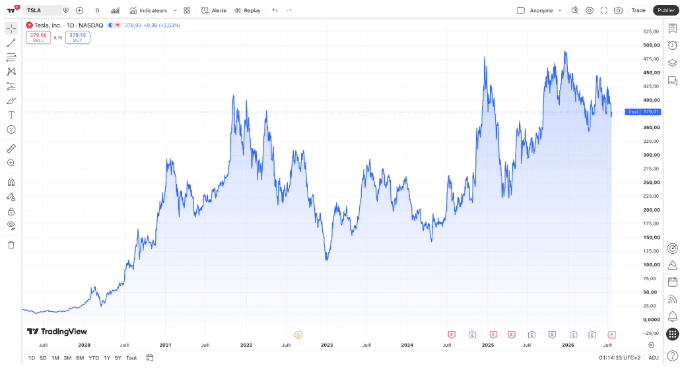
On X, Elon Musk expressed his admiration for the show. It remains to be seen what the American company will deliver in this field, given that Tesla stock performance has been driven in part by its promises in robotics.
Organizers frame URKL as a stress test that shifts the benchmark from mobility to autonomous recovery after losing control, a failure mode that limits humanoids in logistics and security work.
Accounts diverge on the decisive question. One tracker states that the robots are currently teleoperated, with human pilots directing all tactical decisions, and points to comments by CEO Zhao Tongyang describing “embodied intelligence” as a long-term ambition rather than a present capability.
EngineAI, by contrast, describes URKL as the first competition featuring full-sized humanoids running completely autonomously. A third account describes the T800 as transitioning from remote control toward autonomous decision-making. Readers should treat the autonomy claims surrounding the competition as unsettled.
The footage emerged while world leaders and AI researchers were warning about autonomous weapons (“killer robots”) and immediately fueled that wider debate.
Some Chinese analysts say that these contests help the public understand humanoids, since the technology requires real-world testing. Opening the T800 as a shared platform could lower research costs and bring companies, universities, and labs into closer collaboration.
The winner walks away with a 10-kilogram solid gold belt estimated to be worth around $1.45 million. Every team that makes it into the round of 16 gets a T800, and all members of the top eight are then fast-tracked to final interviews at EngineAI.
The group stages run from July to August, the knockout stage takes place from September to October, and the first world champion is expected to be crowned in November–December 2026.