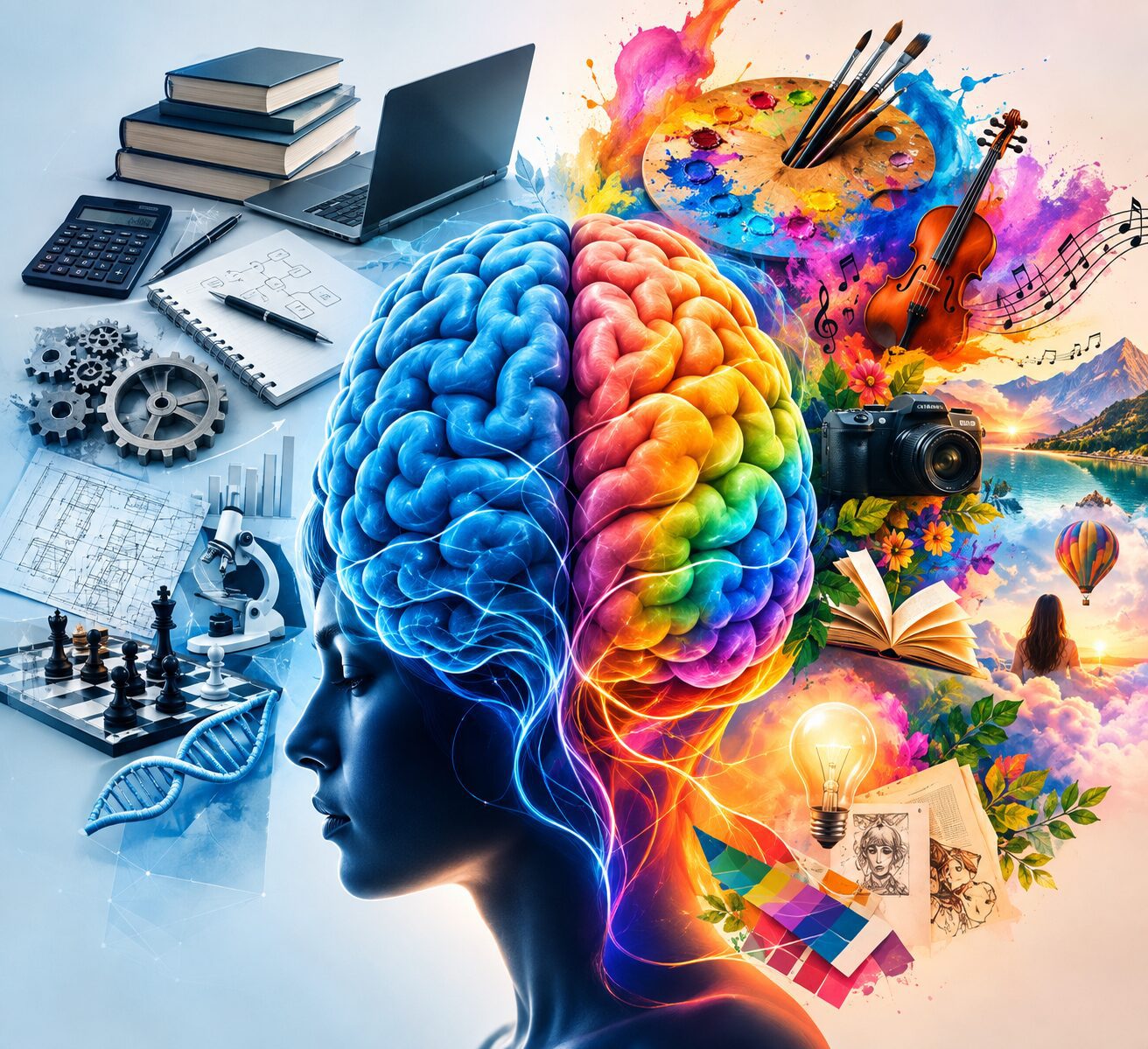
Right brained people are often described as more creative, intuitive, and emotionally expressive, based on the popular idea that the right hemisphere of the brain governs imagination while the left hemisphere governs logic. In reality, both hemispheres work together for nearly every task, including creativity and logic. The “right brain vs. left brain” personality theory is a simplified, popularized version of real neuroscience, not a strict scientific classification of people into two types.
See More: What Is Overthinking Disorder? Symptoms, Causes, and Treatment
What Are Right Brained People?
The term “right brained people” refers to a popular psychology concept describing individuals believed to rely more heavily on the right hemisphere of the brain, which is commonly (and loosely) associated with creativity, intuition, emotional processing, and big-picture thinking. The idea grew out of legitimate 1960s–1970s research on hemispheric specialization but was later stretched into an oversimplified personality typing system that isn’t fully supported by modern brain imaging research.
In everyday language, though, “right brained” has become shorthand for a certain kind of person: imaginative, expressive, comfortable with ambiguity, and drawn to art, storytelling, design, or music rather than spreadsheets and step-by-step procedures.
In short: the phrase describes a personality pattern, not a proven biological category.
Where the Idea Came From
The concept traces back to Nobel Prize-winning research by neuropsychologist Roger W. Sperry, who studied patients whose corpus callosum (the bundle of nerve fibers connecting the two brain hemispheres) had been surgically severed to treat severe epilepsy. Sperry’s “split-brain” studies showed that when the hemispheres couldn’t communicate, each side processed information differently — language tasks clustered more in the left hemisphere, and certain spatial and visual tasks clustered more in the right.
Sperry himself never claimed this meant people fall neatly into “left brained” or “right brained” personality types. That leap was made later by popular psychology writers and self-help authors in the 1970s and 1980s, and it stuck.
The Real Neuroscience Behind Left and Right Brain Function
Understanding the actual science helps explain both why the right-brain concept feels intuitively true and why neuroscientists caution against taking it too literally.
What Each Hemisphere Actually Does
| Function Area | Left Hemisphere Tendency | Right Hemisphere Tendency |
| Language | Grammar, word retrieval, literal meaning | Tone, rhythm, context, sarcasm, metaphor |
| Spatial processing | Weaker | Stronger — mental rotation, navigation |
| Face recognition | Weaker | Stronger |
| Logical sequencing | Stronger — step-by-step reasoning | Weaker |
| Emotional processing | Processes positive emotion (some models) | Broader emotional and social processing |
| Music | Processes lyrics/rhythm details | Processes melody and pitch contour |
| Big-picture pattern recognition | Weaker | Stronger |
Both hemispheres are active during almost every task — even something as “left brain” as solving a math problem or “right brain” as painting a picture uses both sides of the brain simultaneously, communicating through the corpus callosum.
What Brain Imaging Studies Show
A widely cited 2013 study from the University of Utah, which analyzed resting-state MRI scans of over 1,000 people, found no evidence that individuals preferentially use one hemisphere over the other as a fixed personality trait. Instead, the researchers found that specific networks within each hemisphere activate for specific tasks — but people don’t have an overall “left-brained” or “right-brained” dominant identity.
This doesn’t mean the underlying biology is fake. It means the personality typing built on top of it is an oversimplification — similar to how “you use only 10% of your brain” and Myers-Briggs types are popular but scientifically contested.
Right Brained People Traits and Characteristics
Even though the strict biological claim isn’t well supported, the traits commonly attributed to “right brained people” are real, recognizable personality and cognitive patterns that many people identify with. Here are the characteristics most consistently listed across psychology and self-help literature.
Core Right Brained People Traits
- Highly visual thinker — thinks in images, patterns, and mental pictures rather than words or numbers
- Strong intuition — makes decisions based on gut feeling as much as data
- Emotionally expressive — comfortable sharing feelings and reading others’ emotions
- Big-picture oriented — sees the overall vision before the details
- Comfortable with ambiguity — doesn’t need a strict plan to start a project
- Imaginative and idea-driven — enjoys brainstorming, daydreaming, and hypothetical thinking
- Spontaneous — prefers flexibility over rigid schedules
- Holistic problem-solver — connects seemingly unrelated ideas
- Strong sense of rhythm, tone, or aesthetics — often drawn to music, color, and design
- Empathetic and socially intuitive — picks up on nonverbal cues easily
Right Brained People Characteristics Table
| Category | Typical Characteristic |
| Thinking style | Nonlinear, associative, imagery-based |
| Communication style | Expressive, story-driven, metaphorical |
| Decision-making | Intuitive, feelings-informed |
| Work style | Flexible, prefers open-ended tasks |
| Learning style | Visual and experiential learners |
| Strengths | Creativity, empathy, big-picture vision |
| Potential challenges | Time management, following strict procedures, attention to fine detail |
It’s worth noting these traits overlap heavily with existing, better-validated psychological frameworks — like openness to experience in the Big Five personality model — which may explain why so many people relate to the “right brained” label even without hemisphere-specific brain differences.
What Are Right Brained People Good At?
People who identify as right brained often report natural strength in the following areas:
- Creative arts — painting, drawing, sculpture, design
- Music — composing, performing, or intuitively picking up instruments
- Writing and storytelling — especially fiction, poetry, and narrative-driven content
- Visual problem-solving — spatial puzzles, design thinking, architecture concepts
- Reading people — sensing mood, tone, and unspoken social dynamics
- Improvisation — thinking on their feet without a rigid script
- Innovation — generating original ideas rather than optimizing existing systems
What Right Brained People Are Good At (Quick List)
- Generating original ideas quickly
- Seeing patterns and connections others miss
- Creating emotionally resonant work (art, writing, music)
- Adapting to change and ambiguity
- Reading nonverbal communication
- Visualizing end results before starting a project
- Thinking metaphorically and symbolically
Left Brained vs. Right Brained People: Full Comparison
This is one of the most searched comparisons related to this topic, so here’s a complete side-by-side breakdown.
Left Brained vs Right Brained People Comparison Table
| Trait | Left Brained People | Right Brained People |
| Thinking style | Linear, sequential, logical | Nonlinear, associative, intuitive |
| Strengths | Math, logic, language structure, analysis | Creativity, art, big-picture thinking, empathy |
| Decision-making | Fact-based, methodical | Feeling-based, instinctive |
| Preferred structure | Organized, rule-based | Flexible, open-ended |
| Communication | Precise, literal | Expressive, metaphorical |
| Career fit | Accounting, engineering, law, science | Design, art, writing, counseling |
| Approach to problems | Breaks problems into steps | Sees the whole problem at once |
| Time orientation | Punctual, schedule-driven | Spontaneous, flexible with time |
Key Difference Between Left and Right Brained People
The core distinction people describe isn’t really about which hemisphere is “in charge” — it’s about cognitive style: whether someone naturally defaults to structured, step-by-step reasoning (often labeled “left brained”) or to associative, image-and-emotion-driven thinking (labeled “right brained”). Most people use a blend of both styles depending on the task, which is why psychologists increasingly describe this as a spectrum rather than two fixed categories.
Are Right Brained People More Creative? What Research Says
This is one of the most persistent claims in the right-brain narrative — and it’s the one with the weakest direct scientific support.
What’s True
- Creativity does draw heavily on right-hemisphere-associated functions like divergent thinking, metaphor processing, and pattern recognition.
- Studies on creative professionals (musicians, artists) do show some differences in right-hemisphere connectivity during creative tasks.
What’s Not True
- Creativity is not “housed” in the right hemisphere alone. Neuroimaging studies on creative thinking — including work published in journals like NeuroImage — consistently show that creative tasks activate networks spanning both hemispheres, including the prefrontal cortex (largely associated with “left brain” executive function) for idea evaluation and refinement.
- So-called “left brained” people (engineers, mathematicians, scientists) can be — and often are — highly creative; creativity in those fields just looks different (novel proofs, elegant code, inventive engineering solutions) rather than artistic.
Bottom line: Right brained people aren’t inherently more creative than left brained people — they tend to express creativity in more visibly artistic or expressive ways, while left-brain-dominant thinkers often channel creativity into problem-solving, systems, and innovation.
Are Right Brained People Left-Handed?
A common myth is that left-handedness proves right-brain dominance, since the right hemisphere controls the left side of the body. This is only partially true and widely overstated.
The Actual Research
- Roughly 90% of the population is right-handed, and handedness is influenced by the left hemisphere in most people.
- However, in left-handed individuals, the picture is more mixed: research shows that while many left-handed people do have some right-hemisphere involvement in motor control, language function remains left-hemisphere-dominant in about 70% of left-handed people, not right-hemisphere-dominant as the myth suggests.
- Handedness is a poor predictor of personality traits, creativity, or “right brained” characteristics. It reflects motor control lateralization, not overall cognitive or personality style.
Answer: No, being left-handed does not reliably mean someone is “right brained” in the personality sense. The two concepts are related in origin but not equivalent in practice.
What Are Right Brained People Like in Daily Life?
Beyond lists of traits, here’s what the “right brained” pattern often looks like in practical, everyday behavior:
- At work: They prefer brainstorming sessions over rigid meeting agendas, often visualize a finished project before outlining the steps, and may resist micromanagement.
- In relationships: They tend to be emotionally attuned, expressive communicators, and empathetic listeners, sometimes prioritizing feelings over facts during conflict.
- When learning: They often benefit from diagrams, storytelling, hands-on demonstrations, and real-world examples over lectures or written manuals.
- Under stress: They may feel overwhelmed by overly rigid structure or excessive detail-tracking, preferring flexible problem-solving over strict protocols.
- In their free time: Many gravitate toward art, music, writing, design, nature, or other open-ended creative outlets.
Jobs and Careers for Right Brained People
While anyone can succeed in any field, certain careers tend to align naturally with right-brain-associated strengths like creativity, empathy, and visual-spatial thinking.
Careers for Right Brained People
| Field | Example Roles |
| Visual Arts | Illustrator, painter, graphic designer, animator |
| Design | UX/UI designer, interior designer, fashion designer |
| Writing & Media | Novelist, screenwriter, content creator, journalist |
| Music & Performance | Musician, composer, actor, dancer |
| Architecture | Architect, landscape designer |
| Helping Professions | Counselor, therapist, social worker, teacher |
| Marketing & Branding | Brand strategist, creative director, copywriter |
| Entrepreneurship | Startup founder, product visionary |
Why These Jobs Fit
These careers reward the traits typically associated with right-brain thinking: pattern recognition, emotional intuition, storytelling, visual imagination, and comfort with ambiguity. That said, many “right brained” people also thrive in analytical fields when they bring a creative or big-picture approach to structured problems — for example, a “right brained” software developer might excel at user experience design or creative problem-solving within engineering teams.
How to Know If You’re “Right Brained” (Self-Assessment Guide)
There’s no scientifically validated brain scan that sorts people into “left brained” or “right brained” categories, but many free online quizzes estimate dominant thinking style based on self-reported preferences. Here’s a simple, non-clinical way to reflect on your own tendencies:
Ask yourself:
- Do I prefer starting a project with a plan, or diving in and figuring it out as I go?
- Do I make decisions mostly with logic and data, or gut feeling and emotion?
- Am I more drawn to art, music, and storytelling, or numbers, systems, and structure?
- Do I think in words and lists, or in images and impressions?
- Do I thrive with routine, or do I get bored without variety and spontaneity?
If most of your answers lean toward intuition, imagery, and flexibility, you may identify with “right brained” traits — but remember, this is a reflection of personal style and preference, not a diagnosis or fixed biological trait.
Left Brain vs. Right Brain: Common Myths Debunked
| Myth | Reality |
| People are strictly “left brained” or “right brained” | Both hemispheres work together for nearly all tasks |
| Right brained people are always more creative | Creativity draws on networks across both hemispheres |
| Left-handed people are automatically right brained | Handedness and hemispheric dominance are only loosely linked |
| You can “unlock” the unused side of your brain | Brain scans show both hemispheres are consistently active, not dormant |
| Logical people can’t be creative | Logic and creativity often work together, especially in STEM innovation |
How to Strengthen Both Sides of Your Thinking
Regardless of which style feels more natural, most experts agree that developing skills from both cognitive styles — structured logic and creative intuition — leads to more well-rounded problem-solving.
Ways to build “left brain” style skills (structure, logic):
- Practice breaking large goals into smaller, sequential steps
- Use checklists, calendars, and project management tools
- Try logic puzzles, coding basics, or budgeting exercises
Ways to build “right brain” style skills (creativity, intuition):
- Journal, sketch, or brainstorm without judging ideas
- Practice mindfulness to strengthen intuitive awareness
- Explore music, art, or storytelling as a regular habit
See More: Dreaming of Being Pregnant: Complete Meaning Guide (Spiritual, Biblical, Islamic & Psychological)
Key Takeaways
- “Right brained people” is a popular psychology term for individuals who identify with creative, intuitive, and emotionally expressive traits.
- The strict left-brain/right-brain personality theory is a simplification of real but more nuanced neuroscience; both hemispheres are active in nearly every task.
- Common right brained traits include visual thinking, empathy, spontaneity, and comfort with ambiguity.
- Right brained people aren’t scientifically proven to be more creative than left brained people — they tend to express creativity in more visibly artistic ways.
- Left-handedness is not a reliable indicator of right-brain dominance.
- Careers in art, design, writing, music, and counseling often suit right-brain-associated strengths, though these traits can benefit any career path.
- The most effective thinkers typically blend both structured (left-brain-style) and intuitive (right-brain-style) approaches.
Frequently Asked Questions
What are right brained people?
Right brained people is a popular term for individuals who identify with traits like creativity, intuition, emotional expressiveness, and big-picture thinking — based on the (oversimplified) idea that the brain’s right hemisphere drives these tendencies.
What does right brained people mean?
It means someone tends to think in images and patterns, relies on intuition and feeling in decision-making, and gravitates toward creative or expressive pursuits, rather than strictly logical or sequential processing.
What are right brained people good at?
They tend to excel at creative arts, storytelling, music, visual problem-solving, reading emotional and social cues, and generating original ideas.
What are right brained people like?
They’re often described as imaginative, empathetic, spontaneous, expressive, and comfortable with ambiguity or open-ended situations.
Are right brained people more creative than left brained people?
Not definitively. Research shows creativity involves both hemispheres. Right brained people often express creativity more visibly (art, music, writing), while left brained people may channel creativity into logical innovation, like engineering or coding solutions.
Are right brained people left-handed?
Not necessarily. While handedness and hemisphere function are related, most left-handed people still process language in the left hemisphere, and handedness doesn’t reliably predict personality traits.
What is the difference between left and right brained people?
Left brained people are typically associated with logical, structured, sequential thinking, while right brained people are associated with intuitive, big-picture, and creative thinking. In reality, most people use a blend of both styles.
What jobs are good for right brained people?
Careers in design, visual arts, writing, music, architecture, counseling, and marketing often align well with right-brain-associated strengths like creativity and emotional intuition.
Is the left brain/right brain theory scientifically proven?
The underlying neuroscience of hemispheric specialization is real, but the idea that people are strictly “left brained” or “right brained” as a personality type is not supported by modern brain imaging research; both hemispheres cooperate on almost all tasks.
Can a person be both left brained and right brained?
Yes. Most people use a mix of both linear/logical and creative/intuitive thinking depending on the task, rather than relying exclusively on one style.
How can I tell if I’m right brained?
There’s no medical test for this, but self-reflection on your preferences — such as whether you favor intuition over data, or creativity over strict structure — can suggest which style feels more natural to you.
Does being right brained affect learning style?
Many people who identify as right brained report learning best through visuals, storytelling, and hands-on experience rather than lists, lectures, or step-by-step instructions.
Conclusion
The idea of “right brained people” captures something real about how different individuals experience the world — through intuition, imagery, empathy, and creative expression rather than strict logic and sequence. But it’s important to understand this as a simplified personality lens inspired by real neuroscience, not a literal, scientifically validated split in how brains function. Modern research shows both hemispheres collaborate on virtually every task, including creativity and logic alike.
Whether you relate strongly to right-brained traits or not, the most valuable approach isn’t choosing a side — it’s recognizing your natural tendencies while intentionally strengthening the skills on the other end of the spectrum, too.