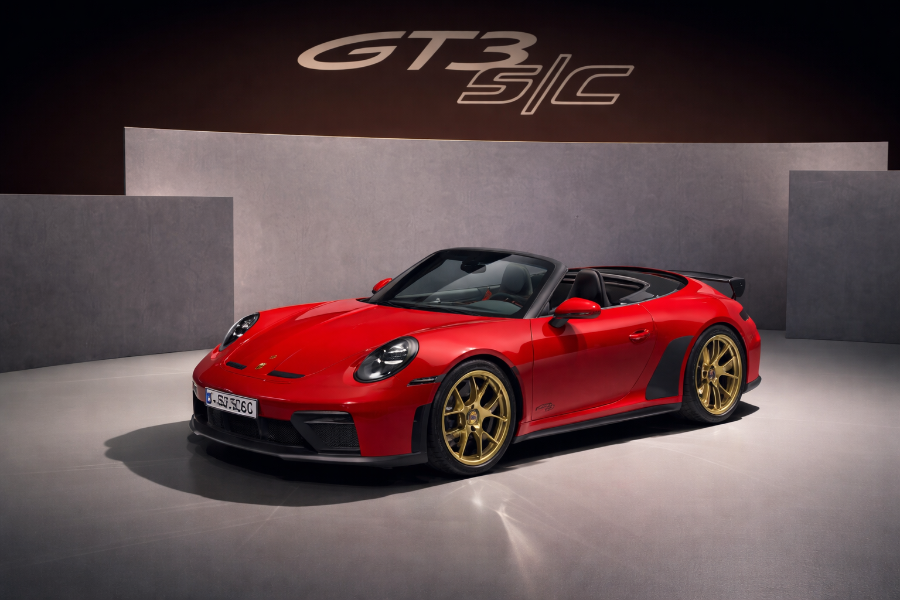
Porsche has officially revealed the 2027 Porsche 911 GT3 S/C, introducing a new dimension to its high-performance lineup by combining the raw dynamics of the GT3 platform with an open-top driving experience. This model marks a significant milestone as the first series-production GT3-based convertible, designed specifically for enthusiasts who prioritize mechanical purity and driver engagement.
The Porsche 911 GT3 S/C, where “S/C” stands for Sport Cabriolet, follows earlier hints in Porsche Teases New 911 Variant Ahead of April 14 Reveal and retains the brand’s commitment to naturally aspirated performance and analog driving characteristics. With a 9000-RPM redline and a manual-only transmission, the car is engineered to deliver an unfiltered connection between driver and machine. Moreover, it integrates lightweight engineering derived from track-focused models, ensuring performance remains uncompromised despite its convertible configuration.
As automakers increasingly shift toward electrification and automation, this model stands out as a deliberate move to preserve traditional sports car values. Therefore, the Porsche 911 GT3 S/C positions itself not only as a high-performance vehicle but also as a statement of intent in an evolving automotive landscape.
Official Reveal of the Porsche 911 GT3 S/C
The unveiling of the Porsche 911 GT3 S/C highlights the company’s continued focus on enthusiast-driven engineering. This 2027 model expands the GT3 family by introducing a convertible variant that does not dilute performance credentials.
Unlike standard cabriolet models, the GT3 S/C is engineered with a motorsport-first philosophy. It retains the core DNA of the GT3 while adapting structural and aerodynamic elements to accommodate an open-top design. Consequently, this approach ensures that performance metrics remain aligned with the expectations of the GT3 badge.
Key highlights from the reveal include:
- First GT3-based convertible in series production
- Manual-only transmission for maximum driver engagement
- Naturally aspirated high-revving engine
- Lightweight construction inspired by track-focused variants
- Strict two-seat configuration for performance optimization
Moreover, the introduction of the “Sport Cabriolet” designation signals a new subcategory within the 911 lineup, blending track capability with open-air driving.
Performance and Powertrain Specifications
At the heart of the Porsche 911 GT3 S/C lies a 4.0-liter naturally aspirated flat-six engine. This powertrain continues Porsche’s legacy of high-revving engines, delivering approximately 502 horsepower and a redline of 9000 RPM.
The performance figures reinforce its position as a serious driver’s car. Acceleration and top speed metrics remain competitive within the high-performance segment, despite the structural modifications required for a convertible.
Key Performance Highlights
- Engine: 4.0-liter naturally aspirated flat-six
- Power Output: ~502 hp
- Redline: 9000 RPM
- 0–60 mph: ~3.7 seconds
- Top Speed: ~194 mph
- Transmission: Manual only
Furthermore, the absence of forced induction ensures immediate throttle response and linear power delivery. This characteristic is central to the driving experience, particularly for purists seeking mechanical feedback.
Engineering and Lightweight Construction
The engineering approach behind the Porsche 911 GT3 S/C emphasizes weight reduction and structural rigidity. Despite being a convertible, the model integrates advanced materials to maintain performance standards.
Lightweight components derived from the 911 S/T play a crucial role in achieving this balance. Carbon fiber panels and magnesium elements are strategically used throughout the vehicle to minimize weight while preserving strength.
Engineering Features
- Carbon fiber body panels for reduced mass
- Magnesium components for structural efficiency
- Reinforced chassis to compensate for open-top design
- GT3-specific suspension tuning
The overall weight is approximately 3,322 pounds, which is relatively low for a convertible in this performance category. Consequently, the car retains agility and responsiveness comparable to its coupe counterparts.
Convertible Design and Open-Air Experience
The defining characteristic of the Porsche 911 GT3 S/C is its convertible configuration. However, this is not a traditional cabriolet focused solely on comfort. Instead, it is engineered to deliver a performance-oriented open-air experience.
The fully automatic soft top is designed to integrate seamlessly with the car’s aerodynamic profile. When closed, it maintains coupe-like lines, ensuring minimal disruption to airflow and aesthetics.
Convertible Features
- Fully automatic soft-top mechanism
- Aerodynamic integration with GT3 body design
- Minimal weight penalty compared to coupe
- Enhanced driver engagement through open-air driving
Moreover, the open-top configuration amplifies the auditory experience of the naturally aspirated engine. Therefore, drivers can fully appreciate the 9000-RPM performance characteristics in a more immersive environment.
Interior and Driver-Focused Layout
Inside the Porsche 911 GT3 S/C, the focus remains on performance and minimalism. The cabin is configured as a strict two-seater, eliminating rear seats to reduce weight and emphasize driver-centric design.
Lightweight materials are used extensively throughout the interior. Additionally, optional bucket seats provide enhanced support during high-performance driving.
Interior Highlights
- Two-seat configuration only
- Lightweight interior materials
- Optional carbon bucket seats
- Minimalist design focused on driving
Standard features also include high-performance components such as carbon-ceramic brakes and GT3 chassis tuning. Consequently, the interior complements the car’s overall performance philosophy.
Porsche 911 GT3 S/C Key Specifications
| Specification | Details |
|---|---|
| Engine | 4.0L Naturally Aspirated Flat-Six |
| Power | ~502 hp |
| Redline | 9000 RPM |
| Transmission | Manual Only |
| 0–60 mph | ~3.7 seconds |
| Top Speed | ~194 mph |
| Weight | ~3,322 lbs |
| Seating | 2 seats |
Position Within the 911 Lineup
The Porsche 911 GT3 S/C occupies a unique position within the broader 911 range. It bridges the gap between track-focused performance and open-air driving enjoyment.
Compared to the GT3 Touring and the 911 S/T, the GT3 S/C introduces a distinct proposition. While the Touring emphasizes subtlety and the S/T focuses on extreme lightweight engineering, the S/C combines performance with a convertible format.
Lineup Positioning
- GT3 Touring: Focus on understated performance
- 911 S/T: Extreme lightweight and exclusivity
- GT3 S/C: Open-air GT3 experience
Therefore, the GT3 S/C serves as a niche offering aimed at enthusiasts who value both performance and the sensory appeal of a convertible.
GT3 S/C vs GT3 Touring vs 911 S/T
| Feature | GT3 S/C | GT3 Touring | 911 S/T |
|---|---|---|---|
| Body Style | Convertible | Coupe | Coupe |
| Engine | 4.0L NA Flat-Six | 4.0L NA Flat-Six | 4.0L NA Flat-Six |
| Power | ~502 hp | ~502 hp | ~518 hp |
| Transmission | Manual Only | Manual/Auto | Manual |
| Weight Focus | Lightweight | Balanced | Ultra-lightweight |
| Seating | 2 seats | 2+2 | 2 seats |
Market Positioning and Target Audience
The Porsche 911 GT3 S/C is positioned within a high-end performance niche. Its pricing, configuration, and engineering clearly target a specific segment of buyers.
This model appeals primarily to driving enthusiasts who prioritize engagement over practicality. Moreover, the manual-only setup and naturally aspirated engine further narrow its audience to purists.
Target Audience Characteristics
- Enthusiast drivers seeking analog performance
- Buyers interested in exclusive, limited-production models
- Customers valuing open-air driving experiences
Additionally, the high price point reinforces its status as a premium offering. Therefore, it is not intended for mass-market appeal but rather for a dedicated enthusiast base.
Limitations and Practical Considerations
While the Porsche 911 GT3 S/C delivers exceptional performance, it also comes with certain limitations. These factors are inherent to its design and purpose.
Key Limitations
- Two-seat configuration limits passenger capacity
- High price point (~$273,000–$275,000)
- Limited practicality for daily use
- Convertible design may reduce structural rigidity compared to coupe
However, these limitations are consistent with the vehicle’s focus on performance and exclusivity. Consequently, they are unlikely to deter its target audience.
Pricing and Availability
The Porsche 911 GT3 S/C is positioned as a premium offering within the 911 lineup. The starting price is expected to range between approximately $273,000 and $275,000.
Orders for the model are currently open, reflecting strong initial demand from enthusiasts. Deliveries are expected to begin before fall 2026, aligning with Porsche’s production timeline.
Availability Details
- Starting Price: ~$273,000–$275,000
- Orders: Open now
- Deliveries: Expected before fall 2026
Moreover, the combination of limited production and high demand may influence availability across different markets.
Industry Trends and Strategic Significance
The introduction of the Porsche 911 GT3 S/C reflects broader trends within the automotive industry. Despite the shift toward electrification, there remains a strong demand for analog driving experiences.
Porsche’s decision to maintain a naturally aspirated engine and manual transmission underscores its commitment to enthusiast-focused engineering. Furthermore, the rise of exclusive, limited-production models highlights a growing market segment.
Key Trends
- Continued demand for high-revving naturally aspirated engines
- Increasing interest in manual transmissions
- Growth of niche, enthusiast-focused vehicles
Therefore, the GT3 S/C is not only a product launch but also a strategic statement about preserving traditional performance values.
Conclusion
The Porsche 911 GT3 S/C represents a unique addition to the 911 lineup, combining the performance capabilities of the GT3 with the sensory appeal of a convertible. Its manual-only transmission, naturally aspirated engine, and lightweight construction reinforce its focus on driving purity.
Moreover, the model addresses a specific niche within the high-performance market, appealing to enthusiasts who value engagement over convenience. While it comes with limitations such as a two-seat layout and high price, these factors align with its intended purpose.
Ultimately, the Porsche 911 GT3 S/C stands as a testament to the enduring appeal of analog performance in a rapidly evolving automotive landscape.
FAQs
What is the Porsche 911 GT3 S/C?
The Porsche 911 GT3 S/C is a high-performance convertible based on the GT3 platform, designed for driving purists with a manual-only setup.
What does S/C stand for?
“S/C” stands for Sport Cabriolet, indicating a performance-focused convertible variant.
Is it manual or automatic?
The Porsche 911 GT3 S/C is available exclusively with a manual transmission.
How powerful is the engine?
It produces approximately 502 horsepower from a 4.0-liter naturally aspirated flat-six engine.
When will it be available?
Orders are open now, with deliveries expected before fall 2026.