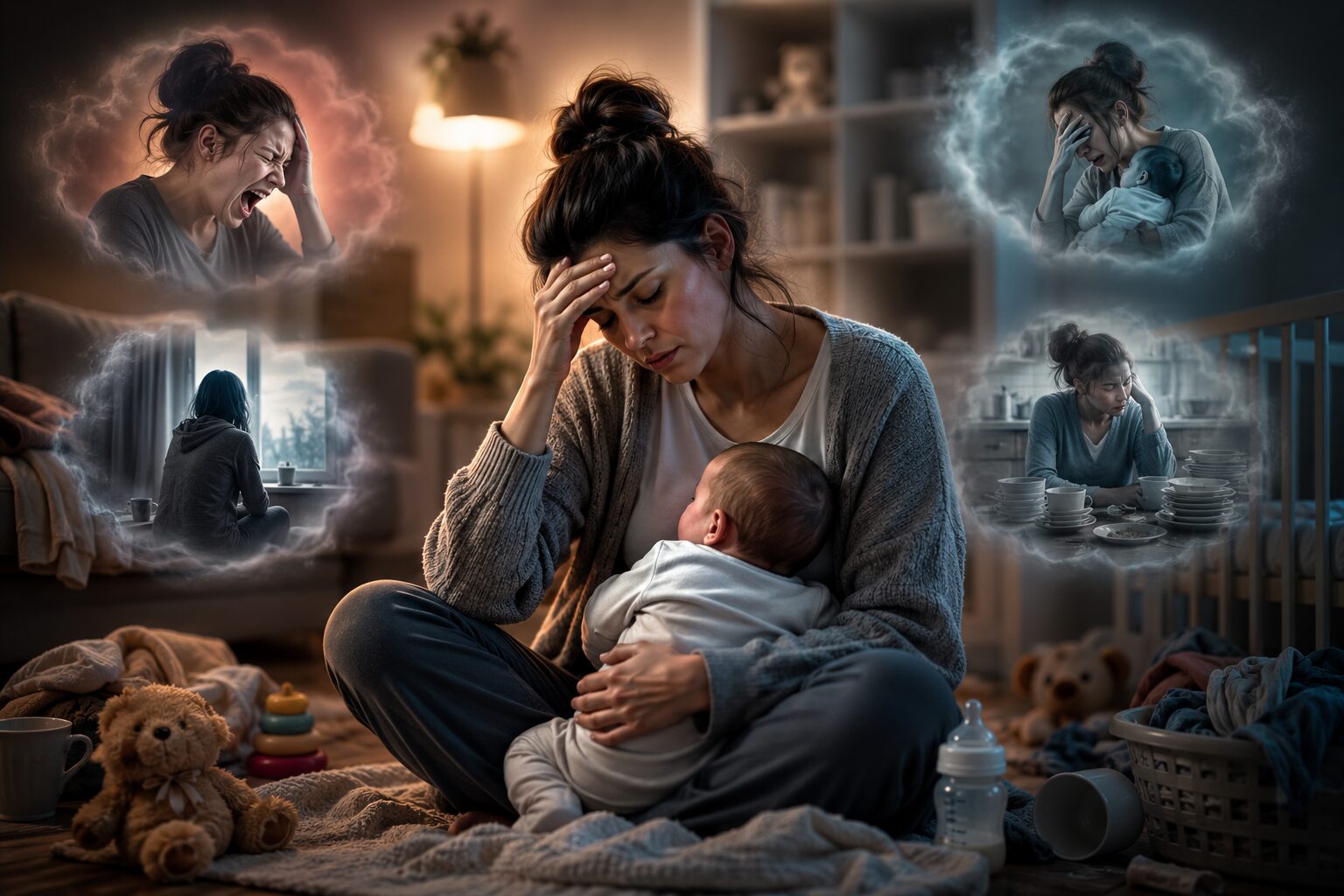
Maternal burnout symptoms include chronic physical and emotional exhaustion that rest doesn’t fix, emotional distancing or numbness toward your children, and a growing sense that you’re failing as a mother despite trying your hardest. Other common signs are irritability or “mom rage,” brain fog, disrupted sleep even when the baby sleeps, loss of interest in things you used to enjoy, and a persistent feeling of being touched-out or trapped. Unlike ordinary tiredness, maternal burnout builds over weeks or months and doesn’t lift with a good night’s sleep.
What Is Maternal Burnout?
Maternal burnout is a state of chronic physical, emotional, and mental depletion caused by the prolonged, high demands of caregiving combined with insufficient rest, recognition, or support. It is closely related to what researchers call parental burnout — a distinct clinical concept studied by psychologists Isabelle Roskam and Moïra Mikolajczak, whose international research has shaped most of what we know today.
The World Health Organization defines occupational burnout in the ICD-11 as a syndrome resulting from chronic stress that has not been successfully managed, characterized by feelings of energy depletion, increased mental distance or cynicism, and reduced effectiveness. While the WHO’s definition technically applies to the workplace, researchers studying parenting have adapted the same three-part framework — exhaustion, detachment, and reduced sense of accomplishment — to describe what happens to overwhelmed mothers and fathers.
Maternal burnout is not a personality flaw, laziness, or a lack of love for your children. It is a predictable outcome of what happens when the demands of caregiving consistently exceed the resources — time, sleep, support, and emotional bandwidth — available to meet them.
In simple terms: it’s what happens when giving has gone on longer than refilling.
See More: Emotional Maturity: The Complete Guide to Meaning, Signs, Development, and Testing
Maternal Burnout vs. Postpartum Depression vs. Normal Exhaustion
One of the biggest content gaps in existing articles is a clear, side-by-side comparison. Mothers often can’t tell which one they’re experiencing — and that confusion delays getting the right kind of help.
| Feature | Normal New-Mom Tiredness | Maternal Burnout | Postpartum Depression |
| Onset | Days to weeks after birth | Builds gradually over months | Can appear anytime in first year |
| Relieved by sleep/rest? | Yes, mostly | No — exhaustion persists even after rest | No |
| Emotional tone | Tired but engaged | Detached, numb, “going through the motions” | Sad, hopeless, tearful |
| Connection to baby | Present, even if tired | Emotionally distant or resentful at times | Often disrupted, guilt-heavy |
| Self-view | “I’m exhausted” | “I’m failing, I’m not myself anymore” | “I’m worthless, I’m a bad mother” |
| Duration | Improves with rest/support | Persists for weeks to months without intervention | Can persist without treatment |
| Underlying driver | Sleep deprivation, adjustment | Chronic stress-resource imbalance | Neurobiological, hormonal, psychological |
| Needs professional care? | Usually resolves on its own | Often — especially if severe or prolonged | Yes, professional treatment recommended |
Burnout and depression frequently overlap and reinforce each other. Research on 560 postnatal mothers found that postnatal depressive symptoms were positively associated with parental burnout, and mothers with depressive symptoms were significantly more likely to fall into the high-burnout group. This means burnout can tip into depression if left unaddressed — and depression can make burnout worse. Neither should be dismissed as “just being a tired mom.”
If you’re unsure which you’re dealing with, that uncertainty itself is a good reason to talk to a doctor, midwife, or therapist rather than trying to self-diagnose.
Core Symptoms of Maternal Burnout
Maternal burnout symptoms cluster into three dimensions, mirroring the structure researchers use to measure parental burnout clinically:
The Three Dimensions of Maternal Burnout
| Dimension | What It Looks Like | Example Thought |
| Exhaustion | Overwhelming, unrelenting fatigue tied specifically to your parenting role | “I have nothing left to give, even for five more minutes.” |
| Emotional Distancing | Feeling detached from your children, going through motions instead of being present | “I love them, but I feel like I’m watching myself parent from outside my body.” |
| Loss of Parental Accomplishment | A persistent sense that you’re not doing a good job, no matter how hard you try | “I used to feel confident. Now I feel like I’m failing every single day.” |
A fourth marker often added by clinicians is contrast with the parent you used to be — burnt-out mothers frequently describe a stark, painful gap between who they were before burnout and who they are now.
Emotional and Psychological Signs
These are often the first symptoms mothers notice, though they’re also the easiest to dismiss or explain away.
- Persistent irritability or “mom rage” — snapping over small things, followed by guilt
- Emotional numbness — feeling flat, disconnected, or like you’re on autopilot
- Loss of joy in activities, hobbies, or even moments with your children that used to feel meaningful
- Constant self-criticism — a running internal narrative that you’re not doing enough
- Feeling trapped — as though there’s no way out of the current routine
- Anxiety that won’t switch off, especially around your children’s wellbeing or your own adequacy
- Resentment — toward your partner, your children, or motherhood itself, followed by shame for feeling that way
- Crying more easily, or conversely, feeling unable to cry at all
- Intrusive thoughts of escape — wanting to run away, disappear, or simply not be needed for a while
One clinical description puts it plainly: burnout is depletion from stress and too little support, and it can open the door to depression. It builds slowly, from the invisible load, the erosion of your sense of self, and needs of your own that never make the list.
These emotional symptoms are not a sign that you don’t love your children. They’re a sign that your emotional reserves have been running on empty for too long.
Physical Signs of a Burnt-Out Mom
Burnout doesn’t stay in your head — it shows up in the body, often before mothers connect the dots.
Common physical symptoms include:
- Chronic fatigue that persists even after a full night’s sleep
- Frequent headaches or muscle tension, especially in the neck and shoulders
- Digestive issues — nausea, stomach upset, appetite changes
- Getting sick more often (a weakened immune response tied to chronic stress)
- Insomnia or disrupted sleep, even during rare windows of quiet
- Changes in weight, either loss or gain
- Racing heart or a constant low-grade sense of physical tension
- Reduced libido
- Physical heaviness — described by many mothers as feeling like moving through mud
Physical symptoms of burnout are amplified when a mother is also managing postpartum nutrient depletion. During pregnancy and breastfeeding, the body prioritizes the baby’s needs first, which can leave iron, B vitamins, and other reserves running low — a pattern some clinicians describe under the term “depleted mom syndrome,” referring specifically to the nutritional, hormonal, and emotional depletion that can occur during pregnancy, childbirth, and the postpartum period. When sleep deprivation stacks on top of this physical depletion, exhaustion compounds quickly.
Behavioral and Relationship Signs
Burnout also changes how mothers act and relate to the people around them.
| Behavior Change | What It Might Sound/Look Like |
| Withdrawing from friends and family | Cancelling plans, avoiding calls, feeling too depleted to socialize |
| Going through the motions with childcare | Meeting physical needs (feeding, bathing) without emotional presence |
| Increased conflict with a partner | More arguments, especially around division of labor |
| Procrastinating on non-essential tasks | Letting things pile up because there’s nothing left to give |
| Using screens, food, or scrolling to numb out | Coping mechanisms that provide short relief but deepen isolation |
| Reduced patience with children | Snapping faster than usual, or feeling touched-out by physical affection |
| Difficulty asking for help | Believing “no one else can do it right” or feeling guilty for needing support |
A therapy-focused source describes this well: mothers experiencing burnout often report intense exhaustion and disengagement or depersonalization related to parenting, such as simply “going through the motions” rather than feeling present or engaged, along with feeling inefficient or useless in their child-rearing role, doubting whether they’re “good enough” at it.
Maternal Burnout Symptoms in Multiple Pregnancies (and With Multiple Kids)
This is a search term many articles overlook — and it deserves real depth.
Why Multiple Pregnancies Raise Burnout Risk
Mothers who are pregnant again while raising an older child, or who have given birth multiple times in close succession, face a compounded version of burnout risk. A cross-sectional study on second-time mothers found that the transition from a one-child family to a two-child family increases parenting pressure, and when that pressure isn’t relieved, it can trigger psychological problems like anxiety or depression. The same study noted that prenatal depressive symptoms have been rising, and second-time mothers show significantly higher rates of depressive symptoms and anxiety than first-time mothers.
Unique Symptom Patterns With Multiple Pregnancies
- Anticipatory exhaustion — feeling depleted before the new baby even arrives, from managing pregnancy symptoms alongside an existing child’s needs
- Split attention guilt — feeling like you’re failing both children simultaneously
- Physical burnout on top of pregnancy fatigue — normal pregnancy tiredness compounded by chronic sleep debt from an older child
- Loss of “recovery windows” — with one child, there may be gaps to rest; with multiple close-in-age children, those windows disappear
- Higher rates of burnout during pregnancy itself — a study of working pregnant women found burnout in 54.1% of participants, and it was linked to real physical outcomes: the breastfeeding rate was lower in the burnout group, and postpartum infective complications occurred in 19.5% of women with burnout versus 8.6% of those without — a statistically significant difference
Burnout and Number of Children
Interestingly, research suggests the number of children matters less than most people assume. The large 42-country study on parental burnout found that individualism plays a larger role in parental burnout than economic inequality or any other individual and family characteristic examined, including the number and age of children and the number of hours spent with them. In other words, support structure and cultural expectations matter more than headcount — a mother with three children and strong support may fare better than a mother with one child and none.
Still, for mothers managing multiple pregnancies close together, the lack of recovery time between physical demands is a distinct and real risk factor worth naming on its own.
Causes of Maternal Burnout
Maternal burnout rarely has a single cause. It’s typically the accumulation of several overlapping pressures.
Primary Causes
- Sleep deprivation sustained over weeks or months
- The mental load — being the default parent who tracks appointments, schedules, needs, and logistics, even when tasks are shared
- Lack of practical support — no reliable childcare, family help, or partner availability
- Unrealistic standards, often self-imposed or absorbed from social media “perfect mom” portrayals
- Financial stress tied to childcare costs or lost income
- Loss of identity — feeling like your entire self has been absorbed into “mom”
- Isolation — reduced adult contact and social connection
- Underlying mental health conditions, such as untreated anxiety or depression, which lower resilience to stress
- Working motherhood strain — balancing a job with caregiving, especially without flexible arrangements
- Children with additional needs — chronic illness, neurodivergence, or high-support requirements
A study on maternal burnout during the pandemic in Tunisia found that 71.8% of participating mothers met the criteria for maternal burnout, with the main contributing factors being the age of the children, financial difficulties, and lack of leisure activities — while the mother’s own age, perceived husband support, and medical or psychiatric history were not associated with burnout levels. This is a striking finding: it suggests circumstantial pressures — money, time, rest — may matter more than individual resilience or personality.
Cause-to-Symptom Table
| Cause | Symptom It Commonly Triggers |
| Chronic sleep deprivation | Physical exhaustion, brain fog, irritability |
| Mental load / invisible labor | Resentment, anxiety, feeling “always on” |
| Isolation | Emotional numbness, loss of identity |
| Financial pressure | Anxiety, sleep disruption, hopelessness |
| Unrealistic self-expectations | Self-criticism, sense of failure |
| Lack of partner support | Relationship conflict, resentment |
Maternal Burnout Syndrome and “Depleted Mother Syndrome”
These two terms are often used interchangeably, but they describe slightly different angles on the same experience.
Maternal burnout syndrome typically refers to the full clinical picture: a state of chronic exhaustion, emotional depletion, and overwhelming stress experienced by mothers, characterized by physical, mental, and emotional exhaustion resulting from the demanding responsibilities and pressures associated with motherhood.
Depleted mother syndrome leans more heavily into the physical and nutritional side of the equation — the idea that a mother’s body has been literally emptied of resources through pregnancy, birth, and breastfeeding, compounding the psychological symptoms of burnout.
| Term | Primary Focus | Typical Symptoms Emphasized |
| Maternal Burnout Syndrome | Psychological + emotional exhaustion from caregiving load | Detachment, exhaustion, sense of failure |
| Depleted Mother Syndrome | Physical, hormonal, nutritional depletion | Fatigue, low immunity, cognitive fog, mood changes |
| Parental Burnout (clinical term) | Research-validated construct used in academic literature | Exhaustion, emotional distancing, contrast with former self, loss of parental accomplishment |
Neither “maternal burnout syndrome” nor “depleted mother syndrome” is currently a formal diagnosis in the DSM-5 or ICD-11. They are widely used descriptive terms in maternal health and wellness contexts, while parental burnout is the term most consistently used in peer-reviewed research.
Compassion Fatigue and Burnout in Mothers
What Is Compassion Fatigue?
Compassion fatigue is a distinct but overlapping concept, most often studied in professional caregivers — nurses, therapists, social workers. It’s defined as the physical and mental exhaustion resulting from chronic exposure to trauma and distress while helping others, marked by exhaustion, frustration, anger, and depression alongside burnout and secondary traumatic stress.
While mothers aren’t typically the population studied in this research, the parallels are strong — especially for mothers caring for a child with chronic illness, disability, or significant emotional needs, or mothers supporting a partner or family member through a health crisis while also raising children.
Compassion Fatigue vs. Burnout: What’s the Difference?
| Feature | Burnout | Compassion Fatigue |
| Core cause | Chronic overload of responsibilities and stress | Absorbing another person’s pain/trauma repeatedly |
| Onset | Gradual, builds over time | Can appear suddenly after intense caregiving episodes |
| Key feeling | Exhaustion, cynicism, reduced accomplishment | Reduced empathy, emotional numbness toward the person you’re caring for |
| Recovery | Often improves with rest, boundaries, support | Often requires processing the emotional/traumatic exposure itself |
As one clinical source summarizes: caregiver burnout is deep exhaustion and stress after caring for another person, while compassion fatigue occurs when a caregiver takes on the emotional stress and trauma of the person in their care — and the two can happen at the same time.
For mothers, this distinction matters most when caring for a medically complex child, navigating a family crisis, or supporting a partner’s mental health struggles alongside parenting duties. In those cases, burnout treatment alone may not be enough — the emotional processing piece (often therapy-based) matters too.
Self-Check: Maternal Burnout Quiz
This isn’t a diagnostic tool, but it can help you get clarity on where you stand. Answer honestly — there’s no “right” score, only useful information.
In the past two weeks, how often have you felt the following?
| Statement | Rarely | Sometimes | Often | Almost Always |
| 1. I feel physically exhausted even after resting. | ||||
| 2. I feel emotionally distant from my child(ren). | ||||
| 3. I go through the motions of parenting without feeling present. | ||||
| 4. I feel like I’m failing as a mother, despite trying hard. | ||||
| 5. I snap at my kids or partner more than I used to. | ||||
| 6. I’ve lost interest in things I used to enjoy. | ||||
| 7. I feel like I’ve lost touch with who I was before becoming a mom. | ||||
| 8. I feel isolated or unsupported. | ||||
| 9. I fantasize about escaping or getting away, even briefly. | ||||
| 10. I feel physically unwell (headaches, stomach issues, low immunity) more than usual. |
How to read your results:
- Mostly “Rarely/Sometimes”: You may be experiencing normal fatigue — prioritize rest, support, and self-care.
- Several “Often” answers, especially on items 2, 3, 4, 7, or 9: These are core burnout markers. Consider speaking with a doctor, therapist, or maternal mental health specialist.
- Mostly “Often/Almost Always”: This pattern suggests significant burnout. Please reach out to a healthcare provider soon — you don’t have to manage this alone, and support genuinely works.
This quiz is for reflection only and does not replace a clinical assessment. If any answers involve thoughts of harming yourself or your child, please contact a healthcare provider or crisis line immediately (see resources below).
How Maternal Burnout Is Diagnosed and Measured
Maternal burnout is not currently a standalone diagnosis in the DSM-5-TR. However, researchers use validated tools to measure it:
- The Parental Burnout Assessment (PBA) — developed by Roskam and Mikolajczak, measuring the same core dimensions used in the global 42-country study
- The Maslach Burnout Inventory (MBI) — originally developed for occupational burnout and adapted in several maternal burnout studies. It measures three dimensions: emotional exhaustion, depersonalization, and professional accomplishment
- BMS-10 (Burnout Measure Short version) — used in several maternal burnout prevalence studies, including the Tunisian study cited earlier
How Common Is Parental/Maternal Burnout?
| Study | Population | Prevalence Finding |
| 42-country global study (Roskam et al.) | 17,409 parents across 42 countries | Conservative estimates suggest at least 5% of parents experience burnout, with prevalence varying dramatically by country |
| Chinese postnatal mothers study | 560 postnatal mothers | Prevalence of burnout was approximately 10%, though the source study also cites broader estimates around 20% of mothers in some research contexts |
| Tunisian pandemic-era study | Mothers during COVID-19 | 71.8% met criteria for maternal burnout, with 30.1% high burnout and 9.6% extreme burnout |
| Pregnant working women (Turkey) | 303 working pregnant women | Burnout identified in 54.1% of participants |
The wide range between these numbers reflects differences in measurement tools, cultural context, and life stage (pregnancy vs. postpartum vs. later parenting years) rather than contradiction. What’s consistent across all of them: maternal burnout is common, not rare, and pandemic-era or high-stress conditions appear to significantly increase rates.
Maternal Burnout Symptoms — NHS and UK Support Options
The UK’s NHS does not currently use “maternal burnout” as a formal clinical diagnosis, but it recognizes and treats the overlapping conditions that often accompany it — postnatal depression, anxiety, and general perinatal mental health difficulties. If you’re in the UK and recognize burnout symptoms in yourself, here’s how the system typically supports you:
- GP appointment — your first port of call; GPs can assess symptoms and refer you onward
- Health visitor — routinely checks in during the first years and can flag concerns early
- Perinatal Mental Health Services — specialist NHS teams for pregnancy through the first year postpartum, for moderate-to-severe symptoms
- IAPT / NHS Talking Therapies — self-referral is often possible for anxiety, low mood, and stress-related difficulties
- Health visitor-led parenting and wellbeing groups — useful for isolation-related burnout symptoms
Practical tip: When speaking to your GP or health visitor, describe specific symptoms (exhaustion unrelieved by rest, emotional detachment, irritability, feeling like you’re failing) rather than just saying “I’m tired” — this helps clinicians distinguish burnout-pattern symptoms from routine fatigue and route you to the right support faster.
Maternal Burnout Treatment: What Actually Helps
Recovery from maternal burnout is rarely about one big fix — it’s usually a combination of practical, relational, and psychological changes.
Evidence-Informed and Practical Approaches
| Category | What It Involves | Why It Helps |
| Professional support | Therapy (especially maternal mental health specialists), or GP-guided treatment | Provides structured tools and addresses co-occurring depression/anxiety |
| Redistributing the mental load | Concrete division of tasks, not just “help” but ownership of specific responsibilities | Reduces the invisible labor driving chronic stress |
| Protected rest | Actual scheduled time off duty — not just quiet moments squeezed in | Interrupts the chronic stress cycle |
| Realistic standards | Actively lowering self-imposed expectations to match actual capacity | Reduces the “failure” narrative that fuels burnout |
| Social connection | Reconnecting with friends, support groups, or other mothers | Directly counters isolation, a major burnout driver |
| Physical replenishment | Addressing nutrient depletion, sleep, and basic health needs | Supports the physical exhaustion component of burnout |
Research on treating parental burnout specifically found real, measurable outcomes: targeted psychological interventions were associated with reductions in suicidal and escape ideation and parental violence or neglect, proportional to the reduction in burnout itself, alongside normalized stress-hormone (HPA axis) activity. This tells us something important — burnout treatment isn’t just about feeling better, it has measurable protective effects for both mother and child.
A Practical First Step
If you’re not sure where to start, a maternal mental health therapist explains the goal simply: creating a plan to manage the mental load of motherhood, looking at the impossible standards you’ve been holding yourself to, and treating rest and your own needs as real priorities that sit alongside everyone else’s.
How to Explain Mom Burnout to Your Husband or Partner
This is one of the most searched, least well-answered questions in this space. Many mothers struggle not with recognizing burnout, but with communicating it to a partner who hasn’t experienced it the same way.
Tips for the Conversation
- Pick a calm moment, not mid-conflict or mid-meltdown — burnout conversations land better outside of crisis moments
- Use concrete examples, not just feelings: “I haven’t had an uninterrupted hour to myself in three weeks” lands differently than “I’m just tired”
- Separate the mental load from the physical load — explain that even tasks you’re not physically doing may still be occupying your mind (appointments, schedules, remembering what’s needed)
- Ask for specific, named responsibility, not vague help — “Can you own bath time and bedtime on weeknights” works better than “I need more support”
- Frame it as a shared problem, not a personal complaint — burnout affects the whole family’s functioning, not just you
- Share what you’ve learned about burnout as a real, researched condition — sometimes it helps partners take it seriously when they understand it’s not just “having a hard day”
A Simple Script You Can Adapt
“I want to talk about something that’s been building for a while. I’m not just tired — I feel emotionally checked out most days, like I’m running on empty and it’s not getting better with rest. I think I might be dealing with burnout, and I need us to actually redistribute some things, not just ‘help out’ when you notice I’m struggling.”
Long-Term Risks of Untreated Maternal Burnout
Leaving maternal burnout unaddressed isn’t just uncomfortable — research links it to more serious outcomes over time.
- Escalation into depression — as noted earlier, burnout and postnatal depressive symptoms are strongly linked and can reinforce one another
- Increased conflict and strain in the parental relationship
- Reduced patience, which can affect parent-child interactions — global research on parental burnout found links to parental neglect and, in severe cases, violence toward children, underscoring why early intervention matters
- Escape and suicidal ideation in more severe cases — a serious reminder that maternal burnout should never be dismissed as “just stress”
- Physical health consequences — including, in the pregnancy-specific research cited earlier, higher rates of postpartum infection and lower breastfeeding continuation
- Chronic stress-hormone dysregulation — burnout has been linked to abnormal HPA-axis (cortisol) activity, which normalizes with effective treatment
Important note: If you are having thoughts of harming yourself or your child, or feel unable to keep yourself or your baby safe, please contact emergency services, your GP, or a crisis line immediately. These thoughts are a sign that you urgently need support — not a sign that you are a bad mother.
Mom Burnout in Pop Culture: The “Mom Burnout Movie” Conversation
Searches for a “mom burnout movie” reflect a growing cultural appetite for honest portrayals of maternal exhaustion, rather than the sanitized version often shown on screen. Films and shows exploring themes of overwhelmed motherhood, identity loss, and the mental load have resonated widely because they validate an experience many mothers feel isolated in. While specific film recommendations shift over time and vary by streaming availability, the broader cultural trend matters: seeing maternal burnout depicted authentically helps normalize it as a real, common experience rather than a private failure — and can be a useful entry point for starting conversations with partners or friends who haven’t lived it.
Prevention: Building Burnout Resistance Before It Hits
Prevention is rarely about doing more — it’s about protecting the resources that keep burnout at bay.
Practical Prevention Strategies
- Build in non-negotiable rest windows, even short ones, before you’re in crisis
- Normalize asking for help early, rather than waiting until you’re depleted
- Track the mental load explicitly — writing out invisible tasks makes them visible and shareable
- Stay connected to your pre-motherhood identity — hobbies, friendships, and interests outside of caregiving
- Set boundaries around unsolicited advice or comparison, especially on social media
- Check in with your own mental health proactively, not just reactively
- Talk about burnout risk with your partner before it becomes a crisis, especially around major transitions like a second pregnancy or return to work
See More: Trust-Owned Life Insurance After the $15 Million Exemption: Keep, Surrender, or Sell?
Key Takeaways
- Maternal burnout is a real, researched pattern of chronic exhaustion, emotional detachment, and a diminished sense of parenting competence — not a character flaw.
- It differs from ordinary tiredness in that rest alone doesn’t resolve it, and it differs from postpartum depression in its specific link to the parenting role, though the two frequently overlap.
- Multiple pregnancies and closely spaced children can compound burnout risk due to reduced recovery time, though support and cultural context matter more than the number of children alone.
- Global research suggests at least 5% of parents experience burnout conservatively, with some maternal-specific studies during high-stress periods reporting rates as high as 70%+.
- Left untreated, maternal burnout is linked to depression, relationship strain, and — in severe cases — serious safety risks, making early support important.
- Effective treatment typically combines professional support, redistributed responsibilities, protected rest, and realistic self-expectations.
- If you’re in the UK, GPs, health visitors, and NHS perinatal mental health services are appropriate first points of contact.
Frequently Asked Questions
What are the first signs of maternal burnout?
The earliest signs are usually persistent exhaustion that doesn’t improve with sleep, growing irritability, and a creeping sense of emotional distance from tasks or people you used to feel connected to. Many mothers notice they’re “going through the motions” before they consciously identify it as burnout.
Is maternal burnout a real medical diagnosis?
Maternal burnout is not currently a standalone diagnosis in the DSM-5-TR, but it is a well-researched psychological construct studied under the term “parental burnout,” measured with validated tools like the Parental Burnout Assessment and the Maslach Burnout Inventory.
How is maternal burnout different from postpartum depression?
Maternal burnout centers on exhaustion and detachment tied specifically to the parenting role and typically builds gradually, while postpartum depression involves broader mood symptoms like persistent sadness, hopelessness, and worthlessness. The two often overlap and can worsen each other, so professional assessment is the best way to tell them apart.
Can maternal burnout happen during pregnancy, not just after birth?
Yes. Research on working pregnant women found burnout in just over half of participants, and burnout during pregnancy has been linked to real outcomes including lower breastfeeding rates and higher postpartum infection rates.
Does having multiple children increase burnout risk?
It can, particularly through reduced recovery time between physical and emotional demands. However, large-scale research suggests that support, culture, and individualistic pressure play a bigger role in burnout risk than the number of children a mother has.
What is “depleted mother syndrome”?
Depleted mother syndrome is a term used to describe the physical, hormonal, and nutritional depletion that can build up during pregnancy, birth, and breastfeeding, often compounding the emotional symptoms of maternal burnout.
How do I know if I have compassion fatigue or burnout as a mom?
Burnout tends to center on overall exhaustion and cynicism about your role, while compassion fatigue involves a specific numbing toward the person you’re caring for, often after repeated exposure to their distress or suffering — relevant for mothers of medically complex or high-needs children.
What should I say to my husband about mom burnout?
Use specific, concrete examples rather than general complaints, name exact responsibilities you’d like shared, and choose a calm moment rather than mid-conflict. Framing burnout as a shared family issue rather than a personal failing tends to open the conversation more effectively than framing it as a complaint.
Are there quizzes to check for maternal burnout?
Self-check quizzes, like the one in this guide, can help you reflect on your symptoms, but they are not diagnostic tools. A conversation with a GP, health visitor, or therapist is the appropriate next step if your results suggest significant burnout.
What does the NHS offer for maternal burnout symptoms?
While “maternal burnout” isn’t a formal NHS diagnosis, GPs, health visitors, and NHS perinatal mental health services can assess and support related symptoms such as chronic stress, anxiety, and low mood during pregnancy and the first year postpartum.
Can maternal burnout affect my children?
Untreated, severe parental burnout has been linked in research to increased risk of neglect or, in serious cases, harm toward children — which is precisely why early treatment matters. Importantly, this research also shows that when burnout improves through treatment, these risks decrease proportionally.
How long does maternal burnout last?
There’s no fixed timeline — it depends on the underlying causes and the support put in place. Some mothers see meaningful improvement within weeks of redistributing responsibilities and getting rest; others, especially with deeper depletion, may need months of combined practical and therapeutic support.
Conclusion
Maternal burnout symptoms are real, measurable, and far more common than most mothers realize — but they are also not permanent. Understanding the difference between ordinary exhaustion, burnout, and postpartum depression is the first step toward getting the right kind of support, whether that’s redistributing household responsibilities, seeking therapy, or simply having an honest conversation with a partner about what’s actually needed. If any part of this guide sounded like your own experience, that recognition alone is meaningful — burnout thrives in silence, and naming it is often where recovery begins.