Erin McGean: Reimagining Collage for the Digital Age
Canadian artist Erin McGean began her career as a trained illustrator and painter and has since transformed her practice into creating analog and digital collages. Over the past several years she has exhibited her art in galleries, sold work to private and corporate collectors, and had pieces commissioned by magazines including Elle Canada, among others.
McGean has described her love of deconstructing images to create something entirely new as her current ongoing visual obsession. She studied painting, drawing, and art history at York University in Toronto, earning an Honors BFA, followed by a BEd from Brock University. She now resides in Oakville, Ontario, where she continues to hone her craft, blending conventional collage techniques with digital technology to repurpose found imagery. McGean’s work has evolved alongside her, growing increasingly avant garde, experimental, and innovative, shaped in large part by the rise of Instagram and social media. Impact Wealth sat down with her to learn more about her artistic vision.
Please tell us how you got started in collage work and about your inspiration.
Erin McGean: I’ve always been an artist. I studied painting and drawing as a student back in university, and I painted for a long time, with some success as a painter. Then I had children and stopped making art for several years. Then Instagram happened, and I began seeing people post photos they had filtered and altered, and something shifted for me. It inspired me to start doing that with pictures of my young children. I began experimenting with different apps, smartphones were relatively new at the time, and suddenly I was introduced to a whole new world of creative possibility.
The art I saw on Instagram inspired me, and it felt like an accessible way to create again, since I didn’t need to set up a studio or gather painting tools. It was an entirely new process, making something on your phone with photos you already had or could easily obtain. I joined Instagram very early on, when it was a small and intimate community, almost like an artist collective. I met so many people, both through the app and in real life, and had incredible experiences going to different events.
Eventually I got bored making art on my phone and hit a wall. I realized I missed the materials I had worked with throughout my professional life, though painting itself is very tactile, which isn’t something I love. So I started editing photos of my work into something closer to collage, and it kept evolving from there. You can actually trace that evolution through my Instagram feed, from my earliest posts in 2011 up to today. It began with a few magazines I had lying around the house, and that’s what kicked everything off.
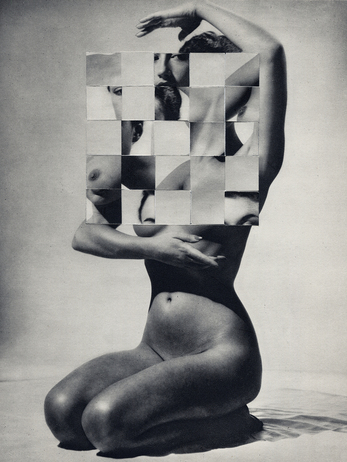
Now I’m pretty obsessed with traditional analog collage, cutting up old books and magazines, while also developing digital collage work. What I’ve discovered is that because of the popularity of the NFT space, many traditional artists are digitizing their existing work, so I started doing the same. But for me, simply scanning a still collage wasn’t enough. My first NFTs were animated versions of my collages. I scan them and use different software and apps to add motion and sound. In my view, that feels more fitting for the NFT space. That’s essentially where I am now, selling still versions of my collages alongside animated ones.
Where did you get your ideas for your use of juxtaposition, and how has it evolved?
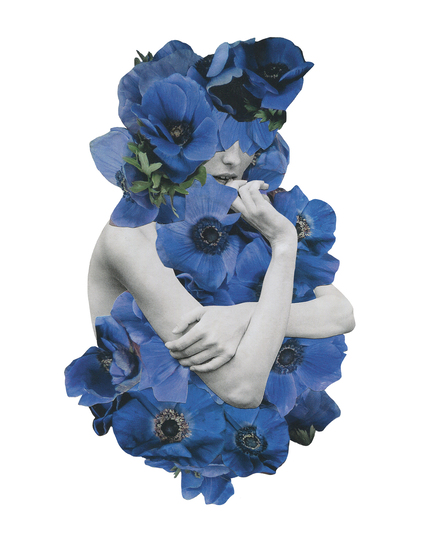
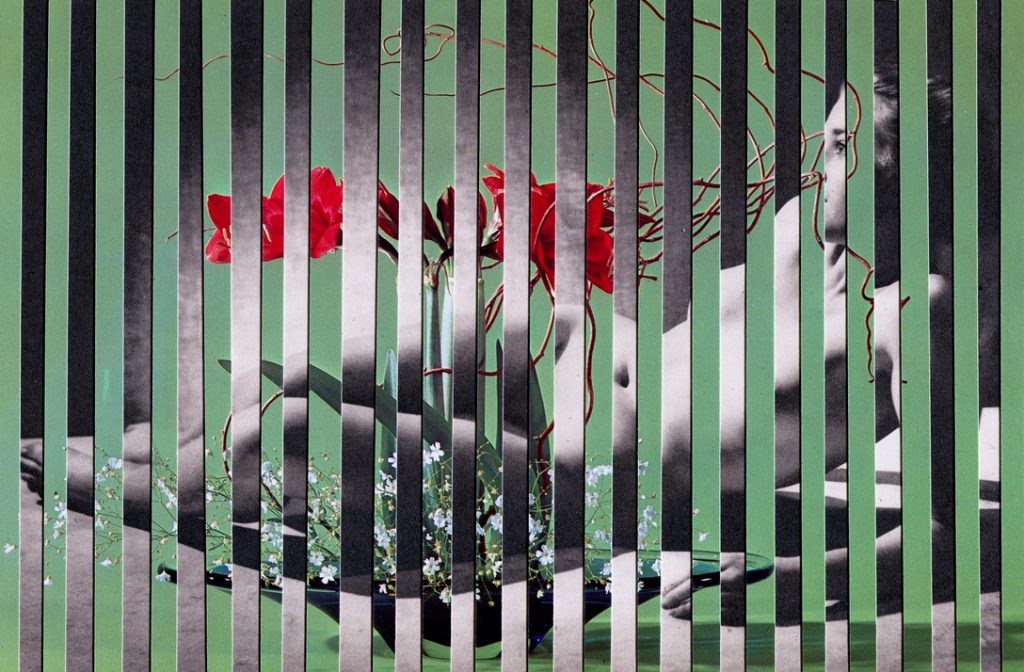
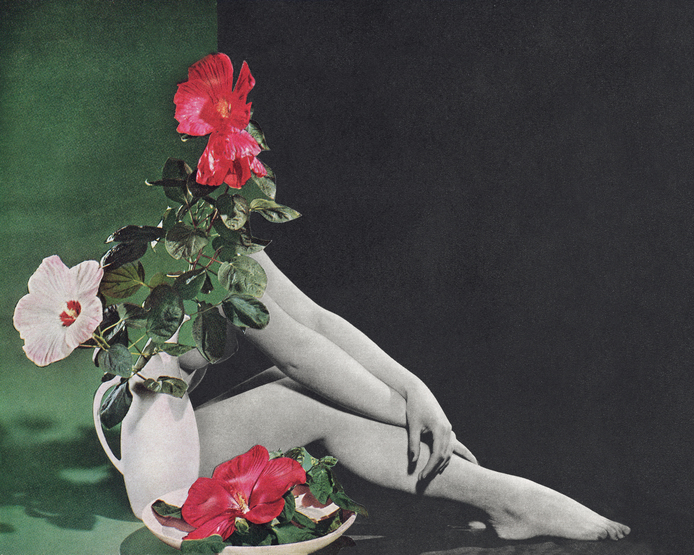
Erin McGean: Since high school, I’ve used female figures in my art to symbolize myself. Those figures often reflect my own feelings about what’s happening in my life. Looking back at my paintings from high school, there was always a figure present, often existing in a somewhat lonely, dark, and melancholy space. The uncertainty and anxiety of those teenage years mirrored how I felt while making the work. When I was having children, I noticed I started incorporating a lot of plants and flowers growing out of these figures, which I think symbolized a more positive outlook. Perhaps I was embracing the fertility I was feeling, along with my mothering and nurturing side.
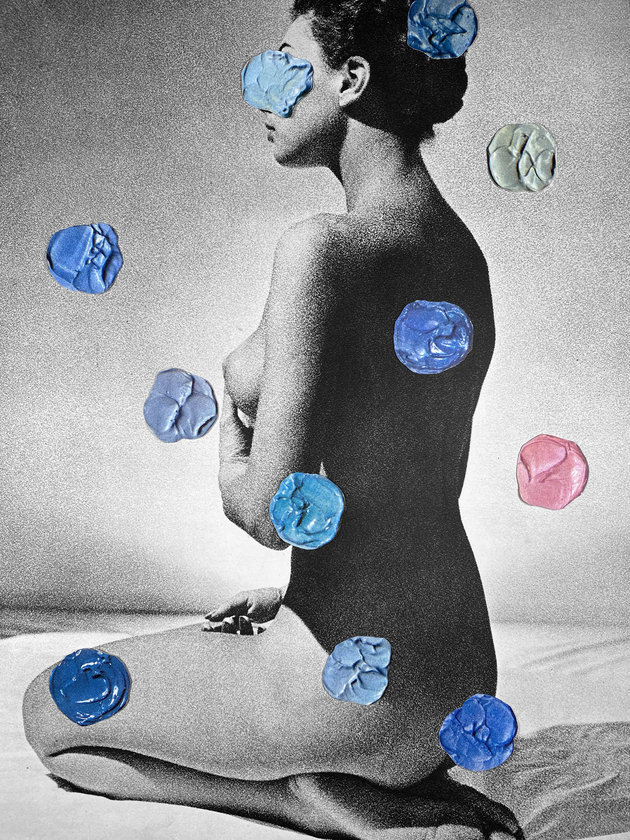
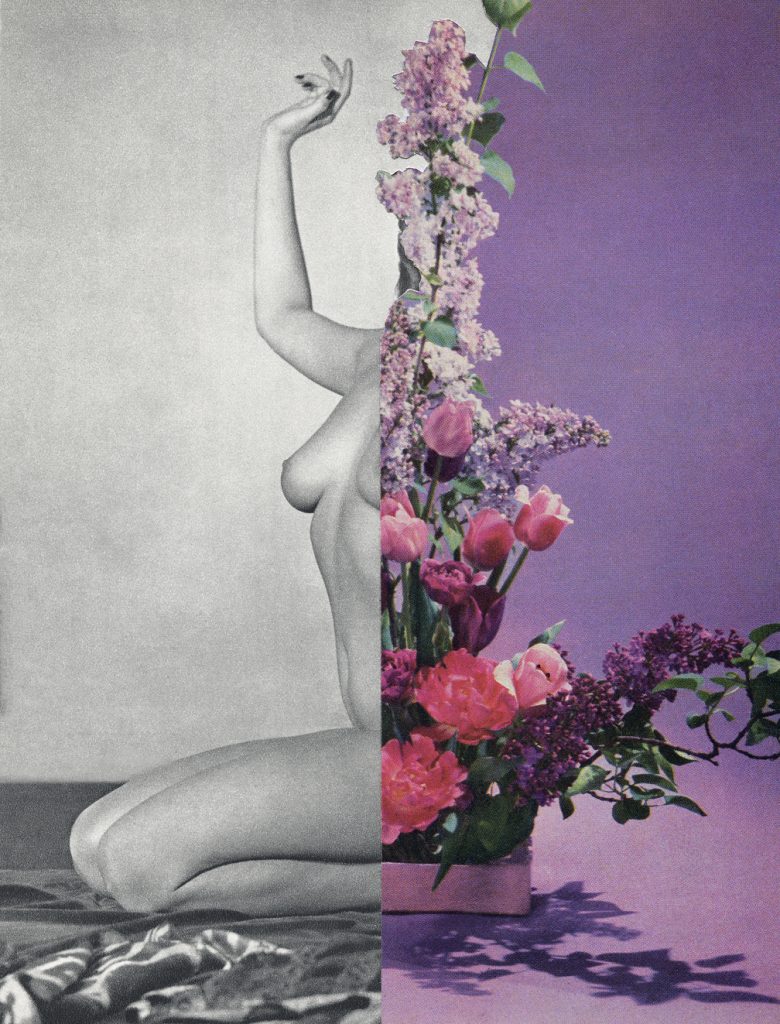
I continue in a similar vein now, but I’m exploring the social expectations placed on women. The way women are depicted in my collages comes from the use of very old fashioned imagery. Part of the meaning embedded in my work comes from the pictures themselves, which I often leave largely unaltered so the sense of the original photo remains intact. I’m exploring how women have historically been depicted, as pinup models, for example, and examining ideas around the male gaze and the objectification of women.
Can you tell us more about your progress in the NFT space?
Erin McGean: I got into NFTs in 2021, almost by accident, through an artist community I was already part of. I still sell physical pieces and hold traditional exhibits, but now I’m also selling through NFTs. I often try to pair a physical piece with its corresponding NFT, so collectors receive a physical collage as well. Another exciting element I discovered through the NFT space is the use of augmented reality.
That’s been a perfect evolution for me, since I had already been making animated versions of my work. I found applications that let me pair physical and digital art through a phone, so someone can hold their phone up to a still version and see the animated NFT come to life. It’s been a fun way to bridge the traditional art world with the NFT world.
For those unfamiliar with the NFT financial structure, how does it benefit collectors and artists?
Erin McGean: For many artists, it comes down to cutting out the middleman. We no longer have to rely on galleries or representatives taking a commission, we can sell directly to collectors. Another advantage is that if the work resells in the future, the artist receives a percentage of that profit, set by the artist themselves. For example, Andy Warhol may have sold a print for $500 that today sells for five million dollars, and he never saw any of those later profits. So if an artist’s career continues and their work increases in value over time, they can share in that growth as their earlier pieces change hands.
Would the artist only receive compensation once the piece resells?
Erin McGean: Yes, most artists set a secondary market value between ten and twenty percent. So if someone resells a piece years later for a hundred times its original value, the artist receives that percentage of the resale.
Is there ever a cap on how many NFTs a single art piece can have, and how is that valued?
Erin McGean: You can compare it to originals and editions in traditional art. An artist might mint just one version of a piece, meaning they publish a unique digital asset on a blockchain so it can be bought, sold, and traded, or they might release an edition of however many they choose, which affects the value much the same way it does in the physical art world.
How do you think artists are contributing to driving up demand and prices for their NFTs?
Erin McGean: Part of it comes from continuing to work as a productive, passionate artist whose output naturally grows in value over time. An NFT was meant to be more than just a JPEG. It can offer membership or additional perks, something called unlockable content. That might be a studio visit, access to an artist’s next release, or first rights to collect future work. You can attach all kinds of things to an NFT that make it more dynamic.
There has been a lot of discussion around NFTs and the metaverse. Are you involved in that as well?
Erin McGean: Yes, there are several different metaverse worlds being built right now. They serve as a great meeting place for people who can’t come together geographically. It makes art more accessible, since you can hold an exhibit in the metaverse and invite people from all over the world to attend in 3D spaces just by looking through their computer screens.
You can also use VR goggles and feel like you’re actually inside the space, viewing the art alongside other people who are there with you, able to talk in real time. The multiplayer metaverse feels remarkably close to a real life exhibit.
Do you think this will reshape the future of how art is made and sold?
Erin McGean: I think it will, though I don’t think it will replace everything that already exists. I think it will offer something new for artists, the same way social media did when it first emerged, which is how I found some of my early success. Being able to sell my art through Instagram and my website changed everything for me, and this feels like the next step in that evolution. I think it will affect education too. As a teacher, I can imagine meeting other artists virtually from around the world. It’s a chance to explore something entirely new.
Which direction do you see your progression as an artist heading?
Erin McGean: I want to stay true to my art and continue making collages, though the NFT space has opened up new possibilities and shifted my work slightly. I want to incorporate new technology into the meaning of the work in a way that genuinely makes sense, rather than for its own sake.
Where do you see your inspiration coming from moving forward? Do you see other mediums entering your work?
Erin McGean: Not yet. I’m still fairly tied to my original process. I think a lot of artists lose sight of who they were when they started, especially once money enters the picture. Some shift their style to match whatever is popular in the space at the time. I’m trying to stay true to what I’ve always done. I see NFTs as simply another way to get my art out into the world and reach new collectors.
What are your plans for Art Basel Miami?
Erin McGean: A lot of these things come together at the last minute, and I’m involved in several different communities within the space. One of them is quite exclusive and is among the premier platforms where the highest selling NFTs trade. I’m also working to build a community of collage artists within the NFT space, both to elevate them individually and to help promote collage as a medium more broadly.
We’ve seen digital photography explode over the past year because it’s digitally native art. Collage artists and painters, especially traditional ones, are still figuring out how to market their work to a space that’s inherently digital. Working alongside a group of other collage artists, we’re hoping to have an exhibit at Art Basel under that same exclusive platform. I’ll also likely have work in a few exhibits at NFT NYC. I was part of three or four different shows there last time, though they all came together at the very last minute.
Are there any artists who inspired you to become both an artist and a teacher?
Erin McGean: Growing up, I was inspired by other female artists like Frida Kahlo, Georgia O’Keeffe, and Emily Carr, who you’ve probably never heard of. Emily Carr is a celebrated Canadian painter associated with the Group of Seven, and her work inspired me deeply. I admired how their art reflected their lives so directly. As I got older, I began studying modern art and was moved by artists like Barbara Kruger. I also admire collage artist Hannah Höch, photographer Carrie Mae Weems, and the surrealism of Man Ray.
What projects are you working on for your next exhibition?
Erin McGean: Right now I’m pretty obsessed with a series called GIFs Out of GIFs. I scan several iterations of a single collage, then compile them in Adobe and add effects to create a moving version of the piece.
With so many new mediums available to artists and collectors, how do you cut through the noise at a place like Art Basel?
Erin McGean: That’s a tough question. Consistency matters, and so does branding. You have to define your style clearly, so when people walk through an exhibit and come across your work, it’s instantly recognizable because something about it sets it apart. In my experience, networking is essential too, getting to know people and putting yourself out there. That’s always a challenge for freelance artists, since many of us tend to be introverted and need to work at getting our voice heard. But if you put in the networking and build a small community and support system around yourself, you know they’ll be promoting your work even when you’re not in the room.
A Practice Rooted in Purpose
What continues to distinguish McGean’s work is not just her willingness to experiment with new technology, but her insistence on keeping the meaning behind each piece intact as the medium shifts around her. Whether she is layering found imagery by hand or animating a collage for the blockchain, the through line remains her interest in how women have been seen, represented, and expected to perform across generations. That consistency of vision, even as the tools evolve, is part of what has allowed her to build a recognizable identity in a space defined by constant reinvention.
Erin McGean continues to create art from her home in Oakville, Ontario, where she teaches high school visual arts while raising her family. She is a pioneer in building an NFT community for collage artists and carving out space for the medium within that developing market. She has said her inspiration comes from her experiences as a woman and mother, alongside a lifelong connection to the natural world. In her own words, her ultimate goal is to express a sense of peace, solitude, and reverence for nature while exploring humanity’s complex relationship to it, with much more still on the horizon.
By Mosaka Williamson