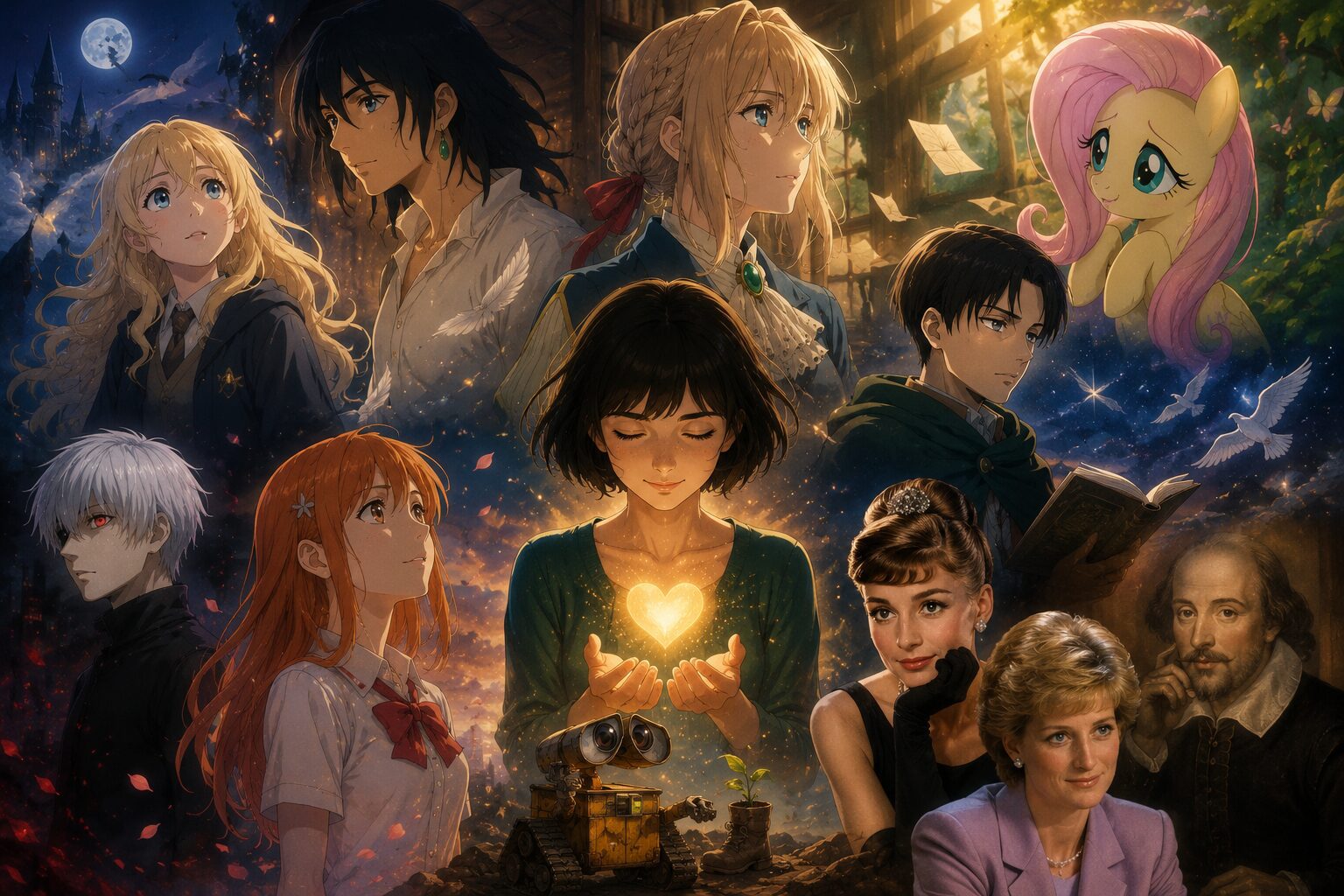
INFP personality type characters are fictional figures and public individuals whose core traits — idealism, deep empathy, rich inner imagination, and quiet emotional intensity — closely match the Myers-Briggs “Mediator” profile. Known INFP-coded characters include Luna Lovegood, Fluttershy, Howl (Howl’s Moving Castle), Violet Evergarden, and Amélie Poulain, while frequently cited real-world INFPs include William Shakespeare, Audrey Hepburn, and Princess Diana. Below is a research-backed breakdown of who they are and why they fit.
See More: How To Build A Strong Bond Between Grandparents And Grandkids
What Is the INFP Personality Type? (Quick Overview)
INFP stands for Introverted, Intuitive, Feeling, Perceiving — one of the sixteen personality types described by the Myers-Briggs Type Indicator (MBTI), a framework built on Carl Jung’s theory of psychological types. INFPs are often nicknamed “the Mediator” or “the Healer” because they process the world through personal values first and logic second.
It’s worth noting upfront, in the interest of transparency: the MBTI framework is popular and widely used in pop culture, career coaching, and self-reflection, but it is a self-report questionnaire that makes pseudoscientific claims to categorize individuals into 16 distinct psychological types according to mainstream psychological research. That means “typing” a fictional character or a celebrity as INFP is always an informed, community-driven interpretation — not a clinical diagnosis. With that caveat in mind, here’s what the type generally looks like.
The INFP Cognitive Function Stack
| Function | Role | What It Looks Like in Practice |
| Introverted Feeling (Fi) | Dominant | A strong, private internal value system; deep empathy but a need for personal authenticity |
| Extraverted Intuition (Ne) | Auxiliary | Sees possibilities, patterns, and “what if” scenarios everywhere |
| Introverted Sensing (Si) | Tertiary | Nostalgic, comforted by familiar routines and sensory memories |
| Extraverted Thinking (Te) | Inferior | Least developed function; can feel clumsy with logistics, deadlines, or blunt logic |
Core INFP Traits
- Idealistic — driven by a vision of how things “should” be
- Deeply empathetic — feels others’ emotions intensely, sometimes to the point of absorbing them
- Creative and imaginative — often drawn to writing, art, music, or storytelling
- Private and reserved — shares their inner world with very few people
- Values-driven, not rule-driven — will break a rule that conflicts with their ethics
- Conflict-avoidant — dislikes confrontation, especially over trivial matters
- Idealizes people and relationships — can be prone to disappointment when reality doesn’t match the ideal
How Rare Is the INFP Type?
Estimates vary slightly by source and sample, but most major typing organizations agree INFPs are a relatively uncommon type. Data from personality-testing platforms puts INFP at around 4.4% of the population, and official data cited by personality researchers similarly places INFPs at about 4.4% of the U.S. population, making it one of the rarer types alongside INFJ and ENTJ. Survey data also suggests INFPs skew heavily female, at roughly 73.5% female to 26% male, which is part of why “male INFP” and “female INFP” are searched as distinct categories — the male expression of the type is statistically less common and sometimes looks different in tone.
Key takeaway: INFPs aren’t defined by being shy or artistic alone — they’re defined by an unshakeable internal compass that shapes every decision, relationship, and creative pursuit, even when it isn’t visible on the surface.
INFP Anime Characters (Male & Female)
Anime is one of the richest sources of INFP-coded characters because the medium leans heavily into introspective narration, emotional arcs, and characters who quietly hold onto ideals in the face of a harsh world — all hallmarks of dominant Introverted Feeling (Fi).
Female INFP Anime Characters
| Character | Series | Why She Fits INFP |
| Violet Evergarden | Violet Evergarden | Processes grief and love almost entirely internally; her arc is a slow, values-driven reconciliation with her own emotions |
| Nausicaä | Nausicaä of the Valley of the Wind | Idealistic environmentalist guided by compassion rather than politics or power |
| Orihime Inoue | Bleach | Gentle, imaginative, deeply loyal, and motivated by protecting the people she loves rather than glory |
| Menma (Meiko Honma) | Anohana | Emotionally sensitive, wistful, and defined by unresolved idealism about friendship |
| Shinobu Oshino | Monogatari Series | Complex inner world hidden behind a detached exterior |
Male INFP Anime Characters
| Character | Series | Why He Fits INFP |
| Howl | Howl’s Moving Castle (Studio Ghibli) | Whimsical, avoids commitment and confrontation, but acts from deep personal conviction when it matters |
| Armin Arlert | Attack on Titan | Idealistic strategist who is more comfortable with ideas and books than combat, driven by loyalty and a longing for the outside world |
| Tamaki Suoh | Ouran High School Host Club | Theatrical and emotionally expressive on the surface, but privately insecure and deeply sentimental |
| Gaara (early arcs) | Naruto | Withdrawn and internally tormented, motivated by a quiet longing for connection and meaning |
| Kaneki Ken | Tokyo Ghoul | Bookish, introspective, and torn between his ideals and the brutal world around him |
Why Anime INFP Characters Resonate So Strongly
Anime storytelling often gives INFP characters an unusually large amount of internal monologue, letting viewers watch their Fi-Ne loop in real time: an idea sparks (Ne), gets filtered through personal values (Fi), and results in a quietly resolute action. This is different from Western animation, which more often externalizes a character’s motivation through dialogue rather than narration.
Bullet summary — traits anime INFP characters usually share:
- A rich inner monologue or introspective narration style
- A tendency to protect one or two people rather than “the world” in the abstract
- Discomfort with confrontation, but unexpected resolve when values are threatened
- An arc built around reconciling idealism with a painful reality
INFP Movie & Cartoon Characters
Outside anime, INFP characters show up frequently in Western animation, live-action film, and literature-based adaptations — usually as the dreamer, the writer, the outsider, or the gentle observer of the group.
Notable INFP Movie Characters
- Amélie Poulain (Amélie) — A whimsical, private woman who expresses love through small, imaginative acts rather than direct confrontation
- Luna Lovegood (Harry Potter franchise) — Unbothered by social norms, guided entirely by her own belief system and inner peace
- WALL-E (WALL-E) — Sentimental, curious, and quietly devoted, expressing emotion through small gestures rather than words
- Belle (Beauty and the Beast) — A reader and dreamer who values inner character over surface appearances and resists social pressure to conform
- Forrest Gump (Forrest Gump) — Guided entirely by simple, unwavering personal values regardless of what the world around him does
Notable INFP Cartoon Characters
| Character | Show | INFP Trait on Display |
| Fluttershy | My Little Pony: Friendship Is Magic | Extreme empathy, conflict avoidance, deep private courage when values are threatened |
| Piglet | Winnie the Pooh | Anxious on the surface, but consistently loyal and kind-hearted |
| Clementine | Eternal Sunshine of the Spotless Mind (animated-adjacent, visually dreamlike) | Impulsive idealist who reshapes her identity around personal meaning |
| Kristoff (secondary) | Frozen | Quietly principled, prefers solitude, and acts from personal loyalty |
Comparison table — Anime vs. Western Animation INFP Characters:
| Aspect | Anime INFPs | Western Cartoon INFPs |
| Expression style | Internal monologue, subtle visual cues | Dialogue-driven, expressive facial animation |
| Common arc | Reconciling idealism with a harsh world | Learning to assert personal values despite pressure to conform |
| Typical role | Quiet strategist or emotional core of the group | The gentle outsider or reluctant hero |
Practical example: If you’re trying to identify an INFP character on your own, look for a moment where they choose the harder, more principled option even though the easier option was socially acceptable. That single choice is usually where dominant Fi reveals itself.
INFP Celebrities (Real People Often Typed as INFP)
Because MBTI typing of real public figures is based on interviews, writing, and public behavior rather than an official test, these classifications are best understood as widely-cited community consensus, not confirmed fact. That said, several public figures are consistently typed as INFP across major personality databases and biographical analyses.
Commonly Cited INFP Historical & Public Figures
- William Shakespeare — Often listed among famous INFPs for his introspective, idealistic, and creative approach to storytelling
- Princess Diana — Frequently cited as an INFP for her empathy, humanitarian idealism, and strong personal values
- Audrey Hepburn — Cited for combining creative expression with quiet humanitarian conviction
- Helen Keller — Cited for her deep personal resolve and idealistic advocacy work
- Isabel Briggs Myers — Notably, one of the creators of the MBTI itself is commonly typed as INFP
INFP-T vs. INFP-A: A Quick Clarification
Some searches specifically look for “INFP-T personality type characters.” The -T (Turbulent) and -A (Assertive) suffixes come from 16Personalities’ extended model, not the original Jungian/MBTI framework:
| Trait | INFP-A (Assertive) | INFP-T (Turbulent) |
| Self-confidence | More stable, less reactive to stress | More self-critical, prone to overthinking |
| Emotional reactivity | Calmer under pressure | More sensitive to setbacks or criticism |
| Motivation style | Internally satisfied | Driven partly by a desire to improve or “fix” perceived flaws |
Most fictional INFPs skew Turbulent (INFP-T) simply because internal conflict makes for better storytelling — a character constantly at peace with themselves rarely drives a plot forward.
Key takeaway: Celebrity and historical INFP typing should be read as an interpretive lens on someone’s public persona and creative work — a useful way to understand why their values-driven approach resonated with audiences, not a verified psychological fact about them.
See More: How to Handle Sibling Rivalry Over Elderly Parents: A Practical Guide
INFP Compatibility: Which Types Pair Best with INFPs
A very common related search is “what personality type is INFP compatible with.” While MBTI compatibility theory isn’t scientifically validated, it’s widely used as a conversational framework for understanding communication styles in relationships and friendships.
Frequently Discussed INFP Compatibility Matches
| Type | Compatibility Style | Why It’s Often Recommended |
| ENFJ | High — “the natural partner” | ENFJ’s Fe (Extraverted Feeling) complements INFP’s Fi, creating mutual emotional understanding |
| ENTJ | High — “the growth partner” | ENTJ’s decisiveness balances INFP’s tendency to overthink, and each supports the other’s blind spots |
| INFJ | Moderate-High | Shared intuition and values create fast emotional rapport, though both can be conflict-avoidant |
| INTJ | Moderate | Mutual respect for depth and authenticity, though communication styles differ |
| ISFP | Moderate | Shared Fi-dominance creates comfort, but both may avoid necessary confrontation |
Bullet list — what INFPs generally look for in a relationship:
- Emotional honesty over surface-level small talk
- A partner who respects their need for solitude and reflection
- Shared or compatible core values, more than shared hobbies
- Patience with their conflict-avoidant tendencies
- Encouragement to pursue creative or meaningful work
Practical advice: Compatibility “matches” are a starting conversation, not a rulebook — real relationship success depends far more on communication and mutual respect than on a four-letter type code.
Frequently Asked Questions
What characters have the INFP personality type?
Characters widely recognized as INFP include Luna Lovegood, Howl, Fluttershy, Amélie Poulain, Violet Evergarden, and Armin Arlert. They tend to share deep empathy, strong personal values, rich imagination, and discomfort with conflict, expressed through introspection rather than direct confrontation.
What are female INFP characters known for?
Female INFP characters, such as Orihime Inoue, Nausicaä, and Luna Lovegood, are typically portrayed as gentle, imaginative, and quietly resolute. They often prioritize protecting the people or values they care about over seeking external validation or status.
What are male INFP characters known for?
Male INFP characters, like Howl, Armin Arlert, and Tamaki Suoh, often appear reserved or even withdrawn on the surface, but reveal strong idealism and emotional depth once their core values are challenged.
Who are some famous INFP anime characters?
Some of the most frequently cited INFP anime characters include Howl (Howl’s Moving Castle), Armin Arlert (Attack on Titan), Violet Evergarden (Violet Evergarden), Orihime Inoue (Bleach), and Nausicaä (Nausicaä of the Valley of the Wind).
What is an INFP-T personality type character?
“INFP-T” refers to the Turbulent variant of INFP under 16Personalities’ extended model, describing individuals who are more self-critical and emotionally reactive than their Assertive (INFP-A) counterparts. Many fictional INFPs lean Turbulent because internal self-doubt often drives their character arcs.
Who are some real INFP celebrities?
Public figures frequently typed as INFP include William Shakespeare, Princess Diana, Audrey Hepburn, and Helen Keller. These classifications are based on public behavior, interviews, and creative work rather than an official test, so they should be treated as informed interpretation rather than confirmed fact.
What personality type is INFP most compatible with?
ENFJ and ENTJ are the two types most commonly cited as strong matches for INFPs, largely because their stronger Extraverted Feeling or Extraverted Thinking functions complement the INFP’s internal, values-driven decision-making style.
Are INFPs rare?
Yes. Most personality-data sources estimate INFPs make up roughly 4% to 5% of the general population, making them one of the less common of the sixteen MBTI types, with a notably higher proportion of women identifying with the type than men.
What cartoon characters are INFP?
Fluttershy from My Little Pony and Piglet from Winnie the Pooh are two of the most commonly cited INFP cartoon characters, both known for their gentleness, emotional sensitivity, and quiet inner strength.
Is INFP a good personality type for creative work?
INFPs are strongly associated with creative fields such as writing, art, music, and design, largely because their dominant Introverted Feeling function drives them to express complex internal values and emotions through creative output rather than direct verbal explanation.
How do I know if a fictional character is INFP rather than another type like INFJ or ISFP?
Look for a character whose decisions are driven by personal, internally-held values (Fi) rather than a desire for group harmony (which leans more INFJ/Fe) or hands-on sensory engagement with the world (which leans more ISFP/Se). INFPs typically imagine possibilities (Ne) before acting, rather than reacting to their immediate environment.
Key Takeaways & Conclusion
- INFP stands for Introverted, Intuitive, Feeling, Perceiving — a personality type defined by strong internal values, deep empathy, and rich imagination.
- INFPs make up roughly 4% to 5% of the population, with a higher proportion of women than men identifying with the type.
- Anime is a particularly rich source of INFP characters — Howl, Armin Arlert, Violet Evergarden, and Nausicaä are among the most cited.
- Movies and cartoons offer their own strong examples, including Luna Lovegood, Fluttershy, Amélie Poulain, and WALL-E.
- Celebrity and historical INFP typing (Shakespeare, Princess Diana, Audrey Hepburn) is best understood as interpretive analysis, not clinical fact.
- INFP compatibility is most often discussed around ENFJ and ENTJ pairings, though real relationships depend on far more than a four-letter type.
- The INFP-T vs. INFP-A distinction explains why some INFPs (fictional or real) seem more self-assured while others are more prone to self-doubt.
Whether you’re trying to identify your favorite anime character’s type, understand a public figure’s creative motivations, or figure out your own compatibility matches, the INFP lens offers a useful — if informal — way to talk about idealism, empathy, and quiet inner strength in both fiction and real life.