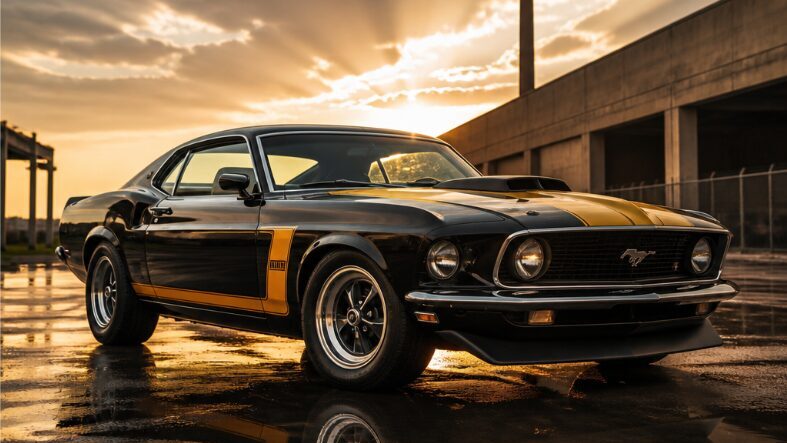
Few automobiles in American automotive history carry the cultural and mechanical weight of the original Boss 302. Born from a specific regulatory need — Ford needed a homologation-legal engine for Trans-Am racing — the Boss 302 became something far greater than a compliance vehicle. It became a symbol of an era when performance engineering and street credibility were inseparable. Decades later, that legacy still resonates deeply among collectors, restorers, and enthusiasts who understand that some machines transcend their original purpose.
The Racing Roots That Defined a Generation
To understand why the Boss 302 remains so revered, you have to go back to the late 1960s, when Ford was locked in a fierce battle with Chevrolet on the Trans-Am circuit. The series required manufacturers to produce street-legal versions of their race cars, and Ford responded with the Boss 302 — a high-revving, small-block powerhouse that could hold its own against the Camaro Z/28 both on the track and on the street. The engine itself was a masterpiece of period engineering, featuring canted valves borrowed from the 385-series big block, a high-rise intake manifold, and solid lifters that demanded regular attention but rewarded drivers with a mechanical intensity that modern engines rarely replicate.
The 1969 model year introduced the Boss 302 to the public, but it was the 1970 version that many purists consider the definitive expression of the nameplate. Ford refined the suspension geometry, updated the front end styling, and dialed in the engine calibration to produce a car that felt more composed and purposeful than its predecessor. The 1970 model year also marked the final chapter for the original Boss 302, making it both a culmination and a farewell — a combination that only deepens its mystique among serious collectors.
Engineering Philosophy Behind the Boss 302
Small Block, Big Ambitions
What made the Boss 302 engine genuinely special was its philosophical approach to performance. Rather than relying on displacement — the traditional American muscle car strategy — Ford’s engineers extracted power through breathing efficiency and high-rpm capability. The engine was rated at 290 horsepower, a figure widely understood to be conservative, and it achieved its output through a combination of free-flowing cylinder heads, aggressive camshaft timing, and a carefully tuned induction system. This approach gave the Boss 302 a character that felt more European than American in some respects — a car that rewarded mechanical sympathy and driver engagement rather than simply planting you in the seat with brute torque.
Chassis and Handling Credentials
Beyond the engine, the Boss 302 received a comprehensive suspension package that set it apart from standard Mustangs of the era. Stiffer springs, revised shock valving, a larger front sway bar, and staggered rear shocks to control axle hop under hard acceleration all contributed to a handling balance that was genuinely competitive for its time. The car could be driven hard through corners in a way that most of its contemporaries simply could not match, and that dynamic capability is a significant part of why the Boss 302 earned such a devoted following among drivers who actually used their cars rather than simply displaying them.
Revology Cars and the Art of Authentic Recreation
Revology Cars has built its reputation on a straightforward but demanding premise: recreating classic Ford Mustangs with period-correct aesthetics and modern mechanical underpinnings. The company’s approach to the 1970 Mustang Boss 302 heritage is particularly compelling because it doesn’t simply replicate the original — it channels the Trans-Am spirit that defined the nameplate while incorporating contemporary engineering solutions that make the car genuinely usable as a daily driver or weekend performance machine. Every panel, every detail, and every mechanical choice reflects a deep understanding of what made the original Boss 302 significant, translated into a vehicle that can be enjoyed without the compromises that come with maintaining a fifty-year-old automobile.
Modern Reliability Meets Classic Character
One of the most persistent challenges in the classic car world is the tension between authenticity and usability. Original Boss 302s are extraordinary machines, but they demand a level of mechanical knowledge and tolerance for temperament that many modern enthusiasts find difficult to accommodate. Revology’s recreation addresses this tension directly, offering the visual and emotional experience of the original while delivering the reliability and refinement that contemporary drivers expect. It is a thoughtful solution to a genuine problem, and it reflects the kind of careful thinking that distinguishes serious automotive craftsmanship from simple nostalgia.
The Mustang’s Enduring Performance Legacy
The Boss 302’s influence didn’t end with its production run. Its engineering philosophy — prioritizing driver engagement, handling balance, and high-rpm performance over raw displacement — can be traced through decades of Mustang development. The Fox-body era GT, the SN95 Cobra, and eventually the modern Shelby GT350 all carry DNA that connects back to the original Boss 302’s approach to performance. Understanding that lineage helps explain why the Mustang has remained culturally relevant across multiple generations of enthusiasts, each finding something in the car that speaks to their particular vision of what a performance vehicle should be. For those interested in how Ford is continuing to attract new audiences to the Mustang nameplate, the 2024 Ford Mustang’s strategy for engaging fresh sports car enthusiasts offers a fascinating perspective on how the brand balances heritage with innovation.
Value, Collectibility, and the Performance Equation
Original Boss 302s have appreciated significantly over the past two decades, reflecting both their genuine rarity and their cultural importance. Documented, numbers-matching examples command serious premiums, and even project cars have become increasingly difficult to find at accessible price points. This trajectory mirrors broader trends in the muscle car market, where the combination of finite supply and growing demand from affluent collectors has pushed values well beyond what most enthusiasts can reasonably afford. For a detailed look at how Mustang performance value has evolved from 1985 through 2025, the historical context is both illuminating and sobering — a reminder that accessibility and performance have always existed in a complicated relationship within the Mustang story.
Why the Boss 302 Story Still Matters
In an automotive landscape increasingly defined by electrification, driver assistance systems, and performance delivered through software rather than mechanical ingenuity, the Boss 302 represents something that is genuinely difficult to replicate: a machine conceived with a specific competitive purpose, executed with engineering integrity, and refined into an expression of what American performance could achieve when it was willing to think differently. The car’s story is not simply about horsepower numbers or quarter-mile times. It is about a moment when Ford’s engineers decided that winning on the track required building something genuinely special for the street — and succeeded on both counts.
Conclusion
The 1970 Mustang Boss 302 occupies a unique position in automotive history — specific enough in its origins to be technically fascinating, broad enough in its appeal to resonate with anyone who appreciates purposeful engineering and genuine performance character. Whether encountered in its original form, through the careful recreations produced by companies like Revology Cars, or through the modern Mustangs that carry its philosophical inheritance, the Boss 302 remains a touchstone for understanding what made American performance cars genuinely great. Its legacy is not a matter of nostalgia alone — it is a living conversation between past engineering ambition and present-day enthusiasm, one that shows no signs of concluding anytime soon.