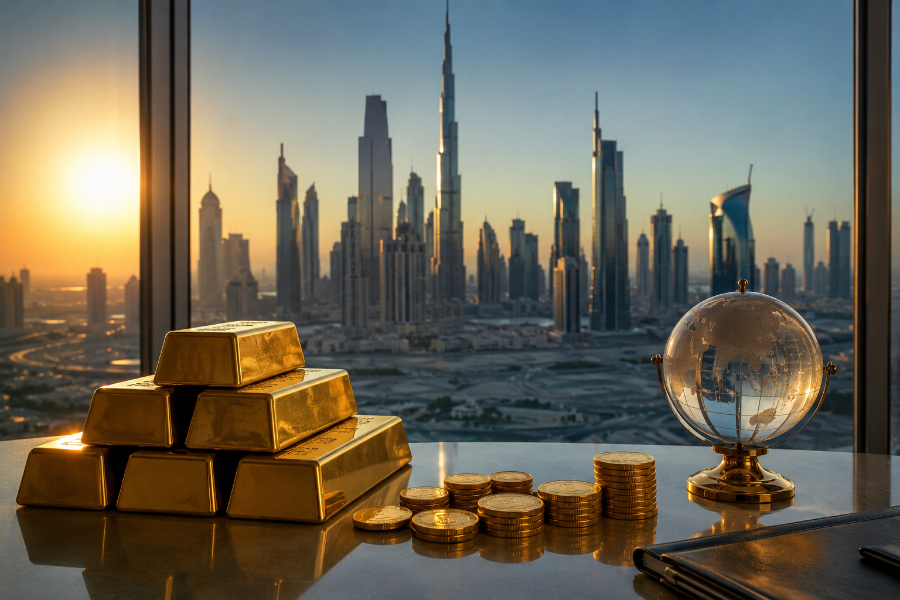
The global financial landscape in 2026 is witnessing subtle but powerful shifts, and at the center of this transformation is Gold Price Today, which continues to reflect rising macroeconomic uncertainty. While gold is often viewed as a traditional safe-haven asset, current movements suggest a deeper structural change is underway, influenced by geopolitical realignments and energy market disruptions.
One of the most significant developments shaping investor sentiment is the UAE’s exit from OPEC. This move has introduced new uncertainty into global oil coordination, weakening long-standing supply management structures. As a result, investors are beginning to reassess risk exposure across commodities, currencies, and equities, with gold quietly regaining attention.
For high-net-worth individuals and institutional investors, the focus is no longer short-term speculation. Instead, portfolio strategies are shifting toward capital preservation, inflation hedging, and geopolitical risk protection. In this environment, Gold Price Today becomes more than a number—it becomes a reflection of global financial anxiety and strategic repositioning.
Gold Price Today: Immediate Market Reaction to UAE’s OPEC Exit
Following the UAE’s exit from OPEC, global commodity markets experienced a measured but noticeable response. Gold Price Today showed mild upward momentum in several Asian and Middle Eastern trading sessions, reflecting increased demand for defensive assets amid energy market uncertainty.
Market participants interpreted the UAE’s decision as a structural weakening of coordinated oil supply management. This raised concerns about medium-term oil volatility, which historically supports gold prices through inflation expectations and safe-haven demand.
Key market reactions included:
- Moderate increase in gold buying interest in regional markets
- Slight rise in bullion demand from institutional hedging desks
- Increased volatility in energy-linked currency pairs
Investor sentiment indicators suggest:
- Rising caution in commodity-linked portfolios
- Gradual rotation toward defensive assets
- Increased focus on inflation-protected instruments
Moreover, traders noted that while oil markets reacted more sharply, gold absorbed uncertainty in a steadier, accumulation-driven manner. This reinforces gold’s role as a long-term stabilizer rather than a speculative spike asset.
Why UAE’s Exit Is Bigger Than It Looks for Global Markets?
The UAE’s departure from OPEC represents more than a political shift; it signals a gradual breakdown in coordinated energy control. As a result, global oil governance is becoming more fragmented, and this change is increasing uncertainty across financial markets. Moreover, investors are now questioning how stable future oil supply management will be without unified production rules.
Previously, oil markets relied heavily on OPEC+ coordination to manage supply levels and stabilize prices. However, that structure is now weakening. Consequently, production decisions are becoming more independent, which introduces less predictability into global pricing systems. This shift does not create immediate collapse, but it does reshape long-term expectations.
From a macroeconomic view, the implications are significant. For instance, inflation trends, currency strength, and commodity-linked investments are all influenced by oil stability. Therefore, even small disruptions in coordination can gradually reshape global financial behavior over time.
Key structural risks emerging:
- Reduced coordination in oil production policies
- Higher probability of supply imbalances
- Increased sensitivity to geopolitical events
- Less predictable pricing cycles
In turn, financial markets are starting to adjust their models. Risk assessments that once assumed stable OPEC influence are now being recalibrated to account for a more uncertain energy environment.
Oil vs Gold Market Reaction (2026)
| Event | Oil Price Impact | Gold Reaction | Investor Behavior | Risk Level |
|---|---|---|---|---|
| UAE exits OPEC | Volatility increases | Mild upward movement | Shift toward safe assets | Medium |
| Supply uncertainty rises | Short-term spikes | Gradual accumulation | Hedging increases | Medium–High |
| Geopolitical tension | Sharp price surges | Strong safe-haven demand | Defensive positioning | High |
Overall, oil and gold are now reacting in opposite but connected ways. While oil experiences sharp fluctuations, gold tends to show steadier demand as investors seek stability.
Oil Prices, Inflation & Gold: The Hidden Link
Oil remains one of the strongest drivers of global inflation. When oil prices rise or become unstable, transportation and production costs increase almost immediately. As a result, inflationary pressure spreads across goods and services in the global economy.
In addition, inflation has historically played a key role in boosting gold demand. Investors often turn to gold when they expect currencies to lose purchasing power. This behavior becomes even stronger during energy-driven inflation cycles.
Key transmission chain:
- Rising oil prices → higher logistics & manufacturing costs
- Higher costs → inflation expectations increase
- Inflation pressure → stronger demand for gold
Meanwhile, central banks often respond to inflation by tightening monetary policy. This can strengthen currencies temporarily, but it also creates mixed signals for gold prices. Therefore, gold may face short-term pressure while still maintaining long-term support.
Ultimately, gold functions as a stabilizing asset when energy markets become unpredictable. It helps balance portfolios that are exposed to inflation shocks and geopolitical uncertainty.
Why Millionaires Are Quietly Increasing Gold Allocation
High-net-worth investors are not reacting emotionally to headlines. Instead, they are gradually reshaping their portfolios based on long-term macroeconomic risks. The focus is shifting away from short-term gains toward capital protection and stability.
Gold is playing a growing role in this strategy. For example, it is no longer viewed only as a commodity but as a core financial safety asset. Moreover, it provides protection in environments where currencies, equities, and bonds may all face pressure at the same time.
Why gold is gaining quiet demand:
- Wealth preservation during uncertain cycles
- Protection against currency fluctuations
- Diversification outside traditional markets
At the same time, this shift is not aggressive. Investors are not making sudden large allocations. Instead, they are slowly increasing exposure in order to reduce overall portfolio risk without disrupting existing structures.
Main motivations driving this behavior:
- Protection against long-term inflation cycles
- Reduced dependence on equity market performance
- Hedging against geopolitical and energy risks
- Preparing for unpredictable macroeconomic shifts
In effect, gold is becoming a strategic stabilizer rather than a speculative asset.
Asset Allocation Shift (2026)
| Asset Class | Risk | Return | Stability | Liquidity |
|---|---|---|---|---|
| Equities | High | High | Medium | High |
| Oil | High | High | Low | Medium |
| Gold | Low-Medium | Medium | High | High |
| Real Estate | Medium | Medium | High | Low |
| Crypto | Very High | Very High | Low | High |
Gold Price Today: Investment Strategy Shift in 2026
The evolution of Gold Price Today reflects a broader transformation in global investment strategy. Markets are no longer driven purely by growth expectations but by uncertainty management.
In the short term, gold is experiencing defensive positioning. Investors are buying during uncertainty spikes but remain cautious due to interest rate environments and dollar strength.
In the long term, however, structural demand remains supported by:
- Central bank diversification strategies
- Persistent geopolitical tensions
- Energy market instability
Institutional investors are leading this shift, while retail investors tend to react later, often after price movements become visible.
Risks & Trade-Offs in Gold Investing
Despite its appeal, gold is not without constraints. The performance of Gold Price Today is influenced by macroeconomic trade-offs that investors must carefully evaluate.
Key risks include:
- Strong US dollar reducing gold attractiveness
- Higher interest rates increasing opportunity cost
- Lack of yield compared to bonds or equities
However, these risks are often offset during periods of uncertainty, where capital preservation outweighs income generation.
Global Macro Trends Driving Gold Demand
Several macroeconomic forces are reinforcing gold’s strategic importance in 2026.
Key drivers include:
- Energy market instability following OPEC structural changes
- Geopolitical tensions in key oil-producing regions
- Increasing diversification away from fiat currency dependency
This environment creates what analysts describe as energy-driven financial uncertainty, where traditional market correlations become less predictable.
The UAE’s exit from OPEC amplifies this trend by shifting global oil markets from coordinated control to fragmented supply decision-making. This increases volatility, indirectly strengthening gold’s appeal as a stabilizing asset.
FAQs
What is Gold Price Today?
It refers to the current market value of gold based on global spot prices and trading activity.
Why did gold prices react to UAE OPEC exit?
Because oil market uncertainty increased, boosting safe-haven demand.
How does oil affect gold prices?
Higher oil prices often lead to inflation, increasing gold demand.
Is gold a safe investment in 2026?
Yes, especially for diversification and inflation hedging.
Why are millionaires buying gold?
For wealth preservation and geopolitical risk protection.
What is the link between inflation and gold?
Inflation reduces currency value, increasing gold demand.
Will gold prices rise in 2026?
They may remain supported but depend on interest rates and dollar strength.
How does geopolitical risk impact gold?
It increases safe-haven demand, pushing prices higher.
Is gold better than stocks right now?
Depends on risk appetite; gold is safer, stocks offer growth.
What should investors do now?
Diversify and balance exposure between growth and defensive assets.