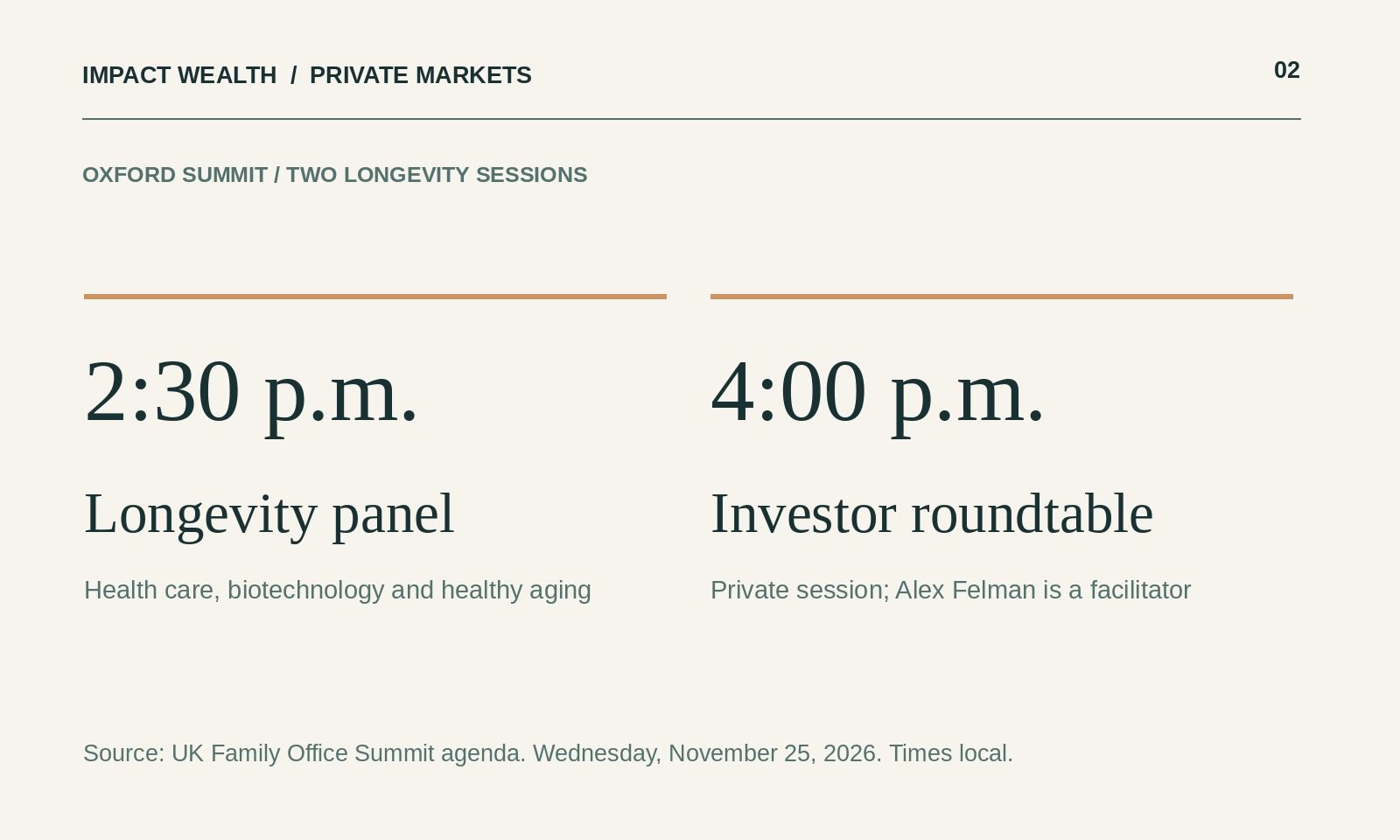
Family offices attending the UK Family Office Summit in Oxford on Wednesday, November 25, have two discussions on longevity on the agenda. A midafternoon panel will look across health care, biotechnology and healthy aging. Later, Alex Felman of Felman Family Office is scheduled to help lead a private investor roundtable. The program raises an underwriting question for families considering a direct deal: What will the next check pay for, and what should it prove before anyone commits more?
The 2:30 p.m. panel, listed in the summit program at The Randolph Hotel will be moderated by Rosemary Sinclair Dokos of NucleicAI and includes Neetu Puranikmath, a venture investor at a single family office, and Richard G.A. Faragher, a University of Brighton professor of biogerontology. The separate 4 p.m. roundtable lists Felman, D2 Impact Group’s Donna Chen and investor Yvette Lu as facilitators. Felman is also scheduled to speak earlier in the day on family office governance.
The milestone depends on who pays
One way to evaluate a longevity deal is to separate the evidence a product needs from the evidence its buyer needs. For a digital tool sold to care providers, an early deployment may help show whether the service works in a clinical workflow. A paid renewal would answer whether the buyer found enough value to keep paying. The UK’s NICE framework for digital health looks at evidence of performance and economic impact. A company developing a treatment may instead have to fund a clinical study before it has a comparable commercial decision point.
Budget for a decision and a delay
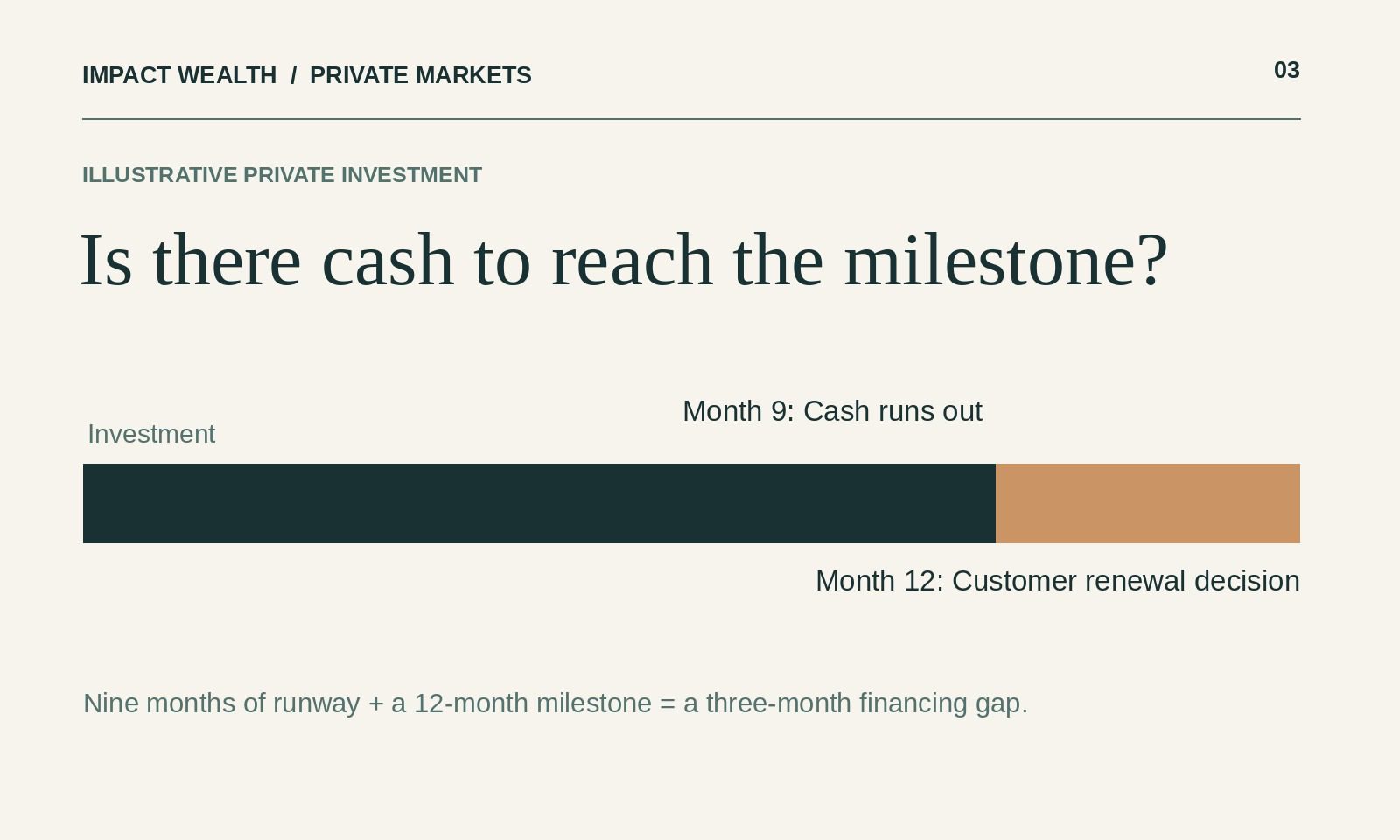
A family office could ask management to identify one result that would justify raising more capital, its expected cost and the cash available if the result slips. In a hypothetical deal, a care software company could have a promising pilot and a renewal decision expected in 12 months, but only nine months of cash. The three-month gap means the office is already evaluating a likely bridge round, even if the pilot performs as hoped.
For a family making a direct investment, the follow-on decision is part of the first one: who will approve it, what independent evidence will they see, and how much of the original investment could be at risk if the company needs funding before that evidence arrives?