By Rehana Farrell, CEO of 100 Women in Finance
When 100 Women in Finance was founded 25 years ago, the term “impact investing” had not yet been coined. Today, the case for impact investing rests on the fact that the forces shaping our world. From increased energy needs from new technology to extreme weather testing aging infrastructure and rising insurance costs, this is all shaping portfolios. Investors who ignore these issues are leaving risk unpriced.
The logic is as compelling as ever. Capital is moving toward strategies that price in environmental and social risk. The question is no longer whether that shift is happening, but who will lead it.
No longer a trade-off
Impact investing was once framed as a trade-off: investors could do good or do well, but rarely both. That framing has not held up. According to the Global Impact Investing Network’s State of the Market 2025 report, impact assets under management now stand at around $1.6 trillion, having grown at a compound annual rate of 21% over the past six years. Today’s leading strategies pursue competitive returns alongside real environmental and social outcomes, and measure both rigorously.
The opportunity set has broadened, too. Energy security has moved from a policy talking point to an investment priority. Resilient infrastructure needs vast long-term capital. Private credit has become a key channel for financing the energy transition. And the AI buildout has introduced a new variable: the power demands of data centers are forcing investors to rethink generation, grids and the environmental footprint of technology itself.
Meanwhile, evolving disclosure rules are making credible reporting the price of entry for any strategy that claims to deliver impact. The field is maturing into a disciplined approach to assessing financial performance alongside environmental and social risks and outcomes, which is exactly what long-term investors require.
Women are at the forefront
If impact investing is about seeing risks and opportunities others miss, then diversity of perspective is a competitive advantage.
Women are already shaping this market as heads of sustainable investing at global banks, portfolio managers at endowments and foundations, investment leaders at mission-driven institutions and senior executives at some of the world’s largest asset managers. Many of them control or influence significant pools of capital. At the same time, the wealth women hold in their own right is growing fast: McKinsey’s 2025 report The new face of wealth estimates that between now and 2030, women in the United States will take control of an additional $16 trillion in assets. Yet our industry still runs largely on networks that were not built with women in mind, and the connections between female allocators and the managers seeking capital do not always form on their own. We work to change this dynamic in real time.
Allocation decisions are built on relationships and trust, and the playing field remains uneven. According to Citywire’s 2025 Alpha Female Report, assets run by women fund managers have roughly tripled since 2016 to £4 trillion, yet women still make up just 12.9% of fund managers globally. When women allocators have fewer opportunities to meet managers, and women managers have fewer chances to get in front of allocators, good ideas go unfunded and capital goes undeployed. Closing that access gap produces better outcomes for portfolios and for the causes impact capital is meant to serve.
At 100 Women in Finance, our role is to make sure women are at the forefront of this shift: allocating, underwriting and setting strategy. To achieve this, we are deliberately creating the spaces where these relationships take shape.
Where the connections get made
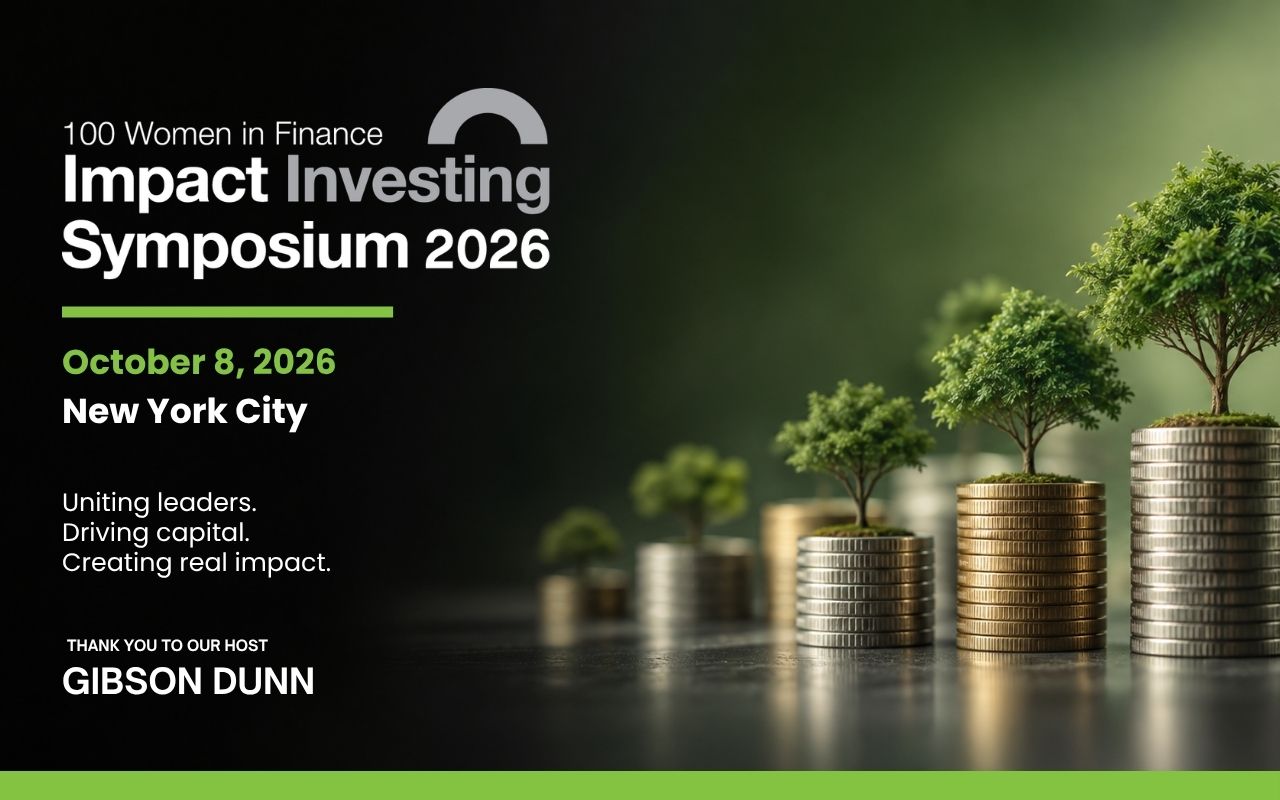
That is the thinking behind our Impact Investing Symposium, which returns to New York City for its fourth year on October 8. The Symposium has sold out in each of its previous three years, drawing hundreds of investors, allocators and managers from across North America.
This year’s half-day program brings together senior leaders from UBS Global Wealth Management, JPMorgan Chase, Wellington Management, MSCI, La Caisse, the Doris Duke Foundation, Trinity Church Wall Street and Glenmede. Through keynote remarks, leadership conversations and expert panels, they will tackle the questions defining the market right now.
Some of the most valuable moments happen in smaller settings. Our Table Topics sessions will put attendees in small groups to exchange ideas directly with practitioners, and our networking reception is designed to build connections across the allocator and manager spectrum. That is where the real work begins: a conversation at a table becomes a follow-up call, then a diligence meeting and, eventually, a partnership.
Building for the long term
Twenty-five years in, our mission of building an inclusive, connected financial ecosystem matters more than ever.
The challenges facing investors are growing more complex, and the capital needed to address them is vast. Meeting that moment will require the full talent of our industry. The future of impact investing will be shaped by the people at the table. We intend to make sure women are among them.