Arteries are blood vessels that carry blood away from the heart to different parts of the body. They form part of the circulatory system, which continuously moves blood throughout the body.
Most arteries carry oxygen-rich blood because they transport blood from the heart to tissues that need oxygen. The major exception is the pulmonary artery, which carries oxygen-poor blood from the heart to the lungs to pick up oxygen.
However, when fat, cholesterol, inflammatory cells, and other substances start to accumulate in the walls of arteries, it leads to narrowing of blood vessels. This can interfere with normal blood flow. This cardiovascular condition is known as atherosclerosis.
It occurs due to changes or injury to the vascular endothelium, the thin layer of cells lining blood vessels. In addition, abnormal lipid levels, oxidative stress, inflammation, smoking, hypertension, and metabolic disturbances also contribute to endothelial dysfunction.
Once the endothelium becomes dysfunctional, lipoproteins can enter the arterial wall. Low-density lipoprotein (LDL) can become modified and promote an inflammatory response. In addition, immune cells, such as monocytes and macrophages, accumulate in the vessel wall and contribute to the development of atherosclerosis plaques.
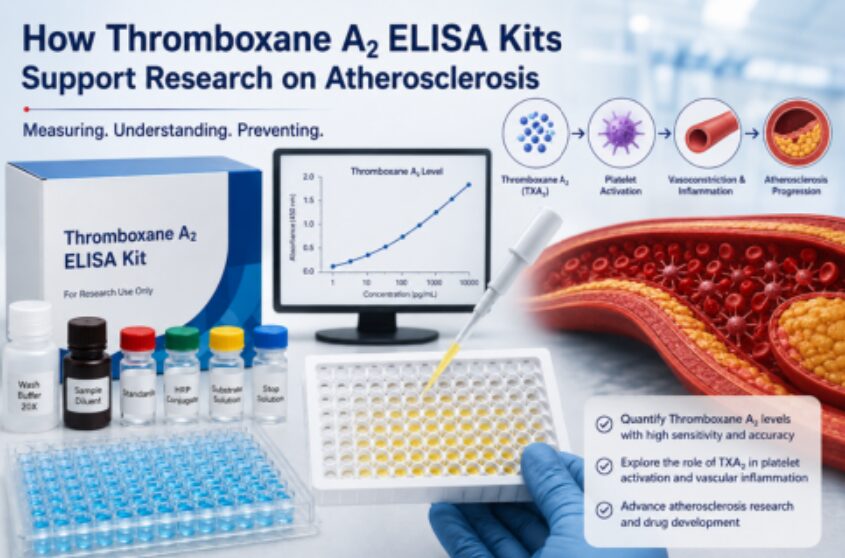
Over time, plaques become larger and more complex. In fact, sometimes, plaques become unstable and rupture. As a result, the thrombogenic material exposes to the circulating blood. This can further trigger platelet activation and thrombus formation, which can cause serious cardiovascular issues. That is why early diagnosis is crucial. Here is where thromboxane A2 ELISA kit comes into play.
What is Thromboxane A2?
Thrombxane A2 (TXA2) is a lipid mediator produced primarily by activated platelets. It is synthesized from arachidonic acid through the cyclooxygenase pathway and acts through thromboxane receptors on platelets and vascular smooth muscle cells.
TXA2 is responsible for platelet activation and aggregation. It can cause vasoconstriction, which reduces the diameter of blood vessels. Since TXA2 has a short lifespan, it quickly hydrolyzes to a more stable metabolite – thromboxan2 B2 (TXB2).
Researchers often the measure the quantity of TXB2 and then indirectly measure the amount of TXA2. This helps researchers investigate pathways related to platelet activity and vascular disease.
What is ELISA?
ELISA stands for enzyme-linked immunosorbent assay. It is a plate-based technique used to detect and quantify the amount of analyte in a biological sample. The analyte can be a protein, antibody, cytokine, hormone, antigen, etc. It relies on antigen-antibody interactions.
This technique is known for:
- High sensitivity
- High specificity
- Compatibility and versatility
- Rapid results
- Affordability
Thromoboxane A2 ELISA kits are specifically designed to quantify the amount of TXB2 in a biological sample. Researchers study the results and compare them with different experiment groups to understand how it contributes to atherosclerosis.
How TXA2 ELISA Kit Helps in Atherosclerosis Research?
Investigate Platelet Activation
Platelets play a major role in thrombosis, especially when an atherosclerotic plaque becomes damaged or ruptures. Activation of platelets results in the release and synthesis of several signaling molecules, including TXA2.
Researchers can examine thromboxane-related measurements alongside other platelet activation markers to better understand changes in platelet behavior. This helps them establish whether experimental conditions influence platelet activation pathways associated with atherosclerosis and thrombotic complications.
Researchers may compare thromboxane-related levels between untreated and treated experimental groups to investigate whether a candidate compound affects platelet-associated signaling.
Study Vascular Inflammation and Dysfunction
Atherosclerosis is not simply a condition caused by lipid accumulation. It also involves chronic inflammation and changes in vascular function. Platelet-derived mediators can interact with endothelial and immune cells. As a result, they create a complex network of cellular communication.
Researchers measure thromboxane-related biomarkers using ELISA kits to examine interactions between platelet activation, endothelial dysfunction, and inflammatory processes.
When combined with measurements of inflammatory cytokines, lipid markers, endothelial biomarkers, or oxidative stress indicators, thromboxane data may provide a broader picture of cardiovascular disease mechanisms.
Evaluate Potential Therapeutic Strategies
Thromboxane pathways are also relevant when investigating potential approaches for controlling platelet activation and cardiovascular risk. So, researchers use ELISA-based measurements to assess changes in thromboxane-related biomarkers after exposure to experimental compounds or interventions.
A decrease or increase in measured thromboxane-related activity may provide evidence that a treatment influences the pathway under investigation. However, thromboxane measurements should generally be interpreted together with other biochemical, cellular, and physiological findings rather than being used as a standalone indicator of atherosclerosis.
Support Research With Quantitative Biomarker Data
Researchers use ELISA kits for quantitative measurements of different biomarkers. These measurements helps them identify differences between experimental conditions and examine associations between thromboxane-related activity and other disease parameters.
The Bottom Line
Atherosclerosis involves interconnected processes involving lipid accumulation, endothelial dysfunction, inflammation, platelet activation, and thrombosis. Thromboxane A2 is particularly relevant to research because of its role in platelet activation and vasoconstriction. Since TXA2 itself is unstable, researchers may analyze its more stable metabolites to investigate thromboxane pathway activity using TXA2 ELISA kits.
However, the overall results depend on factors such as antibody specificity, sensitivity, sample preparation, calibration, assay range, and validation for the intended sample type. Proper controls and standardized experimental procedures are also important for producing reliable results. It is recommended to buy ELISA kits from a reliable supplier.